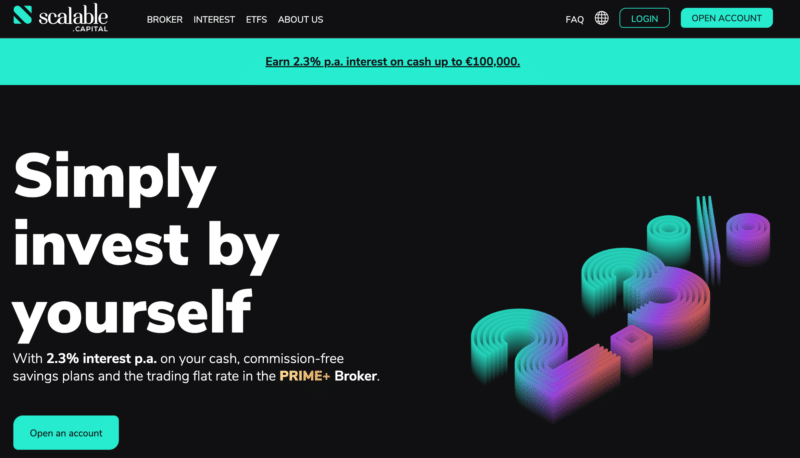
 Scalable Capital has evolved far beyond its origins as a robo-advisor. Founded in 2014 by Erik Podzuweit, Florian Prucker, and Adam French, the company has grown into one of Europe’s largest digital investment platforms. Today, Scalable Capital offers a full-featured broker alongside its wealth management service, giving investors access to stocks, ETFs, bonds, crypto, and more – with a fee structure that has become significantly more competitive over the years.
In this review, I’ll explore the features, advantages, and drawbacks of Scalable Capital, providing an in-depth analysis of the platform’s offerings to help you determine whether it’s the right fit for your investment needs.
Investment Approach
Scalable Capital offers its clients multiple ways to invest and grow their wealth. The platform has expanded well beyond its original robo-advisor roots and now provides three primary ways to invest:
- FREE Broker: The self-directed brokerage service lets you buy and sell stocks, ETFs, bonds, crypto, and funds. Individual trades cost EUR 0.99 each. There is no account minimum, making it accessible to beginners. You can also set up savings plans starting from just EUR 1 per month, which execute for free.
- PRIME+ (EUR 4.99/month): The premium subscription tier gives you unlimited trades with no per-trade fee, plus interest on uninvested cash (currently around 2%). This is the better deal if you trade regularly – just a few trades per month and the subscription pays for itself.
- Wealth Management (Managed Portfolios): Scalable Capital’s original robo-advisory service, where they create and manage personalized portfolios using low-cost ETFs. These portfolios are tailored to each investor’s risk tolerance and financial goals. Scalable Capital uses algorithms and technology-driven investment strategies to optimize the asset allocation and maintain the desired risk level. This option is ideal for investors who prefer a passive, hands-off approach.
These options cater to a variety of investor preferences, from complete beginners who want a hands-off managed portfolio to active traders who want to pick their own stocks.
Scalable Capital has also partnered with BlackRock and launched its own Scalable MSCI AC World Xtrackers ETF, giving European investors a competitive world ETF option. The company has even obtained a license to operate its own EU stock exchange (the European Investor Exchange, or EIX), which is a significant step toward reducing reliance on third-party trading venues.
Account Opening and Onboarding Process
Opening an account with Scalable Capital is a straightforward process. First, you’ll need to provide some personal information, such as your name, address, and tax identification number. For the broker account, you can get started with no minimum investment at all – you can begin investing with as little as EUR 1 through savings plans.
If you opt for the Wealth Management service (the managed portfolio), you’ll be asked to complete a questionnaire to assess your risk tolerance, investment objectives, and financial situation. This information is used by the platform’s algorithms to create a personalized investment strategy tailored to your needs. After completing the questionnaire, you’ll receive a proposed portfolio allocation based on your risk profile, which you can review and adjust before funding your account.
Portfolio Management and Rebalancing
Scalable Capital continuously monitors and manages your portfolio using its proprietary algorithms. The platform regularly rebalances your portfolio to maintain the target asset allocation and risk level, ensuring your investments stay aligned with your financial goals and risk tolerance.
Rebalancing helps to keep your portfolio’s risk in check, as it prevents overexposure to a particular asset class or market segment that may have experienced significant gains or losses. This automated process is a significant advantage of robo-advisors like Scalable Capital, as it eliminates the need for you to constantly monitor and adjust your investments manually.
Fees and Costs
Scalable Capital’s fee structure has been completely overhauled and is now one of the most competitive in Europe:
- FREE Broker: No account fee. Individual trades cost EUR 0.99 each. Savings plans (ETFs, stocks, crypto) are free to execute.
- PRIME+: EUR 4.99/month (billed annually at EUR 59.88) gives you unlimited trades with no per-trade commission, plus interest on uninvested cash. All savings plans are also free.
- Wealth Management: The managed portfolio service charges 0.75% per year on assets under management. This covers portfolio management, rebalancing, and custody.
It’s essential to note that ETF expense ratios, which are inherent to the underlying funds, are not included in the above fees and will be an additional cost for investors. One thing to be aware of: Scalable Capital currently routes most trades through third-party venues like gettex and Xetra, and earns payment for order flow (PFOF). However, the EU’s ban on PFOF in Germany takes effect in June 2026, which may lead to changes in how trading costs are structured. Scalable’s new EIX exchange is likely part of the long-term response to this regulation.
Performance and Risk Management
Scalable Capital uses a dynamic risk management approach to ensure your portfolio stays within your desired risk level. The platform’s algorithms monitor market conditions and adjust your investments accordingly to maintain the target risk level. This process may involve adjusting the allocation of assets in your portfolio or switching to less volatile ETFs during periods of market uncertainty. This dynamic approach to risk management helps protect your portfolio from extreme market fluctuations while still pursuing your long-term investment objectives.
It’s important to note that past performance is not indicative of future results, and individual investment outcomes may vary. That being said, Scalable Capital’s focus on risk management and diversification aims to provide more stable returns over time, reducing the likelihood of significant losses during market downturns.
User Interface and Mobile App
Scalable Capital’s user interface is intuitive and user-friendly, making it easy to navigate and access all the features the platform has to offer. The platform provides a comprehensive dashboard that displays your portfolio’s performance, allocation, and historical data. This allows you to stay informed about your investments and make adjustments as needed easily.
The platform also offers a mobile app, available for both iOS and Android devices, enabling you to manage your investments on the go. The app includes all the functionality of the web-based platform, allowing you to track your portfolio’s performance, make deposits, and even adjust your risk tolerance directly from your smartphone or tablet.
Customer Support
Scalable Capital provides a variety of customer support options to address any questions or concerns you may have. You can reach their support team via email, phone, or live chat. From my experience, the customer support team has been responsive and helpful in addressing any issues or inquiries I had.
Some Drawbacks to Consider
While Scalable Capital has addressed many of its earlier limitations (there’s no longer a high minimum investment, and the platform now offers far more than just ETFs), there are still a few things to keep in mind:
- PFOF uncertainty: With the EU’s PFOF ban hitting Germany in June 2026, it’s unclear exactly how Scalable’s cost structure will be affected. The launch of their own exchange (EIX) is a promising sign, but the transition period could bring changes.
- Limited market access: Compared to brokers like Interactive Brokers, Scalable Capital offers fewer international exchanges. If you need access to exotic markets or complex instruments like options, you may need a more specialized broker.
- Availability: The platform is primarily available in select European countries (Germany, Austria, France, Italy, Spain, Netherlands, and a few others). If you’re outside these markets, you’ll need to look elsewhere.
How Does Scalable Capital Compare?
See how Scalable Capital stacks up against other popular platforms:
Alternatives to Scalable Capital
Here are a few robo-advisors and digital wealth management platforms that are available across Europe and that are worth looking into, with the final selection being dependent on your needs and ideas around investing.
- Moneyfarm: Founded in Italy and operating across Europe, Moneyfarm provides personalized investment portfolios based on ETFs. The platform offers a user-friendly experience, a tiered fee structure, and access to a team of investment consultants for personalized advice.
- Raisin: A pan-European savings and investment platform, Raisin partners with various banks and financial institutions across Europe to offer a wide range of investment products, including savings accounts, term deposits, and ETF portfolios. Raisin focuses on providing competitive returns, diversification, and a user-friendly platform.
Final Thoughts
Overall, I find Scalable Capital to be one of the strongest options for European investors right now. The platform has come a long way from its early days as a pure robo-advisor with a high minimum. Today, whether you want a managed portfolio or prefer to pick your own stocks, ETFs, and crypto, Scalable has a plan that fits.
The FREE Broker tier with EUR 0.99 trades is great for occasional investors, while PRIME+ at EUR 4.99/month is hard to beat if you trade regularly. The partnership with BlackRock, the launch of their own world ETF, and the upcoming EU stock exchange show a company that’s building for the long term.
The main uncertainty is around how the EU’s PFOF ban will affect the platform’s economics starting in mid-2026, but Scalable appears well-positioned to navigate this. As with any investment platform, do your own research and make sure the platform aligns with your investment strategy and goals.
Frequently Asked Questions
Is Scalable Capital safe?
Scalable Capital is regulated by BaFin, Germany’s Federal Financial Supervisory Authority. Client cash balances are held in segregated accounts and covered by the German Deposit Guarantee Scheme up to EUR 100,000. Securities are held in custody separately from Scalable’s own assets. The company manages assets for a large European user base and has partnered with BlackRock for its investment products.
What are Scalable Capital’s fees?
The FREE Broker tier has no account fee; individual trades cost EUR 0.99 each and all savings plans are free. PRIME+ at EUR 4.99/month (billed annually at EUR 59.88) gives you unlimited trades with no per-trade commission, plus interest on uninvested cash. The Wealth Management service charges 0.75% per year on assets under management. ETF expense ratios are additional costs not included in these fees.
What is the difference between Scalable Capital’s broker and robo-advisor?
The broker (FREE or PRIME+ plans) is self-directed: you pick and trade your own stocks, ETFs, bonds, and crypto. The Wealth Management service is the robo-advisor: Scalable’s algorithms build and manage a diversified ETF portfolio based on your risk tolerance, with automatic rebalancing. The broker suits hands-on investors; the robo-advisor suits those who prefer a passive, automated approach.
Does Scalable Capital offer ETF savings plans?
Yes. Scalable Capital offers savings plans starting from just EUR 1 per month, and all savings plans execute for free on both the FREE and PRIME+ tiers. You can set up recurring purchases of ETFs, stocks, and crypto on an automated schedule. Scalable has also launched its own Scalable MSCI AC World Xtrackers ETF in partnership with BlackRock, providing a competitive world ETF option for European investors.
How does Scalable Capital compare to DEGIRO?
Scalable Capital offers free savings plans and unlimited trades for EUR 4.99/month (PRIME+), while DEGIRO charges EUR 2 per US stock trade and EUR 1 for Core Selection ETFs. Scalable also offers a robo-advisor and interest on cash, which DEGIRO does not. DEGIRO covers more international exchanges (50+ markets in 30 countries). Scalable is stronger for automated ETF investing; DEGIRO is better for broad market access.
Which countries is Scalable Capital available in?
Scalable Capital is primarily available in select European countries including Germany, Austria, France, Italy, Spain, and the Netherlands. The platform is not available outside Europe. If you are in a supported country, there is no minimum investment for the broker account, and you can begin investing with as little as EUR 1 through savings plans.
Summary
Scalable Capital is a user-friendly robo-advisor that uses technology-driven investment strategies to optimize risk-adjusted returns for investors. It offers a comprehensive, cost-effective solution for those seeking personalized portfolio management.
Pros
- Customized investment strategies tailored to individual risk tolerance and financial goals
- Focus on diversification and risk management
- Intuitive user interface and mobile app for easy portfolio monitoring
- Regular portfolio rebalancing to maintain target asset allocation
- Competitive fee structure with tiered pricing based on assets under management
Cons
- Minimum investment amount of u20ac10,000 may be a barrier for some investors
- Limited investment options, primarily restricted to ETFs
- May not be suitable for investors seeking direct control over individual investments or a hands-on approach
- The platform's success depends on the accuracy and effectiveness of its algorithms
- No access to alternative investments or individual stocks and bonds
Related






Leave a Reply