I earn a commission if you open an account through the links on this page. It doesn’t change my assessment.
My Verdict (Updated October 2026)
When I first reviewed Maclear in spring 2026, I called it a reasonable small allocation for experienced P2P investors. The evidence that has come out since then changes that, and I’ve rewritten this review to reflect it.
On 11 May 2026, Spain’s securities regulator, the CNMV, put Maclear AG and maclear.ch on its warning list of unregistered entities. Maclear holds no EU crowdfunding license and isn’t supervised by FINMA, the Swiss financial regulator. Its only Swiss oversight is membership of PolyReg, a self-regulatory body that checks anti-money-laundering compliance. The platform still publishes no arrears data beyond a homepage counter showing one default and zero late loans. Independent reviewers have also found borrower figures on Maclear project pages that don’t match what those companies filed with their own registries, and the Estonian register confirms the filed figures for one of them.
Taken together, those are serious red flags, and I’d now treat Maclear as a high-risk platform. If you still want to invest, only put in money you can afford to lose entirely, keep it to a small slice of your P2P allocation, and keep an eye on the warning signs I list in the Is Maclear safe? section below.
I’ve been following the European P2P lending space for years, and Maclear caught my attention as one of the newer platforms in the SME lending category. It’s Swiss-registered, says every loan is collateral-backed, lends to small and medium businesses mostly in Eastern and Southern Europe, and advertises returns of up to 15.6% a year. The team responded to my questions professionally, and the product was clean and functional.
This review covers what Maclear does, how its safety structure is meant to work, the evidence against it, the returns and bonuses on offer, and who, if anyone, it still makes sense for.
Maclear at a Glance
| Founded | Platform launched August 2023 (company acquired 2020) |
| Headquarters | Wallisellen, Zürich, Switzerland |
| Regulation | PolyReg SRO member (anti-money-laundering only); not FINMA-supervised; no EU crowdfunding (ECSP) license |
| Regulator warnings | Spain’s CNMV, unregistered-entity warning, 11 May 2026 |
| Loan Type | SME business loans (Baltic, Eastern and Southern Europe, and further afield) |
| Advertised Returns | Up to 15.6% a year; listed projects mostly 14.5–16% |
| Minimum Investment | €50 |
| Provision Fund | Yes (2% of each funded project, plus secondary market commissions); not a guarantee |
| Collateral | Claimed on all loans (collateral agent structure); enforcement not yet shown in public |
| Secondary Market | Yes (2.5% seller fee, buyers pay nothing) |
| Auto-Invest | Yes (introduced July 2025) |
| Fees for Investors | 0% (no deposit, investment, or withdrawal fees) |
| Total Funded | €160.1M+, of which €58.8M+ repaid (Maclear homepage, October 2026) |
| Registered Investors | 56,938 |
| Loan Duration | 9–16 months typical |
| Defaults and arrears | Maclear reports one default (Vibroedil) and zero late loans; no arrears table or default definition published |
| Languages | English, French, German, Spanish |
The Platform: What Maclear Actually Does
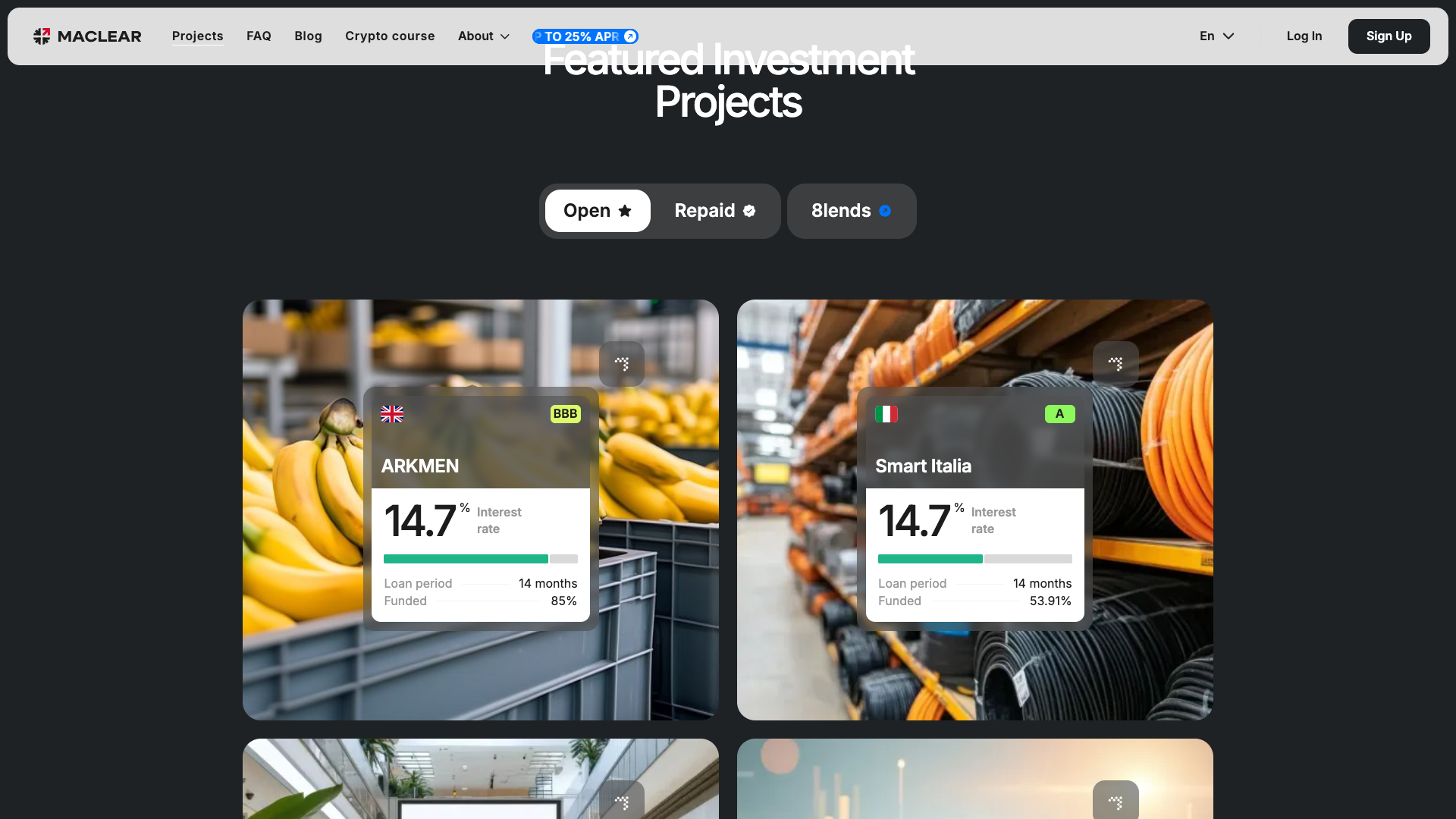
Maclear is a peer-to-business (P2B) lending platform, which means you’re lending to businesses, not consumers. It focuses on SMEs in sectors like manufacturing, trade, logistics, construction and services. Borrowers span the Baltic states, Eastern and Southern Europe, Italy and more recently places further afield, and Maclear’s statistics page lists Spain, France and Portugal as its largest investor countries.
Loan amounts typically sit in the €100,000–€500,000 range for 9–16 months. Maclear says each loan is secured by collateral (equipment, property, receivables) held through a collateral agent, and every funded project contributes 2% to a provision fund meant to bridge short payment delays.
Repayment is structured as a bullet loan: monthly interest payments throughout the term, with the full principal returned in a single lump sum at maturity. So a 14-month loan pays you interest every 30 days from month one, and the principal lands at month 14. That’s common in SME lending, but it has a downside worth understanding: a borrower can keep paying interest for a year and still be unable to repay the principal, and you won’t find out until maturity. On Maclear, €160.1M has been funded and €58.8M repaid, so most of the money investors have put in hasn’t yet reached the point where principal is due.
The platform uses a staged financing model. Rather than disbursing the full loan amount upfront, capital is released to borrowers in stages as operational milestones are verified. Each stage is a separate loan fragment with its own terms, and investors can enter projects at different stages.
Auto-invest launched in July 2025 and lets you set filters (country, return rate, loan term) and have capital deployed automatically. The secondary market lets you list positions for sale (2.5% seller fee, buyers pay nothing), with a 30-day holding period before reselling any purchase. Registration and KYC took under 15 minutes via Veriff.
The Team
Understanding who runs a P2P platform is one of the most important things you can do as an investor. In this space, the team is the single biggest variable between a platform that handles difficulty well and one that implodes.
Denis Ustjev (CEO and co-founder) has a background in business consulting, capital investment and business loan management, with roles across Estonia, Azerbaijan and the United States. He and Aleksandr Lang acquired Maclear AG in 2020, converting a dormant Swiss company that had been in GRC software into a crowdlending platform, and launched the first campaign in August 2023.
Aleksandr Lang (CFO and co-founder) leads financial strategy and project selection. His background is in foreign trade and industrial projects, with a network concentrated in Estonia, which explains the platform’s early focus on Baltic borrowers.
The Swiss commercial register shows a lot of movement in 2026. Alexej Martin, the Swiss-based lawyer who was the registered managing director and whom Maclear presented as head of its AML office, was removed from the register in June 2026. Dmitri Timoškin left the board around the same time. Igor Bannikov was registered as managing director in June 2026 and removed again in August 2026, when Enrijs Altmanis, a Latvian national who joined the board in April 2026, took over as managing director. The register also shows that blueAUDIT GmbH stopped being Maclear’s statutory auditor in January 2026, and no new auditor appears in any registry publication since.
Changes like these aren’t proof of wrongdoing, but this much turnover at the top of a young lending platform within a few months is something I’d want explained before trusting it with money.
Returns and Bonuses
Maclear advertises returns of up to 15.6% a year, and the projects listed on its homepage in October 2026 paid between 14.5% and 16%. That’s well above what more established European platforms pay, and Maclear doesn’t explain why its borrowers can afford that premium when their figures, in the cases independent reviewers checked, are weaker than presented.
On top of base returns, there’s a loyalty program offering up to 3% extra annual return based on how much you’ve invested. New investors get a €15 welcome bonus on their first investment, and a running promotion credits €30 for every €500 invested in a single project on the primary market. A referral program pays both parties 3%. Bonus terms change often, so check the current conditions before relying on them.
Treat these bonuses with care. A large part of the headline return for a new investor comes from them rather than from loan interest, and generous sign-up incentives are a common feature of platforms that need a steady flow of new deposits.
There are no fees charged to investors: no deposit, withdrawal or investment charges. Maclear earns from borrower fees and the spread between what borrowers pay and what investors receive.
Is Maclear Safe?
Based on what’s now public, I can’t call Maclear safe. The evidence is below, with sources, so you can judge for yourself.
A Spanish regulator warning
On 11 May 2026, the CNMV published a warning about unregistered entities that names maclear.ch and MACLEAR AG. The notice says the entities listed aren’t registered with the CNMV and so aren’t authorized to provide investment services or other activities subject to its supervision. This is a public notice that Maclear has no authorization to operate in Spain, rather than a fine or a finding of fraud. It matters all the same: Spain is Maclear’s largest investor country, and a regulator warning is about as clear a signal as investors get.
Regulation: anti-money-laundering membership only
EU platforms that do this kind of lending need a license under the European Crowdfunding Service Providers Regulation (ECSP), which comes with capital, disclosure and conduct rules. Maclear doesn’t have one, and its own explanation is that moving to the ECSP framework “would have been bureaucratically excessive.” Maclear’s FAQ states that it is “not directly supervised by FINMA.” Its Swiss oversight is membership of PolyReg, a self-regulatory organization recognized by FINMA under the Anti-Money Laundering Act. PolyReg’s own membership check confirms that Maclear AG is a member, but that membership covers anti-money-laundering duties. It doesn’t cover Maclear’s solvency, its lending decisions or investor protection, and there’s no deposit insurance or compensation scheme behind your money.
Arrears data: none published
Maclear’s homepage shows a counter reading one default and zero late loans. There’s no arrears table, no definition of when a loan counts as late or defaulted, and no recovery statistics. For a platform with €160M funded and over 50,000 registered investors, a record of zero late loans would be unusual, and Maclear doesn’t publish the data that would let anyone check it. Its own 2024 annual report notes “considerable risk” from insufficient diversification and limited historical experience.
Borrower figures that don’t match registry filings
The German P2P review site re:think P2P compared project pages on Maclear with the official registry filings of several borrowers. Its findings, as reported in its review updated on 29 September 2026:
- Estlat Building Co OÜ (Estonia): Maclear’s project page showed projected revenue of €1.65M for 2023 and €1.97M for 2024, while the company’s filed accounts showed €33,626 and €20,450. The Estonian e-Business Register confirms those filed revenue figures. The company’s 2025 accounts, filed in June 2026, show revenue of €663,312.
- Transbaltika OÜ (Estonia): a projected €856,000 in revenue against €82,922 filed for 2024, with fixed assets of €72,569 and no sign in the accounts of the truck and trailer the loan was meant to buy.
- TLMET OÜ (Estonia): a €460,000 loan for a plasma cutter that re:think P2P couldn’t find on the 2024 balance sheet.
- Vibroedil S.R.L. (Italy): figures shown to investors put 2024 revenue at €15.9M and net profit at €144,390, while the Italian registry figures show €6.4M in revenue and a €1.9M loss.
The Estlat revenue figures match what the Estonian e-Business Register shows today. The other cases are re:think P2P’s findings and haven’t been verified independently here. Maclear’s published response is that registries reflect the book value of assets while its loan-to-value figures use independent market valuations. That addresses collateral values, but it doesn’t explain revenue figures that differ by a factor of 50 or more.
The one default
Vibroedil is the default Maclear acknowledges. Italy’s creditors’ portal lists the company in judicial liquidation (procedure 37/2025), opened in July 2025. Maclear says investors recovered 100% of principal through a settlement agreement and guarantees, without touching the provision fund. How that recovery was funded can’t be checked from outside, and CrowdInform cites a report that the founders covered the loss rather than the collateral being enforced. Either way, collateral enforcement on Maclear has yet to be shown in public.
Maclear’s own finances
Maclear’s 2024 annual report, published in June 2026, shows a net loss of CHF 122,941 and negative equity of CHF 87,026, with a general loan loss provision of 2% (CHF 195,049). The report doesn’t say whether the figures were audited, and as noted above, the commercial register has shown no statutory auditor since January 2026. The register also shows share capital of CHF 272,360, raised partly by converting CHF 55,000 of debt into shares in 2024. That’s a thin cushion for a business that has intermediated €160M.
Marketing practices
Maclear has admitted using “AI-driven algorithms for brand awareness and automated content distribution” in late 2025, and says it stopped in December 2025 after community feedback. P2P Empire, which scored Maclear 0.0 out of 10 on 7 August 2026, reports that a review site called CrowdIndex, which ranks Maclear highly, shares a Google Analytics property with maclear.ch. re:think P2P’s conclusion is that “investing in Maclear is currently not recommended.”
What Maclear’s structure still offers
Maclear says investor cash sits in a segregated client account under Article 401 of the Swiss Code of Obligations, so it would stay outside the bankruptcy estate if Maclear failed, and your loan claims against borrowers would survive. That’s a real legal mechanism, but it has never been tested on this platform, and it only helps if the underlying loans and collateral are what they’re described as. The provision fund is 2% of funded volume, and Maclear’s terms say it isn’t an insurance scheme.
What to watch if you invest
- Principal repayments at maturity. Interest arriving on time tells you little on a bullet loan; watch whether principal comes back on the due date, and whether maturities get extended or restructured.
- An arrears table. If Maclear starts publishing late and defaulted loans with clear definitions, that’s progress. If the counter stays at zero while volumes grow, be skeptical.
- Audited accounts with a named auditor, and whether a new statutory auditor appears in the Swiss register.
- New regulator warnings in your own country, on top of the CNMV notice.
- Secondary market discounts. If sellers have to offer steep discounts to exit, other investors are heading for the door.
- The borrower’s own registry filings. For Estonian borrowers, the e-Business Register shows filed revenue for free, and it takes a couple of minutes to compare with the project page.
How to Start Investing
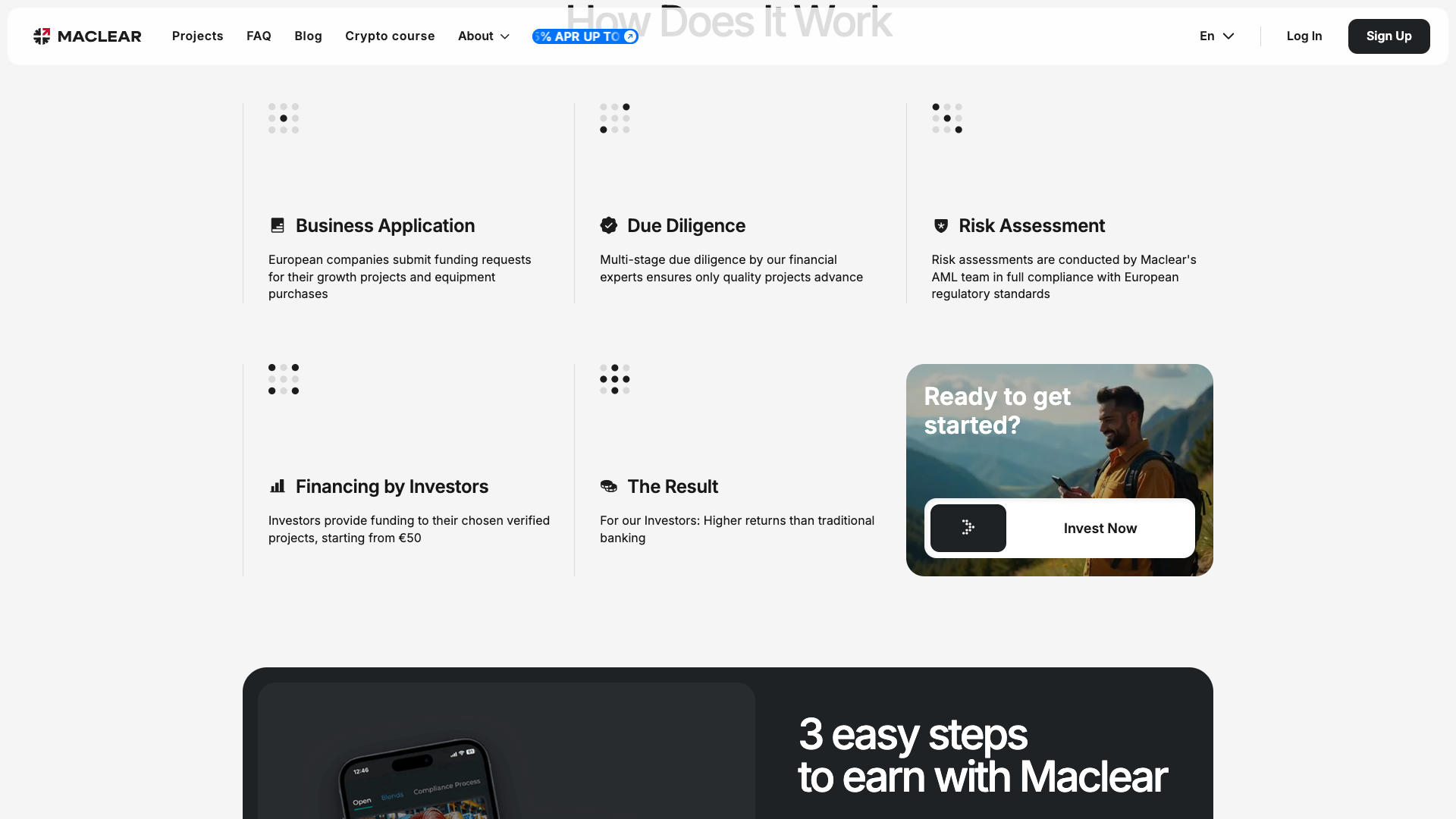
If you’ve read the risks above and still want to try it with a small amount, the process is simple:
- Register at maclear.ch. Basic personal details, takes about 5 minutes
- Complete KYC via Veriff. Upload an ID document and take a selfie; usually approved within 15 minutes
- Fund your account via bank transfer. SEPA transfers typically clear within 1–2 business days
- Browse available projects manually, or set up auto-invest with your preferred filters
- Receive monthly interest payments throughout the term; principal is due at loan maturity
The €50 minimum per project means you can spread a small deposit across several loans. There’s no withholding tax on returns at the platform level, so you’ll need to declare the income yourself.
The Secondary Market
You can list any active investment for sale at its original price or at a discount of up to 50%. Sellers pay a 2.5% fee on successful sales and buyers pay nothing. There’s a 30-day holding period after buying a position before you can resell it. Liquidity isn’t guaranteed, and if many investors want out at the same time, you may need to discount heavily to find a buyer.
Pros and Cons Summary
Pros
- High advertised returns (up to 15.6%) and generous bonuses
- Monthly interest payments throughout the term
- Secondary market with no buyer fee
- Auto-invest tool (since July 2025)
- No fees for investors
- €50 minimum per project
- Segregated client account under Swiss law (untested)
- Multi-language platform (English, French, German, Spanish)
Cons
- Named in a CNMV warning of unregistered entities (May 2026)
- No EU crowdfunding license and no FINMA supervision; PolyReg covers anti-money-laundering only
- No arrears table, default definition or recovery data
- Borrower figures that don’t match registry filings, confirmed in at least one case
- Loss-making operator with negative equity, and no statutory auditor in the register since January 2026
- Heavy management turnover in 2026
- The one acknowledged default (Vibroedil) went into judicial liquidation; collateral enforcement not shown in public
- Most funded capital hasn’t reached maturity yet, and bullet repayments hide problems until then
- Admitted use of automated promotional content in 2025
- Secondary market liquidity not guaranteed
How Maclear Compares to Alternatives
If you’re looking at P2P lending as an asset class, this table puts Maclear next to two of the better-known European platforms so you can see where it sits.
| Feature | Maclear | Mintos | EstateGuru |
|---|---|---|---|
| Loan type | SME / P2B | Consumer + business via originators | Real estate (P2B) |
| Returns | Up to 15.6% | 9–12% | 8–11% |
| Collateral model | Claimed on every loan; enforcement not shown | Originator buyback guarantee | Real estate |
| Jurisdiction | Switzerland (PolyReg AML membership only; CNMV warning in Spain) | Latvia (ECSP) | Estonia (ECSP) |
| Fund segregation | Yes, under Swiss law (untested) | Yes, under EU rules | Yes, under EU rules |
| Provision fund | Yes (2% per project, not a guarantee) | No | No |
| Minimum investment | €50 | €10 | €50 |
| Investor fees | 0% | 0% | 0% |
| Secondary market | Yes (no buyer fee, 2.5% seller fee) | Yes (0.85% buyer fee) | Yes (2% seller fee) |
| Auto-invest | Yes | Yes | Yes |
| Arrears data published | No | Yes | Yes |
| Repayment structure | Bullet at maturity (monthly interest) | Mostly monthly | Bullet at maturity |
| Borrower geography | Baltic, E. Europe, S. Europe, Italy and beyond | Global (40+ countries) | Baltic, Finland, Germany |
Maclear pays more than the licensed platforms, and the gap is the price of what you give up: an EU license, published arrears data and borrower figures you can trust. For most investors, a licensed platform with lower headline returns is the better place for the bulk of a P2P allocation.
Portfolio Diversification
Whatever your view on any single platform, no one P2P platform should dominate a portfolio. The usual rule is to keep no more than 20–30% of your P2P allocation in any one platform. For a platform with Maclear’s risk profile, I’d go well below that, and I’d count every euro there as money at risk rather than as income.
If you do invest, spread small amounts across many projects and mix 9-month and 16-month terms so principal comes back at different points. That way you get early evidence of whether principal is actually being repaid on time, and you can stop adding money if it isn’t.
Who This Platform Is For
After the evidence above, Maclear only makes sense for a narrow group: experienced P2P investors who understand they’re lending through an unlicensed platform, who’ve read the registry findings, and who are comfortable with a small amount they could lose in full in exchange for high advertised returns.
It’s not a fit if you’re new to P2P lending, if you need your money back on a fixed date, if you live in a country whose regulator has warned about the platform, or if you only invest through EU-licensed platforms.
The Bottom Line
Maclear has grown fast, to €160M+ funded and over 56,000 registered investors, and on the surface it has many of the right features: collateral, a provision fund, monthly interest, a secondary market and no investor fees. But a regulator warning in its largest market, no EU license or FINMA supervision, no arrears data, borrower figures that don’t match registry filings, a loss-making operator with no registered auditor, and heavy management turnover add up to a platform I can’t recommend as a core holding.
If you still want exposure after reading this, keep it small, watch principal repayments rather than interest, and be ready to stop adding money at the first missed maturity. You can visit Maclear to see the current projects and terms.
This article is not individual investment advice. All investments carry risk of capital loss, and P2P/P2B lending is no exception. Make your own decisions based on your own research and risk tolerance.
Summary
Maclear is a Swiss-registered SME lending platform advertising returns of up to 15.6%. Spain's CNMV named it in an unregistered-entity warning in May 2026, it has no EU crowdfunding license or FINMA supervision, it publishes no arrears data, and borrower figures on its project pages have been found not to match registry filings. High risk: if you invest at all, keep it small and watch principal repayments.
Pros
- High advertised returns (up to 15.6%) and generous bonuses
- Monthly interest payments throughout the loan term
- Secondary market with no buyer fee
- Auto-invest and a €50 minimum per project
- No investor fees
- Segregated client account under Swiss law (untested)
Cons
- Named in a CNMV warning of unregistered entities (May 2026)
- No EU crowdfunding license or FINMA supervision; PolyReg covers anti-money-laundering only
- No arrears table, default definition or recovery data
- Borrower figures that don't match registry filings, confirmed in at least one case
- Loss-making operator with negative equity and no registered statutory auditor since January 2026
- Heavy management turnover in 2026; collateral enforcement not shown in public
Related







Dear Jean,
I hope this message finds you well. I’m writing regarding your recent article on maclear-review on your website (jeangalea.com/maclear-review/).
I wanted to bring an important factual correction to your attention. In the article, it states that Maclear repays both interest and principal over the loan term. However, based on my personal experience with an active Maclear account, I can confirm that Maclear actually operates on a bullet repayment structure—meaning interest is paid throughout the term, but the full principal is repaid in a single lump sum at maturity.
I have documentation from my own account that demonstrates this repayment model, and I’d be happy to share it with you if it would be helpful for updating the article.
I appreciate your thorough review work and wanted to ensure the information remains accurate for your readers.
Thank you for your attention to this matter.
Best regards,
Froilan
Thanks Froilan, you are completely right and I appreciate the careful read. I have just corrected the article. Maclear is a bullet-loan structure: monthly interest payments throughout the term, with principal returned in full at maturity. The earlier wording wrongly described it as monthly interest plus principal, which is the amortising pattern you would see on consumer P2P platforms, not P2B. I have updated the repayment description, the comparison table, the pros list, the who-it-is-for section, and the bottom line so the structure is now accurately described throughout. Cheers for taking the time to flag it.