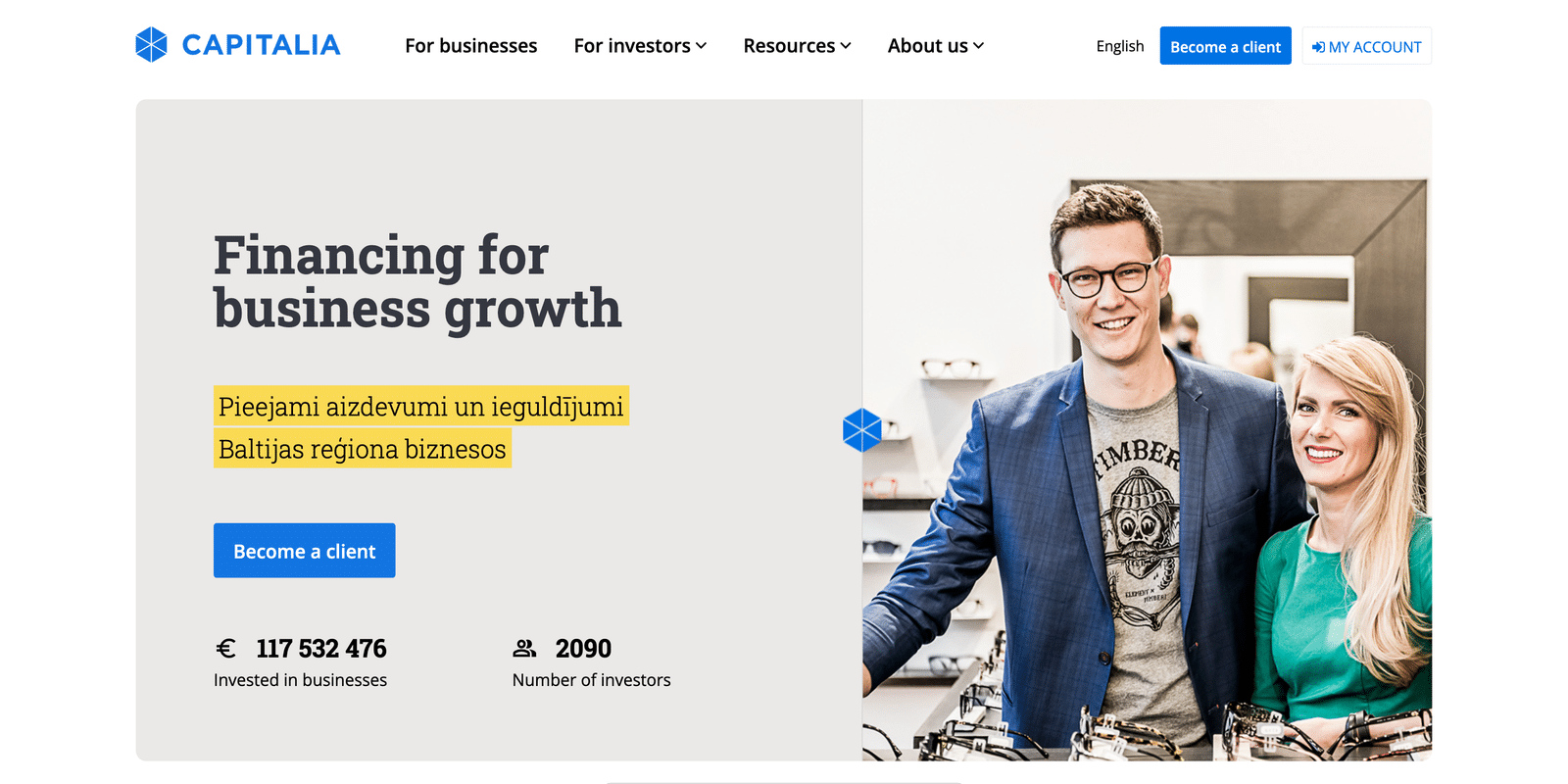
I first came across Capitalia back in 2021, when I had an introductory call with their team. At the time, the platform was still in its earlier stages of opening up to retail investors. Five years later, Capitalia has become one of the most established business lending platforms in Europe, with a track record stretching back to 2007.
What makes Capitalia different from most P2P lending platforms is that it’s not a marketplace. Capitalia originates, underwrites, and services every loan itself. There’s no loan originator layer to worry about, no middleman risk. That’s a meaningful distinction that most investors overlook.
Pros:
- 18-year operating history, the longest in Baltic P2P lending
- Direct lender model eliminates loan originator risk
- ECSP licensed and regulated by the Bank of Latvia
- Some loans backed by the European Investment Fund
- Strict underwriting with only 25-28% of applications approved
- Capitalia co-invests in its own loans (avg 11% skin in the game)
Cons:
- Higher minimum investment (EUR 200 per loan, EUR 5,000+ recommended for diversification)
- 14.1% of portfolio currently in recovery
- Small investor base (~1,800 investors)
- Limited secondary market liquidity
- No buyback guarantee on most loans
How Capitalia Works
Capitalia is a Latvian company that lends directly to small and medium-sized businesses across the Baltic states and Finland: Latvia, Lithuania, Estonia, and as of 2026, Finland. Founded in 2007 by Juris Grisins, it’s the largest non-bank SME lender in the region.
Unlike platforms like Mintos or PeerBerry where you invest in loans originated by third-party companies, Capitalia does everything in-house. They find the borrowers, assess the risk, issue the loans, and handle collections if things go wrong. You’re investing alongside Capitalia, not through a chain of intermediaries.
The platform is structured as a Societas Europaea (SE), a European public company. Their bonds have been listed on NASDAQ Baltic since 2014, which adds a layer of corporate credibility you don’t often see in this space.
Returns and Loan Types
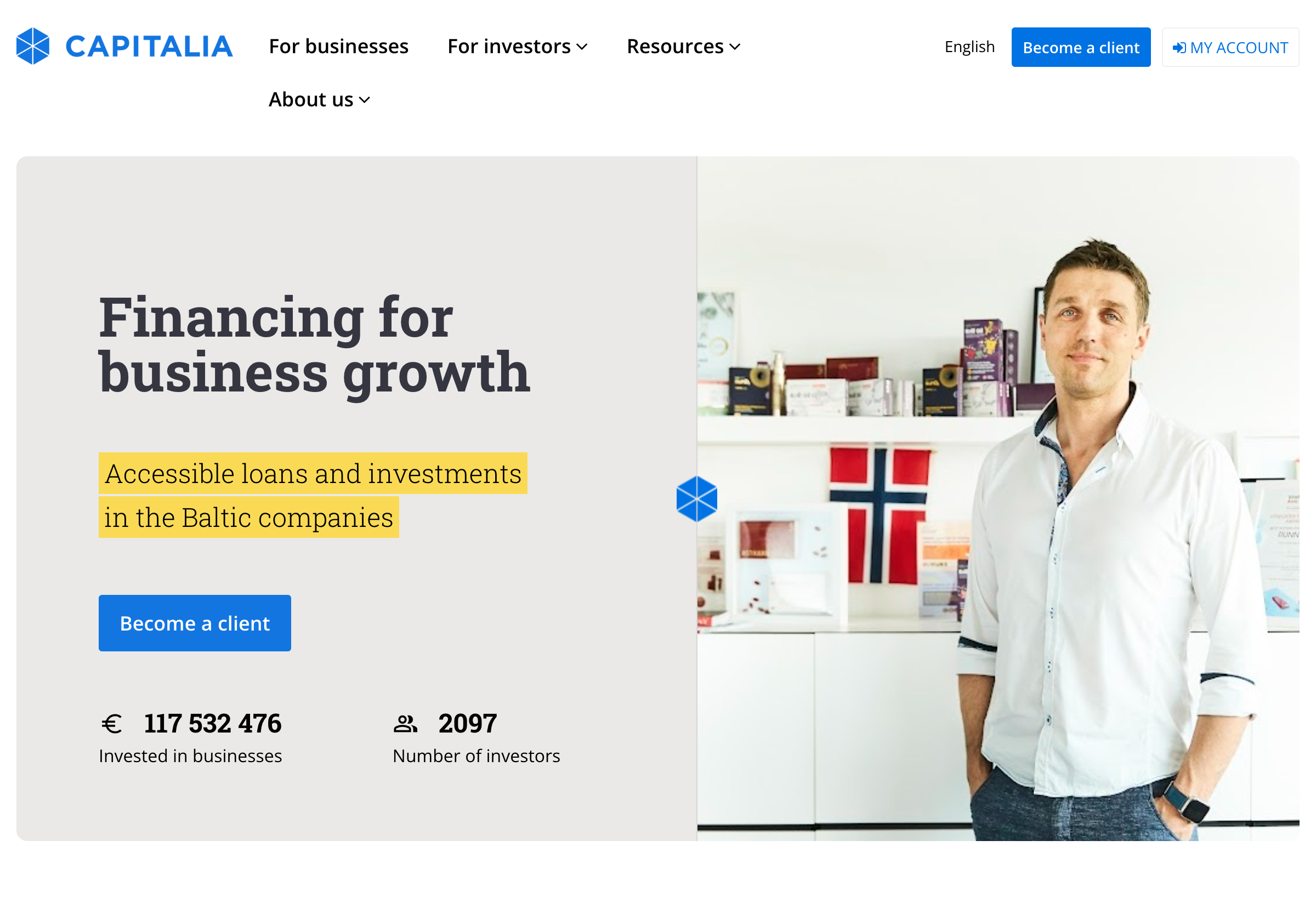
Capitalia offers returns ranging from 6% to 24%, depending on the risk grade of the loan. The average sits around 11% annually. Loans are graded from A+ (lowest risk, lowest return) to D (highest risk, highest return).
A new addition in 2026 is the EIF-backed loan tier, offering 6-8% returns with significantly lower risk thanks to the European Investment Fund guarantee. This gives investors a way to build a more conservative allocation within the same platform.
All loans are business loans. Terms range up to 36 months, with most falling in the 12-24 month range. The minimum investment per loan is EUR 200, which is higher than most consumer lending platforms but reasonable for business debt.
Interest is paid monthly, and principal is typically repaid at maturity or in installments depending on the loan structure. You know what you’re getting into before you invest.
Regulation and Safety
This is where Capitalia stands out. The platform holds an ECSP (European Crowdfunding Service Provider) license issued by the Bank of Latvia in November 2023. This is genuine EU-level financial regulation, not a membership in a self-regulatory organization or a license from a Caribbean jurisdiction.
On top of that, Capitalia Fund Management is registered as an Alternative Investment Fund Manager (AIFP), also with the Bank of Latvia.
The most interesting safety feature is the European Investment Fund (EIF) backing. In 2019, Capitalia signed a EUR 10 million guarantee agreement with the EIF. Under this arrangement, the EIF covers 80% of the principal on qualifying microloans under EUR 25,000. Starting in April 2026, Capitalia is opening EIF-backed loans to retail investors for the first time. These loans carry lower risk and correspondingly lower returns of 6-8% compared to the platform average of around 11%. As far as I know, no other European crowdfunding platform offers retail investors access to EIF-guaranteed loans. This is a genuinely unique feature.
Capitalia also co-invests in its own loans, averaging around 11% skin in the game. When a platform puts its own money at risk alongside yours, incentives are properly aligned.
The Default Rate Question
You’ll see Capitalia’s “0.07% bad debt rate” mentioned in various places. It’s important to understand what this actually means. That figure represents permanent capital losses after all recovery efforts have been completed. It does not mean only 0.07% of loans default.
The current picture shows 14.1% of the portfolio in recovery. That’s not unusual for business lending, where defaults happen but collateral and legal recovery can eventually return most or all of the capital. The distinction between “loans that defaulted” and “money permanently lost” is critical.
For business lending to SMEs, a 14.1% recovery rate with minimal permanent losses is actually a strong track record. But you need patience. Recovery takes time, sometimes months, sometimes over a year.
Auto-Invest and Secondary Market
Capitalia offers auto-invest with three preset strategies or a fully customizable option. You can filter by risk grade, interest rate, loan term, and country. Once configured, it works reliably.
A secondary market exists, but it’s limited. You can sell loans before maturity, but there are no premium or discount options, and sellers pay a 2% fee. Liquidity is low given the small investor base, so don’t count on being able to exit quickly.
The good news is that Capitalia plans to significantly upgrade the secondary market by end of summer 2026, and the auto-invest tool is also getting a refresh this year. Both improvements should make the platform more practical for investors who want a more hands-off experience.
For now, though, this is still largely a buy-and-hold platform.
Fees
Capitalia charges no fees for investing, using auto-invest, or buying on the secondary market. The only fees are a 2% commission when selling on the secondary market and EUR 3 per withdrawal after two free withdrawals per month.
Tax withholding varies: 10% for most EU residents with a tax treaty, 0% for Lithuanian residents with a certificate, 20% for Latvian residents, and 25.5% without a treaty. You can download tax statements directly from your account.
Who Is This For?
Capitalia is not a beginner platform. The higher minimum investment, business loan focus, and longer recovery timelines mean this is better suited to experienced P2P investors who understand the asset class and want genuine diversification away from consumer lending.
If you already invest on platforms like Mintos, PeerBerry, or Nectaro, adding Capitalia gives you exposure to a completely different type of lending: direct business loans with real collateral, institutional-grade backing on some loans, and an 18-year track record.
The ideal allocation here is a moderate position within a diversified P2P portfolio. Don’t put everything into one platform, but Capitalia has earned its place as a credible option in the European P2P landscape.
Should You Invest?
After following Capitalia since 2021 and watching how the platform has evolved, I think it deserves a place in a well-diversified P2P portfolio. The direct lending model, ECSP regulation, EIF backing, and 18-year track record set it apart from the crowd.
The downsides are real: the investor base is small, the secondary market is thin, and you need a meaningful amount of capital to diversify properly across enough loans. But the fundamentals are solid, and the permanent capital loss rate is among the lowest in the industry.
If you’re looking for a platform that takes a more conservative, institutional approach to P2P lending, Capitalia is worth a serious look.
Related








Leave a Reply