I need to be upfront about this comparison: Mintos and Robocash are not on the same level anymore. I’ve invested on both platforms, and while I originally included Robocash in my portfolio as a diversification play, the situation has changed significantly. As of March 2026, I no longer recommend Robocash and have removed it from my best P2P platforms list.
The financial health of Robocash’s parent company, UnaFinancial, has deteriorated — their debt-to-equity ratio surged to 25:1, the company lost over half its equity, and their Philippines lending license was suspended. The CFO also confirmed that no real group guarantee exists, despite marketing materials suggesting otherwise.
The short version: Mintos wins this comparison comprehensively. It’s better regulated, more diversified, more transparent, and financially healthier. If you’re currently deciding between these two, Mintos is the clear choice. If you’re already on Robocash, the concerns I’ve outlined in my Robocash review deserve your attention.
Quick Comparison: Mintos vs Robocash
| Feature | Mintos | Robocash |
|---|---|---|
| Founded | 2015 | 2017 |
| Country | Latvia | Croatia |
| Regulation | MiFID II licensed (pursuing banking license) | Not regulated (no ECSP) |
| Avg. Returns | ~9.2% (weighted avg. APY); ~9% net long-term | 8-13% (historical avg ~9.93%) |
| Buyback Guarantee | Yes (60 days) | Yes (30 days) |
| Secondary Market | Yes (0.85% fee) | Yes (no fees, no discounts) |
| Auto-Invest | Yes (Custom + Core Loans) | Yes (fully automated) |
| Min. Investment | EUR 10 | EUR 10 |
| Total Funded | EUR 13 billion+ | EUR 1.3 billion+ |
| Registered Investors | 700,000+ | 42,000+ |
| Loan Originators | 60+ (independent third parties) | UnaFinancial subsidiaries only |
| Countries | 33+ | 5 (Philippines, Kazakhstan, Sri Lanka, Singapore, Spain) |
| Fees | 0.29% annual (Custom Portfolios), 0.85% secondary market | None |
| Profitability | Small net losses in 2024 and 2025 | Under pressure (UnaFinancial concerns) |
| Investor Protection | EUR 20,000 scheme under MiFID II | None |
Returns and Performance
On paper, the return profiles look similar. Mintos shows a 9.2% weighted average APY on available loans; Robocash advertises 8-13% with a historical average around 9.93%. My personal net return on Mintos over 9 years has been around 9% after originator defaults and market disruptions.
But returns don’t exist in a vacuum — they need to be evaluated against risk. And that’s where this comparison gets lopsided.
Mintos’s returns come from a diversified pool of 60+ loan originators across 33+ countries. When individual originators have failed (and several have over the years), the impact on a diversified portfolio was manageable. My total losses from originator defaults on Mintos were around EUR 600 — a small figure relative to the profits generated by a six-figure portfolio over 9 years.
Robocash’s returns come entirely from UnaFinancial’s own lending subsidiaries. There is zero third-party originator diversification. Every loan on the platform is originated by a UnaFinancial subsidiary in one of five countries (Philippines, Kazakhstan, Sri Lanka, Singapore, Spain). This means your returns are entirely dependent on one group’s financial health.
And that’s the problem. UnaFinancial’s 2024 financials showed declining net interest income, increased credit loss provisions, and significant currency translation losses. By early 2026, the picture had worsened further: the debt-to-equity ratio surged to 25:1, the company lost over half its equity, and the Philippines lending license was suspended. These are serious red flags that directly threaten the sustainability of Robocash’s returns and buyback guarantees.
Even if Robocash delivers 12% returns in the short term, the risk of a catastrophic loss — where UnaFinancial can’t honor buyback obligations or goes under — makes those returns inadequate compensation for the risk.
Regulation and Safety
This is the most significant difference between the two platforms, and it’s not close.
Mintos operates under MiFID II — the European regulatory framework for investment firms. This means EU-level investor protection (EUR 20,000 compensation scheme), structured Notes as regulated financial instruments, and oversight by the Latvian financial regulator. Mintos employs over 160 people across four offices and has operated transparently for 9+ years. In February 2026, Mintos started applying for a banking license from the European Central Bank.
Robocash has no formal regulation. It’s not licensed under MiFID II, not under ECSP, and doesn’t hold a formal investment services license. The platform operates from Croatia without regulatory oversight equivalent to what licensed platforms provide. There is no investor protection scheme. If something goes wrong at the platform level, investors have limited legal recourse.
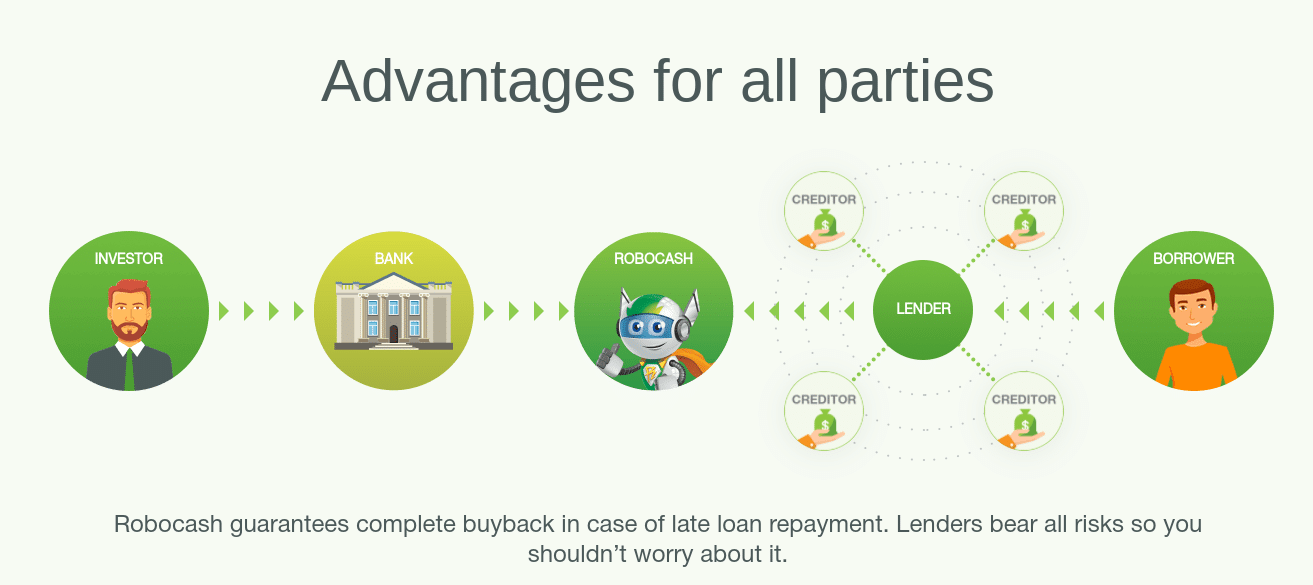
The buyback guarantee comparison is also telling. Both platforms offer buyback, but with different terms. Mintos’s buyback triggers at 60 days of default; Robocash’s triggers at 30 days. On paper, Robocash’s shorter trigger sounds better — you get your money back faster. But a buyback guarantee is only as strong as the entity behind it. Robocash’s guarantee is backed entirely by UnaFinancial subsidiaries — the same group whose financial health has deteriorated significantly.
Mintos’s buyback guarantees come from 60+ independent loan originators, each with their own balance sheets. If one originator fails, the rest continue operating. That structural diversification of guarantor risk is far more protective than a single-entity guarantee from a financially stressed group.
The CFO of UnaFinancial has also confirmed that no real group guarantee exists, despite marketing materials suggesting otherwise. That’s a fundamental trust issue that goes beyond the numbers.
Diversification
Mintos is in a completely different league. Over 60 loan originators across 33+ countries, covering mortgage loans, car loans, business loans, consumer loans, agricultural loans, BNPL products, and more. Beyond loans, Mintos also offers fractional bonds, ETFs, and real estate investments. No other European P2P platform offers this level of diversification.
Robocash has one originator group (UnaFinancial) operating in five countries (Philippines, Kazakhstan, Sri Lanka, Singapore, Spain). The loans are all consumer loans — short-term and long-term. There is no asset class diversification, no third-party originator diversification, and limited geographic diversification.
This matters enormously for risk management. On Mintos, you can build a portfolio across 15-20 profitable originators, multiple loan types, and dozens of countries. If one originator fails, it’s a small slice of your portfolio. On Robocash, a UnaFinancial failure affects everything.
Mintos assigns a Risk Score to each originator, helping investors make informed decisions. Around 45% of Mintos loan originators are not profitable, so selective diversification matters — but at least you have the data to make those selections. On Robocash, you can choose which UnaFinancial subsidiaries to include, but they all share the same parent company risk.
Ease of Use and Features
I’ll give Robocash credit here — the platform is clean and simple. It’s fully automated: you set your criteria and the algorithm handles everything. There’s no manual loan picking, which appeals to investors who want a hands-off experience. The secondary market carries zero fees and typically provides liquidity within 24 hours.
Mintos is more complex but far more powerful. The Custom Strategy builder has many parameters to optimize, though Core Loans offers a simplified auto-invest option for those who want Robocash-level simplicity. The secondary market is larger and more liquid, though it charges 0.85% per transaction. Mintos also provides detailed originator profiles, risk scores, and financial data that Robocash doesn’t match.
Both platforms have auto-invest. Mintos gives you granular control over originator selection, countries, loan types, and durations. Robocash gives you portfolio-level settings with less control over individual loan selection. For a passive investor, Robocash’s simplicity works fine. For someone who wants to actively manage risk, Mintos is far more capable.
Customer support differs too. Mintos has a larger support team with multiple contact channels. Robocash’s support hours are limited (7 AM – 3 PM UTC) with email response times up to 72 hours, which is not great if you have an urgent issue.
Fees
Robocash charges zero fees. No investment fees, no secondary market fees, no withdrawal fees. Mintos charges 0.29% annually on Custom Loan Portfolios and 0.85% on secondary market transactions.
On pure cost, Robocash wins. But I’d happily pay Mintos’s modest fees for MiFID II regulation, diversification across 60+ originators, and a EUR 20,000 investor protection scheme. The 0.29% annual fee on a EUR 50,000 portfolio is EUR 145 per year — a reasonable price for significantly stronger structural safeguards.
Zero fees sound attractive, but they’re meaningless if the platform’s underlying risk profile puts your principal in jeopardy. The cheapest platform isn’t always the best value.
Who Should Choose Which?
Choose Mintos if you:
- Want MiFID II regulation and formal investor protection (EUR 20,000 scheme)
- Value diversification across 60+ independent originators and 33+ countries
- Need a proven secondary market for liquidity
- Want to invest alongside 700,000+ other investors on a platform with EUR 13 billion+ funded
- Prefer a regulated platform pursuing a banking license
- Are building any serious P2P allocation
Consider Robocash only if you:
- Want a fully automated, no-fee platform and accept the concentration risk
- Are comfortable with an unregulated platform backed by a financially stressed parent company
- Are allocating a small amount (EUR 500-1,000) as a speculative position
- Have fully reviewed the UnaFinancial concerns detailed in my Robocash review
My recommendation: Use Mintos. The financial concerns around UnaFinancial — the 25:1 debt-to-equity ratio, the loss of over half its equity, the suspended Philippines license, and the confirmed absence of a real group guarantee — make Robocash a risk I can no longer recommend. If you have money on Robocash, I’d suggest reviewing your position carefully.
Verdict
Mintos wins this comparison on every dimension that matters: regulation, diversification, transparency, financial health, track record, and investor protection. It’s not a close call.
I don’t say this lightly. When I originally invested on Robocash, it had appeal — simple automation, decent returns, and a clean interface. But the UnaFinancial situation has fundamentally changed the risk-reward calculation. A platform’s returns are irrelevant if the entity behind your loans can’t meet its obligations.
Mintos isn’t perfect — the originator default history, the roughly 29% of outstanding loans now in recovery, and the fees are real drawbacks. But these are manageable risks within a diversified, regulated framework. Robocash’s risks are concentrated and structural, with no regulatory safety net.
For the full analysis of each platform, read my Mintos review and Robocash review. For context on how these platforms compare to the broader market, see my guide to the best European P2P lending platforms and the P2P lending guide. If you’re also comparing mid-tier options, my PeerBerry vs Robocash comparison covers a similar risk analysis.
Frequently Asked Questions
Is Mintos safer than Robocash?
Yes, significantly. Mintos is MiFID II licensed with an EUR 20,000 investor protection scheme, diversified across 60+ independent originators, and is pursuing a banking license. Robocash is unregulated, depends entirely on UnaFinancial Group (which has experienced serious financial deterioration), and has no investor protection scheme. As of March 2026, I no longer recommend Robocash.
What are the concerns with Robocash and UnaFinancial?
UnaFinancial’s debt-to-equity ratio surged to 25:1, the company lost over half its equity, and its Philippines lending license was suspended. The CFO confirmed that no real group guarantee exists, despite marketing materials suggesting otherwise. Independent reviewers rate the platform poorly. These are serious structural concerns that affect the viability of Robocash’s buyback guarantees and investor funds.
Why does Robocash have a 30-day buyback while Mintos has 60 days?
The buyback trigger period differs by platform: Robocash repurchases loans after 30 days of default, while Mintos triggers at 60 days. A shorter trigger sounds better, but the guarantee is only as reliable as the entity backing it. Robocash’s guarantees come from UnaFinancial subsidiaries, whose financial health has deteriorated. Mintos’s guarantees come from 60+ independent originators with diverse balance sheets.
Which platform has better returns?
The advertised returns are similar: Mintos 9.2% (weighted average APY), Robocash 8-13% (historical average ~9.93%). My personal net return on Mintos over 9 years is ~9%. Returns must be evaluated against risk, however. Robocash’s returns come with significantly higher platform and concentration risk due to UnaFinancial’s financial situation.
Should I move my money from Robocash to Mintos?
I cannot give individual financial advice, but I can share my perspective: I no longer recommend Robocash and have removed it from my best P2P platforms list due to concerns about UnaFinancial’s financial health. Investors should review the detailed concerns in my Robocash review and make their own assessment. Mintos is a regulated, diversified alternative with stronger structural safeguards.
Does Robocash charge fees?
No. Robocash charges zero fees, including on its secondary market. Mintos charges 0.29% annually on Custom Loan Portfolios and 0.85% on secondary market transactions. While Robocash’s fee structure is more attractive on paper, fees should be weighed against the platform’s overall risk profile and regulatory protections.
Open a Mintos account Open a Robocash account
Related





Leave a Reply