
Every now and then a new P2P lending platform comes along that genuinely catches my attention. Nectaro is one of those platforms. Launched in November 2023, it has quickly become one of the most talked-about newcomers in European peer-to-peer lending, and for good reason. It delivered a 14.91% return in 2025, has zero investor losses to date, and was named “Winner of 2025” by re:think P2P with the highest score of any platform reviewed.
But is the hype justified? In this review, I will break down everything you need to know about Nectaro: who is behind it, how it works, what returns you can expect, and whether the risks are worth it.
What is Nectaro?
Nectaro is a Latvian P2P lending platform that connects investors with consumer and business loans. It is regulated by Latvijas Banka (the Bank of Latvia) under MiFID II, which means your investor account is protected by the EU compensation scheme (Directive 97/9/EC) for up to EUR 20,000 in case of platform misappropriation.
The platform is part of the Dyninno Group, a US-founded conglomerate active in travel, entertainment, and fintech across 50+ markets with over 5,000 employees and close to a billion dollars in annual gross orders. This corporate backing is significant. Many P2P platforms are small startups with limited resources, but Nectaro has a well-funded parent company behind it.
Since launch, Nectaro has funded over EUR 46.6 million in loans, grown its investor base to 8,000+, and expanded its managed portfolio from EUR 3.65 million to roughly EUR 20 million. Those are impressive numbers for a platform that is just over two years old.
Who Runs Nectaro?
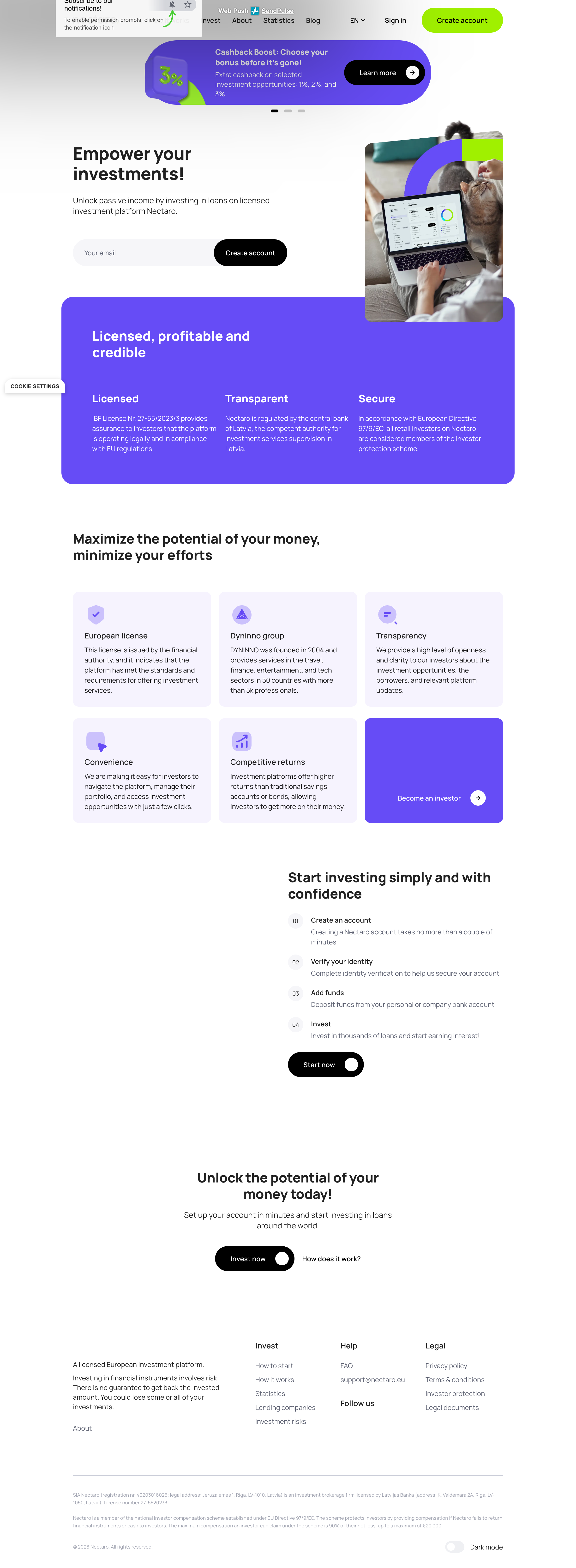
The platform was co-founded by Dmitry Tsymber, who also established EcoFinance, Nectaro’s primary loan originator. Alex Weinstein, the main founder of Dyninno Group, holds approximately 78% ownership, with Tsymber holding the remaining 22%.
Day-to-day operations are led by CEO Sigita Kotlere, who joined in September 2022 to build the platform from the ground up. Her background is worth noting. She previously worked at Mintos during its most active growth phase, managing partnerships with lending companies across multiple regions. Before that, she held positions at Citadele Banka and BluOr Bank. Having someone with direct Mintos experience leading a new P2P platform is a meaningful credential.
The team is small, around 15 people, which is typical for a platform at this stage. What matters more is the depth of fintech experience on the team and the resources of the parent company backing them.
Loan Originators and Loan Types
This is where things get both interesting and a bit concerning. Nectaro currently works with two loan originators, both of which are part of the Dyninno Group:
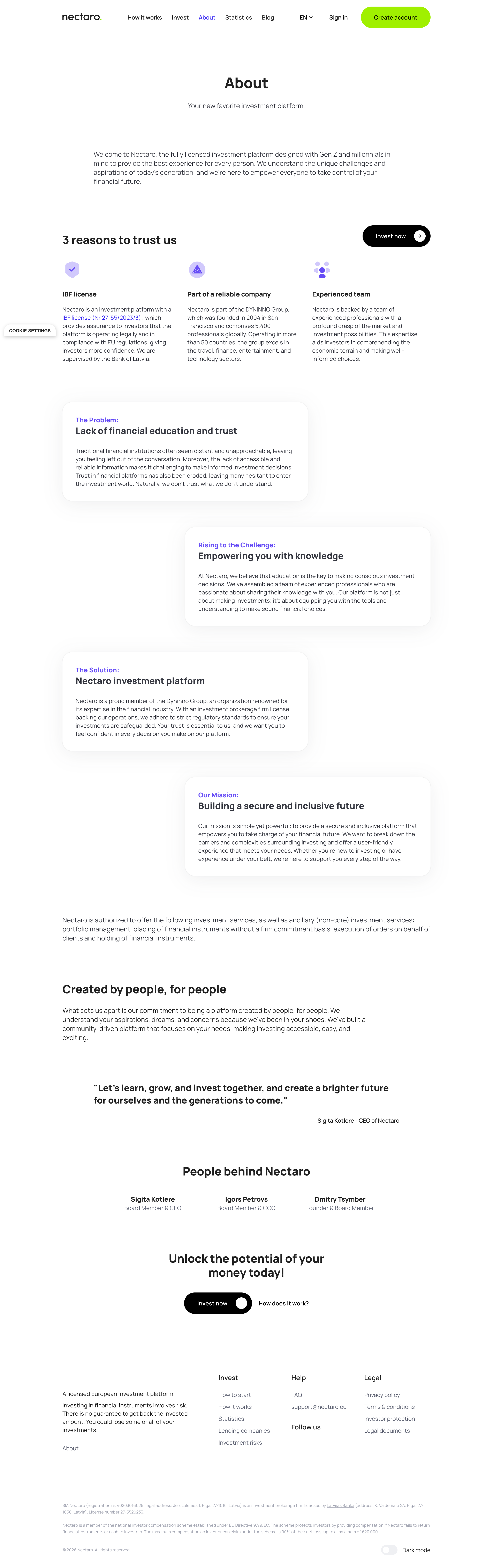
CreditPrime (the trading name of EcoFinance) offers consumer loans in Romania and Moldova. Interest rates range from 12% to 14.5%, with loan terms from 11 months up to 5 years. CreditPrime Romania has a solid equity-to-assets ratio of 34.36% and a strong 23.1% return on assets. The Moldova operation shows a 22.13% equity ratio. Both are profitable.
Abele Finance is a newer addition, established in 2024 in Latvia. It provides business loans funding Dyninno’s own group companies, with operations reaching into Cyprus and the Philippines. Interest rates sit around 9-11% with shorter terms of up to 8 months.
The concentration risk here is real. Both loan originators are Dyninno affiliates, which means if something goes wrong at the group level, your entire Nectaro portfolio could be affected. This is the platform’s biggest structural weakness right now, and it is one the team acknowledges. At least one new lender is expected in 2026, with discussions about potentially onboarding non-affiliated originators for the first time. That would be a major step forward.
Returns and Performance
The numbers speak for themselves. Nectaro’s actual return in 2025 was 14.91%, which placed it at the top of every P2P comparison I have seen. Average interest rates across the platform sit around 13.5%, with individual loans offering up to 15%.
Total investor earnings have crossed EUR 750,000, and the platform maintains a 0.0% investor loss rate. No investor has lost principal on any loan since launch, thanks to the buyback guarantee and healthy loan originator finances.
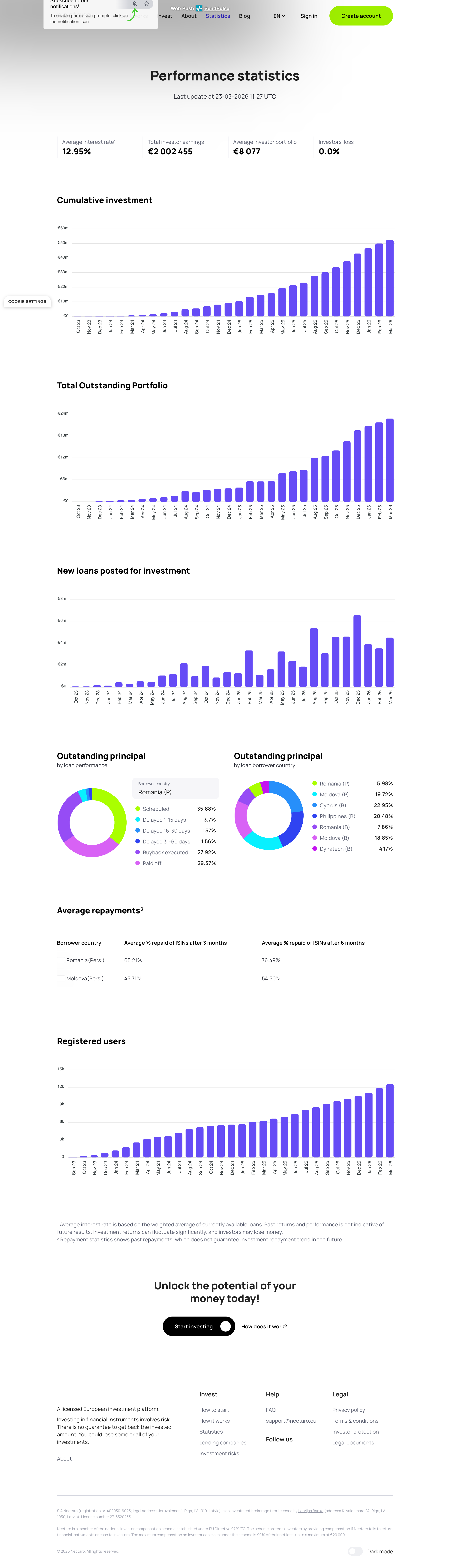
Of course, these numbers come with context. The platform is young and has not been tested by a full credit cycle or a major economic downturn. Zero defaults today does not guarantee zero defaults tomorrow. But the underlying loan originator profitability gives me more confidence than the raw default numbers alone.
Default rates at the borrower level (before the buyback guarantee kicks in) are worth knowing: 8-9% in Romania, around 7% in Moldova, and approximately 20% in the Philippines. These are managed by the loan originators and absorbed through their margins and the buyback mechanism. As long as the originators remain profitable, investors should not see losses.
The Buyback Guarantee
Nectaro offers a 60-day buyback obligation on all loans. If a borrower’s payment is delayed by more than 60 days, the loan originator is required to repurchase the loan from investors, covering both principal and accrued interest.
This guarantee has been honored on every single occasion since the platform launched. That said, it is important to understand that a buyback guarantee is only as strong as the company standing behind it. There is no additional group guarantee from Dyninno, which some investors would like to see. If a loan originator were to become insolvent, the buyback obligation would be worthless.
Fees: None
This is refreshingly simple. Nectaro charges no fees to investors. Registration is free, deposits are free, withdrawals are free, and there are no management or performance fees. Your returns are your returns.
The only thing to note is that withdrawals can take 7-10 days to process due to AML compliance requirements. Not a fee, but worth setting expectations around liquidity timing.
Auto-Invest and Smart Reinvest
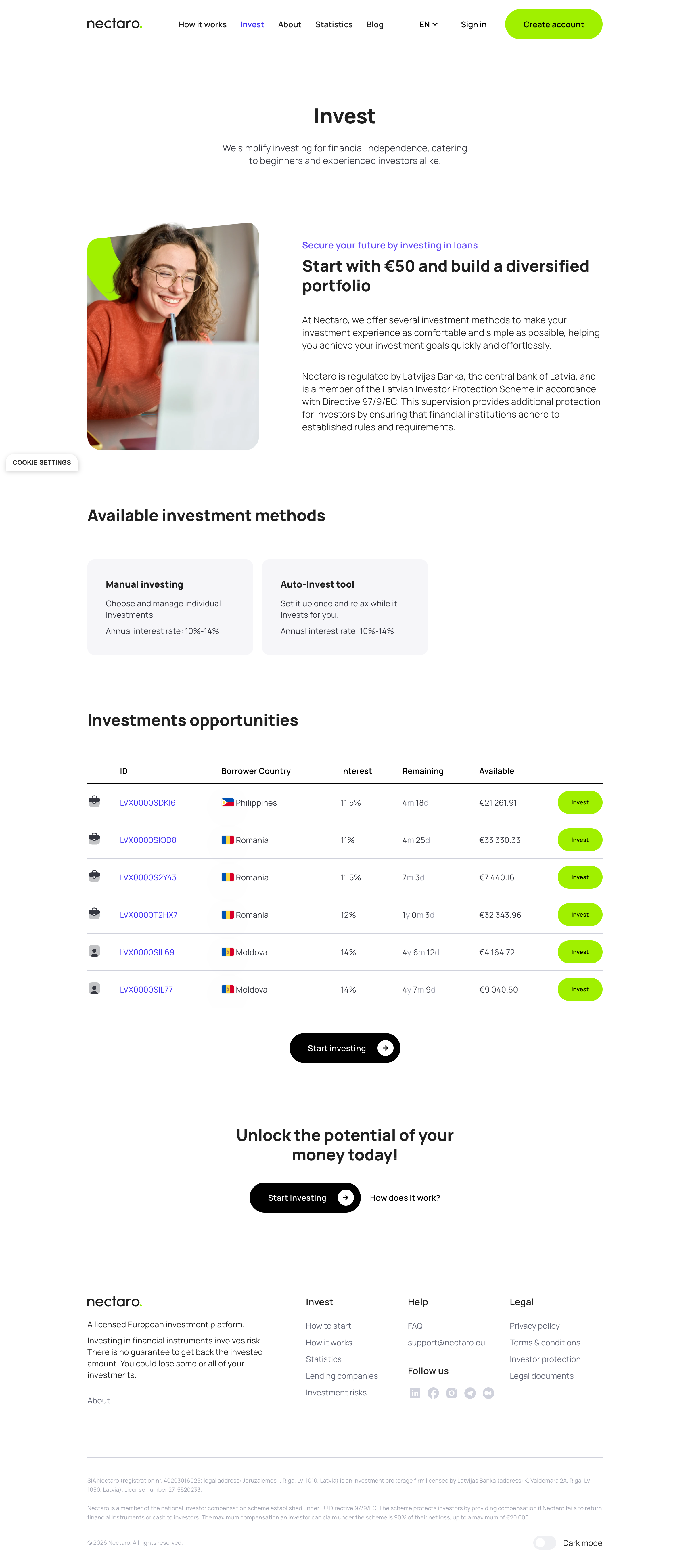
Nectaro offers a solid auto-invest tool that lets you set criteria for automated investing. You can configure up to three separate strategies with parameters for:
- Borrower country
- Loan term (9-51 months)
- Interest rate (11-15%)
- Investment amount per note (EUR 10 to EUR 250)
There is also a Smart Reinvest feature that automatically reinvests principal received from early loan repayments into the same loan series. This is a nice touch that reduces cash drag, which is a common problem on P2P platforms where money sits idle between investments.
Using auto-invest also earns you a small interest rate bonus of +0.29%, which is a clever incentive to encourage automated investing.
The minimum investment is EUR 50 for manual investments and EUR 10 per note through auto-invest.
No Secondary Market Yet
This is Nectaro’s most notable missing feature. There is no secondary market, which means once you invest in a loan, you are locked in until maturity or early repayment. You cannot sell your positions to other investors if you need liquidity.
For short-term loans this is manageable. Many Romanian and Moldovan loans experience early repayment, so you may get your capital back sooner than the stated term. But for longer-duration loans (up to 5 years in Moldova), the lack of a secondary market is a real limitation.
The team has indicated that a secondary market is on their roadmap for 2026. If they deliver on this, it would remove one of the biggest barriers for larger investors.
User Interface and Experience
The platform is clean and modern. Registration involves identity verification via Sumsub and a suitability assessment, which is required by regulation. The dashboard gives you a clear view of your portfolio, returns, and pending investments.
It is mobile-friendly, available in English and Latvian, and the overall experience is straightforward. It does not have the depth of features you would find on a mature platform like Mintos, but for what it offers, the execution is solid. The team is also responsive to investor queries, which matters more than people think.
The EcoFinance Russia Situation
Any honest review of Nectaro needs to address this. EcoFinance, the parent company of Nectaro’s main loan originator CreditPrime, also had operations in Russia through EcoFinance RU. That entity was listed on Mintos and was suspended in June 2022 following the war in Ukraine.
The damage: EUR 3.6 million of investors’ funds remain at risk on Mintos, with only about 11% recovered as of late 2024. This is a real loss for those investors, and it is directly connected to the same corporate family that runs Nectaro’s loan originators.
Now, to be fair, the Russian entity was a separate legal entity operating in a country that became subject to unprecedented sanctions. The Romanian and Moldovan operations are entirely separate, are profitable, and operate in stable regulatory environments. Nectaro itself did not exist when the Russian issues occurred.
But it would be dishonest to ignore this history. It demonstrates that group-affiliated loan originators carry real counterparty risk, and that external events can and do disrupt otherwise functional lending businesses. Keep this in mind when sizing your Nectaro allocation.
How Nectaro Compares
Nectaro’s business model is most similar to ViaInvest, another Latvian platform that works exclusively with affiliated loan originators. Both are regulated, both offer buyback guarantees, and both keep things relatively simple.
Compared to Mintos, Nectaro is much smaller and less diversified but offers higher average returns and a cleaner experience without fees. Mintos has 60+ loan originators, a secondary market, and multiple asset classes, but also charges a 0.29% annual fee and has a more complex interface.
Against TWINO, Nectaro looks healthier. TWINO has had issues with its Russian, Vietnamese, and Philippine lending operations, leaving only Polish loans active. Nectaro’s loan book is smaller but more stable.
Within the Latvian P2P ecosystem, Nectaro is part of an informal alliance of six regulated platforms (alongside LANDE, Indemo, ViaInvest, Debitum, and TWINO). This collaborative approach to promoting Latvian P2P lending as a whole is a positive sign for the industry.
Investor Protection
Being regulated under MiFID II provides meaningful protections:
- Investor compensation scheme up to EUR 20,000 (90% coverage) in case of platform misappropriation
- Segregated client accounts
- Regular auditing and reporting requirements
- Suitability and appropriateness assessments before you can invest
This puts Nectaro ahead of many older platforms that still operate without proper regulation. It does not eliminate risk, but it does mean there are institutional safeguards in place.
Cashback and Bonuses
Nectaro regularly runs promotional campaigns for new investors. The current offer includes a 1% cashback on your average daily invested balance during the first 30 days. They also run periodic boost campaigns offering 1-5% additional returns on specific loan series.
These promotions are a nice sweetener, though I would never recommend choosing a platform based on short-term bonuses alone. The underlying fundamentals matter far more.
Who is Nectaro Best For?
Nectaro is a strong fit for investors who:
- Want high returns (13-15%) from a regulated European platform
- Are comfortable with a younger platform backed by a large corporate group
- Prefer simplicity over complexity
- Do not need immediate liquidity (no secondary market)
- Want to diversify beyond the bigger, more established platforms
It is less suitable for investors who need frequent access to their capital, want maximum loan originator diversification, or are uncomfortable with the concentration risk of group-affiliated originators.
My Verdict
Nectaro has done a lot of things right in a short time. The returns are excellent, the regulation is solid, the user experience is clean, and the corporate backing provides a safety cushion that most new platforms simply do not have. The CEO’s Mintos background shows in the platform’s professional execution.
The concerns are real but manageable. The lack of a secondary market limits flexibility. The concentration in Dyninno-affiliated originators is a structural risk. The EcoFinance Russia history is a red flag that deserves acknowledgment, even if it does not directly impact current operations. And at just over two years old, the platform has not been battle-tested by adverse market conditions.
On balance, I think Nectaro deserves a place in a diversified P2P portfolio. I would not put all my eggs in this basket, but as a complement to more established platforms, it offers some of the best risk-adjusted returns in European P2P lending right now. If they deliver a secondary market and onboard non-affiliated loan originators in 2026, the platform could move from “promising newcomer” to “top-tier contender” very quickly.
Summary
Nectaro is a regulated Latvian P2P platform backed by the Dyninno Group that delivered 14.91% returns in 2025 with zero investor losses. Strong regulation, competitive rates, and a clean user experience make it one of the most promising newcomers in European P2P lending. The lack of a secondary market and limited loan originator diversification are the main drawbacks for now.
Pros
- 14.91% actual return in 2025, highest among reviewed platforms
- Regulated by Latvijas Banka under MiFID II with EUR 20,000 investor protection
- Zero investor losses since launch
- Backed by Dyninno Group (5,000+ employees, ~USD 1B gross orders)
- No fees for investors on deposits, withdrawals, or management
- Solid auto-invest tool with Smart Reinvest feature
Cons
- No secondary market limits liquidity
- Only Dyninno-affiliated loan originators (concentration risk)
- Young platform with limited track record (launched Nov 2023)
- EcoFinance Russia situation on Mintos (EUR 3.6M at risk) raises questions
- No group guarantee beyond buyback obligation
Summary
Nectaro is a regulated Latvian P2P platform backed by the Dyninno Group that delivered 14.91% returns in 2025 with zero investor losses. Strong regulation, competitive rates, and a clean user experience make it one of the most promising newcomers in European P2P lending. The lack of a secondary market and limited loan originator diversification are the main drawbacks for now.
Pros
- 14.91% actual return in 2025, highest among reviewed platforms
- Regulated by Latvijas Banka under MiFID II with EUR 20,000 investor protection
- Zero investor losses since launch
- Backed by Dyninno Group (5,000+ employees, ~USD 1B gross orders)
- No fees for investors on deposits, withdrawals, or management
- Solid auto-invest tool with Smart Reinvest feature
Cons
- No secondary market limits liquidity
- Only Dyninno-affiliated loan originators (concentration risk)
- Young platform with limited track record (launched Nov 2023)
- EcoFinance Russia situation on Mintos (EUR 3.6M at risk) raises questions
- No group guarantee beyond buyback obligation
Related







Leave a Reply