
Nectaro is a Latvian peer-to-peer lending platform licensed by the Bank of Latvia and owned by the Dyninno Group. It’s paid investors around 13% a year since it launched in late 2023, and no investor has lost money on it yet.
My short verdict: Nectaro is one of the better-built newer platforms in European P2P and worth a small, deliberate allocation. It’s regulated, charges no fees, and has grown fast. The trade-offs are real, though. Every loan comes from a company inside the same corporate group, there’s no secondary market, and the platform itself still runs at a loss on shareholder funding. Size your position with that in mind.
Nectaro at a Glance
| Feature | Nectaro |
|---|---|
| Launched | Late 2023 (Riga, Latvia) |
| Regulation | Investment brokerage firm licensed by Latvijas Banka (MiFID II) |
| Investor compensation | 90% of net loss up to EUR 20,000 if the platform fails to return your assets |
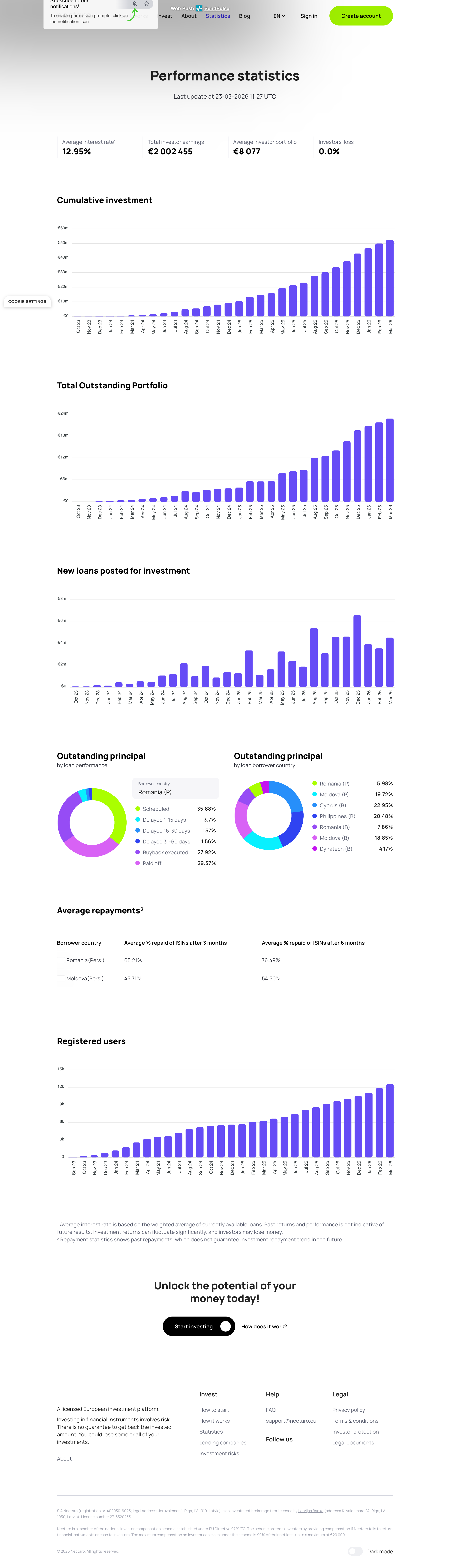
| Average interest rate | 12.83% on currently available loans |
| 2025 average return | 13.14% (Nectaro’s own year-end figure) |
| Investor losses | 0.0% |
| Total funded | About EUR 82.6 million |
| Outstanding portfolio | About EUR 29.8 million |
| Registered users | 17,400+ |
| Buyback | Lender repurchases loans 60+ days late |
| Secondary market | No |
| Fees | None |
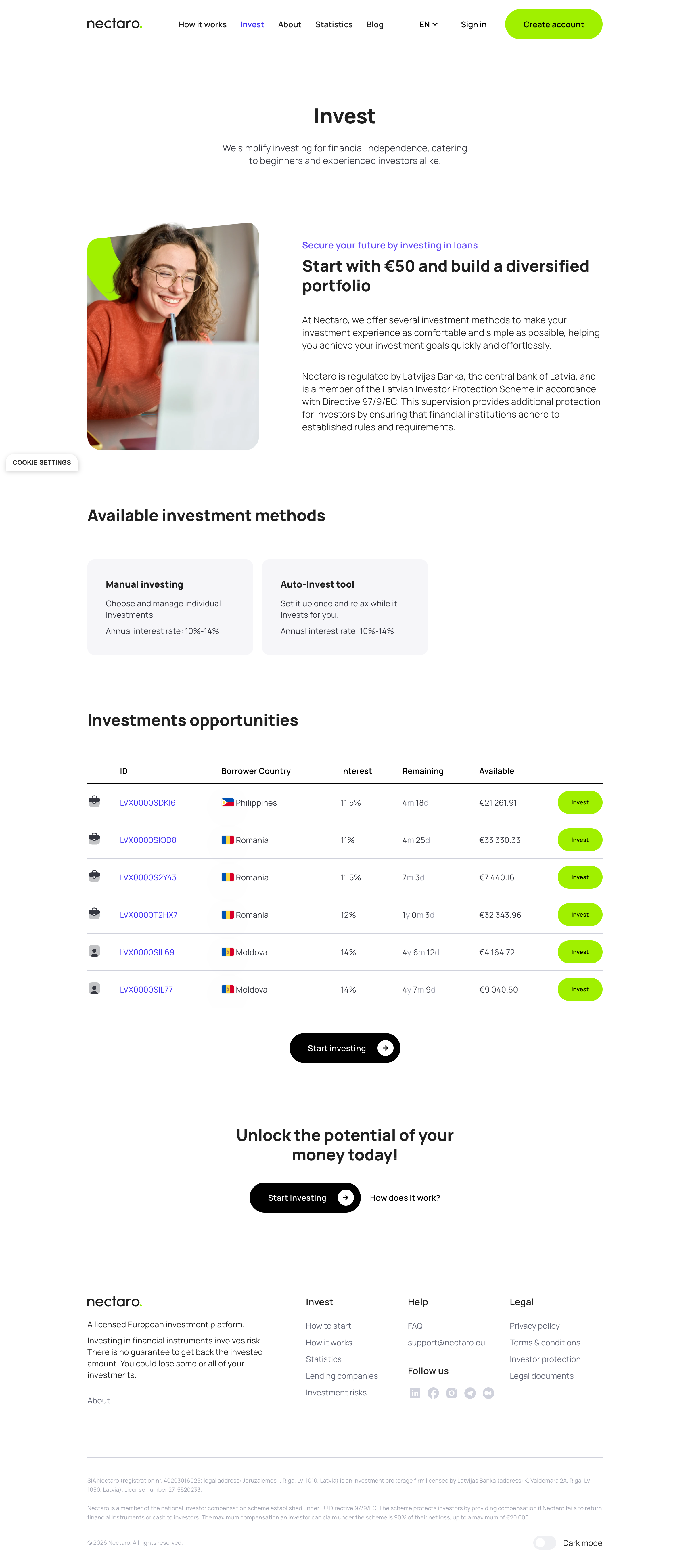
| Minimum investment | EUR 50 per note manually, EUR 10 via auto-invest |
| New investor bonus | 1% cashback on your first 30 days (max EUR 1,000) |
Figures are from Nectaro’s statistics page and its 2025 year-end summary, checked in October 2026.
What is Nectaro?
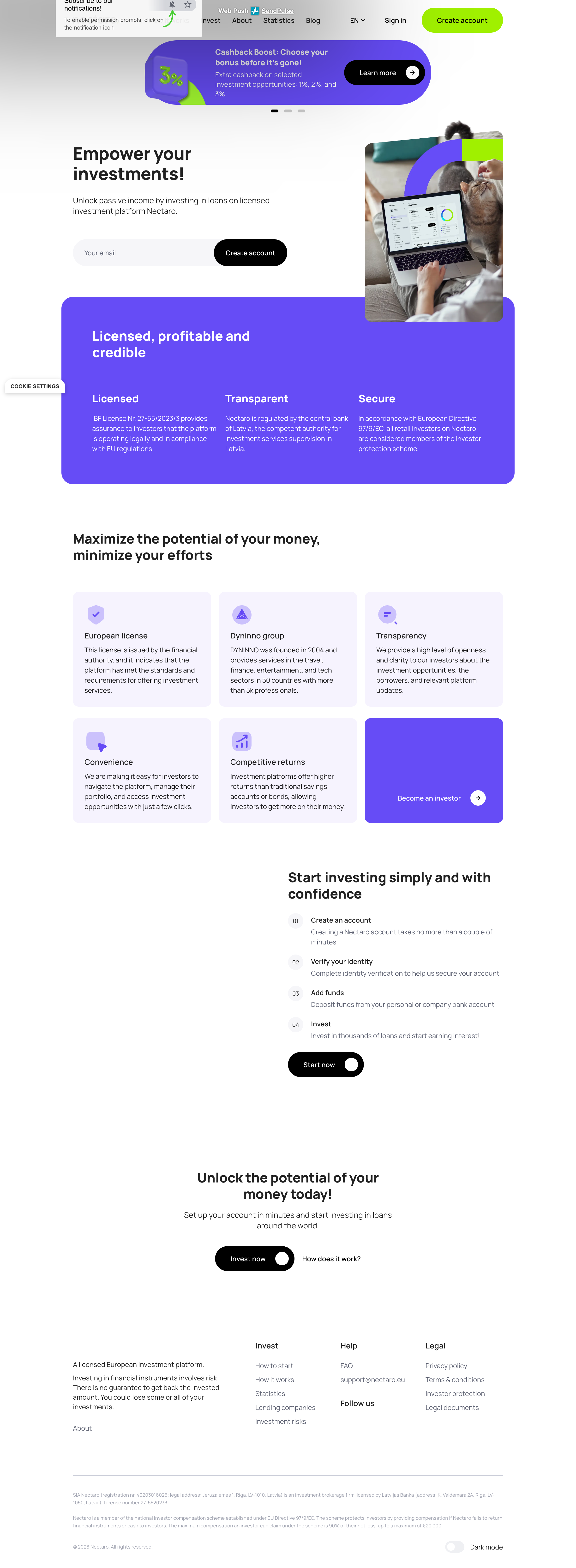
Nectaro connects investors with consumer and business loans issued by lending companies in Romania, Moldova, Latvia, Cyprus and the Philippines. You buy notes backed by those loans and collect the interest as borrowers repay.
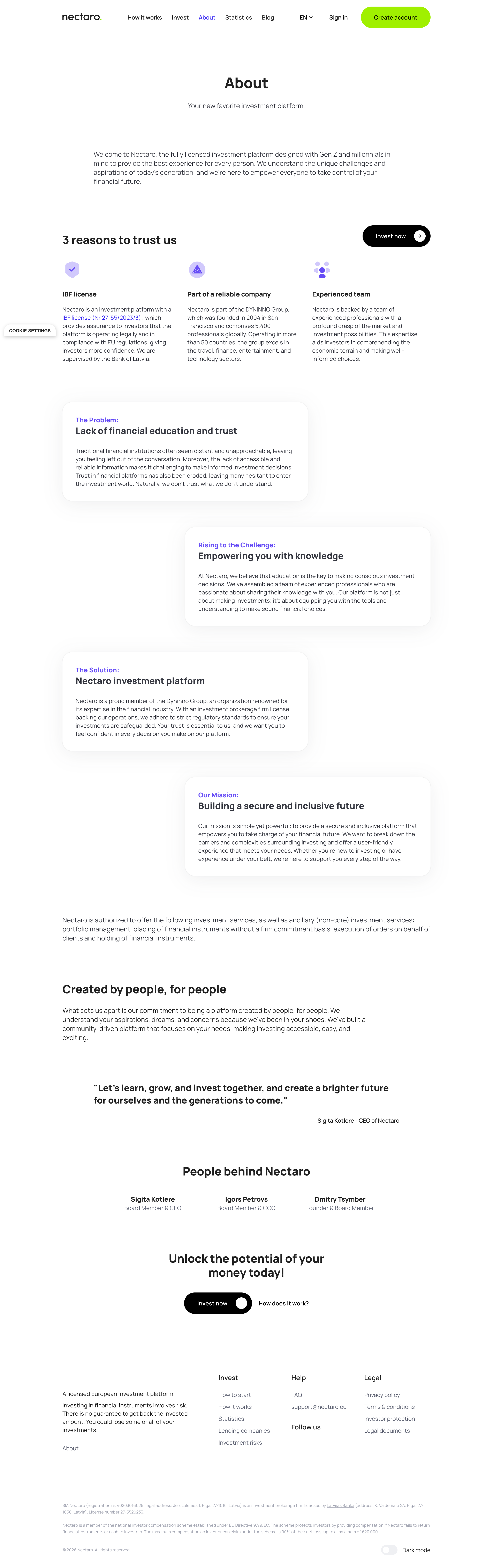
The platform belongs to the Dyninno Group, a US-founded company active in travel, entertainment and fintech in more than 50 countries with around 5,400 staff. That backing matters. Many P2P platforms are small startups, while Nectaro has a large parent that has kept funding it.
Growth has been quick. Investors have put about EUR 82.6 million into loans since launch, and the outstanding portfolio has grown from EUR 3.5 million at the start of 2025 to roughly EUR 30 million today. Investors have earned more than EUR 3.7 million in interest so far.
Who Runs Nectaro?
The platform was co-founded by Dmitry Tsymber, who also established EcoFinance, Nectaro’s main lending partner, and sits on Nectaro’s board. Alex Weinstein, the main founder of Dyninno Group, holds about 78% of the ownership, with Tsymber holding the remaining 22%.
Day-to-day operations are led by CEO Sigita Kotlere, who joined in September 2022 to build the platform from scratch. She previously worked at Mintos during its fastest growth phase, managing partnerships with lending companies, and before that at Citadele Banka and BluOr Bank. Igors Petrovs completes the board as Chief Commercial Officer.
Is Nectaro Safe?
Nectaro is about as safe as a young P2P platform gets, which still leaves meaningful risk. Regulation, the buyback and a partial group guarantee protect you, and each has limits.
Regulation is the strongest point. Nectaro holds an investment brokerage license from Latvijas Banka, the same type of license an investment broker holds. That brings segregated client money, audits, capital requirements, and membership of the national investor compensation scheme, which covers 90% of your net loss up to EUR 20,000 if Nectaro itself fails to return your assets. The scheme doesn’t cover loans going bad.
The buyback obligation is the second layer. If a borrower’s payment is more than 60 days late, the lending company repurchases your note on day 61, with principal and accrued interest. Nectaro calls this an early repayment obligation. It has been honored every time so far, but it’s only as strong as the lender behind it.
In December 2025, Dyninno Fintech Holding also started guaranteeing the payment obligations of Abele Finance, the business-loan lender. That guarantee doesn’t extend to the CreditPrime consumer loans, which make up a large part of the book.
The loan book itself needs watching. Nectaro’s own statistics show that about 23% of the euro value of Romanian personal loans issued through the platform has already gone through buyback, with another 5-6% currently 1 to 60 days late. Moldova shows about 16% bought back and 8% late. Business loans have barely touched the buyback so far. You haven’t lost money on any of this, because the lenders absorb it. It does mean investors rely heavily on those lenders staying profitable.
Finally, the platform isn’t profitable yet. SIA Nectaro’s 2025 annual report shows a net loss of about EUR 1.4 million, covered by fresh capital from its Dyninno shareholder. That’s normal for a growing fintech, but it means Nectaro depends on its parent’s continued support.
If you want more background on these risks across the industry, I cover them in my guide to P2P lending
Loan Originators and Loan Types
Nectaro works with two lending companies, both part of the Dyninno Group:
CreditPrime (the trading name of EcoFinance) issues personal loans in Romania and Moldova. Interest rates run from 12% to 13.5% in Romania and 12.5% to 14% in Moldova, with terms of up to two years in Romania and up to five years in Moldova.
Abele Finance was set up in Latvia in 2024 and lends to Dyninno’s own group companies, including consumer lenders in Moldova, Romania and the Philippines, an IT company in Latvia and the group’s Cyprus holding company. Rates run from 9% to 14%. In 2026 Nectaro also added 30-day instruments for investors who want short, predictable terms.
The concentration risk here is real. All the money on Nectaro ends up inside one corporate family, so a problem at group level would hit your whole Nectaro portfolio. That’s the platform’s biggest structural weakness. Onboarding an external lender would be a major step forward, and it hasn’t happened yet.
Returns and Performance
Nectaro’s 2025 year-end summary reports a 13.14% average annual return for investors. Individual investors with bonuses did better: re:think P2P’s author reported 14.91% on his Nectaro portfolio in 2025, the best result across his P2P platforms that year. Today’s average interest rate on available loans is 12.83%, with individual loans paying up to 14%.
Total investor earnings have passed EUR 3.7 million, and the investor loss rate is 0.0%.
These numbers need context. The platform hasn’t been through a full credit cycle or a recession. Zero losses today doesn’t guarantee zero losses tomorrow. The profitability of the lenders gives me more confidence than the default record alone.
Default rates at the borrower level, before the buyback kicks in, have been reported at around 7-9% in Romania and Moldova and about 20% in the Philippines. The lenders price those losses into their margins and absorb them through the buyback. As long as they stay profitable, investors shouldn’t see losses.
Fees and Withdrawals
Nectaro charges investors no fees. Registration, deposits, withdrawals and investing are all free.
Withdrawals are processed within about five business days, plus up to two business days for the bank transfer. It’s slower than some platforms, so plan around it if you need the cash on a specific date.
Auto-Invest and AutoPilot
The auto-invest tool lets you build strategies filtered by borrower country, loan type, term and interest rate, investing EUR 10 to EUR 250 per note. In 2026 Nectaro added AutoPilot, a predefined strategy that spreads your money across all available instruments and reinvests repayments for you.
Auto-invest used to earn a 0.29% interest bonus. That ended for new investments on December 31, 2025, though notes bought before then keep it until maturity.
The minimum investment is EUR 50 per note when investing manually.
Liquidity: No Secondary Market Yet
This is Nectaro’s most notable missing feature. There’s no secondary market, so once you invest in a loan, you’re in until it’s repaid. You can’t sell your notes early if you need the money.
Short-term loans and frequent early repayments soften this, and the 30-day instruments help if you want to keep some money liquid. Longer Moldovan loans of up to five years are a real commitment, though.
Nectaro’s FAQ says a secondary market is planned without giving a date. re:think P2P, citing the team, reported in 2026 that the launch is now expected in early 2027, later than the original 2026 target.
User Interface and Experience
The platform is clean and modern. Registration involves identity verification and a suitability assessment, which the regulation requires. The dashboard gives a clear view of your portfolio, returns and pending investments.
It works well on mobile and is available in English, Latvian, German and Spanish. It doesn’t have the depth of a mature platform like Mintos, but what it offers is well executed, and the team answers investor questions quickly.
The EcoFinance Russia Situation
Any honest review of Nectaro needs to cover this. EcoFinance, the group behind Nectaro’s main lender CreditPrime, also ran EcoFinance RU in Russia. That entity was listed on Mintos and was suspended in June 2022 after the invasion of Ukraine.
EUR 3.6 million of investor funds were caught up on Mintos, with only about 11% recovered as of late 2024. That’s a real loss for those investors, and it comes from the same corporate family that runs Nectaro’s lenders.
The Russian business was a separate legal entity hit by unprecedented sanctions. The Romanian and Moldovan operations are separate, profitable and in stable regulatory environments, and Nectaro itself didn’t exist at the time.
The history still matters. It shows that group-affiliated lenders carry real counterparty risk and that outside events can break an otherwise working lending business. Keep it in mind when sizing your Nectaro allocation.
How Nectaro Compares
Nectaro’s model is closest to ViaInvest, another Latvian platform that works only with lenders from its own group. Both are regulated, both offer buybacks, and neither has a secondary market. I go through the differences in Nectaro vs ViaInvest.
Compared to Mintos, Nectaro is much smaller and less diversified but pays more and charges no fees. Mintos has 60+ lenders, a secondary market and several asset classes. See Nectaro vs Mintos for the full breakdown.
Against TWINO, Nectaro looks healthier. TWINO had problems with its Russian, Vietnamese and Philippine operations, leaving only Polish loans active. Nectaro’s loan book is smaller but more stable.
I’ve also compared Nectaro with PeerBerry and Afranga, and if you want to spread your money beyond one group, my list of Nectaro alternatives covers the platforms I’d pair with it.
Cashback and Bonuses
New investors get 1% cashback on their average daily invested balance during the first 30 days after registering, capped at EUR 1,000. The clock starts when you register your email, so it pays to have your deposit ready.
Nectaro also runs short cashback campaigns several times a year. In August 2026, for example, it paid 1% to 3% extra on new investments depending on your loyalty tier. The loyalty programme launched in summer 2026 with four tiers based on the largest portfolio you’ve held, and new investors start at Silver.
These promotions are a nice sweetener, but I’d never choose a platform for short-term bonuses alone. The fundamentals matter far more.
Who is Nectaro Best For?
Nectaro is a good fit if you:
- Want returns of 12-14% from a regulated European platform
- Are comfortable with a young platform backed by a large corporate group
- Prefer a simple platform with no fees
- Don’t need to get your money out early
- Want to diversify beyond the bigger, older platforms
It’s a poor fit if you need regular access to your capital, want lenders from many different groups, or aren’t comfortable with the concentration risk of group-affiliated lenders.
My Verdict
Nectaro has done a lot right in under three years. Returns are strong, the license is a tier above most P2P platforms, the experience is clean, and its parent has kept putting money in. The CEO’s Mintos background shows in how professionally it’s run.
The concerns are real but manageable. There’s no secondary market, and its launch has slipped. Every lender belongs to Dyninno, and only the business loans carry a group guarantee. The Romanian consumer book leans heavily on the buyback. The EcoFinance Russia history deserves acknowledgment, and the platform hasn’t been tested by a downturn.
On balance, Nectaro deserves a place in a diversified P2P portfolio, but as a complement to bigger platforms rather than the core. If it adds an external lender and delivers the secondary market, it moves from promising newcomer to top-tier platform.
Summary
Nectaro is a regulated Latvian P2P platform backed by the Dyninno Group, with a 13.14% average return in 2025 (Nectaro's own figure) and zero investor losses so far. Strong regulation, competitive rates and a clean user experience make it one of the most promising platforms in European P2P lending. The lack of a secondary market, concentrated loan originators and a still loss-making platform are the main drawbacks.
Pros
- 13.14% average return in 2025 (Nectaro's figure), 12.83% average rate now
- Regulated by Latvijas Banka under MiFID II with EUR 20,000 investor protection
- Zero investor losses since launch
- Backed by Dyninno Group (5,000+ employees, ~USD 1B gross orders)
- No fees for investors on deposits, withdrawals, or management
- Solid auto-invest tool with Smart Reinvest feature
Cons
- No secondary market limits liquidity
- Only Dyninno-affiliated loan originators (concentration risk)
- Young platform with limited track record (launched late 2023)
- EcoFinance Russia situation on Mintos (EUR 3.6M at risk) raises questions
- Group guarantee covers Abele Finance loans only
- Platform still loss-making (EUR 1.4M loss in 2025, covered by shareholders)
Related






Leave a Reply