My family has been buying Mazdas since the early 1980s. That’s close to 50 years of loyalty to one brand. My mum drives a Mazda. My sister drives a Mazda. I currently own a CX-80 for the family, an MX-5 for the weekends, and a classic Mazda that I keep because I genuinely care about the company’s history. This isn’t passive car ownership for me. I’m into Mazda’s design philosophy, the Kodo design language, the engineering decisions that made them different from every other manufacturer in their price range.
I also previously owned a CX-5. It was a great car. That’s exactly why the new one bothers me so much.
The New CX-5 Is a Step Backwards
The third-generation CX-5 launched recently, and the European press launch happened right here in Barcelona. The Spanish automotive site Motorpasion summed it up in their headline: “ha perdido algo que lo hacía único”, which translates to “it has lost something that made it unique.” Auto Express called it “a step in the wrong direction.” Car Magazine gave it 3 out of 5 stars and said it “loses its best feature.”
Mazda’s edge was never about horsepower numbers or flashy tech specs. It was about feel. Attention to detail. The sense that someone genuinely cared about how the car felt to drive and to sit in. The stitched leather on the steering wheel. The satisfying click of physical climate controls. The Commander knob that let you navigate without taking your eyes off the road. The Jinba Ittai philosophy (horse and rider as one) translated into an actual product philosophy, not just marketing language.
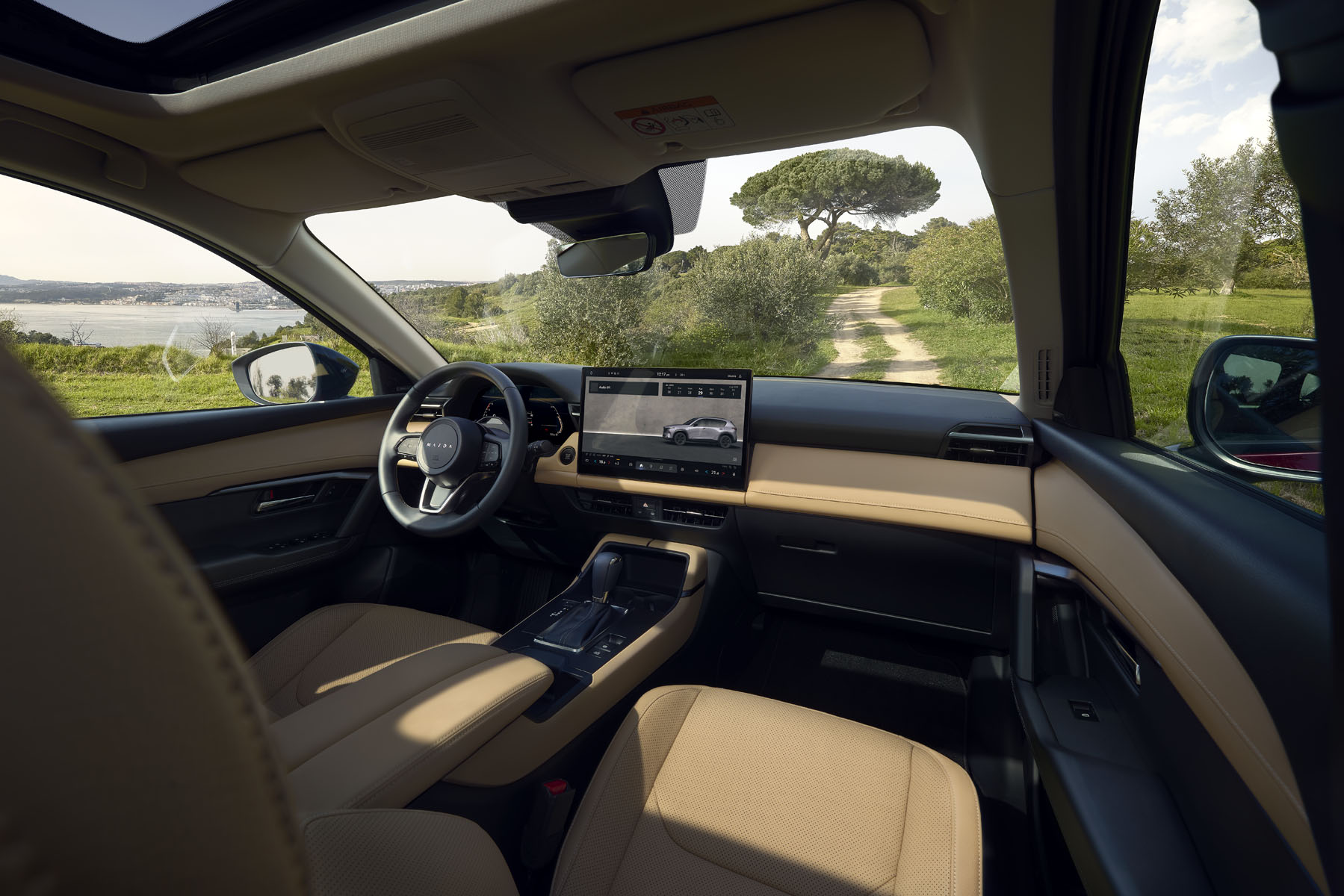
The new CX-5 strips all of that out. Physical climate controls, gone. The Commander knob, gone. The volume knob, gone. The steering wheel stitching, downgraded. Reviewers describe the interior materials as “hard, scratchy, cheap-feeling black plastic.” One Redditor who sat in one at a dealer put it bluntly: “It’s like sitting in a black hole. No character, nothing redeeming… just a void with a giant screen screwed into the middle.”
And the price? Up. The base model costs $940 more than the outgoing version, despite all the cost-cutting.
Then the CFO Said the Quiet Part Out Loud
I could have written this off as the natural drift that happens to most car brands over time. But then Mazda CFO Jeffrey Guyton gave an interview to Automotive News that made things painfully explicit.
Here’s what he said: “Simply, we put money where the customer is going to see it, and we’ve tried to find big cost efficiencies where the customer doesn’t value it as much or won’t see it.”
He described “many, many, many” cost cuts throughout the car but declined to detail most of them. He confirmed that the old steering wheel stitching “costs us more money”, so they changed it. He confirmed that physical climate controls were replaced with a touchscreen because software is cheaper to code than hardware is to manufacture.
Read that again. A CFO bragging about finding things customers “won’t see” so they can quietly cut them. That is the opposite of craftsmanship. That is the opposite of everything Mazda built its reputation on.
As one Reddit commenter in r/cars pointed out: “Typically announcing cost cuts to a product means a significant decrease in price. The new CX-5 is more expensive than the outgoing model, so why are they announcing this?” Good question.
Another nailed the identity crisis perfectly: “First they tried sporty but they couldn’t bring themselves to admit that Americans like lots of HP and torque down low. Then they started chasing Lexus, get 80% of a Lexus at 65% of the price. And now they are backing off that. Mazda just never quite gets it right. Except for the Miata.”
The Touchscreen Hypocrisy
This one stings the most. For years, Mazda was the brand that publicly crusaded against touchscreens. They cited their own research showing that drivers unintentionally torque the steering wheel and drift out of lane when reaching for a screen. They made physical controls a core brand differentiator. It was one of the reasons many of us chose Mazda over competitors.
Then they ripped out the rotary controller, the volume knob, all physical climate controls, and five shortcut buttons, replacing everything with a 15.6-inch touchscreen. Their VP of Operations had the gall to say: “Despite this large touch screen, we continue to believe in our safety philosophy.”
When Mazda’s own CFO tells us the switch was motivated by cost, not by user research or safety data, the safety defence falls apart. It’s cheaper to code software than to manufacture buttons. That’s the real reason.
And it’s not a theoretical problem. One CX-5 owner on the Mazdas247 forum reported that in hot weather, “the screen didn’t turn on due to high heat… no AC controls until the cabin cooled.” Their conclusion: “My next car won’t be a CX-5.” When your only interface to the air conditioning is a screen that fails in the exact conditions when you need AC the most, something has gone seriously wrong with the design philosophy.
Mazda used to be the brand that pushed back against industry trends when those trends were wrong. The MX-5 exists because Mazda was willing to build a pure, lightweight roadster when everyone else abandoned the format. That contrarian instinct was admirable. This is its opposite.
Volvo has already reversed course on touchscreen-only controls. Even Euro NCAP is starting to penalise cars that bury essential functions in screens. Mazda isn’t just following a bad trend, they’re arriving late to a party that’s already ending.
Paying More for Less: The Enshittification Pattern
There’s a word for what Guyton described, coined by Cory Doctorow: enshittification. The process by which a product that was once genuinely good gets gradually degraded. Not all at once, not in ways customers can easily articulate, but through a thousand small decisions that prioritise margin over quality.
Here’s what the new CX-5 delivers for that higher price tag. The 250hp turbo engine option has been eliminated. Fuel economy has actually gotten worse, from 28 combined to 26. The six-speed automatic has been retained while competitors have moved to eight-speed transmissions. Acoustic glass, which made the outgoing model noticeably quieter than competitors, has been dropped. One owner of a 2025 CX-5 called the loss of acoustic glass “a deal breaker”, noting their current model “is so much quieter than the CR-V and Bronco Sport we compared it to.”
Multiple commenters in the CX-5 subreddit pointed out that these cost cuts were designed long before tariffs arrived: “This car was designed loooong before tariffs arrived. So no.” Tariffs may be the convenient excuse, but the European spec retaining double-glazed windows and getting a mild hybrid that the US doesn’t suggests the cuts are strategic, not emergency measures.
Perhaps the most telling reaction came from a 2017 CX-5 owner who test drove the new model: “I literally drove my mint 2017 GT to the dealer the other day to drive the 2026. I was nice to the sales guy and just said, maybe when the hybrid comes in I’ll think about upgrading. But I was smiling on the way home.” He was smiling because his nine-year-old car felt better than the replacement.
I’m Not Alone in This
What struck me most when reading the reactions was how many people expressed the exact same sentiment. This isn’t one person being picky. The r/cars thread about Guyton’s cost-cutting remarks had over 200 comments, overwhelmingly negative. One commenter wrote: “That does not inspire confidence in the product at all. The launch of the new CX-5 is turning into a bit of a PR nightmare for Mazda.”
A CX-70/CX-90 owner went further: “The only premium thing about it is the depreciation. I own one, the car has so many problems.” Consumer Reports dropped Mazda from the top 10 to 14th in their brand rankings, and the CX-90 scored 15 out of 100 for reliability with 11 NHTSA recalls on the PHEV version.
The Autopian’s review comment section summed up what many feel: “This is not the Mazda we know with a driving ethos… a company that makes better driving typical appliances.”
On the Mazdas247 forum, the largest dedicated Mazda community, current owners are actively choosing to buy the outgoing 2025 model rather than wait for the 2026. One 2023 CX-5 Turbo owner wrote: “No turbo, no dice. I am considering trading my 2023 CX-5 turbo on a new 2025 CX-5 turbo.” Another long-time owner was blunt: “No physical buttons = no chance of a purchase… no future Mazda for me if they don’t return the interior to something like what I have now.” An MX-5 owner added: “I love my MX-5 but it looks like I’ll have to go elsewhere for family vehicles.” That last one hits close to home. It’s exactly how I feel.
Auto Express noted that the stripped-down interior now “looks and feels far closer to Chinese rivals like the Omoda 7, rather than the previous CX-5.” Autoblog called the direction “anti-Mazda, frankly” and noted that “forums are already rife with criticisms from current Mazda owners who refuse to upgrade to the 2026 CX-5.”
Why This Matters to Me Personally
Between the CX-80, the MX-5, and a classic Mazda, I have three of their cars. My family has owned Mazdas for nearly five decades. I’ve been an evangelist. When friends ask what car to buy, I’ve told them to consider Mazda, because the driving dynamics, the interior quality, and the value for money were genuinely hard to beat at the price point.
The CX-5 was the car I would have recommended for someone wanting a practical family SUV without feeling like they’d compromised. Now I’d have to caveat that. Now I’d have to say: it used to be great, but the latest one has issues, and the CFO has confirmed they’ve made cost cuts they’re hoping you won’t notice.
That’s not a recommendation I can make with a straight face.
A Note to Mazda
The diesel CX-80 is still a great car. The MX-5 remains one of the purest driving experiences available at any price. Mazda still makes things worth buying.
But the direction matters. The philosophy matters. When the person controlling the finances says openly that the goal is to cut costs in ways customers won’t detect, the product will keep drifting in that direction, because the incentive structure now points there.
The brands that stay great are the ones that treat quality as non-negotiable even in places nobody’s looking. That’s what Jinba Ittai was supposed to mean. It was never just a tagline.
I hope Mazda remembers that. Because right now, the new CX-5 suggests they’re forgetting it, and when it’s time to replace my CX-80, I’ll be looking at what the brand has done in the intervening years before I make any decisions.
Loyalty is earned by doing the right thing consistently. It’s lost the same way.
Related




Leave a Reply