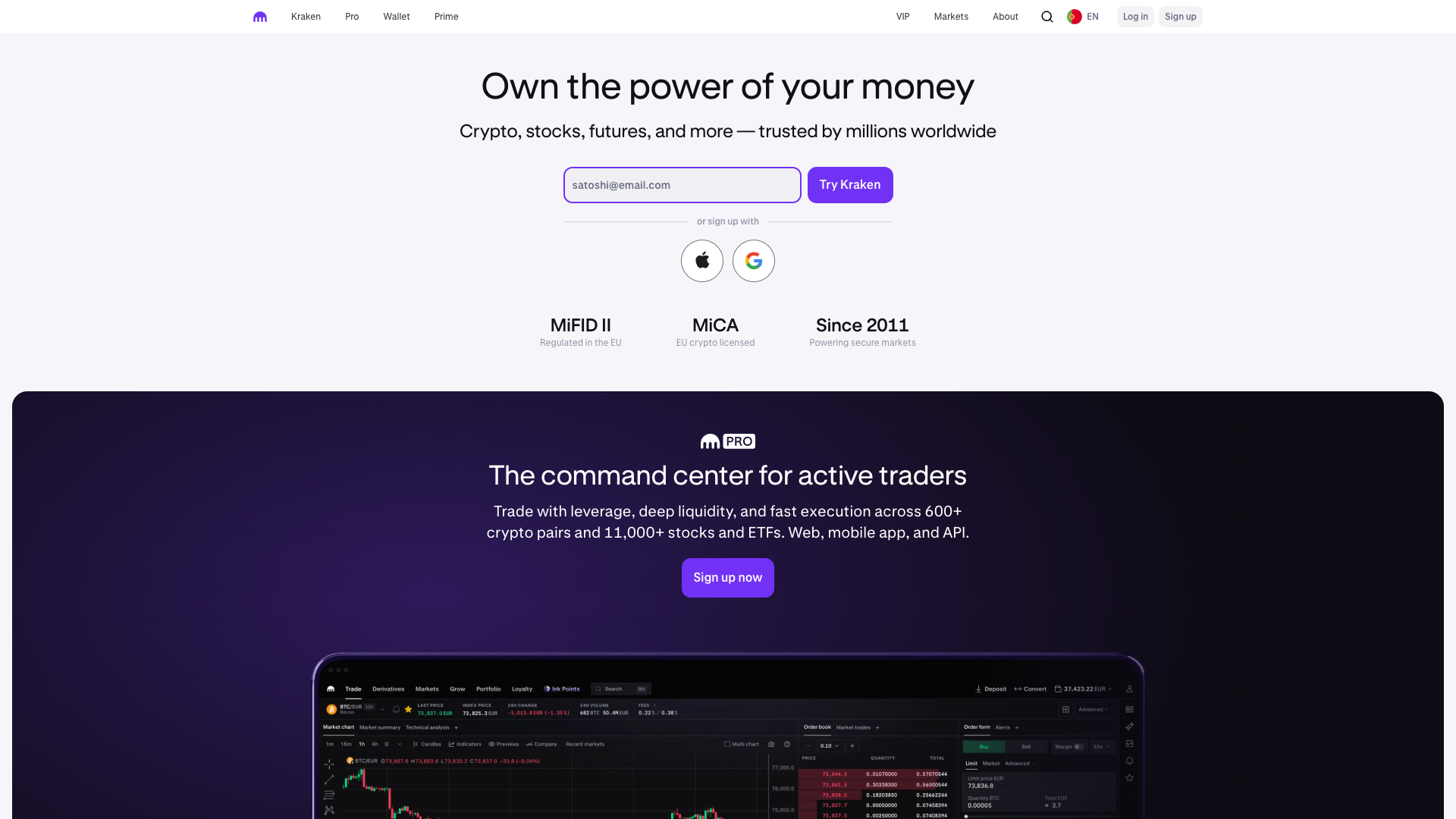
Kraken and Coinbase are the two exchanges I’d use to buy Bitcoin in Europe. Both hold a MiCA license and take SEPA transfers.
The Two Picks
Kraken
Kraken is my first pick for regular buyers. The Central Bank of Ireland granted it a MiCA license in June 2025, which lets it serve customers across the EEA. Spain’s central bank registered it as a virtual asset service provider in September 2023.
Instant buys and recurring buys carry a 1% trading fee, and custom orders carry 1.5%. Spread and payment-method fees, such as those on cards and Apple Pay or Google Pay, come on top. Once you’re comfortable, Kraken Pro takes spot orders at 0.40% maker and 0.80% taker on the lowest tier, with lower rates as your volume grows. Those figures come from Kraken’s own fee schedule, so check the page before you fund anything.
On security, Kraken supports FIDO2 passkey two-factor authentication and doesn’t use phone or SMS recovery. Adding a new withdrawal address requires an email confirmation, and a temporary Global Settings Lock freezes changes to your account. My full Kraken review goes through the rest.
Coinbase
Coinbase is the easier on-ramp for a first purchase. Luxembourg’s financial regulator, the CSSF, granted its MiCA license in June 2025, and the license passports across the EU through Coinbase Luxembourg S.A. Coinbase’s Spain page says the company is registered with the Bank of Spain and that bank-transfer top-ups are free. For Spain, its help center lists SEPA transfers (one to three business days) and 3D Secure card payments (instant).
Coinbase’s fee schedule is the part to read carefully. It combines a spread with a fee that varies by payment method and order type, so the total on a given purchase depends on how you pay. Check the exchange’s own fee page for the figures you plan around. More in my Coinbase review.
Regulatory record
Coinbase has two fines from the Central Bank of Ireland on its record. In November 2025 the bank fined Coinbase Europe EUR 21,464,734 for transaction-monitoring failures that ran from April 2021 to March 2025. In October 2026 it fined Coinbase Ireland EUR 3,252,618 for safeguarding and outsourcing breaches under the E-Money Regulations between November 2020 and August 2025. The settlement dates from October 21, 2026, and Irish Legal News reports it still awaits High Court confirmation. Both penalties concern compliance processes.
Coinbase also disclosed a data breach to the SEC in May 2025: overseas support staff were paid to pull customer data from internal systems. Its filing said passwords and private keys weren’t compromised and that the staff never had access to customer funds. The details are in its SEC filing.
I found no EU enforcement action against Kraken. In the US it settled with the Treasury’s sanctions office in November 2022 for about $362,000 over Iran sanctions violations, and with the SEC in February 2023 for $30 million over its staking program.
Which one to choose
Pick Kraken if you plan to buy regularly and want the lower fees on Kraken Pro. Pick Coinbase if you want the simplest first-time flow and a bank transfer into it. Opening both gives you a fallback when a payment method or transfer is slow. The longer head-to-head is in Kraken vs Coinbase, and the best cryptocurrency trading apps covers the wider field.
Binance no longer belongs on this list. From July 1, 2026 it stopped onboarding new EU users and limited services to position management and withdrawals, after it failed to obtain a MiCA license. Its notices to users named France, Italy, Spain and Poland among the affected countries, according to Unchained.
Readers in Portugal
Kraken’s SEPA support article lists Portugal as a supported country, and its Portuguese-language fee page says the Irish entity is regulated by the Central Bank of Ireland. I found no Portugal-specific registration for either exchange. Portugal wrote MiCA into national law with Law 69/2025 of December 22, with the Bank of Portugal handling prudential supervision and the CMVM handling conduct. Check the country list on the exchange’s own sign-up page before you start.
Why Regulation Matters Now
MiCA is in force, and its transition regime ended on July 1, 2026. An exchange serving EU customers now needs authorization from a national regulator in one member state, which then covers the whole bloc. ESMA allows non-EU firms to serve EU clients only under a narrow reverse-solicitation exception. The question to ask is who licensed the exchange. For Kraken the answer is the Central Bank of Ireland, and for Coinbase it’s the CSSF in Luxembourg. The CSSF register entry itself is worth a look if you want to confirm Coinbase directly.
What an Exchange Costs You
Three charges add up on every purchase: the trading fee, the spread between the buy and sell price, and the payment-method fee. Cards usually cost more than bank transfers. Coinbase’s Spain page says bank-transfer top-ups are free, and Kraken supports both SEPA and Instant SEPA (SCT Inst) for faster funding.
Check Kraken’s fee schedule and funding pages for any SEPA deposit fee and for the card and Apple Pay options in your country. For Coinbase, read the fee page for your country and compare the quoted total on a test purchase before committing a larger amount.
If you want a quick sanity check, buy the smallest amount the exchange allows, then compare what you paid with the amount of Bitcoin you received. The gap between the two is your real cost.
Opening an Account
Sign up with an email address and a strong, unique password. Then verify your identity: you’ll upload a government-issued ID and complete a selfie or video check. Both exchanges must collect this under European anti-money-laundering rules. Approval time varies, so start the verification before you need the coins.
Turn on two-factor authentication before you deposit anything. At Kraken, a passkey is the strongest option. At Coinbase, use the strongest method the account settings offer. An authenticator app beats SMS, and a hardware key beats an app. Write down any recovery codes and keep them off your computer.
Use the affiliate links on this page (Kraken and Coinbase) and I earn a commission at no cost to you.
Making a Deposit
Bank transfer is the default recommendation. In Europe that means SEPA. Coinbase lists one to three business days for a standard transfer, and Kraken supports SEPA Instant for faster funding. Open the deposit screen, choose EUR, and copy the exchange’s bank details exactly, including any reference code. A transfer with a missing or wrong reference can sit unmatched for days.
Cards are quicker and pricier. Coinbase accepts 3D Secure cards. Kraken lists card and Apple Pay or Google Pay purchases, with fees on top of the 1% trading fee, though availability varies by country. If a bank blocks the first transfer to a crypto exchange, call the bank and say the payment is yours. Some banks are friendlier than others, which is why a crypto-friendly bank helps if you buy often.
Buying Bitcoin
Both exchanges give you two ways to buy. The simple screen takes an amount in euros and shows the Bitcoin you’ll receive. The advanced screen shows the order book and lets you place market, limit and stop orders. The simple screen costs more than the advanced one.
For a first purchase, use the simple screen with a small amount. Check the total before you confirm, because the quote includes the spread. After the order fills, the Bitcoin appears in your account balance.
Recurring buys spread your entry price over time. Kraken and Coinbase both let you schedule a fixed euro amount daily, weekly or monthly. Kraken charges its 1% trading fee on recurring buys. You stop trying to time the market and pay the same percentage fee each time.
Bitcoin ATMs are also an option in Europe. I’d skip them: an online exchange costs less.
Storing Your Bitcoin
Leaving coins on an exchange is the easiest choice. The exchange holds the keys, so you depend on it for access and for safekeeping. Kraken publishes proof-of-reserves reports from an independent accounting firm, which Kraken describes as an agreed-upon-procedures engagement and not a full audit. Read Coinbase’s security page for its proof-of-reserves, cold-storage and insurance disclosures before leaving a large balance there.
Self-custody puts the keys in your hands. A hardware wallet is the usual choice for amounts you’d hate to lose: buy it directly from the manufacturer, write the seed phrase on paper, and store two copies in separate places. Never type a seed phrase into a website or photograph it. Withdraw a small test amount first, confirm it arrives, then move the rest.
At Kraken, the first withdrawal to a new address requires an email confirmation, so plan for that step when you move coins.
Selling Your Bitcoin
Choose Sell on the simple screen, or place a limit order on the advanced one if you want a specific price. You can then withdraw the euros to your bank by SEPA. Compare the quote on both screens before selling a large amount, as with buying.
Keep a record of every purchase, sale and transfer. In most European countries a sale, or a swap into another coin, is a taxable event, and the exchange’s transaction history is the starting point for your return.
Crypto Taxes
Tax rules differ by country. These guides walk through the filing for each:
If you trade often, tax software turns exchange exports into a report. See the best crypto tax software for the options that handle European forms.
The Bottom Line
Open an account at Kraken if you plan to buy regularly, or at Coinbase if you want the simplest first-time flow. Fund by SEPA, buy a small amount first, turn on the strongest two-factor option, and move anything you can’t afford to lose into a wallet you control. Before you pay a fee you haven’t seen, read the exchange’s own fee page.
Related





Leave a Reply