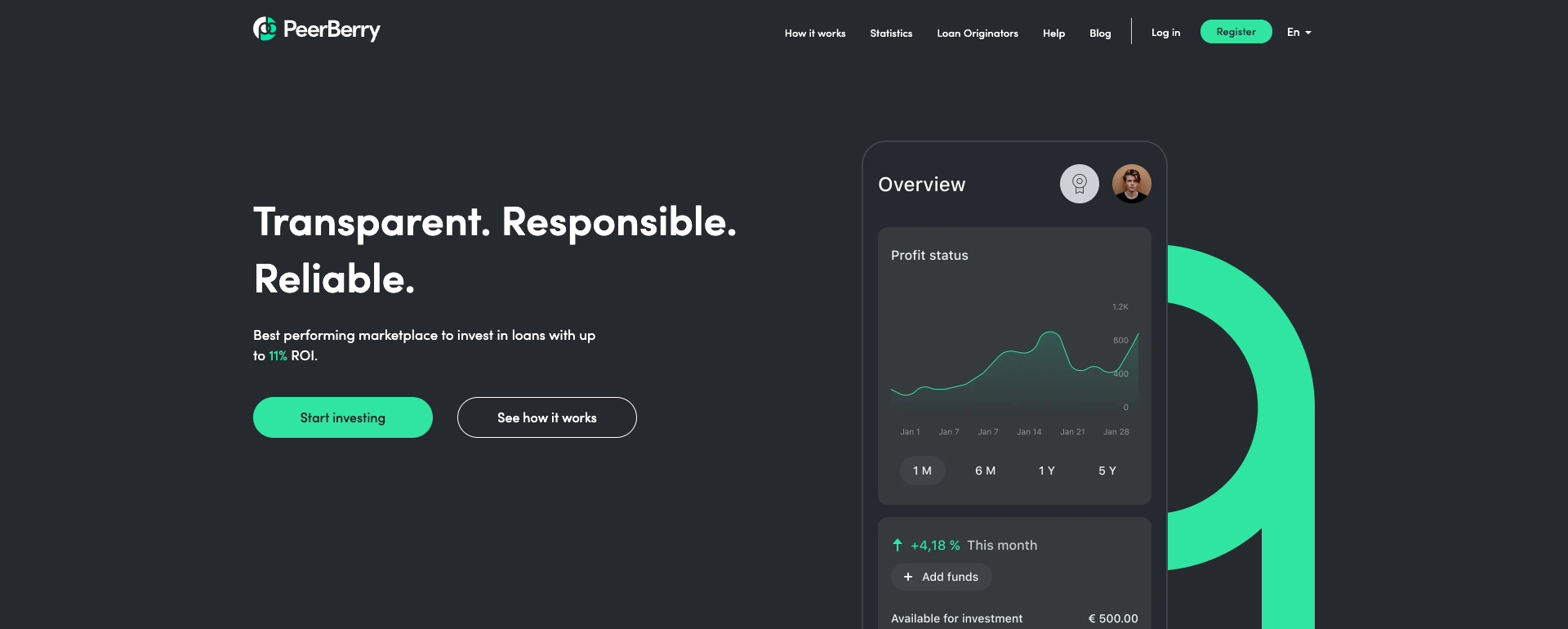
PeerBerry is a P2P lending marketplace that Aventus Group, a Lithuanian lending group, launched in 2017. You invest in short-term consumer loans, business loans and real estate loans from 36 loan originators in 17 countries, and every loan carries a 60-day buyback guarantee. By the end of September 2026, investors had put €3.55 billion through the platform and earned €58.8 million in interest.
I first reviewed PeerBerry in 2020 and have kept this review updated since. Here’s where it stands in 2026.
My Verdict
PeerBerry is one of the safest unregulated P2P platforms in Europe, and its track record is the reason. When the war in Ukraine froze part of its portfolio in 2022, its partners Aventus Group and Gofingo Group repaid every war-affected loan, €51.4 million including interest, with the last payment in December 2024. PeerBerry reports that its investors have never lost money on a loan.
The trade-offs are real, though. PeerBerry itself holds no investment or crowdfunding license, so your protection is contractual rather than regulatory. Most of its originators belong to one group, and its single largest originator is a real estate developer. Real returns land around 9% once idle cash is counted, below the 11% headline. I’d treat it as one part of a P2P allocation, ideally next to a regulated platform like Mintos (see my Mintos review).
PeerBerry at a Glance
| Founded | 2017, by Aventus Group |
| Operator | Peerberry d.o.o. (registered in Croatia, office in Vilnius, Lithuania) |
| Regulation | No investment or crowdfunding license |
| Average Returns | ~11% historical average (PeerBerry figure), 9.1% median for tracked investors |
| Buyback Guarantee | Yes (60 days), plus a group guarantee |
| Secondary Market | Yes, since January 2026 (no fees) |
| Auto-Invest | Yes |
| Min. Investment | EUR 10 |
| Fees | None for deposits, withdrawals or the secondary market |
| Loan Originators | 36 in 17 countries |
| Loan Types | Short-term, long-term, business, real estate, leasing |
| Total Invested | EUR 3.55 billion+ |
| Verified Users | 123,000+ |
Figures as of October 2026, from PeerBerry’s statistics page and September 2026 report.
Is PeerBerry Safe?
Safety on PeerBerry rests on three things: the buyback guarantee, the group guarantee behind it, and the financial health of the companies that issue the loans. There’s no regulator or investor compensation scheme in the picture.
Buyback and group guarantee
Every loan has a buyback guarantee: if a borrower is more than 60 days late, the loan originator buys the loan back in full with accrued interest. That promise is only as good as the originator, so Aventus Group and Gofingo Group have also signed cross-guarantees. If one of their companies goes insolvent, the others cover its obligations to investors.
PeerBerry’s own help page adds that both guarantees “may be affected in case of a force majeure event.” That clause got tested in 2022, when the war shut down lending in Ukraine and Russia. Instead of invoking it, the two groups repaid the war-affected loans in monthly installments over almost three years until all €51.4 million was back with investors. Few platforms caught in the same situation did that.
Regulation
PeerBerry spent 2019 to 2021 in a licensing process with the Latvian regulator, then withdrew the application and moved its operations to Peerberry d.o.o. in Croatia in October 2021. A sister platform with the same shareholders, Crowdpear, holds an EU crowdfunding license from the Bank of Lithuania. PeerBerry itself doesn’t. Your claims rest on the user agreement and the originators’ guarantees, and nobody supervises how the platform runs.
Concentration risk
Aventus Group founded PeerBerry, and its CEO, Andrejus Trofimovas, has owned 50% of the platform since 2022. Aventus supplies 24 of the 36 originators. The group reported €95.7 million in net profit for 2025 and €225.7 million in equity, according to figures published on PeerBerry’s blog. That’s a solid cushion, but those are company-reported numbers, and the platform’s fortunes are tied closely to one group.
The other risk is less obvious. According to PeerBerry’s statistics page in October 2026, real estate loans make up about 52% of the outstanding portfolio, and Si Baltic, part of SIB Group, is the single largest originator at roughly 28%. If you only want short consumer loans, set your Auto Invest filters accordingly.
PeerBerry Returns
PeerBerry quotes a historical average annual return of about 11%. Interest rates on new loans in 2026 are lower: in June, several short-term originators moved up to 10%, and SafeCredit business loans to 8.5%. The loyalty program adds up to 1% on top (see below).
Independent data puts real returns a bit lower. P2P Dash, which tracks real investor portfolios, showed a median XIRR of 9.1% across 335 PeerBerry portfolios in October 2026, with the middle half of investors earning between 8.1% and 10.1%.
The gap is mostly cash drag. The most common complaint in PeerBerry’s Trustpilot reviews (4.0 from 264 reviews) is money sitting idle when loan supply runs short. Supply has grown in 2026, with investors funding €50.5 million in loans in September alone, but check your uninvested balance every few weeks.
How PeerBerry Works
PeerBerry is a loan marketplace, similar to Mintos. Loan originators list loans they’ve already issued, and you buy a share of them. Short-term loans usually run around 30 days and pay principal and interest in one payment at the end, known as a bullet loan. Long-term loans repay monthly on an annuity schedule.
Loans currently come from countries including Lithuania, Spain, South Africa, Poland, Moldova, the Philippines, Kazakhstan, Colombia, Mexico, Argentina, Romania, Peru, Australia, the Czech Republic, Kenya and Canada. The originator groups are Aventus Group, Gofingo Group, SIB Group, Lithome and Litelektra, and each originator has a profile page on PeerBerry with its financial statements.
Late loans keep earning interest until the borrower pays or the originator buys the loan back.
Auto Invest
Auto Invest reinvests your balance in new loans that match your criteria. You can pause or change it any time.
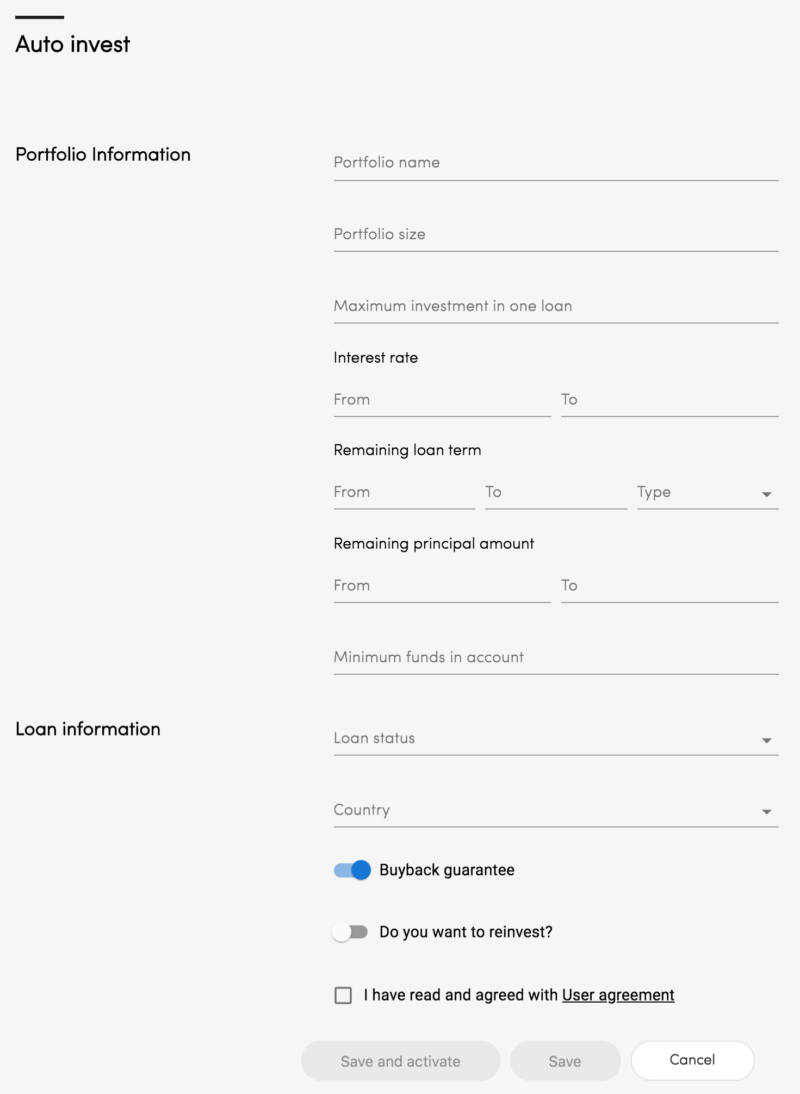
The main settings are:
- The total amount to invest and the maximum per loan.
- Interest rate and remaining loan term.
- Loan type, country and loan originator.
- Loan status (current or late).
- A minimum balance to keep uninvested.
The originator and loan type filters are where you control concentration, so it’s worth setting them rather than leaving everything open.
Loyalty program
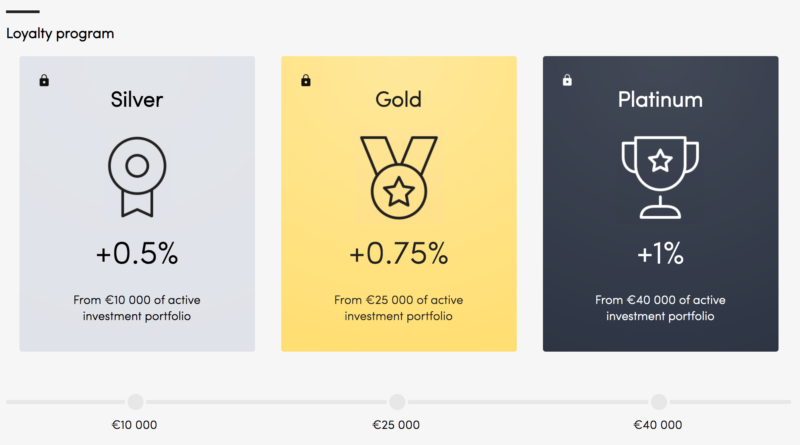
Investors with a larger active portfolio earn a bonus on new investments:
- Silver: from €10,000 active portfolio, +0.5%
- Gold: from €25,000, +0.75%
- Platinum: from €40,000, +1%
A Silver investor buying a 10% loan earns 10.5%. The bonus doesn’t apply to loans bought on the secondary market.
Secondary Market and Withdrawals
For years the main drawback of PeerBerry was the lack of a secondary market. That changed on 15 January 2026, when PeerBerry launched one. The rules:
- No fees for buyers or sellers.
- You can sell at the remaining value or at a discount of up to 50%.
- You sell whole investments only, no partial sales.
- Offers stay listed for 14 days, then cancel automatically.
- Loans bought on the secondary market keep the same buyback and group guarantees.
- It works on desktop only for now.
Liquidity depends on other investors wanting your loans, so treat it as an exit option rather than instant access.
Withdrawals have no fee. Requests are processed the same or next business day, and the money can take up to two more working days to reach your bank. The limit is €15,000 per transaction, and funds go back to the bank account you deposited from.
Opening an Account
Anyone 18 or older can join, apart from citizens of countries on the FATF and EU high-risk lists. Companies can open accounts too. After registering, you verify your identity with a passport or ID card through an online check, then fund the account by SEPA transfer in euros. You can start with €10.
PeerBerry doesn’t withhold tax. You declare the income where you’re tax resident, and the platform generates a tax statement for any date range. My guide to P2P lending taxation covers how that works.
Who Runs PeerBerry
Peerberry d.o.o. is registered in Zagreb and run from Vilnius by CEO Arūnas Lekavičius. Besides Andrejus Trofimovas, the shareholders listed in 2022 were Vytautas Olšauskas and Ivan Butov with 25% each. When I first reviewed the platform, the team answered my questions in detail and quickly, and PeerBerry still publishes monthly portfolio reports and originator financials on its blog.
Pros and Cons
Pros:
- Every war-affected loan repaid in full, with interest.
- Buyback guarantee on every loan, backed by group guarantees.
- No fees anywhere on the platform.
- Secondary market since 2026.
- Loyalty bonus of up to 1%.
Cons:
- No investment or crowdfunding license, and no investor compensation scheme.
- Heavy reliance on Aventus Group.
- A large share of the portfolio sits in real estate loans from one developer.
- Cash drag pulls real returns below the headline rate.
How Does PeerBerry Compare?
- Mintos vs PeerBerry
- PeerBerry vs Robocash
- Bondora vs PeerBerry
- PeerBerry vs Lonvest
- Nectaro vs PeerBerry
- Afranga vs PeerBerry
If you want a second platform to spread your risk, see my list of PeerBerry alternatives, or look at Income Marketplace.
Frequently Asked Questions
Is PeerBerry safe?
PeerBerry has one of the best records among unregulated P2P platforms. Every loan has a 60-day buyback guarantee backed by group guarantees, and its partners repaid all €51.4 million of war-affected loans with interest. It isn’t licensed, though, so your protection depends on the loan originators, mainly Aventus Group.
Is PeerBerry regulated?
No. PeerBerry is operated by Peerberry d.o.o. in Croatia and doesn’t hold an investment or crowdfunding license. Its sister platform Crowdpear holds an EU crowdfunding license from the Bank of Lithuania.
Does PeerBerry have a secondary market?
Yes. PeerBerry launched a secondary market in January 2026. There are no fees, and you can sell whole investments at their remaining value or at a discount of up to 50%.
Do I get interest on late loans?
Yes. Late loans keep earning interest until the borrower repays or the loan originator buys the loan back.
Do I pay taxes on my returns?
PeerBerry doesn’t deduct tax. You declare the income in your country of tax residence, and you can download a tax statement from your account.
Who can invest in PeerBerry?
Anyone 18 or older who isn’t a citizen of a country on the FATF or EU high-risk lists, plus companies. Deposits are SEPA transfers in euros, starting from €10.
Conclusion
PeerBerry has done what matters most for an unregulated platform: it paid investors back through a war. The secondary market fixed its biggest weakness, and there are still no fees. The risks are the lack of a license and how much depends on Aventus Group, so size your allocation with that in mind.
Summary
PeerBerry has a long record of honoring its 60-day buyback, repaid all EUR 51.4M of war-affected loans, and launched a secondary market in 2026. The trade-offs are no license of its own and heavy concentration in Aventus Group lenders. Real returns sit nearer 9% than the advertised 11%.
Pros
- 60-day buyback with a strong repayment record
- Group guarantees from its main lenders
- Secondary market launched in 2026
- No investor fees
- Auto Invest and loyalty bonus
Cons
- Not licensed or regulated itself
- Heavy concentration in Aventus Group lenders
- Real returns below the 11% headline
- Group guarantee has a force-majeure clause
Related




Hi Jean, First and foremost many thanks for the very interesting content you continue publishing re P2P Platforms.
I’m completely new to this asset class and have been trying to educate myself before allocating some of my capital. With respect to PeerBerry, in one of your posts you included a link to a site where one could purchase Aventus Groups’ financial statements. I have tried that link but I landed at a site that is no longer operational. Could you advise where one could find the groups’ statements? Many thanks in advance.
I would recommend Peerberry to anyone tbh.