Most people looking to buy property in Spain go straight to Idealista or Fotocasa and start scrolling. Nothing wrong with that, but there’s another route that almost nobody talks about: judicial auctions.
In Spain, thousands of properties end up being auctioned off through the courts every year. Some are bank repossessions from the 2008 housing crash, but plenty are from more recent foreclosures, business bankruptcies, and debt enforcement proceedings. This isn’t a historical curiosity. It’s an ongoing market, and the deals can be significant.
I got into this by accident when some apartments and parking spots in my own building went up for auction. What followed was an education in how the system works, and I walked away genuinely impressed by the discounts available.
What Are Spanish Judicial Auctions?
When a debtor in Spain can’t pay their mortgage or other secured debts, the creditor (usually a bank) can petition the court to seize and sell the asset. The sale happens through a public auction, open to anyone who meets the requirements. These are called subastas judiciales.
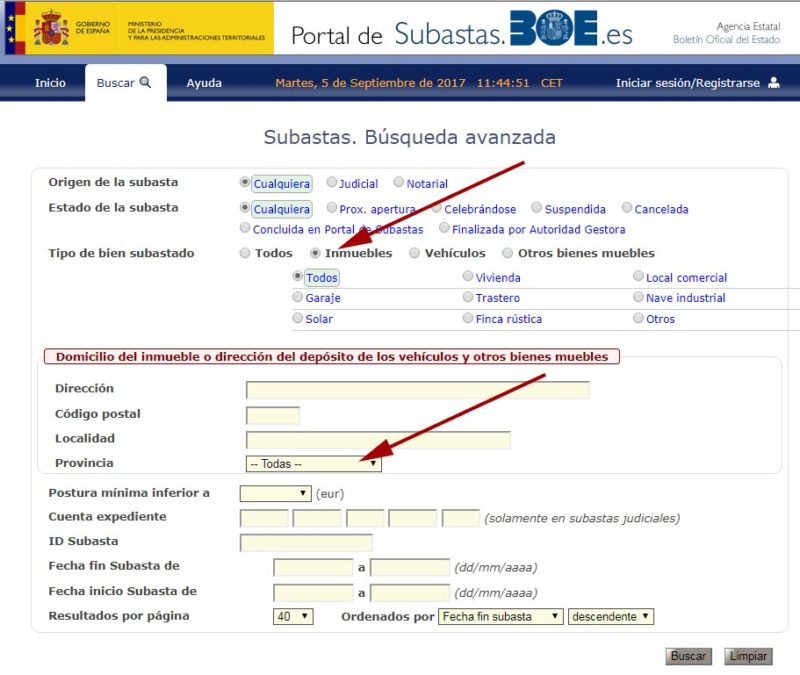
The entire process runs through the Portal de Subastas del BOE (Boletín Oficial del Estado), the official government auction platform. Everything is done online. You can browse current auctions, filter by province, asset type, and price range.
What Can You Buy?
Most people think of apartments, but the range is wider than that:
- Residential property (apartments, houses, villas)
- Commercial premises (offices, retail spaces, warehouses)
- Parking spaces and storage units
- Land (urban and rural plots)
- Vehicles (cars, motorcycles, boats)
- Other movable assets (machinery, equipment)
Properties are concentrated in the regions that were hit hardest by the housing bubble, though you’ll find auctions across all of Spain:
- Andalucía
- Valencia (Costa Blanca area)
- Catalonia
- Madrid
How to Participate: Step by Step
The process is more straightforward than you might expect, but there are a few bureaucratic hoops to jump through first.
1. Get a NIE
You need a Número de Identidad de Extranjero if you’re not Spanish. This is the standard tax identification number for foreigners in Spain. If you’re already a resident, you’ll have one. If not, you can apply through the Spanish police or a consulate.
2. Get a Digital Certificate
To register on the Portal de Subastas and place bids, you need a certificado digital issued by the FNMT (Fábrica Nacional de Moneda y Timbre). You can request it online at sede.fnmt.gob.es and then verify your identity in person at a government office (Hacienda, Social Security, or your local council). The certificate is free and valid for several years.
3. Register on the Portal de Subastas
Head to subastas.boe.es and create an account using your digital certificate. Once registered, you can browse all active auctions.
4. Put Down the Deposit
For each lot you want to bid on, you need to transfer a deposit of 5% of the asset’s assessed value. This is done via bank transfer to a court-designated account. The deposit is refunded if you don’t win. If you want to bid on multiple items, you’ll need a separate deposit for each one.
5. Place Your Bid
Bids are placed online through the portal. Each auction has a closing date, but if a new bid comes in near the deadline, the auction extends by one hour. This can go on for a while, as I’ll explain below.
6. After Winning
If you’re the highest bidder, you have 20 days to pay the remaining balance. The court then issues a decree awarding you the property, which you take to the notary and then register at the Registro de la Propiedad (Land Registry).
My Experience: Bidding on Parking Spots
I found out about auctions when my neighbours told me that some apartments and parking spots in our building were being auctioned off. The original developers of the apartment block had gone bankrupt several years earlier, and the bank was finally selling.
I decided to participate by bidding on a few parking spots, mostly to learn how things work and see what kind of discount I could get.
It was quite an exciting experience. When you make a bid, you send over the 5% deposit via bank transfer, then place your bid which must be higher than everyone else’s. You get notifications whenever your bid is superseded.
Each auction has a set closing time, but that doesn’t mean things end there. Whenever there’s a new bid, the end time extends by an hour. In my case, two of the items I bid on dragged on for another 12 hours, including overnight. Clearly there were some motivated bidders who stayed up all night to get a parking spot.
When bidding, you also have the option of keeping your bid in queue once the auction closes. This means that if the highest bidder fails to pay within 20 days, the second-highest bidder gets the chance. The process continues until a paying bidder is found. The bidder who doesn’t pay loses their deposit.
The Results
Parking spot 1
- Assessed value: €20,334
- Winning bid: €16,967 (17% discount)
Parking spot 2
- Assessed value: €21,103
- Winning bid: €14,751 (30% discount)
Parking spot 3
- Assessed value: €17,649
- Winning bid: €17,424 (1% discount)
Some nice discounts there. Parking spot 2 went for 30% below its assessed value. On the other hand, parking spot 3 sold at essentially its full value, which surprised me given that it was just as good as the other two.
The apartments in our building showed even bigger savings in absolute terms:
Apartment 1
- Assessed value: €621,615
- Winning bid: €468,807 (25% discount)
Apartment 2
- Assessed value: €652,315
- Winning bid: €490,517 (25% discount)
Both apartments went for 25% below their assessed value. On properties worth over half a million euros, that’s a saving of over €150,000.
Risks and Disadvantages
This isn’t free money. There are real risks you need to understand before bidding.
You need liquidity. If you win, you have 20 days to pay the full remaining amount. Getting a mortgage approved in that timeframe is nearly impossible. You need the cash ready before you bid. If you fail to pay, you lose your deposit.
You might not be able to inspect the property. Some auctioned properties are occupied, and you may not get access before bidding. You could be buying blind.
Occupied properties (okupas). This is a real risk in Spain. Some foreclosed properties have squatters or former owners who refuse to leave. Evicting them can take months or even years through the Spanish legal system. Always check the auction details for notes about occupation status.
Hidden debts. The property might come with unpaid community fees (gastos de comunidad), local property taxes (IBI), or other charges. The new owner can be liable for these. Check with the community administrator and the local council before bidding.
Additional costs. On top of the winning bid, you’ll pay:
- ITP (Impuesto de Transmisiones Patrimoniales), the transfer tax, which varies by region (typically 6-10%)
- Notary fees
- Land Registry fees
- Potentially a lawyer if you want professional help navigating the process
Renovation costs. Many auctioned properties have been empty for years and need work. Budget for this.
Practical Tips
Based on my experience, here’s what I’d recommend:
- Start small. Do what I did and bid on something low-value like a parking spot or storage unit first. Learn the mechanics before committing to a €400,000 apartment.
- Check the Registro de la Propiedad. Before bidding on any property, get a nota simple from the Land Registry. This will show you all charges, liens, and encumbrances on the property.
- Talk to the community administrator. Ask about outstanding community fees and any known issues with the property.
- Budget for total cost, not just the bid. Add 8-12% on top of your winning bid for taxes, fees, and registration costs.
- Have your finances ready. Don’t bid unless you can pay the full amount within 20 days. The deposit you lose isn’t trivial.
- Read the auction details carefully. The court filing (edicto) contains important information about the property’s condition, occupation status, and any special terms.
Where to Learn More
The main platform is the Portal de Subastas del BOE. It’s entirely in Spanish, but the interface is straightforward enough to navigate with a translator if needed.
If you want to go deeper, Subastanomics offers courses specifically about investing through Spanish judicial auctions. Their content is in Spanish. I have no relationship with them, but the free material on their site is worth a look if you’re serious about this.
Have you tried buying through a Spanish auction? I’d be curious to hear about your experience in the comments.
Related



Thanks for this useful information.
I am considering participating in a subasta.
Do i have to have a bank account with one of these bank (see link) or every spanish IBAN will do?
https://www2.agenciatributaria.gob.es/static_files/common/internet/dep/aplicaciones/ov/padeposx.html?boe
You need an account with one of the banks in the list. I used Bankia.
Very interesting read. I have experience doing exactly the same in the US, just with a bank account. I wish you would have elaborated who is eligible to invest – do I need o be a resident? Can I do this just by being online? Will certainly do a lot more research on this topic, Real estate isn’t cheap anywhere in Spain – so it’s quite a nice deal to purchase foreclosed properties at a discounted price! Thanks,
Chris
I think what you would need is a NIE number, I’m not sure if you have to be a resident, I would assume it’s open to everyone.