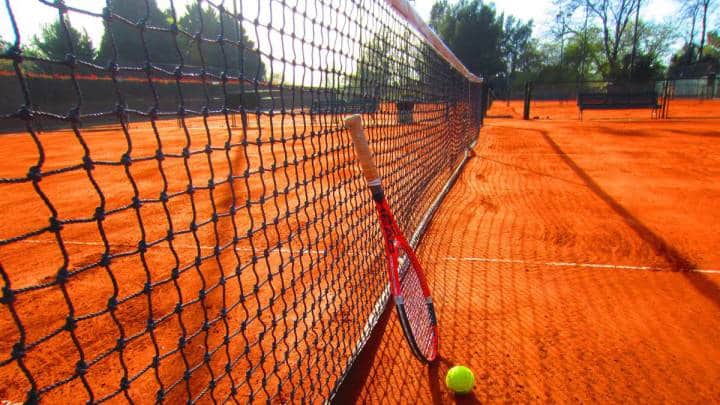
I started training tennis in May 2019 as a way to complement my padel game. It might seem counterintuitive, but it turned out to be a good decision. A tennis racquet gives you a much more responsive feel on the ball, which makes it easier to sense how your movements are actually affecting it. Skills that were hard to internalise through padel started to click much faster on a tennis court.
In any case, I’m enjoying the process of learning a new sport and challenging myself both physically and mentally. This post collects everything I’ve picked up along the way: lessons from training, how I use video to analyse my strokes, and the online resources I’ve found most useful.
Lessons Learned
Walking Step vs Open Stance
The walking step is penetrating in nature, while the open stance is a side step. With an open stance there is no forward movement, which makes it great for baselines and counter punchers — useful when you have no intention of moving forward.
The walking step, on the other hand, lets you get to the ball and take it on the rise while moving forward. Both stances have a role in the game, but you need to master the walking step if you want to move forward in a threatening way.
Chess as a Complement
Many tennis pros play chess as a way to relax and sharpen their focus and tactical thinking. As an amateur, you can get the same benefits. The parallel is real: anticipating your opponent, managing risk, staying calm under pressure. It’s worth picking up.
Learning to Juggle Three Balls
A surprisingly useful drill for improving visual perception on court is learning to juggle. I always assumed it was too difficult, but following one of Essential Tennis’s tutorials I managed it with a few hours of practice. It trains your eyes to track moving objects, which directly helps with reading the ball.
Missing Shots is Part of the Game
As a beginner, it is easy to get frustrated with yourself when you miss shots that seemed simple. The reality is that most tennis rallies end with unforced errors at every level. Accepting this early saves you a lot of wasted mental energy.
Breathing to Manage Pressure
It is easy to get anxious, stressed, or angry during a match. Box breathing is a reliable way to reset: inhale for four counts, hold for four, exhale for four, hold for four. That cycle creates the “four sides of the box” and is enough to bring you back to a calm, focused state.
5 Signs of a Bad Tennis Lesson
These signs come from an episode of the Essential Tennis podcast that resonated with me — they described almost exactly what I had come to dislike during my padel training. Worth keeping in mind when evaluating a coach.
- Working on your entire game in 60 minutes. It is barely possible to make a meaningful change to one shot in a single lesson, let alone the whole repertoire. A lesson that tries to cover everything leaves you with nothing.
- Instruction whack-a-mole. The coach watches you hit and keeps tacking on adjustments — footwork, wrist, shoulder, stance — one after another. The fix is to break each shot down into its constituent parts and work on them one at a time, with patience.
- Quantity over quality. Some drills send you sprinting across the court hitting ball after ball. As an amateur without efficient technique yet, you just end up panting and hitting everything late. Exhausting, but you learn nothing.
- No homework for the rest of the week. Training once or twice a week is not enough to improve quickly. A good coach should always leave you with exercises to do on your own — wall drills, shadow swings, footwork patterns. Ask for them if they are not offered.
- No video analysis. I have written about how important it was for me to record my padel matches, and the same applies to tennis. Video is the only way to see what you are actually doing on court versus what it feels like you are doing. More on this below.
Recording and Analysing Your Strokes
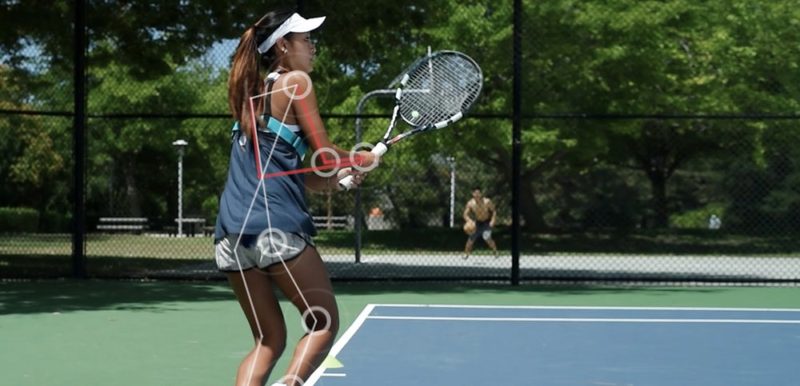
Video is one of the most underused tools in amateur tennis. I already covered the general case in my post about recording padel matches, but there are some tennis-specific things worth going into here.
Equipment
A GoPro works well. If you do not have one, an iPhone or iPad is perfectly fine. Pair it with a quality tripod — I use a Manfrotto — and you are set for most situations. If you want to attach the camera to the back fence, a Joby Gorillapod handles that well.
App: Coach’s Eye
The best app for stroke analysis is Coach’s Eye. It lets you draw lines, annotate, and compare your technique against reference footage side by side. For the comparison, use Federer — he has the cleanest classical technique to reference for most shots.
Always insist with your coach that you record sessions. Without a baseline recording from the start, you cannot clearly see the improvement that happens over time. And as a coach, you cannot have a rally while simultaneously watching the fine details of your student’s technique from the other end of the court. Video solves that.
Camera Angles
The angle you use matters. These are the ones that work best:
- Side view for forehand and backhand
- Back view for posture and movement patterns
- 45-degree side-back angle for volleys
Record about a minute of each stroke so you have enough footage to pick the most representative repetitions.
Frame Rate
Slow motion is essential for stroke analysis. Use the highest frame rate available on your camera — typically 60fps or 120fps. At regular speed you miss the critical moments within each stroke. At slow motion you can see the kinetic chain, the contact point, the follow-through. That is where the real information is.
Best Online Tennis Courses
Since starting tennis I have invested in several online courses to improve as fast as possible. These are the ones I recommend:
- Ian Westermann’s Essential Tennis
- Will Hamilton’s Fuzzy Yellow Balls
- Jeff Salzenstein’s Total Tennis Training
- Craig O’Shannessy’s Brain Game Tennis
- Jan Metelka’s PLB Method
- Tomaz Mencinger’s FeelTennis
- Daily Tennis Lesson — free
- Jeff Greenwald’s Fearless Tennis
- Florian Meier’s OnlineTennisInstruction
- Clay Ballard’s TopSpeed Tennis
- TennisResources.com
- Udemy Tennis 101
For doubles specifically:
- Bill and Matt Previdi’s The Previdi System
Training-to-Playing Ratio
These courses are genuinely useful, but there is no substitute for court time with a good coach. If you are early in your journey, aim to train two or three times a week and play once. A 2:1 or 3:1 ratio of training to playing is what drives rapid improvement.
During a match you are focused on winning, not on your technique — so you are not really improving. This is something I noticed directly after crossing over from padel. My slice was already solid and I was comfortable coming to the net, which gave me an edge against other tennis beginners. But winning points with those weapons was not actually making my tennis better. The improvement came from deliberate practice, not from matches.
Related






The best tip is to play real people as much as possible and to try to play people who are better than you are. Hitting off a ball machine or balls a coach feeds you doesn’t prepare you for hitting game shots which are rarely fed to you but usually hit as far from you as possible. One of my friends hits on a machine a couple of hours every day. His strokes look better than mine but I can beat him because I play real people more than he does.
Good point, I think a good balance between training and playing is important. I’m currently trying to maintain a 3-1 ration in favor of training.