TL;DR: Entrepreneurship is rewarding but isolating. Joining the right community gives you peer support, curated knowledge, and connections you can’t find elsewhere. Below are the best entrepreneur communities in 2026 — from invite-only networks for 8-figure founders to accessible groups for bootstrapped online business owners. I’m personally involved in three of these (The Good Life Collective, Dynamite Circle, and The Latticework).
Entrepreneurship can be an exciting but lonely experience. You start off with nothing and most likely with your peers thinking you’re chasing an impossible dream, or worse, doing nothing of worth. If you manage to prove your worth and build a successful business, you’ll also lose touch with those same peers because your concerns are quite different from theirs, and they most likely start to regard you as the lucky guy.
They say it’s lonely at the top, and that certainly applies to successful entrepreneurs. You don’t need to achieve great wealth or success to start to feel that. Even the mere fact of owning a business and being fully responsible for your and your family’s financial future (not to mention that of the employees who depend on your company) makes you part of a small group of society.
The Good Life Collective
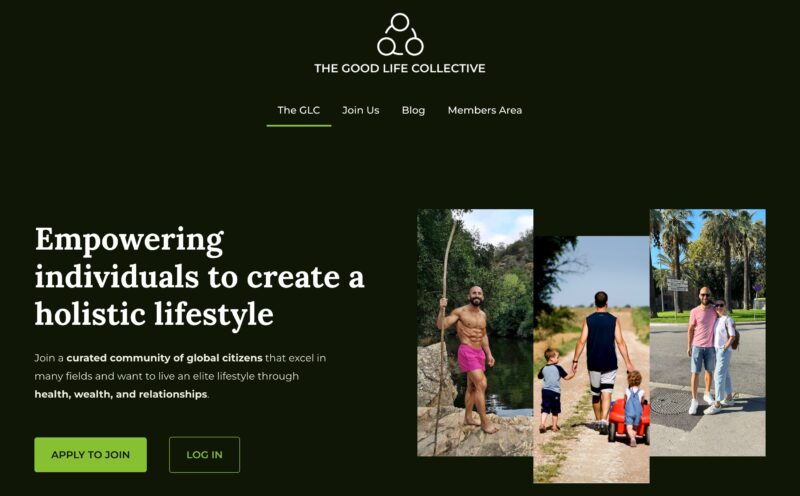
The Good Life Collective (GLC) is a community I founded in 2022 as an extension of this blog and a way to bring my trusted network together.
The community features a Telegram-based chat organized by topics. The chat is where daily interaction between members happens. When you join, you also gain access to webinars, a weekly newsletter, mastermind sessions, and IRL events.
Membership to the GLC is curated, and you can apply to join here. The community is close-knit and values openness highly. All topics are welcome, but discussions tend to center around health, wealth, and relationships.
Most members are entrepreneurs that are somewhat location-independent, in their late 20s, 30s, and 40s. Because many of us have families or are thinking of starting one, we think a lot about how to raise the next generation. As a father of young kids, I find these discussions invaluable.
We love to share resources and recommendations, which means I typically learn something new every day.
Because we share the same values and similar goals in life, being part of this community feels like an instant expansion of one’s thinking. It’s also a great place to reach out during tough times. The community has been extremely generous and helpful in getting members back on their feet after setbacks, and we also make sure to celebrate the big wins.
Baby Bathwater Institute
The Baby Bathwater Institute is a unique entrepreneurial community founded by Hollis Carter and Michael Lovitch. It’s designed as a curated network of accomplished entrepreneurs, founders, and open-minded humans — focused on building authentic, non-transactional relationships.
Unlike traditional business conferences, Baby Bathwater emphasizes genuine connections over immediate deals. The idea is that meaningful, long-term relationships lead to better collaborations and opportunities than any sales pitch at a trade show.
Their events are held in unique, relaxed settings and include educational sessions, outdoor activities, and social gatherings. In 2026, they have events planned in Baja, Boulder, and Texas.
Prospective members go through a vetting process to ensure alignment with the community’s values. The aim is a diverse group of people who aren’t just successful, but also generous with their knowledge and committed to supporting their peers.
While I’m not currently a member since I’m not able to travel much with a young family, I’ve interacted with the founders and several members, and they are all legitimate, good-natured, and successful people. If you can travel to their events and you’re looking for a mix of fun, learning, and networking with good people, this is a great community to join.
Entrepreneurs’ Organization
EO is a global network exclusively for entrepreneurs. It helps leading entrepreneurs learn and grow through peer-to-peer learning, once-in-a-lifetime experiences, and connections to experts.
Joining EO requires a business generating more than $1 million in annual revenue, and costs around $6,000. It’s aimed at experienced, successful entrepreneurs — not those just starting out.
That might seem elitist, but the requirements make sense. The value of the organization depends on members sharing similar concerns and being able to offer useful advice and contacts to each other. A beginner entrepreneur simply won’t face the same challenges — or bring the same capacity to help — as someone running a million-dollar company with employees.
There are events throughout the year, subsidized rates at hotels and tours, and you’ll meet entrepreneurs across all ages and industries. This widens your perspective and exposes you to sectors you might never have considered.
The most important feature is the local chapter — a group of around 8 members that meets monthly in your city. Big cities like Barcelona have several chapters. Members consistently say these local meetings are the most valuable part of EO, directly addressing the loneliness problem I described at the beginning.
Dynamite Circle
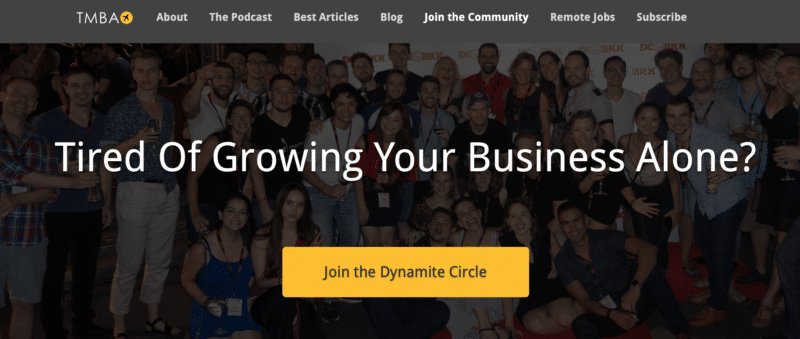
The Dynamite Circle was created by Tropical MBA founders Dan & Ian. It’s grown into the go-to network for online entrepreneurs — people running remote teams, bootstrapped businesses, and location-independent companies.
The Tropical MBA podcast (10M+ downloads) was originally about becoming location-independent and was one of the driving forces behind the digital nomad movement. These days, both founders are settled in their own cities while keeping the freedom to move. This path has been followed by many members, myself included. Constant travel eventually gets old, and you fall in love with one place. In my case, that’s Barcelona.
The DC holds big meetups throughout the year — DCBKK in Bangkok (October 2026), events in Lisbon, and local meetups in cities like Tokyo, Buenos Aires, and Da Nang. An active online forum lets you tap into the collective knowledge of the community, and there’s an option to join a mastermind group.
For more experienced founders, DC BLACK is an exclusive tier for 7- and 8-figure businesses ($4,500-$5,500/year), with smaller group conversations and a more intimate setting.
I’ve been a member for years and found tremendous value in the forums. Looking back, I could have picked up on opportunities earlier — like Bitcoin, which was being discussed in the DC back in 2014, two years before I started seriously researching crypto. That’s one of the biggest benefits of being in a circle of driven, informed people: you learn about opportunities years before everyone else.
DC businesses are optimized for profit and lifestyle vs trying to impress people.
It’s popular in the business world to think that the point of starting businesses is simply to make money. Not here in the DC. We believe our businesses can be so much more — a path to personal freedom, legacy, a secure foundation for a family or community, or as a means for finding deeper meaning and abundance.
Low overhead / lean, founder operated, online, positive cashflow, bootstrapped.
Online-first, location independent businesses between 6-8 figures a year.
Hampton
Hampton is a private community for founders, CEOs, and entrepreneurs. Each applicant is vetted, and fewer than 10% are accepted. The average member runs a business with $23M in annual revenue, though the minimum requirement is $1M in revenue, $3M in funding, or a previous exit.
Most members run digital startups, and you must be a founder or CEO. Your 8-person Core group is matched by business size and industry.
What members get:
- Monthly Core Groups: 8 founders with an executive facilitator, sharing critical feedback and advice.
- Digital Community: An engaged online network, dedicated concierge, and weekly newsletter.
- In-Person Events: Monthly dinners, annual retreats, and local adventures.
- Speaker Series: Workshops featuring hard-to-reach experts.
- Perks: Discounts on popular software and tools.
Young Presidents Organization
YPO is a global network of young chief executives and business leaders. Founded in 1950, it was one of the first organizations to recognize that young company presidents could learn more from each other than from traditional mentorship alone.
The peer network lets members confidentially discuss business and personal challenges — something especially valuable for younger executives who may lack the experience of older peers. YPO offers educational events, curated digital resources, exclusive experiences, and high-level workshops covering leadership, innovation, and personal development.
Members must meet criteria related to age and the scale of businesses they lead, which keeps the group focused on people facing similar challenges.
YPO also places a high value on personal growth and family life, which is refreshing in a world where business organizations often treat personal development as an afterthought.
Tiger 21
TIGER 21 (The Investment Group for Enhanced Results in the 21st Century) is for high-net-worth individuals — members typically manage personal assets exceeding $10 million. Founded by Michael Sonnenfeldt in 1999, it provides a confidential environment for wealth creators to discuss investing, philanthropy, and family dynamics.
The core offering is small, confidential peer group meetings where members discuss financial strategies and tap into collective intelligence. TIGER 21 also provides expert speakers, networking events, and resources for navigating the challenges that come with significant wealth — succession planning, wealth preservation, and values-based legacy planning.
Membership requires a thorough vetting process and is limited to individuals with significant personal assets.
Vistage
Founded in 1957, Vistage is a leading executive coaching and peer advisory organization for CEOs and business leaders. It operates in 35+ countries including Spain.
Members get:
- Peer Advisory Groups: Monthly confidential meetings facilitated by experienced Chairs.
- Executive Coaching: One-on-one sessions to tackle individual challenges and stay accountable.
- Expert Speakers: Workshops on a wide variety of business topics.
- Global Network: Access to 45,000+ business leaders across multiple industries.
- Events: Members-only gatherings for additional learning and networking.
Vistage aims to help leaders make better decisions and achieve better results — both in business and personally. If you’re a CEO or key executive looking for structured peer support, this is one of the most established options available.
Trends.vc
Trends.vc, created by Dru Riley, is a research service and community focused on emerging business, technology, and market trends. It’s popular with entrepreneurs, investors, and forward-thinking builders.
Beyond the in-depth trend reports (150+ and counting, including recent ones on AI-powered education), the community offers daily standups, 1:1 founder introductions, masterminds, and discounts on popular apps and services. With 50,000+ founders in the community, it’s one of the largest and most active groups for staying ahead of market shifts.
If you want to spot opportunities before they become mainstream — and connect with the kind of people who are already building in those spaces — Trends.vc delivers.
The Latticework
The Latticework, established by Blas Moros, is an intellectual community for curious minds. Inspired by Charlie Munger’s concept of a “latticework of mental models,” it takes a multi-disciplinary approach to learning and problem-solving.
Blas has personally read and summarized 1,000+ books, distilling them into 160+ mental models that form the backbone of a structured worldly wisdom learning journey. Rather than chasing trends, the focus is on timeless ideas and principles across business, economics, philosophy, and the sciences.
What makes The Latticework different from most communities: it’s not just about acquiring knowledge. Members are encouraged to share how they’re putting their learning into practice. This turns abstract reading into real-world improvement.
I’m a member, and I get the most value from Blas’ newsletter on mental frameworks and the WhatsApp group chat. Discussions tend to center around book recommendations, productivity, and general advice on living better day-to-day.
Sloww
Sloww was founded by Kyle Kowalski — an ex-marketing executive turned solopreneur who found his purpose after an existential crisis: synthesizing lifelong learning that catalyzes human development.
That might sound like a handful, but Kyle has written hundreds of articles expanding on what he means. The best way to get a feel for it is to browse some of his articles on the Sloww blog.
The community (now 1,000+ members from 50+ countries) is focused on mindful, deliberate living — a counterweight to the constant hustle of modern entrepreneurship. Kyle shares insights on mindfulness, purposeful living, and personal development. The weekly newsletter reaches 10,000+ subscribers.
If you feel like you’re optimizing your business but neglecting the bigger questions about how to live, Sloww offers a thoughtful space to explore that.
ASmallWorld

ASmallWorld is a members-only social network and travel community established in 2004. It positions itself as an exclusive platform for prominent individuals who share a passion for travel, luxury experiences, and social connection.
Members get access to special events (cocktail parties in major cities, exclusive weekend getaways), preferential hotel rates, travel perks, and an online social network. In recent years they’ve added partnerships with Lufthansa Miles & More and hotel elite status programs.
I’ll be honest: I haven’t joined ASW myself, but I have friends who are or were members. Based on what I’ve seen of the app, the content, and feedback from current and past members, I wasn’t impressed. Events seem to attract people focused on appearances over substance, there’s no real membership vetting, and the tangible benefits are limited.
The travel perks (hotel discounts, airline miles partnerships) might be worth it if you travel frequently, and it could be useful for meeting people when you land in a new city. Beyond that, it’s a hard one to recommend.
Do you know of any other networks worth joining? Let me know in the comments section.
FAQ
What’s the best entrepreneur community for beginners?
The Dynamite Circle is the most accessible community on this list for online business owners and entrepreneurs who are still growing. It doesn’t have revenue requirements (though you should have an existing business or serious side project), and the community is supportive of people at various stages. Trends.vc is another good option if you want research-backed insights and peer networking without a heavy price tag.
Which communities require the highest revenue or net worth?
Tiger 21 is at the top — members typically manage $10M+ in personal assets. Hampton requires $1M in revenue, $3M in funding, or a previous exit. EO requires $1M in annual revenue. YPO has age and business-scale requirements. These are all aimed at established leaders, not early-stage founders.
Are there any good AI-focused entrepreneur communities?
The space is evolving fast. Trends.vc covers AI trends extensively in their reports. The Dynamite Circle has an active discussion around AI tools for online businesses. For dedicated AI communities, check out the AI Product Accelerator (for non-technical founders building AI products) and Y Combinator’s community programs for AI startups. Many general entrepreneur communities have also added AI-focused channels and events.
How much do these communities cost?
It varies widely. The Dynamite Circle runs a few hundred dollars per year. The Good Life Collective has accessible pricing. EO is around $6,000/year. Hampton and YPO are in similar ranges for premium membership. Tiger 21 is significantly more. Free options exist (ASW has a free tier), but the paid communities tend to attract more committed members and deliver better value.
Which community is best for location-independent entrepreneurs?
The Dynamite Circle was built for this. Most members run remote, online businesses and many are (or were) location-independent. The Good Life Collective also has a strong contingent of location-independent entrepreneurs, many based in Europe. Both communities hold events in multiple cities worldwide.
Related






Leave a Reply