
Every time Bitcoin makes headlines — whether it’s crossing a new milestone or going through one of its trademark corrections — my inbox fills up with the same question: should I buy Bitcoin right now?
I’ve been answering some version of this question since 2013. My answer has stayed consistent, even as the number at the end of the ticker keeps moving.
The short answer: yes, if you have a 5-10 year horizon and understand what you’re buying. Not because I can tell you where the price is going next month, but because I genuinely believe Bitcoin is the best investment opportunity of our generation — and the evidence for that has only strengthened since I last updated this article.
Let me walk you through how I think about it.
How to Buy Bitcoin (If You’re Ready to Get Started)
If you already know you want in and just need a practical starting point, here’s the short version.
The easiest route is a reputable centralized exchange. I’ve used all three of these and recommend them for different reasons:
- Coinbase — Best for beginners. Clean interface, US-regulated, good mobile app.
- Binance — Largest exchange by volume. More features, lower fees, better for active users.
- Kraken — Strong security track record, good for European users, competitive fees.
Sign up, verify your identity (KYC is standard now across all serious exchanges), and buy. That part has never been easier.
Once you’ve bought, the next question is where to keep it. For amounts worth protecting, I’d recommend moving your Bitcoin off the exchange and into a hardware wallet. Ledger is the most widely used. Yes, there’s a learning curve — but leaving significant value on an exchange indefinitely isn’t something I’d be comfortable with.
That said, if you’d rather get exposure without managing custody at all, Bitcoin spot ETFs are now an option. More on that below.
Don’t Try to Time the Market
This is the part most people want to skip, but it’s the most important thing I can tell you.
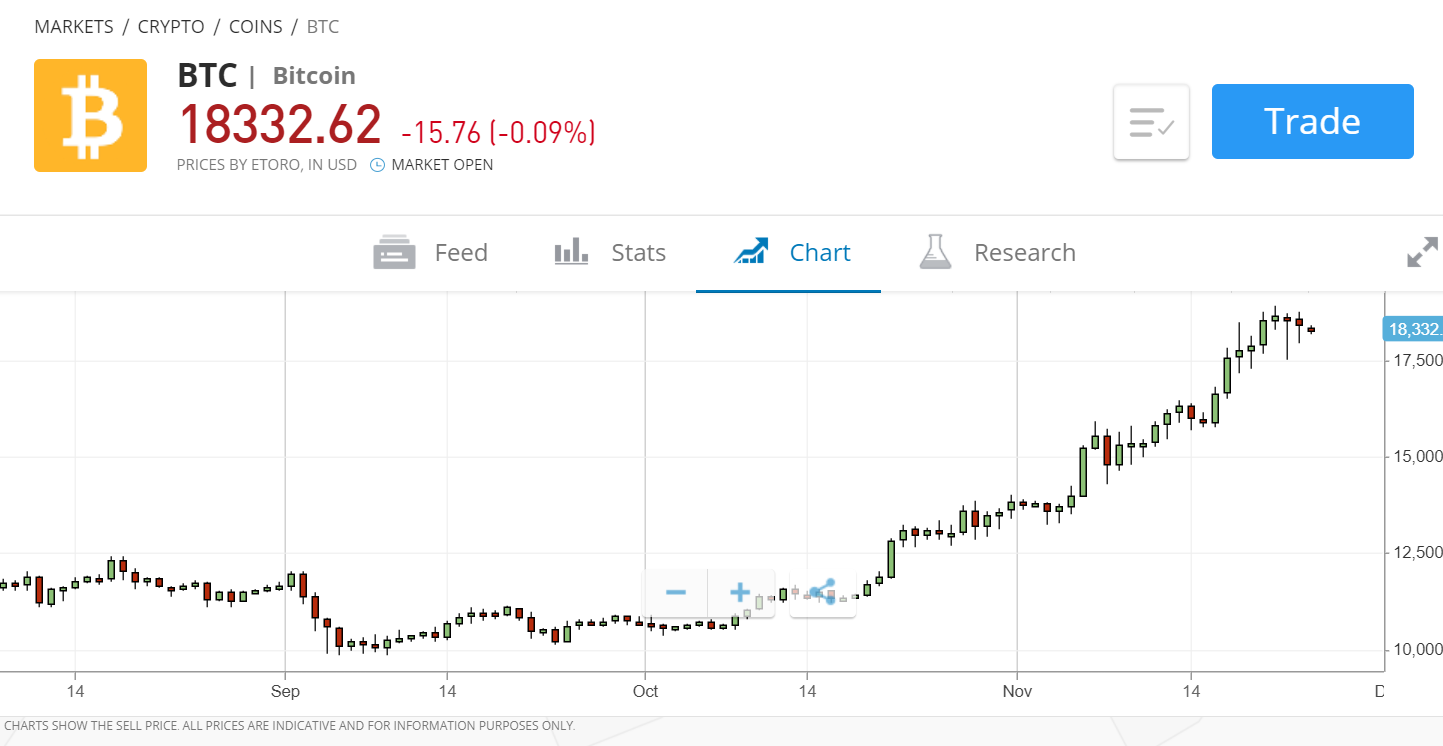
I don’t try to call market bottoms. I don’t wait for the “perfect” entry. I’ve been buying Bitcoin at various price points over the years — some in hindsight looked like brilliant timing, others looked terrible in the short term. Over a multi-year horizon, the price I paid on any given day has mattered much less than the decision to buy and hold at all.
If the uncertainty of lump-sum investing keeps you on the sidelines, use dollar-cost averaging instead. Set up automatic monthly purchases — $100, $500, whatever fits your situation — and remove the emotional decision-making entirely. You’ll buy some at highs and some at lows, and over time that averages out into a sensible cost basis.
The mistake I see repeatedly is people waiting for a correction that either doesn’t come, or comes and then they still don’t buy because it feels like it might drop further. Meanwhile, the asset they were waiting to buy is significantly higher than when they started watching it.
If your thesis is long-term and fundamental — which mine is — the entry point matters far less than most people think.
Why I’m Still Bullish in 2026
Let me lay out the fundamental case, updated for where we are now.
The scarcity argument hasn’t changed — and never will
There will only ever be 21 million Bitcoin. That’s not a policy. It’s code that thousands of nodes around the world enforce simultaneously. No central bank, no government, no company can change it unilaterally.
Meanwhile, every major fiat currency on earth continues to be inflated by its issuing government. The purchasing power erosion from 2020-2022 alone made this point viscerally clear to a lot of people who had previously dismissed it as abstract.
Bitcoin’s fixed supply against an expanding money supply is the core of the investment thesis, and it hasn’t weakened.
The stock-to-flow model held
When I wrote the original version of this article, I cited the stock-to-flow model and Bitwise’s “fourth era” prediction of Bitcoin reaching $100,000 or more. At the time, Bitcoin was trading around $30,000-$40,000 and those predictions seemed bold to many people.
Bitcoin crossed $100,000 in late 2024 and has consolidated above that level. The Kraken wealth transfer report I referenced previously predicted Bitcoin reaching $70,000 by 2044. It surpassed that figure decades ahead of schedule.
I’m not saying price models are gospel. But the directional thesis — that Bitcoin’s value would continue to appreciate as adoption grew and supply became increasingly scarce — played out.
The halving keeps doing its job
The April 2024 halving reduced the block reward from 6.25 BTC to 3.125 BTC. This happens every four years, programmatically cutting the rate at which new Bitcoin enters circulation. Historically, halvings have preceded significant bull runs, and the current cycle has followed that pattern.
The next halving is in 2028. If you’re investing with a 5-10 year horizon, that’s relevant context.
Institutional adoption is no longer a prediction — it’s a fact
In January 2024, the SEC approved Bitcoin spot ETFs in the United States. This was a landmark moment. BlackRock, Fidelity, and several other major asset managers now offer regulated Bitcoin investment products to institutional and retail investors alike.
The significance of this can’t be overstated. These firms collectively manage trillions of dollars in assets. Even modest portfolio allocations to Bitcoin ETFs represent enormous demand against a fixed and slowly growing supply. BlackRock’s Bitcoin ETF became one of the fastest-growing ETFs in history within months of launch.
When I was writing about Bitcoin in 2013 and 2017, the institutional question was entirely speculative. That’s no longer true.
Regulatory clarity is improving
Europe’s MiCA (Markets in Crypto-Assets) regulation came into full effect in 2024, providing a comprehensive legal framework for crypto across EU member states. That’s 27 countries with clear rules — a significant shift from the patchwork of uncertainty that existed before.
El Salvador made Bitcoin legal tender back in 2021, and other countries have been exploring similar moves. Regulatory direction, broadly speaking, has moved toward accommodation rather than prohibition in the major economies.
There’s still uncertainty in some jurisdictions, particularly around tax treatment and specific use cases. But the narrative that governments would simply ban Bitcoin has become increasingly implausible — especially now that US-regulated ETFs exist from companies like BlackRock and Fidelity.
The energy FUD has weakened considerably
Bitcoin mining uses energy. That’s true and worth acknowledging. But the narrative that Bitcoin is an environmental catastrophe has been significantly undermined by the data that’s emerged over the past few years.
A growing proportion of Bitcoin mining now runs on renewable energy — stranded hydroelectric, flared natural gas that would otherwise be vented into the atmosphere, and purpose-built renewable installations. The economic incentive to use the cheapest available electricity naturally drives miners toward stranded or excess capacity, much of which is renewable.
This doesn’t make Bitcoin “green” in a simple sense. But the one-dimensional “Bitcoin wastes energy” argument is far weaker than it was a few years ago.
The Hurdles That Remain
I’m bullish, but I’m not dismissive of the real challenges. Anyone considering a significant allocation should think honestly about these.
Custody is still complicated
Self-custody has gotten easier — hardware wallets are more user-friendly, and there’s better documentation and tooling than there used to be. But it’s still not something you can do carelessly. Lose your seed phrase with no backup, and your Bitcoin is gone. There’s no customer support, no password reset, no recourse.
For people who want exposure without the responsibility of custody, Bitcoin ETFs now provide a legitimate alternative. You give up the sovereignty and the self-sovereign ethos, but you gain simplicity and regulatory protection. That tradeoff is worth naming clearly.
Volatility is real and won’t disappear soon
Bitcoin has dropped 50-80% multiple times in its history, often from all-time highs. It has always recovered and gone on to new highs — but the recoveries have taken months to years. If you buy and the price drops 60% next month, can you hold without selling? If the honest answer is no, you should either reduce your position size or reconsider the timeline.
This isn’t a reason not to invest. It’s a reason to invest only what you can afford to leave alone for years.
Correlation with tech stocks
One argument for Bitcoin has always been its low correlation with traditional asset classes — the digital gold narrative. In practice, during risk-off periods (rising interest rates, liquidity crunches), Bitcoin has tended to sell off alongside tech stocks rather than behaving as an uncorrelated safe haven.
This may change as the asset matures and more of its holders are long-term institutional allocators rather than leveraged speculators. But it’s worth knowing that Bitcoin is not yet a reliable hedge against equity market downturns.
Regulatory uncertainty in specific jurisdictions
MiCA has clarified things in Europe. The US now has regulated ETFs. But tax treatment, reporting requirements, and specific rules vary significantly by country and continue to evolve. If you’re holding meaningful amounts, you need to understand the rules in your jurisdiction — and ideally talk to an accountant who actually understands crypto.
Ways to Get Exposure
There are now several legitimate ways to hold Bitcoin, each with different tradeoffs.
Buy and hold on an exchange
The simplest starting point. Buy on Coinbase, Binance, or Kraken, and keep it there while you get comfortable. Not ideal long-term (exchange risk, not your keys), but fine for smaller amounts while you learn.
Self-custody with a hardware wallet
Move your Bitcoin off the exchange into a Ledger or similar hardware wallet. You control the private keys. This is the sovereign approach — and the one that aligns with Bitcoin’s original design. It requires more responsibility but gives you genuine ownership.
The Lightning Network has also matured significantly for smaller transactions. If you want to actually use Bitcoin for payments rather than just hold it, Lightning makes that practical in a way that on-chain transactions don’t at current fees.
Bitcoin spot ETFs
If you invest through a brokerage account and don’t want to deal with wallets, seed phrases, or exchange accounts, a Bitcoin ETF is now available. BlackRock’s iShares Bitcoin Trust (IBIT) and Fidelity’s Wise Origin Bitcoin Fund (FBTC) are the largest. You get price exposure through a familiar, regulated wrapper. You don’t get the Bitcoin itself — but for a retirement account or a brokerage portfolio, this is a meaningful option that didn’t exist two years ago.
Tax Considerations
Taxes on Bitcoin vary significantly by country, and this is one area where getting it wrong is expensive. A few principles that apply broadly:
- In most countries, selling Bitcoin for fiat is a taxable event — capital gains apply.
- Buying Bitcoin is generally not taxable.
- Exchanging Bitcoin for another cryptocurrency is often treated as a taxable disposal.
- Some jurisdictions treat Bitcoin payments for goods and services as taxable events at the time of transaction — which is one reason why everyday Bitcoin spending remains awkward.
Portugal has historically been favorable for crypto holders, treating gains as tax-free under certain conditions — though the rules have evolved, so check the current situation. I’ve written more about this in my article on Portugal’s crypto tax rules.
For a broader overview of crypto taxes, see this article. And if you’re holding significant amounts, please talk to an accountant. The complexity and stakes are both high enough to justify professional advice.
Still Early. Still Clear.
Bitcoin crossed $100,000. The ETFs launched. BlackRock and Fidelity are in the market. MiCA is law. The halving happened. Every major prediction I was tracking when I wrote the original version of this article has come true or is on track.
And yet I still think we’re early. Not in the “Bitcoin will 100x” hyperbole sense — I’m not making price predictions. But in the sense that Bitcoin’s role as a global reserve asset, a savings technology for people in weak-currency economies, and a store of value sitting alongside gold in institutional portfolios is still being established. The infrastructure, the regulatory frameworks, the mental models — all of it is still being built.
My personal approach hasn’t changed: I believe in Bitcoin and hold it as part of my net worth. I don’t trade it, and I don’t lose sleep over the short-term price movements. I’m not waiting for the right moment, because I don’t believe in timing markets — and because I think the right moment was years ago and the second-best time is now.
If you believe, as I do, that sound money matters, that scarcity has value, and that the current financial system’s structural problems aren’t going away — Bitcoin is the clearest expression of that belief you can make with your savings.
Do your own research. Understand what you’re buying. Size your position appropriately. And take a long view.
Related






Leave a Reply