
- My top picks for 2026: Nectaro (best overall), Mintos (most diversified), PeerBerry (best track record)
- Always diversify across 3-5 platforms to manage risk
- Prioritize platforms with MiFID II or ECSP licenses for better investor protection
- Expected returns range from 6% (Bondora Go & Grow) to 15% (Nectaro) depending on risk
- Ranked from my own experience with real money on more than a dozen European platforms since 2016
I made my first P2P lending investment in 2016. Since then I’ve put real money into more than a dozen platforms, watched several fail, and seen others grow into properly regulated businesses that now manage hundreds of millions in investor assets.
The market looks very different in 2026 than it did when I started. Four platforms now hold MiFID II investment firm licenses, the strongest financial regulation available for this asset class in Europe. Several more operate under the EU’s ECSP crowdfunding framework. The platforms that survived the pandemic, the war in Ukraine, and the interest rate shock of 2022-2023 have proven something about their operational resilience.
Below are the platforms I currently consider the best options for European investors. I’ve invested in most of them personally. This is not a list of every platform that exists. I also maintain a list of platforms I’d avoid. If you’re new to the asset class, my guide to how P2P lending works covers the basics first.
Best P2P Lending Platforms in Europe for 2026
- Nectaro: best overall: MiFID II licensed, 13-15% returns, zero defaults so far (read my review)
- Mintos: most diversified: MiFID II, 60+ loan originators in 30+ countries (read my review)
- PeerBerry: best track record: repaid all EUR 51.4M of war-hit loans (read my review)
- ViaInvest: MiFID II, short-term consumer loans averaging 12-13% (read my review)
- Debitum: collateralized business loans, MiFID II and ECSP licensed (read my review)
- InRento: rental real estate, ECSP licensed, 0% default rate (read my review)
- Income Marketplace: originators hold a junior share of every loan (read my review)
- Afranga: 13.92% delivered in 2025, ECSP licensed (read my review)
- LANDE: farmland-secured agricultural loans, around 37% average LTV (read my review)
- Capitalia: Baltic SME lending since 2007, ECSP licensed (read my review)
- Bondora: Go & Grow at 6% with daily liquidity, the simplest option (read my review)
Quick Comparison
| Platform | Score | Regulation | Returns | Lifetime Volume | Founded |
|---|---|---|---|---|---|
| Nectaro | 4.7/5 | MiFID II | 13-15% | EUR 47M | 2022 |
| Mintos | 4.5/5 | MiFID II | ~9% | EUR 13B+ | 2015 |
| PeerBerry | 4.3/5 | Unregulated | 10-11% | EUR 3.24B | 2017 |
| ViaInvest | 4.0/5 | MiFID II | 12-13% | EUR 618M | 2016 |
| Debitum | 4.2/5 | MiFID II + ECSP | 9-12% | EUR 135M | 2018 |
| InRento | 4.5/5 | ECSP | 8-10% | EUR 80M | 2020 |
| Afranga | 4.2/5 | ECSP | 12-14% | EUR 89M | 2021 |
| Income Marketplace | 4.1/5 | Unregulated | 12-13% | EUR 201M | 2020 |
| LANDE | 4.0/5 | ECSP | 10-14% | EUR 32M | 2019 |
| Capitalia | 4.0/5 | ECSP | 10-12% | EUR 185M | 2007 |
| Bondora | 3.8/5 | Estonian FSA | 6% | EUR 1B+ | 2009 |
Best Platform For…
| Category | Platform | Why |
|---|---|---|
| Best Overall | Nectaro | Strong returns for a regulated platform (13.14% average in 2025), MiFID II licensed, zero defaults |
| Best Returns | Afranga | 13.92% in 2025 from an ECSP-regulated marketplace, zero defaults to date |
| Best Regulated | Debitum | Holds both MiFID II and ECSP licenses, double regulatory coverage |
| Best for Real Estate | InRento | Rental income from actual properties, ECSP licensed, 0% default rate |
| Best for Business Loans | Debitum | Exclusive focus on collateralized SME lending across Europe |
| Best for Agricultural Loans | LANDE | Unique niche: farmland-secured loans, ECSP, 37% average LTV |
| Best for Diversification | Mintos | 60+ originators across 30+ countries plus bonds and ETFs, though close to 29% of outstanding loans are in recovery and fees now apply |
| Best Track Record | PeerBerry | Repaid EUR 51.4M from war-hit regions with zero losses, though volume and rates softened in 2025 |
Let’s look at each platform in detail.
1. Nectaro
| Regulation | MiFID II (Latvijas Banka) |
| Average Returns | 13-15% |
| Buyback | Yes (60 days) |
| Secondary Market | Yes |
| Auto-Invest | Yes |
| Min. Investment | EUR 10 |
| Loan Types | Consumer loans |
| Founded | 2022 |
Nectaro was the clear standout platform of 2025 and one of the most impressive newcomers in European P2P lending. It holds an investment firm license from Latvijas Banka, the same regulator that supervises Mintos, ViaInvest, and Debitum, making it one of only four MiFID II-licensed P2P platforms in Europe.
The numbers speak for themselves: a 13.14% average return to investors in 2025 (Nectaro’s figure), an A- grade from the re:think P2P community (the highest rating of any platform), and zero defaults since launch. Lifetime volume has reached nearly EUR 47 million with investor numbers growing 323% year-on-year. The platform works with loan originators in multiple markets and offers a secondary market for early exits.
What puts Nectaro in the #1 slot is the combination of top-tier regulation with the highest returns of any properly licensed platform. Most MiFID II platforms offer 9-12% — Nectaro delivers nearly 15% under the same regulatory framework. The platform is still relatively young (founded 2022), which is the main caveat. But the trajectory and regulatory standing are exceptionally strong.
See also: My full Nectaro review
2. Mintos

| Regulation | MiFID II (Latvijas Banka) |
| Average Returns | ~9% (9.2% weighted avg. APY) |
| Buyback | Yes (60 days) |
| Secondary Market | Yes |
| Auto-Invest | Yes |
| Min. Investment | EUR 50 |
| Loan Types | Consumer, business, mortgage |
| Founded | 2015 |
Mintos is the largest P2P lending marketplace in Europe and the platform where I’ve put the most capital over the years. Founded in 2015 in Riga, Latvia, it now counts over 700,000 registered investors and has facilitated more than 13 billion euros in loans across 30+ countries. Monthly origination runs around EUR 97 million, which is several times larger than any competitor.
What sets Mintos apart is its regulatory standing. The platform holds an investment firm license from Latvijas Banka (the Latvian financial regulator) and operates under the MiFID II framework. That gives investors real legal protections, not just a buyback guarantee backed by the word of a small loan originator. In February 2026, Mintos started applying for a banking license from the European Central Bank. It shows a weighted average APY of about 9.2% on available loans, before any losses from failed originators, with loan originators across more than 30 countries and a secondary market where you can exit positions if needed.
Since May 2025, Mintos charges a 0.29% annual fee on Custom Loan Portfolios, and the new High-Yield Bonds Portfolio (launched November 2025) carries a 0.39% annual management fee. About EUR 190 million, close to 29% of outstanding loans, was in recovery in September 2026, including the Nera Capital payment stop, and the re:think P2P community gives it a C grade despite its scale.
See also: My full Mintos review
3. PeerBerry

| Regulation | Unregulated (sister platform Crowdpear holds ECSP) |
| Average Returns | 10-11% |
| Buyback | Yes (60 days) |
| Secondary Market | Yes (launched Jan 2026) |
| Auto-Invest | Yes |
| Min. Investment | EUR 10 |
| Loan Types | Consumer, business |
| Founded | 2017 |
PeerBerry launched in 2017 and has become the second-largest European P2P platform by lifetime volume, with over EUR 3.24 billion in loans funded and more than 110,000 registered investors. Monthly origination runs around EUR 31 million, though volume dropped roughly 47% year-on-year in 2025. That decline is worth monitoring, though it may reflect tighter lending standards rather than underlying problems.
PeerBerry’s most impressive achievement: it was the only P2P platform to fully repay investors affected by loans tied to war-impacted regions, returning all EUR 51.4 million without a single euro under recovery. That kind of follow-through matters when you’re evaluating who to trust with your money. The platform launched a secondary market in January 2026, works with 28 loan originators across 13 countries, and average returns sit around 11%.
PeerBerry is not regulated under MiFID II or ECSP at the platform level, though its sister platform Crowdpear holds an ECSP license. For investors who prioritize scale and track record over regulatory framework, PeerBerry is a strong pick.
See also: My full PeerBerry review
4. ViaInvest

| Regulation | MiFID II (Latvijas Banka) |
| Average Returns | 12-13% |
| Buyback | Yes (60 days) |
| Secondary Market | No |
| Auto-Invest | Yes |
| Min. Investment | EUR 10 |
| Loan Types | Short-term consumer |
| Founded | 2016 |
ViaInvest won the re:think P2P community vote for 2025 with 53.8% of votes, beating out every other European P2P platform. That kind of grassroots endorsement from active investors carries more weight than any marketing claim.
Founded in 2016 in Latvia, ViaInvest holds a MiFID II investment firm license from Latvijas Banka. Over 46,000 investors have used the platform, and lifetime volume sits at EUR 618 million with monthly origination of around EUR 6 million. Returns average around 13%, which is among the highest of any MiFID II regulated platform. The parent company VIA SMS Group has been profitable for multiple years.
ViaInvest focuses primarily on short-term consumer loans (typically 30 days) with a buyback obligation. The combination of proper regulation, strong returns, and a profitable parent company makes it one of the most compelling platforms in the market right now. The re:think P2P community rates it a B grade (11/15).
See also: My full ViaInvest review
5. Debitum
| Regulation | MiFID II + ECSP (Latvijas Banka) |
| Average Returns | 9-12% |
| Buyback | Yes (90 days) |
| Secondary Market | Yes |
| Auto-Invest | Yes |
| Min. Investment | EUR 10 |
| Loan Types | Business (collateralized) |
| Founded | 2018 |
Debitum (rebranded to Debitum Investments in February 2024) focuses exclusively on business loans: secured, collateralized, and backed by tangible assets. It’s been operating since 2018 and saw strong growth in 2025, with the portfolio nearly doubling to over EUR 53 million and the platform achieving its first year of profitability. Lifetime volume sits at EUR 135 million across 24,000 investors.
Debitum holds both a MiFID II investment firm license and an ECSP license from Latvijas Banka, making it one of the most thoroughly regulated platforms on this list. Returns average 9-12% annually with a 90-day buyback guarantee. There’s a 15% penalty applied to loan originators who delay repayments, which creates a real incentive for originators to stay current.
If you want exposure to SME lending with a proper regulatory backstop, Debitum is worth a close look. The re:think P2P community rates it B+ (12/15), second only to Nectaro.
See also: My full Debitum review
6. InRento

| Regulation | ECSP (Bank of Lithuania) |
| Average Returns | 8-10% |
| Buyback | No (real estate backed) |
| Secondary Market | Yes |
| Auto-Invest | Yes |
| Min. Investment | EUR 500 |
| Loan Types | Real estate (rental income) |
| Founded | 2020 |
InRento is a real estate rental investment platform that lets you invest in properties generating actual rental income rather than development loans. Founded in 2020 in Lithuania, it holds an ECSP license from the Bank of Lithuania and has funded over EUR 80 million across properties in Lithuania, Latvia, Poland, Ireland, and Spain.
What makes InRento stand out is its 0% default rate. Every project on the platform has paid as expected, which is a genuinely remarkable track record in a sector where real estate platforms have been dropping like flies (EstateGuru, Reinvest24, Bulkestate all collapsed). Returns range from 8-10% annually from rental yields, with some capital appreciation on top. The minimum investment is EUR 500, and investors receive monthly rental income distributions.
The model is fundamentally different from most P2P platforms: instead of short-term consumer loans with buyback guarantees, you’re investing in actual properties with real tenants paying real rent. That’s a different risk profile, and I’d argue a more tangible one. InRento is expanding into new European markets, which should provide more diversification options going forward.
See also: My full InRento review
7. Income Marketplace
| Regulation | Unregulated (Lithuanian registration) |
| Average Returns | 12-13% |
| Buyback | Yes (junior share mechanism) |
| Secondary Market | No |
| Auto-Invest | Yes |
| Min. Investment | EUR 10 |
| Loan Types | Consumer loans |
| Founded | 2020 |
Income Marketplace stands out for its structural investor protections. The platform requires loan originators to hold a junior share of every loan, meaning the originator absorbs the first losses before any investor capital is at risk. That mechanism puts real skin in the game and goes further than a standard buyback guarantee.
Since launching in 2020, Income Marketplace has facilitated over EUR 201 million in funded loans. Returns average around 12-13% and the platform works with multiple originators across several countries. It doesn’t have a secondary market, which limits liquidity, but the junior share structure provides one of the strongest investor protection mechanisms in the European P2P space.
The platform is not regulated under MiFID II or ECSP, which is worth factoring into your allocation decisions. But on pure structural protections, few platforms can match what Income Marketplace offers.
See also: My full Income Marketplace review
8. Afranga
| Regulation | ECSP (Bulgarian FSC) |
| Average Returns | 12-14% |
| Buyback | No |
| Secondary Market | No |
| Auto-Invest | No |
| Min. Investment | EUR 10 |
| Loan Types | Consumer loans |
| Founded | 2021 |
Afranga received its ECSP license from the Bulgarian Financial Supervision Commission in September 2023 and has quickly established itself as one of the better-performing platforms in European P2P lending. The re:think P2P community rates it B+ (12/15), placing it alongside Debitum as one of the highest-rated platforms.
The platform delivered 13.92% actual returns to investors in 2025 with zero reported defaults, and has facilitated over EUR 89 million in funded loans since launching in 2021. Afranga works with Stikcredit as its primary loan originator, which provides consumer loans in Bulgaria. There’s no buyback guarantee: investors hold loans secured by the originator’s assets instead.
One notable advantage: Bulgaria’s withholding tax on P2P income for non-residents is just 10%, and under most double tax treaties this can be reduced or credited against your home country tax. That’s competitive compared to the 20% WHT in Latvia (though Latvia’s treaties allow reduction to 10% for most EU investors too). The platform is still on the smaller side, but the combination of ECSP regulation, strong returns, and zero defaults earns it a spot on this list.
See also: My full Afranga review
9. LANDE
| Regulation | ECSP (Latvijas Banka) |
| Average Returns | 10-14% |
| Buyback | No (mortgage-secured) |
| Secondary Market | Yes |
| Auto-Invest | Yes |
| Min. Investment | EUR 50 |
| Loan Types | Agricultural (farmland-secured) |
| Founded | 2019 |
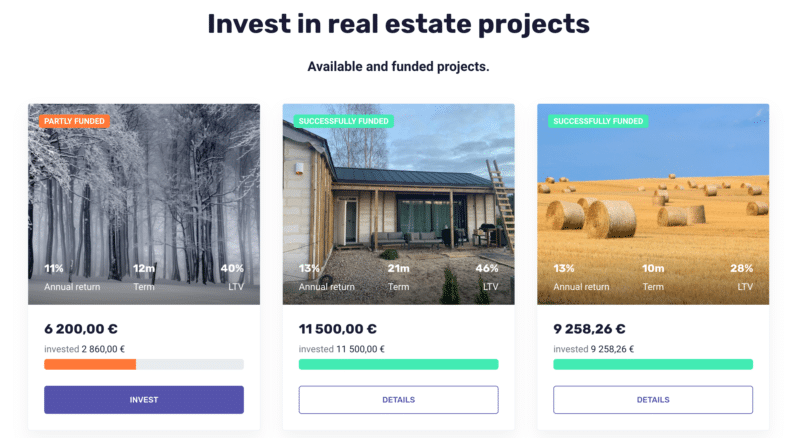
LANDE occupies a niche that no other platform on this list touches: agricultural loans for farmers in Eastern Europe, secured by first-rank mortgages on farmland and agricultural assets. Founded in 2019 in Latvia (originally as LendSecured), the platform holds an ECSP license, has over 8,500 investors, and has funded more than EUR 32 million in loans.
Returns range from 10-14% annually. The collateral structure is extremely conservative, with an average loan-to-value ratio around 37%. All loans carry first-rank mortgage security, meaning LANDE investors sit ahead of everyone else in the repayment queue in the event of default. To date there have been zero capital losses for investors. LANDE also invests its own capital alongside investors in every project, which aligns incentives properly.
The monthly volume is modest (around EUR 1 million), reflecting the niche agricultural focus. That’s not a weakness. It’s a platform that does one thing well rather than trying to be everything to everyone.
See also: My full LANDE review
10. Capitalia
| Regulation | ECSP (Latvijas Banka) |
| Average Returns | 10-12% |
| Buyback | No (collateralized) |
| Secondary Market | Yes |
| Auto-Invest | Yes |
| Min. Investment | EUR 50 |
| Loan Types | Business loans |
| Founded | 2007 |
Capitalia has one of the longest operating histories in European P2P. Founded in 2007 in Latvia, the company has been providing SME financing in the Baltics for nearly two decades. It holds an ECSP license from Latvijas Banka and has facilitated over EUR 185 million in business loans.
The platform focuses on secured business loans with collateral backing, typically offering returns of 10-12%. What sets Capitalia apart is the maturity of the operation. While most P2P platforms launched in the last five to seven years, Capitalia has been underwriting business loans through multiple economic cycles. That experience shows in the quality of their loan book.
The trade-off is that Capitalia is not a high-yield play. If you want 14%+ returns, look elsewhere. But if you want exposure to Baltic SME lending from an operator that has been doing this longer than nearly everyone else in the market, Capitalia deserves consideration.
See also: My full Capitalia review
11. Bondora
| Regulation | Estonian Financial Supervision Authority |
| Average Returns | 6% (Go & Grow) |
| Buyback | No |
| Secondary Market | No (withdraw any time, EUR 1 fee) |
| Auto-Invest | Yes (Go & Grow is automated) |
| Min. Investment | EUR 1 |
| Loan Types | Consumer loans |
| Founded | 2009 |
Bondora is one of the oldest P2P lending platforms in Europe, operating since 2009. With over EUR 1 billion in loans funded and more than 250,000 registered investors, it has real scale. The platform is supervised by the Estonian Financial Supervision Authority.
Bondora’s flagship product is Go & Grow, which has targeted a flat 6% annual return since 2025, with withdrawals available any time for a EUR 1 fee. It works more like a savings product than traditional P2P lending — you deposit money and earn a fixed rate, while Bondora handles the underlying loan portfolio. That simplicity is attractive for investors who don’t want to manage individual loans or worry about loan selection.
The returns are lower than most platforms on this list, but the liquidity and simplicity are hard to match. Bondora is best suited as a conservative allocation within a broader P2P portfolio, or as an entry point for investors just getting started with P2P lending.
See also: My full Bondora review
Also Worth Considering
These platforms didn’t make the top 11 but are legitimate options worth evaluating depending on your priorities.
Fintown is a Czech real estate platform focused on AirBnB apartments in Prague. The niche is interesting and the platform has funded around EUR 24 million. It’s unregulated and small, so treat it as a satellite allocation rather than a core holding. Read my review.
Monefit SmartSaver offers a savings-like product with expected returns of 7.5% on the main account and up to about 10.5% in fixed-term Vaults, backed by Creditstar Group’s consumer lending portfolio. With over 30,000 investors and EUR 302 million in assets, it’s a simple option for investors who want P2P-level returns without managing individual loans. The parent company Creditstar is a well-established lender, though the product itself is not separately regulated. Read my review.
Lonvest launched in 2023 and targets up to 13% returns with a 60-day buyback guarantee. It’s connected to the UnaFinancial ecosystem (part of the UnaFinancial group) and is expanding into Mexico. At only EUR 1.6 million in lifetime volume and roughly 600 investors, it’s still very early stage. The signals are positive but treat it as a small speculative allocation. Read my review.
Crowdpear is the ECSP-licensed sister platform to PeerBerry, focused on real estate crowdfunding. It provides a regulated option for investors who like the PeerBerry ecosystem but want the additional protections that come with ECSP licensing. Still building volume, but the regulatory standing and backing from the Aventus Group give it a solid foundation. Read my review.
Letsinvest is a Lithuanian real estate crowdfunding platform with an ECSP license from the Bank of Lithuania. It focuses on development and rental projects in the Baltics and offers returns in the 10-12% range. A newer entrant to the space but properly regulated from the start. Read my review.
InDemo takes a different approach to P2P lending by letting investors buy claims on non-performing loans at a discount. It’s based in Latvia and offers a unique risk/reward profile compared to traditional P2P platforms. The model is more complex than standard P2P investing, so make sure you understand how distressed debt works before committing capital. Read my review.
How I Evaluate P2P Lending Platforms
Nearly a decade in P2P lending has given me a framework for evaluating platforms that goes beyond headline returns. These are the factors I weigh most heavily:
Regulation first. A MiFID II investment firm license is the gold standard. ECSP is good. No regulation means you’re trusting the platform’s word alone. My rule of thumb: put the majority of your P2P capital on regulated platforms and only smaller amounts on unregulated ones with proven track records.
Parent company financials. Buyback guarantees are only as strong as the entity making them. I look at parent company profitability, debt-to-equity ratios, and revenue trends. A platform offering 14% returns with a parent company bleeding cash is riskier than one offering 10% with a profitable parent.
Track record through stress. Platforms that operated through COVID, the Ukraine war, and the 2022 interest rate shock without investor losses have earned credibility that newer entrants simply don’t have. That lived experience matters.
Diversification of loan originators. Single-originator platforms concentrate your risk. If that originator fails, your entire investment is at risk simultaneously. Multi-originator marketplaces like Mintos spread that risk across dozens of lenders in different countries.
Liquidity options. A secondary market matters if you might need access to your capital before loans mature. Platforms without one lock your money until each loan term ends.
Understanding Regulation
Regulation has become the single most important differentiator between P2P platforms. Here’s what the three tiers mean in practice.
MiFID II (strongest): Platforms holding an investment firm license under MiFID II are supervised by the same financial regulators that oversee banks and brokerages. Investors benefit from the EUR 20,000 compensation scheme, mandatory capital adequacy requirements, and proper complaint resolution mechanisms. Four platforms on or near this list hold these licenses: Mintos, Nectaro, ViaInvest, and Debitum.
ECSP (good): The European Crowdfunding Service Provider regulation provides a pan-EU framework for crowdfunding platforms. It’s less comprehensive than MiFID II but still requires regulatory authorization, key investment information sheets, and investor protection measures. Platforms with ECSP licenses include Debitum, Afranga, LANDE, and InRento.
Unregulated (higher risk): Several popular platforms operate without specific financial regulation, often from jurisdictions like Croatia or Estonia where they can argue legal exemption. These platforms may still be trustworthy, but you’re relying entirely on the platform’s goodwill and track record rather than regulatory backstops. PeerBerry falls into this category.
Who Can Invest?
All platforms listed here accept investors from across the European Union. Most also accept investors from non-EU European countries. If you’re based outside Europe, some platforms will still accept you. Check each platform’s registration flow for current eligibility rules.
Most platforms require you to be at least 18 years old and to complete identity verification (KYC). The process typically takes a few minutes to a few days. Some platforms have minimum deposit requirements ranging from EUR 50 to EUR 500 (InRento).
What Returns Can Investors Realistically Expect?
In 2026, realistic net returns on well-managed P2P portfolios across European platforms fall in the 8-12% range. That’s after accounting for cash drag, occasional defaulted loans, and any platform-level risks that materialize.
That range is worth contextualizing. European savings rates have risen from near zero to somewhere in the 2-4% range for short-term deposits, depending on the bank and country. High-yield bond ETFs yield 5-7%. P2P lending still offers a meaningful premium over both, but the spread has compressed compared to the 2015-2021 period when bank savings paid essentially nothing.
The platforms advertising 14-16% headline rates tend to have higher underlying risk, shorter track records, or significant cash drag that eats into effective yields. I wouldn’t build a portfolio around the top of that range. For the core of a P2P allocation, I’d favor platforms targeting 10-12%, with strong regulatory standing and multiple years of clean track record behind them.
Risks of P2P Lending
P2P lending is an alternative investment with real risks. Platform failure, loan originator default, liquidity risk, and regulatory change can all affect your returns or your ability to access your capital at all. Buyback guarantees protect against individual borrower defaults but not against the insolvency of the loan originator making that guarantee.
The European market has lost multiple platforms in recent years: Grupeer turned out to be a scam, Crowdestor defaulted on 67-80% of its portfolio, Reinvest24 collapsed with 100% of funds in recovery, and EstateGuru has 62% of its portfolio under recovery with EUR 133 million in defaults. These are not edge cases. They represent a meaningful portion of the platforms that existed five years ago.
The most effective risk mitigation strategy is diversification across multiple regulated platforms combined with realistic return expectations. Never invest money you can’t afford to lose entirely, and never concentrate more than 10-15% of your investment portfolio in P2P lending.
I’ve written a detailed guide on whether P2P lending is safe that covers these risks properly. Read it before you invest.
Alternatives to P2P Lending
If you want to diversify your alternative investment allocation beyond P2P loans, European real estate crowdfunding platforms are the most natural complement. They typically offer similar yield ranges backed by property assets rather than consumer or business loans. The liquidity profile is different (terms tend to be longer) but the collateral quality can be higher.
For a more conservative allocation, Monefit SmartSaver bridges the gap between savings accounts and higher-risk P2P, offering an expected 7.5% (up to about 10.5% in fixed-term Vaults) with a simpler, more liquid product.
Frequently Asked Questions
What is P2P lending?
Peer-to-peer lending connects investors directly with borrowers through online platforms, cutting out traditional banks. You lend money to individuals or businesses and earn interest on the repayments. In Europe, most P2P platforms work with loan originators who underwrite and service the loans, rather than individual borrowers posting loan requests. My complete guide to P2P lending covers how it works in more depth.
Is P2P lending safe?
P2P lending carries real risk. Platform failures, loan originator defaults, and fraud have cost investors money. However, properly regulated platforms (MiFID II or ECSP licensed) offer meaningful investor protections. The key is diversifying across multiple platforms and prioritizing regulation over headline returns. Read my detailed guide on P2P lending safety.
What returns can I expect from P2P lending in Europe?
Realistic net returns in 2026 range from 8-12% annually on a well-diversified portfolio. Higher-risk platforms may advertise 14-16% but actual returns are often lower after accounting for cash drag and defaults.
Do I need to pay tax on P2P lending income?
Yes. P2P lending income is taxable in most European countries, typically as interest income or capital gains. Some platforms withhold tax at source (e.g., 20% in Latvia, 10% in Bulgaria), which can usually be credited against your home country tax liability under double tax treaties. I’ve written about how P2P lending is taxed in Spain as an example.
What is the difference between MiFID II and ECSP regulation?
MiFID II (Markets in Financial Instruments Directive) is the same framework that regulates stockbrokers and investment firms. It provides the EUR 20,000 investor compensation scheme and strict operational requirements. ECSP (European Crowdfunding Service Provider) is a newer, EU-wide regulation specifically for crowdfunding. It requires authorization and investor protection measures but is less comprehensive than MiFID II. Both are significantly better than no regulation.
What is a buyback obligation?
A buyback obligation (sometimes called a buyback guarantee) means the loan originator promises to repurchase a loan if the borrower falls behind on repayments, typically after 30-60 days. The originator buys back the principal and accrued interest. However, this is a contractual promise, not an insurance policy. If the loan originator itself goes bankrupt, the buyback obligation becomes worthless.
Can I invest in European P2P platforms if I live outside the EU?
It depends on the platform. Many European P2P platforms accept investors from non-EU countries, though some restrict access based on jurisdiction. Check each platform’s eligibility requirements during registration. You’ll need to complete identity verification regardless of where you’re based.
P2P Platform Comparisons
Not sure which platform is right for you? These head-to-head comparisons break down the key differences:
Conclusion
If you’re new to P2P lending and want to start somewhere sensible, I’d suggest opening accounts with Nectaro and ViaInvest first. Both hold MiFID II licenses and pair strong returns with proper regulation. Mintos is still worth holding for its unmatched diversification, though factor in its recovery backlog and the management fees it now charges. From there, diversifying across two or three additional platforms reduces your single-platform concentration risk.
If you want to understand how P2P lending works before committing money, my guide to how P2P lending works covers the mechanics in depth. And if you’re still on the fence about whether the asset class makes sense for you, I’ve written a straightforward breakdown of why you should (or shouldn’t) invest in P2P lending.
Before you invest, make sure you understand how P2P income is taxed in your country. I’ve written a full European P2P tax guide covering most major EU jurisdictions, and a more specific guide to P2P lending taxation in Spain.
Related







Thanks for the top picks 🙏 Please add me to the mailing list if you have one..
Hi Jean,
Really interesting and useful information. I’ve also read your articles on passive income from crypto. Living in the UK some of these platforms require EU bank accounts and are only accepting investors from EEA countries. Since the end of the transition period UK is not an EEA participant. Others it seems still allow UK investors. Could you comment on your understanding of which platforms are still allowing UK investors?
Regards Paul
Hi Paul, check out this article about the best P2P lending platforms in the UK specifically. I haven’t checked all the European platforms lately for UK investor eligibility unfortunately so I cannot tell you offhand which ones of those are still accepting UK investors. I would imagine that most of them will eventually want to allow UK investors if they don’t already do so.
Shame he wouldn’t expand on how they make money ….
Hi John, if you mean how the platforms make money, that is a good point indeed and would be a good addition to the post. I’ll add in a section about it, thanks for your feedback.
Hi Jean,
Thank you for your interesting article about the best P2P lending platforms in europe! It helped me significantly, but still had some questions where I would like to receive your insights:
– How much (%) of your monthly recurring income (an employee salary) would you invest in P2P lending platform?
– What would be your maximum total amount that you would invest in Mintos and IBAN?
– When and how often would you withdraw your profits/money from these platforms?
– Imagine you have 100K EUR available. How would you diversify it accross different investments? (Does not need to be only P2P platforms, can be shares, real estate, savings accounts, etc…)
– How much would you always keep in your savings account?
– Would you consider IBAN as a savings account?
Thank you in advance for sharing your insights!
You’re welcome Alexander.
Since I’m not your financial advisor (nor am I a financial advisor, period) I cannot suggest what percentage of your salary you should invest nor what total amounts you should invest on any platform.
I would not consider IBAN as a pure savings account, as it comes with risks that you wouldn’t have with a traditional bank’s savings account. On the other hand, the savings account at your bank will give you zero returns these days. So it’s a balance between risk and reward that you have to take.
I like to keep at least 6 months of savings in a highly liquid form, being in actual cash, current accounts or other. If possible, I feel more comfortable to have 1 year of savings, perhaps having 6 months’ worth as cash in a bank account, and the other 6 months invested in a highly liquid product such as Mintos’ Invest & Access account. The idea of having 6 to 12 months’ worth of money always available is that it gives you a nice cushion if you were to lose your job or have some other calamities happen in which you need quick and substantial cash to get out of a tough situation.
I am always seeking to invest more and more of my net worth, so the better question is not when to withdraw but when to rebalance. You will obviously need to withdraw if you have some big expense coming up such as a home purchase, but apart from those expenses I just monitor the market and see if it makes sense to move some of my money from one asset class to another. I do this roughly once a year. An example would be to move some money out of the stock market and into P2P lending.
As to your question about how I would diversify, as I just mentioned I like to be as diversified as possible, but I don’t currently have a fixed strategy I’m following. There are several strategies online that you can read about, but none of them are sure winners, so in the end, my belief is that each investor should come up with the strategy that best suits his current situation and future goals, then updated it every year at least to take account for changes in their lives. Here is a post I wrote about ways you can invest online, to give you some ideas of asset classes I am invested in or have been invested in the past.
Hope that helps.
Hi Jean. Awesome catchy post, i agree on most of your points!
You talk about the importance of liquidity, but i generally see direct P2P lending (without loan originators) to be more secure, even though the liquidity might be lower compared to the mass production loan originator service Mintos provides. Can’t it be two-folded? I mean would you definitely only go for the top 20 largest p2p lending providers compared to those listed with a lower total funding volume on a site like say p2pmarketdata.com – or do you differentiate in the three party platforms vs. four party platforms (with loan originator intermediates)?
Thanks Martin. Very interesting question, thank you. I tend to look at many factors and the bigger platforms like Mintos tend to have not only higher liquidity but easier ways to get in touch (support in multiple languages), a better interface, a bigger secondary market, etc.
I’m not saying it’s the best way to do things, but I don’t want to spend a lot of time on P2P loans every month, so working with the big and proven platforms gives me more peace of mind and saves me from spending time to learn new interfaces, getting to know new people at each website etc.
Hi Jean,
Thank you for the nice informative article, loved it!
I’m excited to start on Mintos soon.
Also, you mentioned that you also invest in stocks. Do you mean ETFs? I wanted to try out robo-advisors such as Betterment, but they only allow US residents. In your expert view, could you please recommend a good robo advisor with a low starting fund I could look into? What company or platform do you use to invest in stocks, loans and real estate?
I look forward to hearing from you. Thanks a lot 🙂
Excellent, Mintos is my favorite platform for P2P.
For roboadvisors I have no recommendations.
I have written about all the real estate platforms I use on this site, just use the search option and they’ll show up. It depends on which country you want to invest in, so make sure you include the country in your search query. I have invested in Spain, Italy, Portugal, Germany, UK real estate so far.
With regard to stocks I like the dividend growth investing approach, and the choice of platform really depends on what kind of trading and investing you plan on doing, the amounts you want to invest and where you’re a resident. Some good brokers to look into are Interactive Brokers, Saxo Bank and DeGiro. I’ve written about the best stock brokers in Spain as well as the best stock brokers in Europe based on my experience and research.
Hi jean, I appreciate the site, recently moved to Eire from UK, I wanted mention I’ve bn using funding circle zopa rayesetter in UK for last 2 years so I’m used of the concept, I moved here year ago and inbvestef in linked finance , but I have bn looking into European p to p sites, thanks to yours asmd others I started invest mintos October 2018 and when exchange Rateimprove all use twino and lendix
I do have a question for you , I wish to invest into equities like a MAP or something like that a fund that would be fairly safe I guess, as i take my risks with p2p
Do you recommend any funds I could look at? They are so many , its tricky to know which way to turn ,
The sum I wish to usebis approx 50\60k euro
This would diversify my money nicely between p2p UK Eire and Europe ,, not intrested in owning property again , way too much hassle , p2p has given me my time bk so…..
Appreciate your thoughts and if u wanted to know anything of my experiences using p2p in UK
Kind regards
Mal
Hi Malcolm, it would be cool to know about your p2p experience in the UK for sure.
With regard to equities I’m not an expert in that area but Vanguard index funds are always highly rated. I would recommend De Giro as a broker.
Hi Jean, thanks for the post! Can USA investors invest in Mintos and Twino?
I believe so Tom, here’s what it says on the Mintos FAQ:
Both individuals and entities can invest through Mintos. Individual investors must be at least 18 years old, have a bank account in the European Union or third countries currently considered to have AML/CFT systems equivalent to the EU, and have their identity successfully verified by Mintos.
Family trusts, partnerships, limited liability companies and other organizations must have a bank account and be registered in the EU or third countries currently considered to have AML/CFT systems equivalent to the EU.
what is the incentive for you advertise a good P2P platform that you invest through? I also invest through these platforms but will not tell any of my friends, let alone write a blog about it. You know, success attracts more money and before you know it returns will come down. Also i fear that the really successful platforms may be bought up by big banks or hedge funds and then they will put their own funding in and shut it down for retail investors. So, shhhht don’t write about this anymore. It is our secret ok?
I take that as a tongue-in-cheek comment but it’s worth mentioning why I share this stuff. Blogging about my investments helps me learn and also helps many of my friends learn from my experiences. I love sharing and teaching and blogging about many topics comes natural to me. The argument about attracting jealous eyes or having others flood the market has existed since the beginning of time. Yes there is this risk, but the benefits I obtain from blogging far outweigh the downsides. For every set of jealous eyes, there are 3 or 4 other people who read my articles and leave valuable feedback that makes me a more informed person and better investor.
Great Article…I mainly use Mintos; will see others though as well. May I ask you Jean if you ever had a loan yourself with one of the sites mentioned or others? If yes how was it? Maybe an article about the experience? Mintos don’t give loans as I checked….You can just invest….
Hi Joseph,
I’ve only been active on these platforms as an investor.
ok thanks. I will try to get a loan from them…if you want i will report back to you how it was
Sure, that would be interesting thanks.
Will do…Cheers
Very interesting article! I read about Mintos and Twino from other blog posts and articles, and it looks like they are quite reliable with good returns too. Are there any other platforms that you would recommend that are known to accept investors from Malta? Also, how does the tax system work after starting to get the returns?
Thanks Bjorn, those are the only two I would recommend at the moment. You would need to declare the returns in Malta, they give you the gross sum and then you deduct tax from it and declare it, leaving you with the net amount. Best to check with an accountant exactly how it is noted on the Maltese tax return.