Barcelona is one of the most popular cities in the world, and many people who come for a few months end up staying longer, sometimes even indefinitely.
The biggest expense you will face in Barcelona will undoubtedly be that for your accommodation, usually in the form of an apartment. The average rent on new leases signed in Barcelona city was €1,137 a month in the first quarter of 2026, according to the Incasòl deposit register, and you’ll need to add utility bills on top. You can read more about renting in my guide to renting an apartment in Barcelona.
- Rents: Barcelona has been a stressed housing market (zona de mercado residencial tensionado) since March 2024. On a new lease, an ordinary landlord can’t charge more than the previous tenant’s rent, updated, and large landlords and homes not let in the previous five years are capped at the official reference index.
- Temporary lets: since 1 January 2026, Catalan law (Llei 11/2025) applies the same rent rules to temporary rentals for work, study or medical reasons. Holiday lets are outside it.
- Lease length: a long-term lease runs for at least 5 years (7 if the landlord is a company) if you want to stay, and you can leave after 6 months with 30 days’ notice.
- Buying costs: transfer tax on a resale home in Catalonia is 10% up to €600,000, rising in steps to 13% above €1.5 million, and buyers who are large holders pay 20%. Notary, land registry and agency fees come on top.
- Pending: Spain’s Real Decreto-ley 29/2026, published on 7 October 2026, tightens the rules on temporary rentals and changes landlords’ tax reductions. It still needs Congress to validate it within 30 days, and the previous version was rejected.
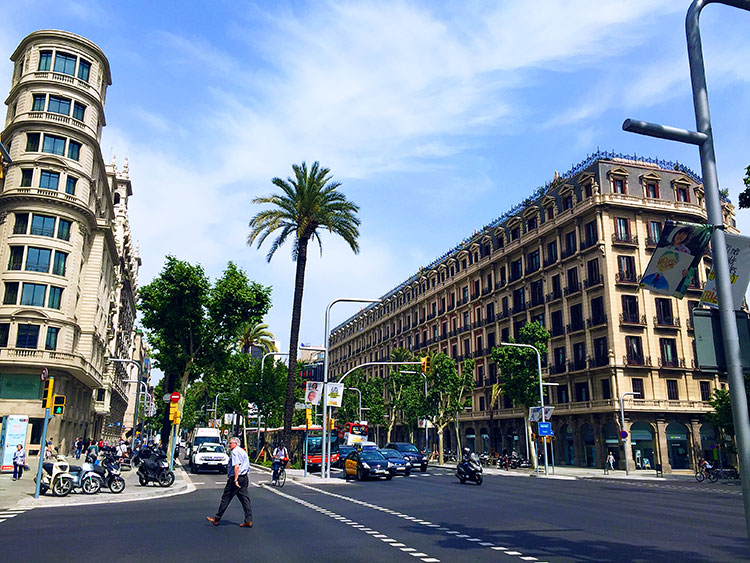
Barcelona Avinguda Diagonal
Once you’ve been in Barcelona for a few months you will probably start to wonder whether it makes more sense to buy property rather than rent. This question will definitely pop into your heard if you’re from Southern Europe, where most young people aspire to own their property. In Northern Europe, this way of thinking is less common. In any case, it’s worth thinking about this choice as it is a decision that will have a considerable impact on your future.
After the 2008 crisis, Spanish property prices collapsed, with some properties selling for half their previous value. The worst falls were in developments built purely for speculation, while the centers of cities like Madrid and Barcelona were hit less severely.
Typically local banks will finance up to 80% of the value of the property (or the price you’re paying for it, whichever of the two is lower). This is a far cry from days gone by where banks were more than happy to finance the whole purchase as well as vehicles to boot.
Therefore if we wish to buy we would need to put a downpayment of 20% of the property’s value. However, one must not forget that there are taxes and fees to be paid when purchasing property, which will likely push up that 20% towards the region of 30% to 40%, so it’s best to factor those in too when making your calculations. In Catalonia, transfer tax alone is 10% on a resale home up to €600,000.
Banks will ask you to have life insurance and home insurance with the same bank before giving you loans, and it is typically quite difficult to finance the purchase of a property with a loan from the bank back in your home country. This is quite logical. If you fail to make your monthly payments, the bank back home will find it quite difficult to repossess your home in the worst case, compared to repossessing homes in the home country. Hence they are quite careful when it comes to giving out such loans. As always, there is always some room for negotiation.
It’s really difficult to predict what prices will do in the short term, so buying a property purely for capital appreciation isn’t a good idea, as it’s far from guaranteed.
If you do a quick search online you will find many buy/rent calculators that will help you understand the financial implications of the decision. However you should definitely not rely 100% on these calculators, these are only tools to help you understand things, and they will inevitably not fully cover your particular scenario.
Keep in mind that Barcelona is a city in which there will always be a lot of demand for property, even when the real estate market in surrounding towns and villages will be practically dead. There is simply too much tourism and commerce going on in Barcelona, plus the fact that the city has reached its natural borders and there is not much more room to grow outwards.
When I lived in Barcelona, the yields on apartments there were too low for my liking. Judging by my own numbers and those of people I knew, 3-4% was a good return, and that’s before you consider any expenses related to the property plus the work involved in managing it and dealing with tenants.
However, it excludes capital appreciation, which in a city like Barcelona could be a factor that is even more important than the rental yield. Buying an apartment for capital appreciation would however mean resorting to speculation and trying to predict the future. Prices could very well go down.
Rent vs Buying – Practical Considerations
Apart from the large financial commitment that comes with buying a property, there are many other things to keep in mind when comparing renting to buying.
Flexibility
Probably the number one reason for renting would be flexibility. On a long-term lease, you can move out after the first 6 months and get your deposit back, as long as you give 30 days’ notice. That gives you a lot of flexibility especially if you don’t know how long you will be staying in Barcelona yet, or you just came to explore the city and decide whether it’s the right place for you or not.
Family stability
Of course, the flip side of that is lack of stability. Imagine that you have raised a family in a very nice apartment, and one fine day the owner calls and gives you some bad news. His children are moving out and want to live on their own, hence he needs the apartment back so that they can use it. The tenancy law (LAU) gives you some protection: a long-term lease lasts at least 5 years, or 7 if the landlord is a company, and the landlord can only take the home back for their own or a close relative’s use if the contract allows it. Once that period ends, though, you’re never guaranteed you’ll keep the apartment.
Customization
Having your own property also means that you can customize things as you deem fit, heck even paint the walls in pink if that’s what you fancy. With rental apartments this is obviously not the case, the place must be returned in its original condition and many contracts specify that you cannot make any modifications to the place. Even drilling a tiny hole to hang a painting might be disallowed in some cases, so that could be a downside especially over the longer term.
Investing
Owning a home is, of course, considered an investment although there is no guarantee that the value will rise, and you also need to consider the maintenance costs that arise on a yearly basis.
With rentals, you are not responsible for maintaining the property and paying the communal fees, so that’s one less headache for you.
However, if prices shoot upwards and you are renting, you might be kicking yourself for not buying at an earlier stage. This can be doubly frustrating if you end up paying a higher rent due to the real estate prices rising across the board.
Wrapping Up
Buying or renting is ultimately a personal decision, however, I tend to agree with those who advise that given the current market conditions, the best is to rent unless you find a perfect apartment/house that you want to live in yourself for many years. Renting simply involves much less hassle and the costs of buying are quite elevated, so you shouldn’t feel bad if you decide that renting is the way forward for you.
In fact, many foreigners in Barcelona rent for the first few years until they get a better feel for the city and the different barrios. Then when they are settled, have kids (consider school locations) and hopefully have a bit more capital they will start looking at buying that perfect property that will be best suited for them.
The idea is to buy only when you know you want to live in the same place for 15+ years. Only then does it make sense to invest a lot of money and energy into a place while also depriving yourself of the flexibility to move to other places or invest your money elsewhere. When you buy a house or apartment, you are also buying into the place you’re living in and its economics and political system. When I lived in Barcelona, I didn’t feel confident enough in the Catalan economy and politics to buy, so I kept renting and kept my options open.
See also: Official rent statistics for Barcelona (Incasòl)
So what’s your take on this subject? Have you decided to rent or buy in Barcelona?
Related







Thanks for the article, very helpful.
I love your article about renting v buying. I would like to buy 2 bed room aoartment in Barceloneta at seaview. I made uo my mind to buy
nice article
Interesting blog on renting vs buying property Barcelona, keep it up. Please keep sharing.
Why prices of properties are so high in spain?
It depends on the area you’re referring to. In general, the big cities have high property prices, just like all major cities in Europe.