
- Worldwide taxation: If you spend 183+ days in Spain, you pay tax on your global income. No exceptions.
- Income tax (IRPF): Progressive rates from 19% to 47% on salary. Investment income taxed separately at 19%–30%.
- Beckham Law: New arrivals can opt for a flat 24% rate on Spanish-sourced income for 6 years — if they qualify.
- Modelo 720 + 721: You must declare foreign assets (accounts, investments, property, crypto) worth over 50,000 EUR per category by March 31 each year.
- Key deadline: Annual tax return (Renta) filed April 6 — June 30 for the previous year’s income.
I moved to Barcelona from Malta over a decade ago. The lifestyle upgrade was immediate. The tax upgrade was… the opposite.
Spain has one of the most complex and aggressive tax regimes in Europe. Between the overlapping national and regional taxes, the foreign asset declarations, the wealth tax (yes, two of them), and the endless modelos you need to file, it’s enough to make any expat’s head spin.
This guide is the single page I wish had existed when I first became a Spanish tax resident. It covers every major tax obligation affecting expats, with links to my detailed guides on each topic. Bookmark it. You’ll come back.
A note: I am not a tax advisor. Everything here is based on years of personal experience navigating the system as an expat in Barcelona. For your specific situation, always consult a qualified professional. If you need a recommendation, I have worked with trusted tax advisors for years and can point you in the right direction.
Quick Reference: Key Spanish Taxes for Expats
| Tax / Obligation | What It Is | Rate / Threshold | Deadline |
|---|---|---|---|
| IRPF (Income Tax) | Tax on employment and self-employment income | 19% — 47% (varies by region) | April 6 — June 30 |
| Savings Tax | Tax on dividends, interest, capital gains | 19% — 30% | April 6 — June 30 |
| Wealth Tax | Annual tax on net assets above 700,000 EUR | 0.2% — 3.5% (region-dependent) | Same as IRPF |
| ITSGF (Solidarity Tax) | National wealth tax on assets above ~3.7M EUR | 1.7% — 3.5% | Same as IRPF |
| Modelo 720 | Declaration of foreign assets (non-crypto) | 50,000 EUR per category | January 1 — March 31 |
| Modelo 721 | Declaration of foreign crypto holdings | 50,000 EUR | January 1 — March 31 |
| Modelo D6 | Securities held abroad | No minimum | January 31 |
| Autonomo Social Security | Monthly contribution for self-employed | 230 — 530+ EUR/month (income-based) | Monthly |
| IVA (VAT) | Value-added tax on goods and services | 21% (standard), 10%, 4% | Quarterly (Modelo 303) |
Are You a Tax Resident in Spain?
Before anything else, you need to know whether Spain considers you a tax resident. If it does, you owe tax on your worldwide income — not just what you earn in Spain.
You’re a tax resident if any of these apply:
- You spend 183 or more days in Spain during a calendar year (doesn’t matter if you’re formally registered)
- Your main professional activity is based in Spain
- Your spouse and dependent children live in Spain (your residency is then presumed unless you prove otherwise)
This catches more people than you’d expect. If your family lives in Barcelona and you travel for work, Spain still considers you a resident. The burden of proof falls on you to demonstrate otherwise.
For a deeper look at residency rules, filing requirements, and a breakdown of every tax type, read my full guide to Spanish taxation.
Income Tax (IRPF) — The Big One
Spain’s personal income tax (Impuesto sobre la Renta de las Personas Fisicas) is a split system: 50% set by the national government, 50% by your autonomous community. Where you live matters enormously.
Combined state + regional rates (Madrid — lowest in Spain):
- Up to 12,450 EUR: 19%
- 12,451 — 20,200 EUR: 24%
- 20,201 — 35,200 EUR: 30%
- 35,201 — 60,000 EUR: 37%
- 60,001 — 300,000 EUR: 43%
- Over 300,000 EUR: 45%
Catalonia? Top marginal rates hit 50%. If you earn a high income, the difference between living in Madrid and Barcelona can easily be tens of thousands of euros per year.
Savings income (dividends, interest, capital gains) is taxed under a separate national scale that doesn’t vary by region:
- Up to 6,000 EUR: 19%
- 6,001 — 50,000 EUR: 21%
- 50,001 — 200,000 EUR: 23%
- 200,001 — 300,000 EUR: 27%
- Over 300,000 EUR: 30%
The 30% top rate took effect January 1, 2025 under Ley 7/2024. If you’re working from older references, update your numbers.
Tax returns are due between April 6 and June 30 for the previous year. There are no extensions. Late filing means penalties.
For the full picture — deductions, joint filing, digital certificates, and everything else — see my detailed Spanish taxation guide.
The Beckham Law — A Flat 24% for New Arrivals
Spain’s Beckham Law (Regimen de Impatriados) lets qualifying newcomers pay a flat 24% on Spanish-sourced employment income up to 600,000 EUR, instead of the progressive IRPF scale. Income above that threshold is taxed at 47%. Foreign income is largely exempt, and wealth tax applies only to Spanish assets.
The regime lasts 6 years and was expanded significantly by the Startup Law (Law 28/2022):
- Prior non-residence requirement reduced from 10 years to 5 years
- Application window extended from 6 months to 12 months after arriving
- Now covers digital nomads, innovative entrepreneurs, and highly qualified professionals — not just corporate transfers
Who doesn’t qualify: Self-employed workers (autonomos). The Beckham Law is designed for employees and, under the Startup Law expansion, remote workers employed by foreign companies. If you’re freelancing or running your own business as an autonomo, this regime is off the table.
Digital Nomad Visa holders (also introduced by the Startup Law) can apply for Beckham Law treatment. Non-EU nationals working remotely for foreign companies can obtain the visa for up to five years.
The Beckham Law is a genuine advantage if you qualify. A high earner paying 24% instead of 47% saves a huge amount over six years. But it comes with trade-offs — you can’t offset foreign income losses, and you lose certain deductions available under the standard regime. Run the numbers with an advisor before opting in.
Modelo 720 — Declaring Foreign Assets
If you hold assets outside Spain worth more than 50,000 EUR per category, you must file Modelo 720 between January 1 and March 31 each year. The three categories are:
- Bank accounts
- Securities, insurance, and annuities
- Real estate
The good news: Spain’s original penalty regime — which included absurd 150% surcharges and no statute of limitations — was struck down by the EU Court of Justice in January 2022. Penalties are now proportionate: 20 EUR per missing data point, with a minimum of 300 EUR and a maximum of 20,000 EUR. A four-year statute of limitations now applies.
The bad news: the form itself is still mandatory and still a pain to fill in.
I’ve written a complete guide to the Modelo 720 covering everything from how to fill it in, to community property rules for married couples, to the specific question of whether P2P lending balances need to be declared.
Modelo 721 — Crypto Declaration
Since 2023, there’s a separate form for crypto: Modelo 721. If you hold crypto worth over 50,000 EUR on foreign exchanges or custodians as of December 31, you must file between January 1 and March 31. Self-custodied wallets (where you control the private keys) are outside the scope.
From 2026, the EU’s DAC8 directive requires all EU-based crypto service providers to report client balances and transactions to tax authorities. If your Modelo 721 doesn’t match what exchanges report, an automatic assessment will follow.
Crypto Taxation in Spain
Spain has one of the more detailed crypto tax frameworks in Europe. The basics:
- Capital gains from selling or swapping crypto are taxed as savings income at 19%–30%
- Crypto-to-crypto trades are taxable — trading BTC for ETH triggers a gain/loss calculation, even if no fiat changes hands
- Gains are calculated using the FIFO method
- Staking rewards and airdrops are treated as ordinary income at IRPF rates (19%–47%)
- Crypto must be declared on your wealth tax return
For a country-by-country comparison of how crypto is treated across the continent, including which countries are still more favorable, read my guide on how Bitcoin and cryptocurrencies are taxed in Europe.
If you need a tool to track it all, Koinly connects to your exchanges and generates Spain-compatible tax reports automatically.
P2P Lending and Crowdfunding Income
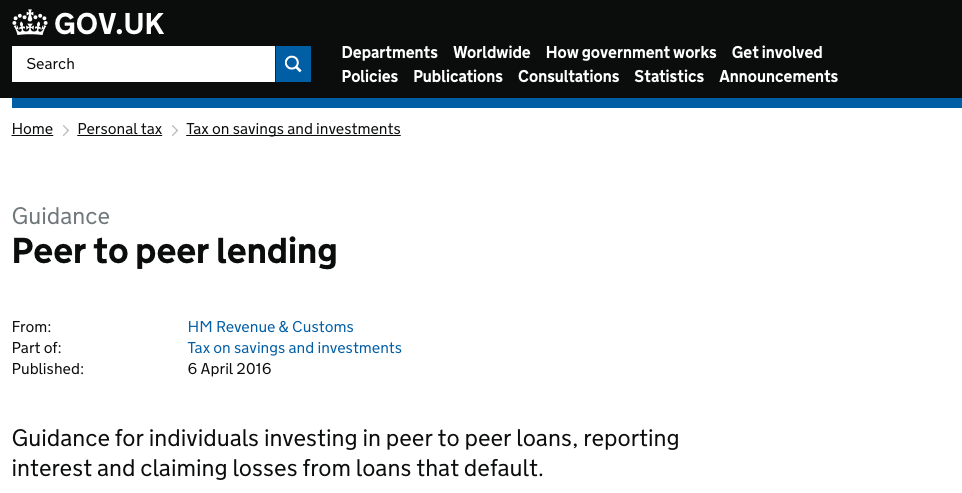
Interest from P2P lending and property crowdfunding platforms is classified as rendimientos del capital mobiliario — income from movable capital. It goes in casilla 027 of your Modelo 100 and is taxed under the savings income scale (19%–30%).
Key points expats miss:
- You must declare interest even if you reinvested it and never withdrew cash
- Spanish platforms withhold 19% automatically. Foreign platforms generally do not — you add those manually
- If a foreign platform withheld tax at source, claim double taxation relief in casilla 588
- Defaulted loans can be declared as losses once formally deemed uncollectible
I’ve written two dedicated guides: how P2P and crowdlending is taxed in Spain covers the Spanish specifics, and how P2P lending is taxed in Europe gives the continent-wide picture.
Property Income and Capital Gains
Rental income from Spanish property is taxed as general income under the IRPF. If you rent out your property, you can deduct expenses (mortgage interest, repairs, depreciation, community fees, insurance, IBI) to arrive at a net figure. EU/EEA residents can deduct a 60% allowance on net rental income from long-term residential lets.
Non-residents who own property but don’t rent it out still owe tax on an “imputed income” of 1.1%–2% of the cadastral value, taxed at 19% for EU/EEA residents and 24% for everyone else.
Capital gains from selling property are taxed under the savings income scale at 19%–30%. The gain is calculated as the sale price minus the purchase price (including transaction costs), adjusted for depreciation and improvements.
Property transfer tax: Buying a resale property incurs 6%–10% transfer tax depending on the region. New-build properties carry 10% IVA instead.
IBI (local property tax): An annual municipal tax of up to 1.3% of the cadastral value.
Self-Employment: The Autonomo System
If you work for yourself in Spain — freelancing, consulting, running an online business — you’ll register as autonomo (self-employed).
Social security contributions: Since 2023, Spain moved to an income-based contribution system. Monthly payments range from roughly 230 EUR (for the lowest earners) to over 530 EUR (for high earners), based on your declared net income. New autonomos can access a reduced flat rate of approximately 80 EUR/month for the first 12 months, extendable to 24 months if income stays below the minimum wage.
Income tax: Your net business income flows into the general IRPF brackets (19%–47%). You’ll make quarterly estimated payments (Modelo 130, due April/July/October/January) and reconcile in your annual Renta.
When to form a company instead: If you earn above roughly 60,000 EUR net per year, a Sociedad Limitada (SL) can be more tax-efficient. Corporate tax is 25% (15% for new companies in their first two profitable years), and you have more flexibility in how you extract profits.
VAT (IVA) for Freelancers and Businesses
Spain’s standard VAT rate is 21%. Reduced rates of 10% (food, restaurants, transport) and 4% (bread, medicine, books) apply to specific goods and services.
If you’re an autonomo or run an SL, you’ll charge IVA on your invoices to Spanish and EU clients (with the reverse charge mechanism applying for B2B EU sales). You file quarterly IVA returns via Modelo 303 and an annual summary via Modelo 390.
Freelancers providing services to businesses also withhold IRPF (retencion) on their invoices — typically 15% (7% during the first three years of activity). This is an advance payment of your income tax, not an additional charge.
Double Taxation Treaties
Spain has double taxation agreements with over 90 countries, including all major economies. These treaties prevent you from being taxed twice on the same income — but they don’t eliminate tax. They determine which country gets first taxing rights and provide mechanisms for credits or exemptions.
In practice, this means:
- Income taxed at source in another country can usually be credited against your Spanish tax liability
- Some income types (pensions, government salaries) have specific treaty rules that override the general framework
- You may need to provide certificates of tax residency to claim treaty benefits
If you receive income from multiple countries, a tax advisor familiar with the specific treaties is essential. The difference between correct and incorrect treaty application can be thousands of euros.
Wealth Tax — Yes, Spain Has Two
Spain levies a regional wealth tax (Impuesto sobre el Patrimonio) on net assets above 700,000 EUR per person, with an additional 300,000 EUR exemption for your primary residence. Rates range from 0.2% to 3.5% depending on your region. Madrid grants a 100% rebate, meaning its residents pay zero.
Then there’s the national solidarity tax (ITSGF), introduced in 2023 and made permanent in 2025, which targets net assets above approximately 3.7 million EUR at rates of 1.7%–3.5%. This was explicitly designed to nullify Madrid’s wealth tax exemption.
Both are covered in detail in my full Spanish taxation guide.
Key Deadlines Calendar
| When | What | Form |
|---|---|---|
| January 1 — 31 | Modelo D6 (foreign securities declaration) | D6 |
| January 1 — 20 | Q4 IVA + IRPF withholding returns | 303, 111, 130 |
| January 1 — March 31 | Modelo 720 (foreign assets) + Modelo 721 (foreign crypto) | 720, 721 |
| April 1 — 20 | Q1 IVA + IRPF withholding returns | 303, 111, 130 |
| April 6 — June 30 | Annual income tax return (Renta) + Wealth tax | 100, 714 |
| July 1 — 20 | Q2 IVA + IRPF withholding returns | 303, 111, 130 |
| October 1 — 20 | Q3 IVA + IRPF withholding returns | 303, 111, 130 |
Miss these and you’ll face automatic penalties. Spain does not offer filing extensions.
Thinking About Leaving? Know Your Options
If you’re weighing up Spain against more tax-friendly jurisdictions, you’re not alone. I’ve spent years researching this.
- The best European corporate and personal tax structures in 2026
- Portugal tax for expats: NHR is gone, IFICI is here
- The tax advantages of Cyprus
- Malta’s 5% effective corporate tax rate
- Making Malta your new (low-tax) home
- The Netherlands in global tax strategies
- Can digital nomads legally pay no taxes?
And when you do leave Spain, don’t forget to file Modelo 030 to deregister as a tax resident, and check whether the exit tax applies to you (it kicks in if you’ve been resident for 10+ years in the past 15 and hold shares worth over 4 million EUR or 25%+ in a company worth over 1 million EUR).
Related Tax Guides on This Site
This hub connects to all the detailed tax content I’ve published over the years:
- Expat Guide to Spanish Taxation — the comprehensive walkthrough of every Spanish tax type
- Filling in the Modelo 720 for Expats — step-by-step guide including married couples and P2P questions
- How P2P Lending and Crowdlending is Taxed in Spain
- How P2P Lending is Taxed in Europe
- How Bitcoin and Cryptocurrencies are Taxed in Europe
- The Most Crypto-Friendly Countries in Europe
- The Best European Tax Structures in 2026
- Portugal Tax for Expats (NHR / IFICI)
- The Tax Advantages of Cyprus
- Malta’s 5% Effective Corporate Tax Rate
- Can Digital Nomads Legally Pay No Taxes?
- Tax vs. Life: Making the Right Move
Frequently Asked Questions
Do I have to pay tax on worldwide income in Spain?
Yes. If you are a tax resident in Spain (183+ days per year, or your main economic interests are here), you owe tax on all income earned anywhere in the world. This includes salary, investment income, rental income, capital gains, and crypto profits regardless of where they originate. Double taxation treaties can provide credits for tax already paid in other countries, but they do not eliminate your Spanish obligation.
What is the Beckham Law and do I qualify?
The Beckham Law is a special tax regime that lets qualifying newcomers pay a flat 24% on Spanish-sourced employment income (up to 600,000 EUR) instead of the progressive IRPF scale. You qualify if you haven’t been a Spanish tax resident in the past 5 years and you’re moving to Spain for employment or as a remote worker for a foreign company. Self-employed autonomos do not qualify. You must apply within 6 months of registering with Spanish Social Security (the Startup Law extended the relocation window to 12 months).
When is the Modelo 720 deadline?
The Modelo 720 must be filed between January 1 and March 31 each year, covering assets held abroad as of December 31 of the previous year. The filing obligation is triggered when any single category (bank accounts, securities, or real estate) exceeds 50,000 EUR in total value. In subsequent years, you only need to refile if a category increases by 20,000 EUR or more, or if you close or open accounts.
How is crypto taxed in Spain?
Capital gains from selling or swapping crypto are taxed as savings income at rates from 19% to 30%. Crypto-to-crypto trades count as taxable events. Staking rewards and airdrops are taxed as ordinary income at IRPF rates (19%–47%). You must declare crypto on your wealth tax return, and if you hold over 50,000 EUR in crypto on foreign platforms, you must also file Modelo 721 by March 31 each year.
Do I need an accountant or can I file taxes myself in Spain?
You can technically file yourself using the Hacienda website and the Renta draft they provide. But if you have foreign income, investments, or assets — which most expats do — I strongly recommend working with an accountant who understands international taxation. The risk of errors on forms like the Modelo 720, and the resulting penalties, makes professional help well worth the cost. Expect to pay 300–600 EUR per year for a good tax advisor who handles everything.
What is the wealth tax in Spain?
Spain has two wealth taxes. The regional wealth tax applies to net assets above 700,000 EUR per person (with a 300,000 EUR exemption for your primary residence), at rates from 0.2% to 3.5% depending on your region. Madrid grants a 100% rebate. On top of that, a national solidarity tax targets assets above approximately 3.7 million EUR at 1.7%–3.5%. The solidarity tax was designed to override Madrid’s exemption.
What happens if I leave Spain — is there an exit tax?
If you’ve been a Spanish tax resident for at least 10 of the past 15 years, an exit tax may apply to unrealized capital gains on shares or company interests worth over 4 million EUR (or a 25%+ stake worth over 1 million EUR). Moving to another EU/EEA country defers the tax for up to 10 years. You must also file Modelo 030 to deregister as a tax resident and obtain a certificate of tax residency from your new country.
How much do autonomos pay in social security?
Since 2023, autonomo contributions are based on your net income. Monthly payments range from approximately 230 EUR for the lowest earners to over 530 EUR for high earners. New autonomos can access a flat rate of around 80 EUR per month for the first 12 months, extendable to 24 months if income remains below the minimum wage. These contributions are mandatory regardless of whether you also contribute to social security in another country — unless a bilateral agreement applies.
Get in touch for a tax consultation
Last updated: April 2026. Tax rates and thresholds are current as of the 2025 tax year (filed in 2026). Always verify with a qualified advisor for your specific situation.
Related







Leave a Reply