Track your crypto taxes with Koinly
If you own crypto — especially across multiple exchanges and wallets — you already know the tax reporting headache. Every trade, swap, staking reward, airdrop, and DeFi interaction is potentially a taxable event. Tracking all of it manually is somewhere between “soul-crushing” and “impossible.”
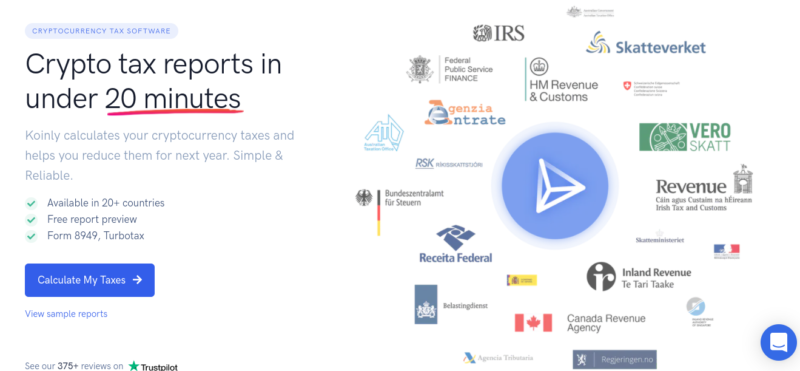
Koinly exists to solve exactly this problem. It pulls your transaction data from exchanges, wallets, and DeFi protocols, figures out your capital gains (and losses), and generates the tax reports your country’s tax office actually wants.
I’ve been following this platform for years, and it has matured significantly. With support for over 1,000 integrations, 20,000+ cryptocurrencies, and tax reports for 20+ countries, it’s one of the most comprehensive crypto tax tools you can use. Here’s my updated take.
- Best for: investors who want clean, country-specific tax reports with minimal fuss
- Free plan: yes, import up to 10,000 transactions; you only pay to download the reports
- Paid from: $49 per tax year (Newbie), priced by transaction count
- Coverage: 20+ countries with localized tax reports
Koinly – An Overview
Unless you live in a crypto-friendly country with no capital gains tax on digital assets, you’re going to owe taxes on your crypto activities. And the rules keep getting stricter. The EU’s MiCA regulation, combined with tightening reporting requirements across most European countries, means that flying under the radar is becoming less and less viable.
Koinly takes the complexity out of this. The platform automatically compiles your trades across every exchange and wallet you use, calculates your capital gains using the cost-basis method your country requires, and generates the actual tax forms you need to file.
The real time-saver? It can do this in minutes, even if you have thousands of transactions across dozens of platforms. Try doing that in a spreadsheet.
Koinly Features
Koinly has expanded well beyond basic tax reporting. Here’s what the platform offers in 2026:
Massive Integration Library
This is Koinly’s biggest strength. The platform connects to over 1,000 integrations, including:
- 850+ exchanges and wallets — every major platform is covered, from Binance and Coinbase to Kraken and niche platforms
- 7,200+ DeFi protocols — Koinly automatically categorizes complex on-chain activities like minting, lending, liquidity provision, and yield farming
- 20,000+ cryptocurrencies supported
- Unlimited CSV imports for any platform not directly integrated
Recent integrations added in 2025 include Hyperliquid, Berachain, Apechain, and several other newer networks. The platform keeps adding support for new chains as they gain traction.
Automatic Transaction Tracking
Connect your exchange accounts via API and Koinly syncs your transactions automatically. No need to manually export CSV files every time you want to update your records (though you can if you prefer).
The platform tracks everything: spot trades, margin trades, staking rewards, mining income, airdrops, forks, DeFi interactions, and NFT trades. All visible through a single dashboard.
Smart Transfer Matching
This is one of Koinly’s most useful features. The AI-powered Smart Transfer system automatically detects when you’ve moved crypto between your own wallets — for example, transferring ETH from Binance to a hardware wallet. Without this, those transfers could be misidentified as taxable disposals. Koinly recognizes them and excludes them from your tax reports.

Portfolio Tracking and Growth
Beyond taxes, Koinly gives you a clear view of your entire crypto portfolio across all wallets and exchanges. You can see your total holdings, profit/loss, unrealized capital gains, and portfolio growth over time. This alone makes the free plan worth setting up, even if you don’t need tax reports yet.
Multi-Country Tax Compliance
Koinly generates localized tax reports for 20+ countries, including:
- USA: IRS Form 8949, Schedule D, Schedule 1, TurboTax-compatible reports
- UK: HMRC capital gains reports using the Shared Pool method
- Germany, France, Spain, and other EU countries: country-specific reporting
- Australia, Canada, Japan and more
You can choose from multiple cost-basis methods depending on your jurisdiction: FIFO (First In First Out), LIFO (Last In First Out), HIFO (Highest In First Out), Average Cost (ACB), and Shared Pool (UK).
A 2025 update improved the wallet-based cost tracking system, meaning tax lots are now selected correctly when assets are transferred between wallets — a significant accuracy improvement over the previous universal cost-tracking method.
Tax Report Types
Koinly generates several report types:
- Capital gains disposal report (long-term and short-term holdings)
- Income report (staking, airdrops, forks, DeFi rewards)
- End-of-year valuation report
- Gift and donation reports
- Loss reports (hacks, security breaches)
Reports can be downloaded as PDF, CSV, or Excel, and exported directly to tax filing software like TurboTax, TaxACT, and Drake.
For European crypto investors, the ability to generate country-specific reports that comply with local tax regulations is a huge time-saver. I’ve covered crypto tax loss harvesting strategies separately if you want to optimize your tax position.
How to Get Started with Koinly
The setup process is straightforward and takes about 15-20 minutes for most users.
Step 1: Set Up Your Wallets
After creating your account, head to the Wallet section and start adding your exchanges and wallets. Koinly creates a mirror of each one, showing your cryptocurrency holdings (without any actual wallet functionality — it’s read-only).

With 850+ supported platforms, you’ll almost certainly find your exchanges and wallets in the list. If not, you can create a custom wallet and import data via CSV.
Step 2: Import Your Transaction Data
Four ways to get your data in:
- API sync (recommended) — connects directly to your exchange and keeps everything up to date automatically
- CSV file upload — download from your exchange and upload to Koinly
- Custom file — for non-standard data formats
- Manual entry — for one-off transactions
API sync is the way to go for most people. Set it up once and forget about it.
Step 3: Let Koinly Calculate
Once your data is imported, Koinly fetches market prices, verifies transactions, and calculates your capital gains. This happens automatically and usually takes just a few minutes, even for large transaction histories.
Step 4: Verify the Data
Not every exchange provides complete transaction history through APIs. For example, some don’t include fiat deposit/withdrawal history, and others may only provide limited historical data. Koinly will show a yellow warning icon next to any wallet where balances don’t match.
Cross-check by comparing your Koinly balances against your actual exchange balances. Small differences are normal. Large variances mean something was missed — usually fixable by uploading a supplementary CSV.
Step 5: Download Your Tax Reports
Once everything checks out, head to the Tax Reports page, review your capital gains summary, and download the reports you need. The reports are formatted for your country’s tax regulations by default.
Koinly Pricing
Koinly’s paid plans are priced per tax year, based on how many transactions you need to process. The figures below are current as of 2026; check the live pricing page for the latest.
Free Plan – $0
The free plan is genuinely useful. You can import up to 10,000 transactions, connect unlimited wallets and exchanges, track your portfolio, and preview your capital gains. The only thing you pay for is downloading the official tax reports, so you can set everything up and see exactly what you’d owe before committing.
Newbie Plan – $49 per Tax Year
Up to 100 transactions. Includes all tax report types, international tax reports, audit reports, and export to TurboTax/TaxACT. Good for casual holders who buy and hold without frequent trading.
Hodler Plan – $99 per Tax Year
Up to 1,000 transactions. Same features as Newbie, just a higher transaction limit. Best for active investors who trade regularly across a few platforms.
Trader Plan – $179 per Tax Year
Up to 3,000 transactions with priority email support from the Koinly team. For power traders and those using DeFi protocols that generate many individual transactions.
Pro Plan – $279 per Tax Year
Up to 10,000 transactions. The top standard tier, built for heavy traders reconciling large multi-year histories.
Custom Plans
For very large accounts (hundreds of thousands of transactions), Koinly offers custom pricing. Contact their team for a tailored quote.
Important Note on How Plans Work
Koinly’s transaction count is cumulative. To calculate your gains for 2025, Koinly needs to process all your transactions from previous years too. So if you have 9,000 historical transactions and only 90 in the current year, you’ll need a plan that covers 9,090 total transactions.
However, you only get the report for the year you’re paying for. If you need reports for multiple years, you’ll need to purchase a plan for each year separately. You can upgrade by paying the difference.
Koinly Safety and Security
Koinly has invested heavily in security, and the certifications back it up:
- SOC 2 certified — validates adherence to rigorous security and operational standards
- ISO 27001 certified — the international standard for information security management systems
- GDPR compliant — important for European users
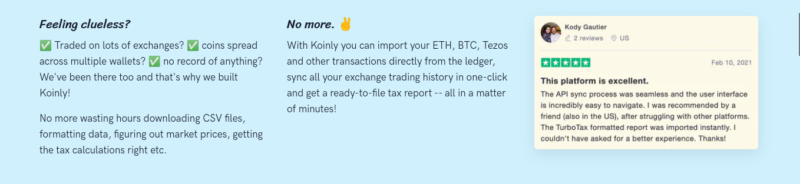
Crucially, Koinly never has access to your funds. It uses read-only API connections — meaning it can view your transaction history but cannot trade or withdraw anything. You can configure your API keys with all trading and withdrawal permissions disabled for extra peace of mind.
The platform uses AWS for hosting and employs encryption for all stored API keys. There have been no reported data breaches.
How Koinly Compares to Competitors
The crypto tax software market has seen some consolidation since 2023. Here’s how Koinly stacks up:
- CoinTracking — another popular option with a solid portfolio tracking dashboard. Supports margin trades and liquidity pools. However, users report slower and less accurate imports compared to Koinly, often requiring manual tagging for complex transactions.
- Blockpit (which acquired Accointing in 2024) — originally focused on the European market. Now a broader offering after the acquisition, with both EU and US tax report support. Worth considering if you were an Accointing user.
- CoinTracker — excellent portfolio tracker that’s integrated with Coinbase. Strong on the tracking side, but Koinly edges it for international tax reporting, especially outside the US.
- CoinLedger (formerly CryptoTrader.Tax) is the simplest of the bunch and the strongest on US tax-software integration, exporting straight into TurboTax and H&R Block. Worth a look if you want the fastest route to a finished report.
- Divly is a European specialist that generates your country’s official tax form (such as Sweden’s K4 or Germany’s Anlage SO) in your own language. If you file in a country it localizes for, it can get you closer to a submittable document than a generic report.
Koinly’s main advantage is its combination of massive integration support, international tax compliance, and user-friendly interface. For European users specifically, it’s hard to beat — most competitors lean heavily toward US tax codes.
Koinly Resources and Customer Support
Koinly offers a solid set of free resources: a crypto tax calculator, country-specific tax guides, and a comprehensive help center. The blog is regularly updated with articles on tax regulation changes (including MiCA implications for European investors).
For paid users, support is available via live chat and email. Trader plan users get priority support. Free plan users may experience longer response times.
The Koinly community forums are also active and useful for troubleshooting specific import issues or understanding how particular transaction types are handled.
Potential Downsides
No platform is perfect. Here are the main drawbacks to consider:
- Pricing can add up: If you have a large historical transaction count, you might end up on a higher plan than your current-year activity warrants. The cumulative transaction counting can feel punishing for long-time crypto users.
- API limitations: Some exchanges don’t provide complete data through their APIs (Binance fiat history is a common issue). You’ll need to supplement with CSV uploads for full accuracy.
- DeFi categorization isn’t always perfect: While Koinly has gotten much better at handling DeFi transactions, complex protocol interactions sometimes need manual review and recategorization.
- Per-year pricing: You need to purchase a plan for each tax year you want reports for. If you need to file for multiple years, costs multiply.
These are relatively minor complaints for what’s otherwise a very capable platform. The time saved compared to manual tracking easily justifies the cost for most crypto investors.
Koinly – Conclusion
Koinly has earned its position as one of the go-to platforms for crypto tax reporting. The integration library is massive, the reports are localized for 20+ countries, and the security credentials (SOC 2, ISO 27001) are reassuring.
For European crypto investors dealing with evolving tax regulations, Koinly is particularly valuable. It handles the complexity of different cost-basis methods across jurisdictions and generates reports that your accountant can actually use.
The free plan is genuinely useful for portfolio tracking alone. And when tax season comes around, the paid plans ($49-$279/year) are a fraction of what you’d pay an accountant to manually sort through thousands of crypto transactions.
If you’re actively trading or holding crypto across multiple platforms, I’d recommend setting up a free Koinly account now — even if you’re not ready to pull the trigger on tax reports yet. Having your full transaction history imported and organized will save you a significant amount of stress when filing time arrives.
See also: How are Bitcoin and cryptocurrencies taxed in Europe?
Do your crypto taxes with Koinly
Frequently Asked Questions
Is Koinly free?
Koinly offers a genuinely useful free plan that includes unlimited transaction imports, portfolio tracking, and a preview of your capital gains. However, downloading actual tax reports requires a paid plan, which starts at $49 per tax year. The free plan is a great way to get set up and see exactly what you owe before paying for reports.
How much does Koinly cost?
Paid plans range from $49 to $279 per tax year, depending on the number of transactions: Newbie ($49, up to 100 transactions), Hodler ($99, up to 1,000), and Trader ($179, up to 3,000) and Pro ($279, up to 10,000). Custom pricing is available for portfolios with over 500,000 transactions. Each plan covers one tax year, so you’ll need separate plans if you need reports for multiple years.
Is Koinly safe to use?
Yes. Koinly is SOC 2 and ISO 27001 certified, and GDPR compliant. It only uses read-only API connections, so it can never access, trade, or withdraw your funds. API keys are encrypted before storage, and the platform is hosted on AWS. There have been no reported data breaches since Koinly launched.
Which countries does Koinly support?
Koinly generates localized tax reports for over 20 countries, including the US (IRS Form 8949, Schedule D), UK (HMRC), Germany, France, Spain, Australia, Canada, Japan, and more. It supports country-specific cost-basis methods and tax calculation rules. Even if your country isn’t specifically supported, you can still use Koinly for portfolio tracking and generate generic capital gains reports.
How does Koinly handle DeFi and NFTs?
Koinly supports 7,200+ DeFi protocols and automatically categorizes on-chain activities like lending, staking, liquidity provision, yield farming, and NFT trades. While it handles most DeFi transactions well, complex protocol interactions sometimes require manual review and recategorization. The platform has improved significantly in this area over the past two years.
What’s the difference between Koinly and CoinTracking?
CoinTracking is another solid option with good portfolio tracking. Koinly’s main advantages are broader integration support (1,000+ vs CoinTracking’s library), better DeFi handling, and stronger international tax reporting — especially for European users. CoinTracking can be better for advanced traders who need detailed portfolio analytics. Both are good choices; I’d recommend trying the free tiers of each to see which interface you prefer.
Related reading: Best crypto tax software in 2026 and CoinTracking vs Koinly.
Summary
Koinly is a crypto tax preparation software that you can rely on to calculate your crypto tax for the year, and you can also use it to keep track of your crypto portfolio across various exchanges and wallets.
Related









I used this walk through to do my 2021 tax return and it was very easy with koinly. https://sharetrading.guru/using-koinly-to-complete-your-australian-tax-return/