Over the last several years I’ve become genuinely interested in nutrition. Part of that was chasing athletic performance — I play padel, lift, and pay attention to body composition — and part was simply noticing how much my energy, focus, and sleep respond to what I eat.
Nutrition is a field full of loud opinions and shaky evidence. I’ve tried to stay close to the handful of things that actually hold up across decent research and long-term experience. In practice, what I eat is essentially a Mediterranean diet — seasonal, cooked fresh, built around vegetables, legumes, grains, fish, olive oil, and moderate animal protein. It’s one of the few dietary patterns with genuinely robust long-term evidence behind it, and it happens to match the food cultures I actually live near.
Here are the rules of thumb I apply to my plate — whether I’m cooking or someone else is cooking for me.
The rules
- Whole grains or their derivatives — whole-wheat bread, whole-wheat pasta, brown rice, etc. — in most meals, except those built around potatoes.
- Legumes every day — lentils, chickpeas, beans. In smaller quantities than the whole grains, but daily.
- Fish, eggs, and meat — roughly daily, with fish at least twice a week for the omega-3s. I don’t obsess over ratios; I just make sure animal protein shows up consistently.
- One or two vegetable types in every dish. Plain boiled broccoli as a side is fine. It doesn’t need to be elaborate — it needs to be present.
- One to three fruits per day, ideally local and seasonal. This doesn’t include packaged or bottled fruit juices, which are typically loaded with sugar. Whole fruit is almost always better — you keep the fibre, which is the point. Juicing concentrates the fructose and throws the fibre away.
- One dairy product per day, preferably fermented. Greek yoghurt is my default — for breakfast, or after dinner as dessert.
- Fatty foods in moderate quantities, weighted toward plant sources (olive oil, nuts, seeds) plus fatty fish, with an eye on a healthy balance between omega-6 and omega-3 fatty acids.
- Ultra-processed foods kept to an absolute minimum. Refined grains, refined oils, refined sugar, and anything with an ingredient list longer than the dish itself. This is the single highest-leverage rule on the list.
- Salt: don’t fear it, don’t drown in it. If you’re cooking with real ingredients, you’re already well below where most people end up on a UPF-heavy diet.
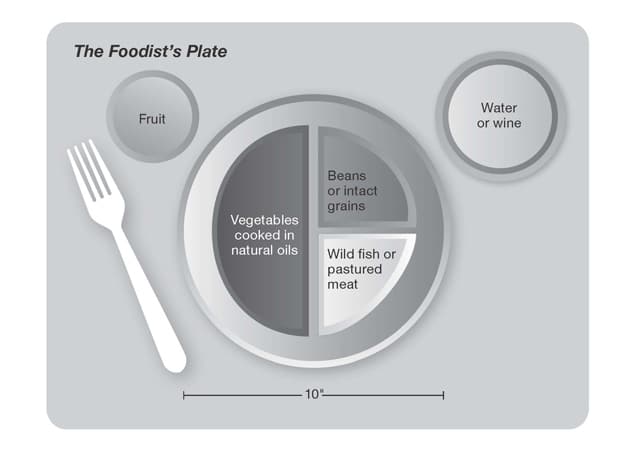
The image above shows the rough portions I aim for in a typical meal.
Drinks
- Water is the default. Everything else is a sometimes drink.
- Coffee daily, no real limit before 3 or 4pm. It doesn’t affect my sleep if I cut it off by mid-afternoon. No sugar.
- Alcohol, minimal. I drink at social events when I feel like it, which ends up being once or twice a month — usually a couple of glasses of wine. I don’t miss it the rest of the time.
I eat when I’m hungry
I don’t follow a meal schedule, don’t do structured fasting, and don’t force breakfast if I’m not hungry. Hunger is a reliable signal when you’re eating real food; it gets unreliable when you’re eating ultra-processed stuff that hijacks appetite. Fix the inputs and you can trust the signal.
The two golden rules
Beyond the composition of what’s on the plate, two habits matter at least as much:
- Stop before you’re full. Eat until satisfied, not until stuffed — the Japanese call it hara hachi bu, eating to 80%. This gets much easier when the rules above are followed, because fibre-heavy meals fill you up and keep you full.
- Chew properly. Slow down. Chewing kicks off digestion and helps you actually absorb what you’re eating — plus it gives the satiety signal time to reach your brain before you’ve overshot.
If you hit these two, most of the rest sorts itself out.
Supplements
I’ve written a separate post on supplements — what I actually take and why. Food first, supplements to fill specific gaps.
Why I don’t worry about exact macros
For athletes chasing specific goals, macro tracking matters. For everyone else, the rules above will cover 90% of what you need. The difference between a “great” and a “good” diet at this level is mostly about consistency, not optimization.
Keeping these bases covered, it’s not hard to build a diet around your location, physical activity, and what’s available at your local market.
The changes that made the biggest difference
Two shifts did more for me than any single rule above.
The first was hiring a chef. Once the food showing up on the table is consistently high-quality, seasonal, cooked fresh, and built around the rules above, most of the daily friction disappears. I don’t negotiate with myself about what to eat, I don’t ration portions because everything is already nutrient-dense and satisfying, and I don’t have to cook when I’d rather be doing something else.
Sourcing is the other half of it, and it’s the part most people underestimate. In a supermarket you often don’t really know what you’re buying — where it came from, how it was grown, how long it’s been sitting. A good chef handles that piece too: knowing the producers, picking what’s actually in season, avoiding the industrial-food-system defaults. Of everything I’ve tried over the years — tracking, meal prep, cutting categories — outsourcing the cooking and the sourcing to someone who shares the same nutritional priorities was by far the highest-leverage move.
The second was pulling back on bread. I haven’t eliminated it; I still have it sporadically. But it used to be a default at most meals and now it isn’t. I don’t believe in cutting whole food categories — life is for living, and a rigid diet you resent is worse than a flexible one you sustain. Bread in particular is just easy to overshoot on, and the meals I build without it tend to be denser in vegetables, legumes, and protein by default.
The chef piece is the realisation behind HealthyFoodBCN — custom meal plans, delivered in Barcelona, with the option to coordinate directly with a nutritionist. A private chef is more accessible than most people realise.
Further reading
Ultimately, the best source of nutrition knowledge isn’t books — it’s observing healthy people and paying attention to what they actually do. The Mediterranean basin offers plenty of examples: long-lived populations eating seasonally, cooking fresh, and building meals around plants, fish, legumes, and olive oil. Books help you question dogma and spot nonsense, but the evidence base in popular nutrition writing is thinner than most authors admit. A few resources I’ve genuinely found useful:
- Otra Alimentación es Posible by Claude Aubert — one of the best Spanish-language books I can recommend, if you read Spanish. Available here.
- Ultra-Processed People by Chris van Tulleken — the UPF evidence base is the strongest argument for any single rule on the list above, and this book builds it carefully.
- Sheila Kealey’s evidence-based nutrition resources — and her list of nutrition experts you shouldn’t trust, which is equally useful.
Related









Leave a Reply