Comparing Bondora and PeerBerry isn’t really comparing two similar products. It’s comparing two completely different philosophies of P2P investing. Bondora’s Go & Grow gives you a flat 6% annual return with absolutely zero effort — deposit money, earn interest, withdraw when you want. PeerBerry gives you ~11% through a traditional loan marketplace where you choose originators, set auto-invest criteria, and manage your portfolio. My PeerBerry review covers that platform on its own.
I’ve invested on both: Bondora from around 2016, and PeerBerry from shortly after its 2017 launch. My experience reflects what the numbers suggest: Bondora is the savings account alternative that happens to live in the P2P space; PeerBerry is actual P2P investing with all the control and complexity that entails.
The short version: If you want maximum simplicity and are OK with lower returns, Bondora’s Go & Grow is hard to beat. If you want nearly double the returns and don’t mind a bit more involvement, PeerBerry is the stronger platform. Most investors shouldn’t agonize over choosing — the answer depends entirely on what you value more: simplicity or returns.
Quick Comparison: Bondora vs PeerBerry
| Feature | Bondora | PeerBerry |
|---|---|---|
| Founded | 2009 | 2017 |
| Country | Estonia | Croatia (office in Vilnius) |
| Regulation | Estonian Financial Supervision Authority (EFSA) | Not licensed |
| Main Product | Go & Grow (6% flat) | Loan marketplace (~11%) |
| Buyback Guarantee | No | Yes (60 days) |
| Secondary Market | Yes (limited liquidity) | Yes (since January 2026, no fees) |
| Auto-Invest | Yes (Go & Grow is fully automatic) | Yes (configurable) |
| Min. Investment | EUR 1 | EUR 10 |
| Total Funded | Large (since 2009) | EUR 3.55 billion+ |
| Registered Investors | Large | 123,000+ |
| Loan Originators | 1 (Bondora itself) | 36 |
| Countries (loans) | 5 (Estonia, Finland, Netherlands, Spain, Latvia) | 17 |
| Fees | EUR 1 withdrawal fee | None |
| Loyalty Program | No | Yes (+0.5% to +1%) |
| Company Profitable | Yes (8 consecutive years) | Yes (Aventus Group/Gofingo) |
Returns: 6% Flat vs ~11% Variable
The return difference is the elephant in the room. Bondora’s Go & Grow pays a flat 6% annually. PeerBerry’s average is around 11%, and with the Platinum loyalty tier (EUR 40,000+ invested), you can push that to 12%.
Let’s put real numbers on this. On a EUR 10,000 investment over 3 years:
- Bondora Go & Grow at 6%: ~EUR 1,910 in returns
- PeerBerry at 11%: ~EUR 3,676 in returns
- PeerBerry at 12% (Platinum): ~EUR 4,049 in returns
That’s a difference of EUR 1,766 to EUR 2,139 over three years on just EUR 10,000. Scale that up to EUR 50,000 and the gap becomes EUR 8,830 to EUR 10,695. That’s real money.
The counterargument: Bondora’s 6% is a fixed rate. You know exactly what you’re getting. PeerBerry’s 11% is an average — your actual returns depend on loan availability, reinvestment speed, and whether any originators run into trouble. Over PeerBerry’s history, the returns have been consistent, but they’re not guaranteed the way Go & Grow’s rate is.
For me, PeerBerry’s roughly 4 percentage point advantage justifies the additional complexity. But I understand why some investors prefer the certainty of Bondora’s fixed rate, especially those who treat P2P as one small slice of a larger portfolio and don’t want to think about it.
Regulation and Safety
Bondora is regulated by the Estonian Financial Supervision Authority (EFSA) and has been operating since 2009 — making it one of the oldest P2P platforms in Europe. The company has been profitable for eight consecutive years, which is exceptional in this industry. Investor funds are held in segregated accounts, and the company publishes regular financial reports.
PeerBerry operates from Croatia without an investment or crowdfunding license, so it isn’t regulated under MiFID II or ECSP frameworks. There’s no equivalent investor compensation scheme. The platform relies on the financial strength of its loan originators, primarily Aventus Group, which supplies 24 of its 36 originators, and Gofingo Group, both of which report being profitable.
Bondora’s regulatory position is stronger. But it’s worth understanding what “safer” means in practice. Bondora originates all its own loans — so if Bondora itself faces problems, there’s no diversification across multiple independent lenders. PeerBerry at least has 36 different loan originators (albeit dominated by Aventus Group), providing some structural separation between the platform and the lending operations.
The real safety question is: what happens if the platform goes under? With Bondora’s EFSA regulation, there are clearer procedures and oversight. With PeerBerry, you’re relying on the Aventus Group guarantee and the platform’s operational integrity. Neither scenario is likely given both companies’ profitability, but the regulatory framework gives Bondora a structural edge for worst-case scenarios.
How They Actually Work (Day to Day)
Using Bondora’s Go & Grow is about as close to a savings account as P2P lending gets. You open an account, verify your identity, deposit money via SEPA transfer, and click one button to allocate to Go & Grow. That’s it. Returns accrue daily. You can withdraw at any time (EUR 1 fee). There is nothing to configure, no loans to evaluate, no auto-invest settings to optimize. It’s an account you can forget about, because it requires literally zero attention.
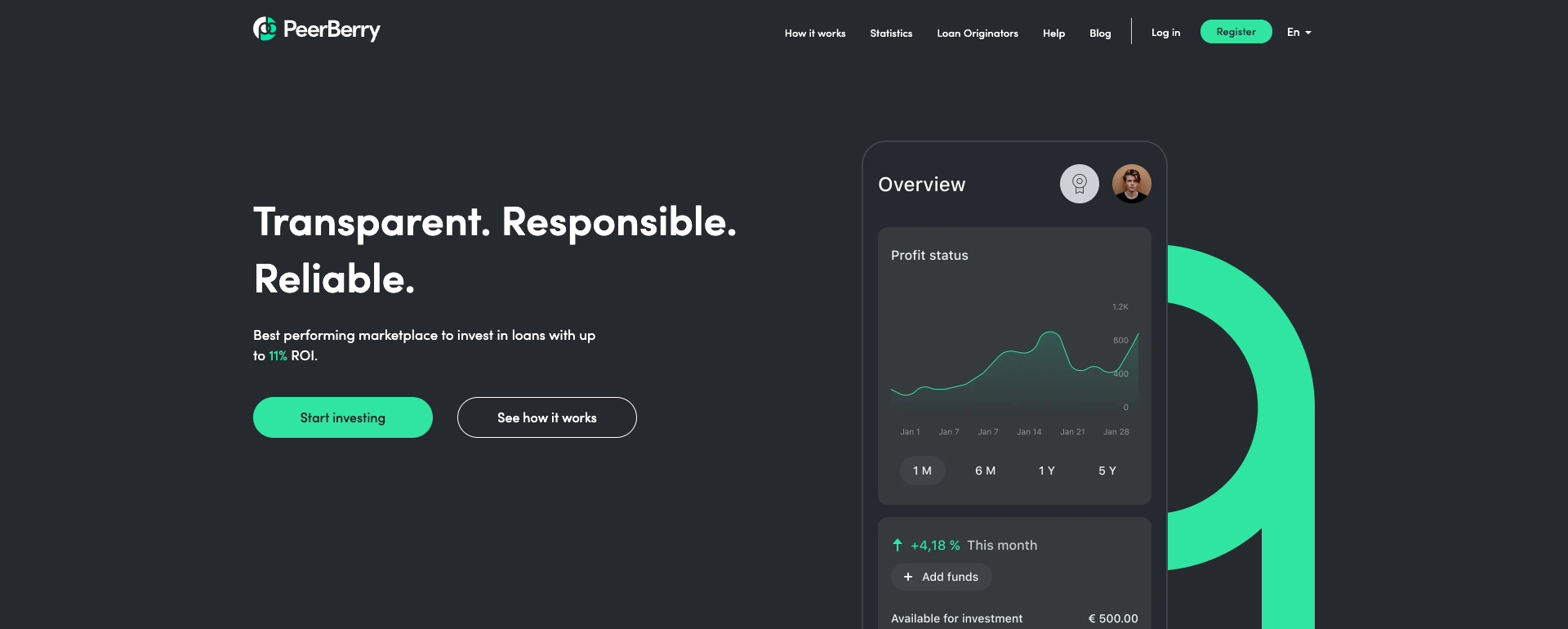
PeerBerry requires more engagement, though “more” is relative. You set up auto-invest with your preferences — loan originator, interest rate, loan term, country, buyback guarantee — and the system does the rest. Most loans mature in about 30 days (they’re full bullet loans, meaning you get principal plus interest at the end), so your money recycles quickly. You should check in occasionally to make sure auto-invest is running smoothly and that your criteria still match available supply.
The difference in time investment is real. Bondora takes 5 minutes to set up and then zero minutes per month. PeerBerry takes 15-20 minutes to set up and maybe 10-15 minutes per month to review. For a hands-off investor, that’s the gap that matters.
Loan Model and Diversification
These two platforms have fundamentally different structures, and that affects your risk exposure.
Bondora is a single-originator platform. The company itself issues consumer loans in Estonia, Finland, the Netherlands, Spain and Latvia, then offers them to investors through Go & Grow. You have no control over which loans your money funds — Bondora manages the entire portfolio. The advantage is simplicity and quality control. The disadvantage is concentration: your entire investment sits with one company’s lending decisions.
PeerBerry is a loan marketplace with 36 originators across 17 countries. Aventus Group dominates, supplying 24 of them, but you can also invest through Gofingo, SIB Group and other originators. The loans span short-term consumer, long-term consumer, real estate, and leasing products. You have granular control over which originators and loan types you invest in.
For diversification-minded investors, PeerBerry offers more levers to pull. You can spread across multiple originators, countries, and loan types. Bondora’s Go & Grow is a black box by comparison — you’re trusting the company to manage diversification internally.
That said, PeerBerry’s reliance on Aventus Group is a real issue. If something were to happen to Aventus, the platform’s loan supply would be severely impacted. This is PeerBerry’s single biggest structural risk, and it’s not unlike Bondora’s single-originator model in terms of concentration — just structured differently.
Fees
PeerBerry charges zero fees. No investment fees, no withdrawal fees, no management fees. Combined with the loyalty program (Silver at EUR 10,000 adds 0.5%, Gold at EUR 25,000 adds 0.75%, Platinum at EUR 40,000 adds 1%), PeerBerry is one of the most cost-effective P2P platforms operating today.
Bondora charges a EUR 1 fee per Go & Grow withdrawal. No other fees apply. On a EUR 10,000 portfolio, the occasional EUR 1 withdrawal fee is negligible. It’s essentially fee-free for long-term investors.
Both platforms are extremely cost-effective compared to platforms like Mintos, which charges 0.29% annually on Custom Portfolios and 0.85% on secondary market transactions.
Who Should Choose Which?
Choose Bondora if you:
- Want a completely hands-off experience with zero ongoing management
- Prefer a fixed, predictable return (6%) over variable higher returns
- Value the regulatory oversight of the Estonian Financial Supervision Authority
- Are new to P2P lending and want the simplest possible entry point
- Think of P2P as a savings account alternative rather than an investment strategy
- Want to start with as little as EUR 1
Choose PeerBerry if you:
- Want higher returns (~11%, or up to 12% with the loyalty program)
- Prefer a traditional loan marketplace with control over your investments
- Value buyback guarantees on your loans (Bondora doesn’t offer this)
- Are investing EUR 10,000+ and want to benefit from the loyalty program
- Are comfortable with a platform that isn’t regulated under MiFID II/ECSP
- Want zero fees (not even a withdrawal fee)
Use both if: You want to hedge your approach. A common strategy among European P2P investors is to keep a portion in Bondora Go & Grow as a stable, liquid holding (similar to a cash buffer) while investing a larger allocation on PeerBerry for the higher returns. The two platforms serve different functions in a portfolio, so there’s no redundancy.
Verdict
For most investors looking to grow their money through P2P lending, PeerBerry is the stronger choice. The ~11% returns (up to 12% with loyalty), zero fees, buyback guarantees, and EUR 3.55 billion+ in funded loans represent a well-run platform with a proven track record since 2017.
Bondora’s Go & Grow isn’t competing on the same terms. It’s competing with savings accounts and money market funds — and at 6%, it beats most of them while being almost as simple to use. If that’s what you need, it’s excellent at what it does.
My suggestion: use PeerBerry as your primary P2P allocation and consider Bondora Go & Grow as a liquid, low-effort complement. You get the best of both worlds — higher returns where it matters and simplicity where convenience matters.
For a deeper look at each platform, read my full Bondora review and PeerBerry review. Also see my Mintos vs Twino comparison and my guide to P2P lending.
Frequently Asked Questions
Is Bondora safer than PeerBerry?
Bondora is regulated by the Estonian Financial Supervision Authority and has been profitable for 8 consecutive years since 2009. PeerBerry is not regulated under MiFID II or ECSP but its main loan originators (Aventus Group, Gofingo) report being profitable. Bondora has a regulatory edge; PeerBerry compensates with buyback guarantees that Bondora doesn’t offer.
Why are Bondora’s returns so much lower than PeerBerry’s?
Bondora’s Go & Grow offers a fixed 6% return because it’s a managed product where Bondora handles all risk and loan selection. The fixed rate means less risk for investors but lower returns. PeerBerry’s ~11% reflects the higher yields from directly investing in consumer loans with buyback guarantees. Higher returns come with more direct exposure to loan performance.
Does Bondora have a buyback guarantee?
No. Bondora does not offer buyback guarantees on its loans. If borrowers default, Bondora pursues recovery, but there’s no guaranteed timeline. With Go & Grow, this risk is abstracted — you still earn your 6% regardless. PeerBerry offers a 60-day buyback guarantee on all loans.
Can I withdraw my money at any time from both platforms?
Bondora Go & Grow allows withdrawals at any time with a EUR 1 fee. PeerBerry has had a fee-free secondary market since January 2026, but a sale depends on other investors wanting your loans. Since most PeerBerry loans have 30-day terms, your money recycles quickly, but you can’t instantly liquidate your portfolio the way you can with Go & Grow.
Which platform is better for beginners?
Bondora Go & Grow is the easiest P2P product to use — period. You deposit money and it earns 6% with nothing to configure. PeerBerry requires setting up auto-invest preferences, which is straightforward but still more complex than Go & Grow. For absolute beginners, Bondora is the gentler introduction to P2P investing.
What is PeerBerry’s loyalty program?
PeerBerry rewards larger investors after 90 days of membership: Silver (EUR 10,000+) adds 0.5% to your returns, Gold (EUR 25,000+) adds 0.75%, and Platinum (EUR 40,000+) adds 1%. This means a Platinum investor earning 11% effectively earns 12%. Bondora does not have a loyalty program.
Open a Bondora account Open a PeerBerry account
Related





Leave a Reply