Jean Galea

Health, Wealth, Relationships, Wisdom

  • Start Here
  • Guides
    • Beginner?s Guide to Investing
    • Cryptocurrencies
    • Stocks
    • P2P Lending
    • Real Estate
    • Forex
    • CFD Trading
    • Start and Monetize a Blog
  • My Story
  • Blog
    • Cryptoassets
    • P2P Lending
    • Real estate
  • Consultancy
    • Consult with Jean
    • Consult a Lawyer on Taxation and Corporate Setups
  • Podcast
  • Search

Should Global Investors Consider the UK Stock Market?

Last updated: February 02, 2026Leave a Comment

invest uk stock marketIn the global investing landscape, the UK stock market often flies under the radar. It lacks the tech-heavy glamour of the US or the hyper-growth potential of emerging markets. Yet, a recent conversation with a long-time UK-based investor made me pause.

His portfolio, rooted in FTSE 100 stalwarts and selectively chosen high-value companies, has not only weathered market cycles but consistently produced impressive dividend income.>Notably, he didn’t just stick to broad index funds—he identified undervalued opportunities based on balance sheet strength and forward-looking fundamentals.

This prompted a deeper question: Does it make sense for a global investor to allocate part of their portfolio to UK equities? Let’s explore the strategic case for doing so.

1. Attractive Dividend Yields

The UK stock market is renowned for its high dividend yields. The FTSE 100 consistently offers a yield in the 3.5% to 4.5% range, often significantly higher than other developed markets.

Why? UK companies traditionally place a strong emphasis on returning capital to shareholders, and the market composition includes mature, cash-rich sectors like energy, financials, tobacco, and mining. These industries tend to support higher dividends because:

  • They are capital-intensive but mature: With limited reinvestment opportunities for rapid expansion, these companies often distribute excess profits to shareholders.
  • They generate steady, predictable cash flows: Utilities, oil majors, insurers, and tobacco companies typically operate in sectors with relatively stable demand, which enables consistent dividend payments.
  • They are structurally profitable: Many benefit from strong pricing power, long-term contracts, or regulatory protections that support margins even during economic downturns.

Noteworthy examples include:

  • British American Tobacco (BATS) – Yield ~5.7–6.0%
  • Legal & General (LGEN) – Yield ~8.4–8.6%
  • M&G (MNG) – Yield ~7.8–8.0%
  • Phoenix Group (PHNX) – Yield ~8.3–8.6%

For investors focused on income, these yields remain very competitive—especially when compared to global peers, where 2–4% is often considered high. UK equities offer a rare combination of dividend consistency and attractive valuation that income-seeking investors should not overlook.

2. Diversification by Sector and Style

UK equities offer diversification benefits that go beyond geography. Many global portfolios today are heavily tilted toward growth-oriented tech, especially those focused on US or pan-European indices. The UK, by contrast, has a value tilt and is concentrated in sectors like:

  • Energy and Resources: Shell, BP, Rio Tinto
  • Financial Services: HSBC, Lloyds, Prudential
  • Consumer Staples: Unilever, Diageo

This concentration and value bias are rooted in the historical and structural makeup of the UK economy. Unlike the US, which has fostered a vibrant ecosystem of high-growth technology firms, the UK’s capital markets have long been dominated by mature industries that emerged during its industrial and colonial past. Many of these sectors—such as oil, banking, and insurance—continue to play a central role in the UK’s economy and capital markets.

Furthermore, London’s role as a global financial hub has attracted listings from multinational companies that generate most of their revenue overseas but are valued on more traditional fundamentals like cash flow, dividends, and asset strength. This reinforces the market’s identity as a haven for income and value investors rather than growth chasers.

This makes UK equities a useful counterbalance to growth-heavy allocations. They also tend to perform better in inflationary environments or when interest rates rise, offering a form of macroeconomic hedging.

3. Valuation Discounts

UK equities trade at a meaningful discount to peers in the US and Europe. The FTSE 100 typically shows a forward P/E ratio in the 11–13x range, compared to 15–20x for the Euro Stoxx 50 and even higher for the S&P 500.

This discount is often attributed to:

  • Brexit overhang and political uncertainty
  • Sector mix that lacks high-growth tech
  • Low domestic GDP growth

However, for long-term investors, valuation gaps of this magnitude can signal opportunity rather than weakness.

3a. Recent Tailwinds and Outperformance

Over the past two years, UK equities have enjoyed a notable run, with several large- and mid-cap names delivering substantial returns—some even doubling in value. This outperformance has been fueled by a combination of macroeconomic and structural tailwinds:

  • Commodities and Energy Boom: Rising oil, gas, and commodity prices have significantly boosted profits and valuations for firms like Shell, BP, and Glencore.
  • Weak Pound Sterling: A subdued GBP has inflated the value of foreign earnings when translated back to sterling—especially important since over 70% of FTSE 100 revenues come from abroad.
  • Rising Interest Rates: The UK’s large financial sector has benefited from improved margins on lending and underwriting.
  • Valuation Re-Rating: Many UK stocks began to re-rate as global capital returned in search of value and income.

An additional opportunity lies in potential acquisitions. Many UK-listed companies, particularly mid-cap and small-cap firms, are trading at valuations that make them attractive targets for larger global—often US-based—corporations. With the pound remaining relatively weak, UK assets are more affordable for foreign buyers, creating upside for existing shareholders.

4. Favorable Tax Treatment of Dividends

One of the standout advantages of UK equities is that the UK does not impose a withholding tax on dividends paid to non-residents. This is in stark contrast to many other European countries, where withholding taxes can range from 15% to 30%, often with complex refund procedures. As a result, non-UK investors receive dividend income gross, improving overall yield potential.

This benefit becomes even more powerful when combined with residence or structuring in tax-favorable jurisdictions. Here are a few notable examples:

  • Malta: Through its full imputation system and tax refund mechanism, Maltese holding companies can receive dividends tax-free and remit them with partial refunds to shareholders. Foreign-sourced dividends are often not taxed at the personal level if structured via the remittance basis or through participation exemptions.
  • Cyprus: Under the non-domicile regime, individuals who qualify as “non-doms” are exempt from taxes on worldwide dividends for 17 years. Many investors use Cyprus personal residency or holding company setups to shield passive income from tax entirely.
  • Dubai (UAE): There is no personal income tax in the UAE. Both individuals and companies domiciled in Dubai can receive foreign dividends without any local taxation, making it highly attractive for high-net-worth investors and global entrepreneurs.
  • Singapore: Singapore does not tax foreign dividends received by individuals, provided they are not remitted in a way deemed part of a business. For companies, exemptions or territorial-based rules may also apply. The country’s stable rule of law and pro-investor tax policy enhance its appeal.

In all these jurisdictions, the combination of no UK withholding tax and low or zero local tax can result in entirely tax-free dividend income—especially when using company structures, trusts, or appropriate personal residency status.

However, local tax treatment will ultimately depend on an investor’s personal tax residency, structuring, and remittance behavior. It is therefore advisable to consult with an international tax advisor before acting on these advantages.

5. Currency Exposure

For euro-based or other non-GBP investors, currency fluctuations add a layer of risk (or opportunity). A weak pound can drag on returns when repatriated, but a strengthening pound boosts your income and capital gains in local currency terms.

Investors can hedge this exposure in several ways:

  • Currency-hedged ETFs: GBP-hedged versions of UK equity ETFs.
  • Forward contracts or FX options: Used to lock in exchange rates.
  • Natural hedging: Diversifying across multiple currencies in your portfolio.

Hedging adds complexity and potential cost, but it can protect purchasing power and stabilize returns over shorter investment horizons.

6. Access and Liquidity

London-listed shares are easily accessible via most international brokers. Platforms like Interactive Brokers or DEGIRO offer direct access. Many UK companies also trade as ADRs on foreign exchanges, but direct LSE access often provides better liquidity and pricing.

For ETF investors, options include:

  • iShares Core FTSE 100 UCITS ETF (ISF)
  • Vanguard FTSE UK Equity Income Index Fund

7. Risks to Keep in Mind

  • Sector concentration: Heavy weight in energy and finance.
  • Political and regulatory risks: The UK continues to face policy instability and leadership turnover.
  • Diminished geopolitical influence: The UK is no longer considered a global economic or political leader by many investors.
  • Growth limitations: Sluggish domestic economy and limited tech/innovation exposure.

These are not reasons to avoid UK stocks outright, but they suggest the market should be seen as a complementary allocation, not the core of a global equity portfolio.

8. Who Should Consider UK Equities?

  • Income-focused retirees or near-retirees
  • Value-oriented investors
  • Global diversification seekers
  • Investors who value legal transparency in an English-speaking jurisdiction
  • Residents in tax-favorable jurisdictions
  • Contrarian investors betting on UK recovery and acquisitions

UK equities serve as a compelling complement—especially when income, diversification, and defensiveness are top priorities.

Conclusion: A Strategic Income and Diversification Play

For income-oriented investors or those seeking valuation discipline, the UK market is worth serious consideration. High dividend yields, no withholding tax, sectoral diversification, and valuation discounts make it a strong candidate for inclusion in a well-rounded global portfolio.

While the UK may not offer the explosive growth of tech or emerging markets, it provides consistency, cash flow, and a counterweight to dominant market narratives. For European investors in particular, it’s geographically close, structurally accessible, and fiscally efficient.

In an era of market froth and stretched valuations, that quiet dependability may be just what your portfolio needs.

Filed under: Money, Stock market

The Dilemma of Options Trading: To Let Expire or Close Early?

Published: January 17, 20253 Comments

options-expire-closeOptions trading often boils down to one critical decision: should you let your position expire or close it early? This choice is relevant for both buyers and sellers of calls and puts. In this article, I’ll break down the scenarios for each type of option—long calls, short calls, long puts, and short puts—and provide practical tips for making the best decision.
The Four Scenarios

1. Long Call Options

When you buy a call option, you’re paying for the right to buy the underlying stock at the strike price.

  • If Held to Expiry:
    • In the Money (ITM): You can exercise the option to buy the stock at the strike price, locking in the intrinsic value (difference between stock price and strike price).
    • Out of the Money (OTM): The option expires worthless, and your loss is limited to the premium paid.
  • If Closed Early:
    Selling the option at its current market price lets you capture both intrinsic value and remaining time value. This strategy can protect against the risk of stock price reversal.

2. Short Call Options

Selling a call obligates you to sell the underlying stock at the strike price if the buyer exercises the option.

  • If Held to Expiry:
    • ITM: You must sell the stock at the strike price, resulting in a loss if the market price is higher.
    • OTM: The option expires worthless, and you keep the premium received as profit.
  • If Closed Early:
    Buying back the call caps your losses if the stock price is rising. However, it may also limit potential profits if the stock reverses and the option becomes OTM.

3. Long Put Options

Buying a put gives you the right to sell the underlying stock at the strike price.

  • If Held to Expiry:
    • ITM: You can sell the stock at the strike price, profiting from the difference between the strike price and market price.
    • OTM: The option expires worthless, and your loss is the premium paid.
  • If Closed Early:
    Selling the put at its current market price lets you capture remaining value, especially if there’s significant time value left. This avoids the risk of the stock reversing direction.

4. Short Put Options

Selling a put obligates you to buy the underlying stock at the strike price if the buyer exercises the option.

  • If Held to Expiry:
    • ITM: You must buy the stock at the strike price, potentially incurring a loss if the market price is lower.
    • OTM: The option expires worthless, and you keep the premium received.
  • If Closed Early:
    Buying back the put prevents further losses if the stock price is falling, but it may cost more than letting it expire if the stock stabilizes.

Key Factors to Consider Across Scenarios

1. Time Value

  • For long options, closing early can capture the remaining time value.
  • For short options, time value decays in your favor, so waiting until expiry can be beneficial unless the position moves ITM.

2. Stock Price Movement

  • Predicting the stock’s direction is critical:
    • For calls, a bullish move increases value for long positions and risk for short positions.
    • For puts, a bearish move does the same.

3. Premium Received or Paid

  • Sellers (short calls/puts): The premium received offsets some losses if the option moves ITM.
  • Buyers (long calls/puts): The premium paid is the maximum risk for OTM options.

Example Scenario: Short Call on Amazon

Let’s use Amazon (AMZN) as an example to break down this decision in a simple, realistic way.

You sold 20 short call options on Amazon with a strike price of $200, and they expire in three days. Amazon’s current stock price is $210, meaning the options are in the money (ITM). When you sold the options, you earned a premium of $2 per option (a total of $4,000).

Now you’re deciding whether to:

  1. Let the options expire and settle them at expiry, or
  2. Buy them back today to close the position and limit your risk.

Key Factors to Consider

1. Premium Received

When you sold the options, you earned $2 per option, giving you $4,000. This premium offsets some of your potential losses and is a critical part of your calculation.

2. Current Option Price

The market price for the call options today is $11 per option, reflecting their intrinsic value (stock price minus strike price) and a small remaining time value.

3. Intrinsic Value vs. Time Value

Intrinsic Value: The amount by which the stock price exceeds the strike price. For these options:
$210 (current price) – $200 (strike price) = $10 per option.

Time Value: The extra cost due to time left until expiration. In this case:
$11 (current price) – $10 (intrinsic value) = $1 per option.

If you let the options expire, the time value of $1 will decay to zero, saving you that extra cost.

Scenario Analysis

Option 1: Let the Options Expire

If you let the options expire, the buyer will exercise them because they are ITM. You will need to deliver the shares at $200 per share.

  • Intrinsic Loss Per Option: $210 (market price) – $200 (strike price) = $10.
  • Total Loss: $10 × 20 contracts × 100 shares = $20,000.
  • Adjusted for Premium Received: $20,000 – $4,000 = $16,000 (net loss).

Option 2: Buy Back the Options Today

If you buy the options back at the current price of $11, you’ll pay:

  • Cost Per Option: $11.
  • Total Cost: $11 × 20 contracts × 100 shares = $22,000.
  • Adjusted for Premium Received: $22,000 – $4,000 = $18,000 (net loss).

Comparison of Outcomes

Scenario Total Loss Premium Offset Net Loss
Let Options Expire $20,000 $4,000 $16,000
Buy Back Today $22,000 $4,000 $18,000

In this scenario, letting the options expire is the more cost-effective choice, saving you $2,000. However, this assumes that Amazon’s stock price does not rise significantly before expiry. If you believe there’s a strong chance of further price increases, buying back the options might be worth the extra cost to avoid potential larger losses.

Key Risks and Considerations

  • Stock Price Movement: If Amazon’s stock price rises above $210 in the next three days, your losses will increase. For example, at $215, your total loss becomes $15 per share × 20 × 100 = $30,000 before premiums.
  • Time Decay (Theta): With only three days left, the time value of $1 per option will disappear. By letting the options expire, you avoid paying for this time value.
  • Risk Tolerance: If you’re uncomfortable with the possibility of Amazon rising sharply, buying back now eliminates your risk of further losses.

Practical Tips for Managing Options

  1. Set Alerts: Use trading platforms to set alerts for critical price levels. These help you react quickly to market changes without constantly monitoring the stock.
  2. Roll Positions: If you’re concerned about short-term price movements, consider rolling the position to a later expiry date. For example:
    • Long Options: Roll to give the stock more time to move in your favor.
    • Short Options: Roll to reduce immediate risk and collect additional premium.
  3. Hedge Your Position: Offset risks by hedging with shares or other options:
    • Long options can be hedged with short options (e.g., a covered call or protective put).
    • Short options can be hedged by holding shares of the underlying stock.

Tax Implications: Exercise vs. Closing Early

In Europe, tax treatment varies by country, but generally, exercising an option to sell or buy the underlying stock triggers a separate taxable event, which may be taxed as a capital gain or loss based on the stock’s cost basis. In contrast, closing the option early (buying or selling the option itself) simplifies tax reporting since only the option transaction is taxed. Closing early can also accelerate income recognition into the current tax year, while exercise may offer more flexibility for offsetting gains or losses depending on the timing.

Conclusion

The decision to let options expire or close them early depends on the specific scenario and your market outlook. Use tools like alerts, hedging, and rolling to manage your risk effectively. Whether you’re buying or selling calls or puts, a clear understanding of the dynamics at play will help you make the best decisions for your portfolio.

What’s your preferred strategy for managing options positions? Share your thoughts or questions in the comments!

Filed under: Money, Stock market

Scalable Capital Review 2026 – A Solid European Roboadvisor

Last updated: January 17, 2026Leave a Comment

Scalable Capital is a digital wealth management platform that aims to make investing more accessible and efficient for a wide range of investors. Founded in 2014 by Erik Podzuweit, Florian Prucker, and Adam French, the company has quickly become one of Europe’s leading robo-advisors. Focusing on technology-driven investment strategies, Scalable Capital offers personalized, cost-effective portfolio management while minimizing risk.

In this review, I’ll explore the features, advantages, and drawbacks of Scalable Capital, providing an in-depth analysis of the platform’s offerings to help you determine whether it’s the right fit for your investment needs.

Invest with Scalable Capital

Investment Approach

The investment approach of Scalable Capital is based on Modern Portfolio Theory (MPT), which aims to maximize returns while minimizing risk through diversification. The platform uses advanced algorithms and technology to create an individualized investment strategy tailored to your risk tolerance, financial goals, and investment horizon.

The platform offers its clients multiple ways to invest and grow their wealth, catering to different investment styles and financial goals. Here are the three primary ways to invest with Scalable Capital:

  1. Broker: Scalable Capital provides brokerage services that enable investors to buy and sell a wide range of financial instruments, such as stocks, bonds, and exchange-traded funds (ETFs). With their brokerage service, investors can create a custom portfolio, selecting individual securities that align with their investment strategy and preferences. This option offers investors more control over their investment choices and is suitable for those who prefer a hands-on approach to investing.
  2. Interest: Scalable Capital offers a fixed-interest investment product known as “Scalable Capital Interest Account” (previously called “Savings Plan”). This option allows investors to deposit a fixed amount of money, typically with a predetermined interest rate, for a specified period. The interest account can be an attractive choice for conservative investors or those looking to diversify their portfolio with a lower-risk investment option. The interest rates can vary depending on market conditions and the duration of the investment.
  3. ETFs (Managed Portfolios): Scalable Capital’s core offering is its robo-advisory service, where they create and manage personalized portfolios using low-cost ETFs. These portfolios are tailored to each investor’s risk tolerance and financial goals. Scalable Capital uses advanced algorithms and technology-driven investment strategies to optimize the asset allocation and maintain the desired risk level. This option is ideal for investors who prefer a passive, hands-off approach to investing, as the platform takes care of portfolio management, including regular rebalancing and risk monitoring.

These three investment options cater to a variety of investor preferences, allowing them to choose the most suitable method based on their financial goals, risk tolerance, and desired level of involvement in the investment process.

Account Opening and Onboarding Process

Opening an account with Scalable Capital is a straightforward process. First, you’ll need to provide some personal information, such as your name, address, and tax identification number. Then, you’ll be asked to complete a questionnaire to assess your risk tolerance, investment objectives, and financial situation. This information is used by the platform’s algorithms to create a personalized investment strategy tailored to your needs.

After completing the questionnaire, you’ll receive a proposed portfolio allocation based on your risk profile. You can review this allocation and make adjustments if necessary before proceeding with funding your account. The minimum investment amount for Scalable Capital is €10,000, which can be a barrier for some investors with limited capital. On the other hand, I usually advise people to build a certain size of additional wealth before they decide to start investing. The minimum investment amount of €10,000 is what I would recommend as a minimum for this purpose, so in my view this makes sense.

Portfolio Management and Rebalancing

Scalable Capital continuously monitors and manages your portfolio using its proprietary algorithms. The platform regularly rebalances your portfolio to maintain the target asset allocation and risk level, ensuring your investments stay aligned with your financial goals and risk tolerance.

Rebalancing helps to keep your portfolio’s risk in check, as it prevents overexposure to a particular asset class or market segment that may have experienced significant gains or losses. This automated process is a significant advantage of robo-advisors like Scalable Capital, as it eliminates the need for you to constantly monitor and adjust your investments manually.

Fees and Costs

Scalable Capital charges an all-inclusive management fee based on the total assets under management (AUM). The fee starts at 0.75% per year for portfolios up to €50,000, with a tiered fee structure that reduces the fee as your investment amount increases. For example, the fee drops to 0.50% per year for portfolios between €50,000 and €200,000, and 0.35% per year for portfolios above €200,000.

This management fee covers all the costs associated with the platform’s services, including portfolio management, rebalancing, and custody fees. However, it’s essential to note that ETF expense ratios, which are inherent to the underlying funds, are not included in the management fee and will be an additional cost for investors.

Performance and Risk Management

Scalable Capital uses a dynamic risk management approach to ensure your portfolio stays within your desired risk level. The platform’s algorithms monitor market conditions and adjust your investments accordingly to maintain the target risk level. This process may involve adjusting the allocation of assets in your portfolio or switching to less volatile ETFs during periods of market uncertainty. This dynamic approach to risk management helps protect your portfolio from extreme market fluctuations while still pursuing your long-term investment objectives.

It’s important to note that past performance is not indicative of future results, and individual investment outcomes may vary. That being said, Scalable Capital’s focus on risk management and diversification aims to provide more stable returns over time, reducing the likelihood of significant losses during market downturns.

User Interface and Mobile App

Scalable Capital’s user interface is intuitive and user-friendly, making it easy to navigate and access all the features the platform has to offer. The platform provides a comprehensive dashboard that displays your portfolio’s performance, allocation, and historical data. This allows you to stay informed about your investments and make adjustments as needed easily.

The platform also offers a mobile app, available for both iOS and Android devices, enabling you to manage your investments on the go. The app includes all the functionality of the web-based platform, allowing you to track your portfolio’s performance, make deposits, and even adjust your risk tolerance directly from your smartphone or tablet.

Customer Support

Scalable Capital provides a variety of customer support options to address any questions or concerns you may have. You can reach their support team via email, phone, or live chat. From my experience, the customer support team has been responsive and helpful in addressing any issues or inquiries I had.

Some Drawbacks to Consider

While Scalable Capital offers many benefits for investors, there are a few drawbacks to consider as well. The minimum investment amount of €10,000 can be a barrier for some investors with limited capital, potentially excluding those who are just starting out on their investment journey.

Additionally, the platform’s investment offerings are primarily limited to ETFs, which may not be suitable for investors looking for a more hands-on approach or access to individual stocks, bonds, or alternative investments.

Alternatives to Scalable Capital

Here are a few robo-advisors and digital wealth management platforms that are available across Europe and that are worth looking into, with the final selection being dependent on your needs and ideas around investing.

  1. Moneyfarm: Founded in Italy and operating across Europe, Moneyfarm provides personalized investment portfolios based on ETFs. The platform offers a user-friendly experience, a tiered fee structure, and access to a team of investment consultants for personalized advice.
  2. Raisin: A pan-European savings and investment platform, Raisin partners with various banks and financial institutions across Europe to offer a wide range of investment products, including savings accounts, term deposits, and ETF portfolios. Raisin focuses on providing competitive returns, diversification, and a user-friendly platform.

Final Thoughts

Overall, I find Scalable Capital to be an attractive option for investors seeking a technology-driven, personalized investment solution. The platform’s emphasis on risk management and diversification, combined with its intuitive user interface and comprehensive support options, make it a compelling choice for those looking to simplify and optimize their investment process.

However, it’s essential to be aware of the platform’s constraints, such as the minimum investment amount and the focus on ETFs, when evaluating its suitability for your individual needs. As with any investment platform, it’s crucial to conduct your own research, consider your financial goals and risk tolerance, and ensure that the platform aligns with your overall investment strategy.

In conclusion, if you’re an investor looking for a robo-advisor that offers a personalized, risk-aware approach to investing, Scalable Capital may be worth considering. Its features cater to a variety of investment styles and preferences, but as always, carefully assess the potential risks and rewards before committing your hard-earned money to any investment platform.

Invest with Scalable Capital

Filed under: Money, Stock market

Is Stock Picking Right for You? – My Favorite Stocks

Last updated: May 09, 20232 Comments

how to invest in stocks

For most people, it is a better idea to just own a general stock market index. However, I like taking risks and love learning about companies and taking bets on their futures, so picking stocks suits my profile better.

On the other hand, I do use stock market index funds instead of keeping my money in the bank. Granted, that is also a risky strategy for most people, but I’m aware of the implications and am comfortable with the choice.

Buy stocks on DEGIRO

The way I look at the markets, I see 5 categories of stocks:

1. Growth Stocks

These are my favorite kind of stock. That doesn’t mean they’re the best or the right choice for you. I have a very high risk tolerance and love the feeling of ambitious growth, and these companies tick those check boxes for me. These are companies that reinvest all of their earnings into themselves to facilitate the growth of short/long term internal projects or acquisitions.

The best examples are classic tech stocks (also an area in which I have direct expertise), but with time, pretty much every company is becoming a tech company. What I mean by that is that if you look carefully at how companies operate, you will find that most companies already have their main asset and moat lying in the technology they’ve developed to help run their business, even though the end product or service might not be a highly technological one.

Examples: Shopify, Zoom, Facebook, Netflix

2. Cyclical Companies

These are stocks that are highly correlated with the overall state of the economy, because they provide services and goods that are elastic, meaning that people buy more of them when things are good and less when times are tough. Interestingly, over the COVID-19 lockdown period, we’ve seen some of these companies, especially those related to logistics and shipping) move inversely to the prevailing economic climate. Danaos was one such stock.

Apart from a few specific plays that I’ve made, like Danaos at the start of the lockdowns, I generally avoid these stocks.

Examples: Cruise liner stocks, airline stocks

3. Blue Chip Companies

Blue chips have been around for a long time, typically 25 years plus, have stable earnings and probably also have a stable to slowly rising dividend. with excellent reputations who have been around for a long time, have stable earnings and typically pay out dividends to investors.

They’re great if your goal is to achieve passive income to either supplement your salary, or to retire completely from your day job. You’ll find many blogs online about these kinds of companies. Just search for “dividend investor” and similar keywords. They’re probably the favorite investment of those who are enamored with the FIRE Movement.

Blue chip companies are not a personal favorite of mine, at least not for the time being. However, I think they’re a great option when you’ve reached your net worth target and want to derisk and live off your wealth.

Examples: IBM, Coca-Cola, 3M

4. Speculative Stocks

These are also favorites of mine. Such companies are characterized by having large potential upsides but also downsides. They are companies whose stock price tends to be extremely volatile and they will add definitely add extra risk to your portfolio.

I would only recommend investing in these types of companies if you are comfortable taking risks, have taken precautionary measures to protect your family’s wealth, and you don’t mind following the companies and their stock prices closely, in order to sell if the stock price pumps beyond your target price (I wouldn’t set limit sell orders as you might end up selling too early). I also think that you need to understand what the company does at a deep level in order to have any real conviction about the future of the company or the sector, else you’re just gambling away your money.

Examples: Mobility stocks like Tesla, Nio, Blade, biotech like CRISPR, and crypto plays like Microstrategy, Hut 8 Mining, Riot Blockchain.

5. Defensive Stocks

Defensive stocks are stocks of companies that have a solid reputation, have existed for many years, and provide non-cyclical products or services that people not only want but need. Thus they can be considered to be mostly impervious to the ups and downs of the market cycle.

I like having a few of these stocks sprinkled in my portfolio, and as my total stock valuation grows I expect that I will buy more of these and less growth or speculative stocks.

Examples: Walmart, McDonald’s, AT&T, Verizon, Proctor & Gamble

My Favorite Stocks

Now let’s move on to my favorite stocks, most of which are to be found in my portfolio. Note that I have many stocks that I like and follow, and will continue adding to this list, but I decided to publish the article rather leave it pending.

As I mentioned while describing the different kinds of categories of stocks, my favorites at the moment are growth and speculative stocks. You’ll see that most of my portfolio consists of these stocks, and most of them are tech-related, as that’s my area of expertise.

This is by no means a guide to what you should invest in, and I am sure there are a million arguments against my choices, but this is what works for me. When investing in any asset class, my strategy is to invest in businesses or assets that I like, because that is the only way to get myself interested in learning about them and provide enough enjoyment to invest on a long-term basis.

While my stock category preferences and individual sticks might not be a good fit for you, I really recommend taking the time to think about what excites you and whether you even want to be hands-on at all with your stock investments. If you have zero interest in stock picking and monitoring, you might be better off just picking an index fund and letting the market do its magic over time.

I will try to update this section at least once a year so you’ll have an idea of what I currently hold. I do move my allocations around and can sometimes exit a company altogether, sometimes for good, and sometimes temporarily when I consider that funds are better allocated elsewhere for a certain time period.

Activision Inc. (pending acquisition by Microsoft)

Activision Blizzard (NASDAQ:ATVI) is a video games company. They have a large portfolio of successful games, including Call of Duty, Crash Bandicoot, Spyro, Diablo and Overwatch. 

The company has been regularly issuing dividends over the past years. The yield is below 1%, however, there have been raises announced and the company has a growing cash pile ($5.9 billion as at end of Q1 2021).

Alibaba Group

Alibaba (NYSE:BABA) is China’s largest e-commerce company and the top cloud-infrastructure service provider. It’s basically the Amazon of China. The group comprises several big names in the Chinese market, including Aliexpress, which is probably the most known e-commerce brand in the West.

The Alibaba stock tumbled in late 2020 and 2021 due to regulatory headwinds and fines decreasing investors’ confidence in the company. However long-term prospects are good as the company continues to expand its reach in different market sectors. The big risks are the US-China tensions as well as the regulatory risks in both the US and China for this company.

An alternative stock could be Baozun which is less subject to regulator scrutiny due to the nature of its business, or even Baidu, which can be thought of as the Google of China. You can also buy the EMQQ index ETF that includes not only many of the best Chinese tech companies but also those of other emerging markets.

Alphabet Inc.

Alphabet Inc. (NASDAQ:GOOGL) is an American multinational conglomerate headquartered in Mountain View, California. It was created through a restructuring of Google on October 2, 2015, and became the parent company of Google and several former Google subsidiaries. The two co-founders of Google (Sergey Brin and Larry Page) remained as controlling shareholders, board members, and employees at Alphabet. Alphabet is the world’s fourth-largest technology company by revenue and one of the world’s most valuable companies.

The main subsidiary holding is Google, but there are other notable companies in the group including YouTube, DoubleClick, Waze, Fitbit and Nest.

In 2021 they posted excellent results with a huge increase in revenue compared to the previous year. This is one of those stocks that I plan to continue piling cash into on a long-term basis as it has all the characteristics of a solid company with significant moats and a great leadership team.

Apart from being a solid financial bet, I also like this stock as Alphabet owns several companies that are a bet on the future. I’m the kind of person who is more likely to stay interested in something if I’ve got real money invested in it. So if you want to keep updated on what’s coming next, owning Alphabet gives you an extra incentive to stay informed. For example, one of the companies under Alphabet is Calico, which does a lot of research that aims to solve aging. That’s something that I think a lot about and a topic that I’m extremely interested in, so I love the fact that I can own a part of this company through my Alphabet holding

There can also be an argument made that owning Alphabet can be a good entry into startup investing. This is due to the fact that Alphabet also features two companies that focus on startups: GV and Google Capital.

GV is Alphabet’s early-stage venture arm. Formerly known as Google Ventures, GV has more than $4.5 billion under management and has invested in more than 400 companies, including Uber, Lime, and Slack.

Google Capital — now known as CapitalG — is Alphabet’s growth equity investment fund. Its mission is purely financial returns, but unlike GV, CapitalG focuses on later-stage startups. Some of its investments include Airbnb, Glassdoor, and Thumbtack.

As a potential risk for this stock, you should look at the lawsuits that the company keeps getting hit with, mostly concerning anti-competitive practices. On the other hand, the company has a huge cash hoard and its core businesses have a sustainable future ahead with lots more growth potential.

Amazon.com Inc.

Amazon (NASDAQ:AMZN) is another stock that I plan to continue investing in regularly over the next months and years. I think founder Jeff Bezos is an exceptional entrepreneur and leader and I am a big user of Amazon’s services myself since the early days. This means that I have become really familiar with its products and services over the years.

Amazon also has several branches like AWS and Whole Foods, apart from the Amazon.com online retailer site we all use. Like Alphabet, this is a stock that I consider a blue-chip stock that I can keep investing in every few months whenever I have any spare cash, without needing to do a ton of research before I put in the money.

Apple Inc.

Apple (NASDAQ:AAPL) is another stock where I’m a big fan of the company’s products and services, and while it feels more restricted in terms of its range of business when compared to Alphabet and Amazon, I also feel very comfortable DCAing into it over time.

Blade Air Mobility

Now here’s an interesting one. Blade (NASDAQ:BLDE) is one of my big bets for the future. Blade offers air transport, currently using helicopters, from the city centers to the airports of major American cities. There is lots of growth potential with this company, although a substantial risk too as it’s a novel concept that has also been hurt by the pandemic’s effect on travel. I acquired this stock while it was underperforming the S&P 500 index, but as I said I’m quite bullish on its growth prospects.

The company’s CEO, Rob Wiesenthal, has loads of experience. Until June 2012, Wiesenthal was Executive Vice president and Chief Financial Officer of Sony Corporation of America, Executive Vice President, Chief Strategy Officer, Sony Entertainment Inc., and Group Executive, Sony Corporation, leading corporate development, and mergers and acquisitions. From 2012 to June 2015, he was Chief Operating Officer of Warner Music Group. Read more about the company on the Blade Air Mobility website.

Coinbase Global

The Coinbase (NASDAQ:COIN) IPO was one of the most anticipated IPOs of 2021, but it ended up being a flop, as the price tanked soon after the IPO, probably due to unfortunate market timing (the Bitcoin price suffered a huge dip soon after the IPO). Nevertheless, I strongly believe that this company has a great future ahead. It’s been one of the early pioneers in the crypto space, building an exchange that was and is friendly with regulators. While other exchanges have chosen to operate on the edge of legality or to seek lax jurisdictions, Coinbase operated from the US and was happy to comply with all the required regulations, while also being cautious about which coins to list.

Over the years it has also diversified its services, and while most of the revenue still accrues from retail trading activity on the exchange, services like custody will probably play a bigger part in the future, especially since institutions feel comfortable about working with Coinbase, given its sterling reputation in the space.

ConocoPhilips

ConocoPhilips (NYSE:COP) is an energy play, specifically in the oil sector. I bought it following the dip due to COVID, with the idea that demand would return, production would resume and oil prices would re-stabilize, which is what eventually happened. I love to spot opportunities like these where temporary situations in the market hammer a company’s prices, because it’s usually an easy win if I’m able to wait a year or two. It has a huge cash position and will be distributing this back to shareholders through share buybacks and dividend distributions. Longer-term I see this being a cash cow for many years.

CRISPR Therapeutics

Headquartered in Zug, Switzerland, CRISPR Therapeutics (NASDAQ:CRSP) is a long-term play in the gene-editing therapy niche. This company is one of the pioneers of gene editing. Gene-based medicine is one of the big life improvements that I look forward to in the next decades, but these are still early days. Therefore I’m not counting on this company for stable returns in the coming years, but only use it in order to diversify my portfolio and because I am interested in the technology and its applications, hence owning a stock will increase my incentive to keep tabs on what’s happening in the space.

Danaos Corp.

Danaos (NYSE:DAC) has been one my best-performing stock picks so far, although it came as a surprise. I didn’t expect it to perform as well as it did. Based in Greece, the Company is an international owner of containerships, chartering its vessels to many of the worlds liner companies. This purchase was one that was clearly driven by the COVID issues in the supply chain. It was a bit of a wild bet but it certainly paid off so far.

Enbridge Inc.

Enbridge (TSX:ENB)(NYSE:ENB), in my opinion, is a great income and growth stock and I consider it to be a long-term investment that is on the safer side.

Enbridge hauls a quarter of all crude destined to the U.S. market, as well as one-fifth of the natural gas consumed by the U.S. market.

The company issues a nice quarterly dividend, has growth potential both in its core competency of energy pipelines as well as renewable energy.

In recent years, Enbridge has invested heavily in renewables, making it a significant player in this new market as well, where growth is to be expected.

Certainly, for those who are excited by yield-generating investments, Enbridge woul be a top pick.

Fastly

Fastly (NYSE:FSLY) is an edge computing and CDN provider. It has been a losing bet for me so far, since it lost most of its price momentum and went on a downward spiral this year. However, I remain bullish on the company. It’s clearly a growth stock that has performed better in the past thus driving up the price, while now the prospects don’t seem as hot anywhere, but it’s still a growing market and Fastly is a good company in terms of management and services offered.

Fidelity National Financial

Fidelity (NYSE:FNF) is an insurance provider in the US. It is actually one of the biggest companies in the housing market but it is overlooked by many inestors. This creates an opportunity as Fidelity is involved in nearly one-third of all home purchases and refinances in the United States. As the housing market is expected to remain hot for quite a while, Fidelity National Financial should continue to see large growth in its business. While the stock has outperformed the broader market over the past year, it still trades near its steepest discount in years, so I will probably hold this for a while.

Galaxy Digital

Galaxy Digital (TSX:GLXY), spearheaded by the charismatic Mike Novogratz, is the type of company I like. It’s involved in several aspects of cutting-edge technology, mostly in the crypto space. Galaxy Digital is a merchant bank that offers multiple cryptocurrency-focused services for institutional investors. The firm recently bought crypto custodian BitGo (another company I followed closely) for a whopping $1.2 billion.

Galaxy’s platform includes principal investing, asset management, trading, advisory services, and bitcoin mining. Galaxy has also partnered with Morgan Stanley and is in the process of getting listed on a US exchange. I’m very bullish about this company along with the crypto space in general.

Roblox

Roblox (NYSE:RBLX) is a company that sits at the intersection of gaming and the creator economy. This is a new and novel way of creating games at its core. While traditional computer games can take years and millions of dollars to produce, Roblox is allowing its own players to craft the game. Almost all of Roblox’s games come from its 8M creators.

There are two main elements that make up the Roblox experience:

  1. A game engine called Roblox Studio used by creators and developers to create games, social experiences and customization items.
  2. A game client and an app store called Roblox Client used by players to manage their friends’ relationships, customize their avatar and access an apps store to pick the next game they want to play.

It’s not a new company, having been founded in 2004 and launched the first version of the game on PC in late 2006. However, it has achieved a big yearly rise in popularity since 2016.

Nowadays it has 43M daily active players, half of which are under 12 years old (interestingly, almost with a 50/50 split in genders). These kids are hanging out with their friends in Roblox instead of on social media. While you might be concerned about these kids and think that maybe they would be better off socializing in the real world, I’d argue that socializing within a game is better than on social media anyway.

Here are the top 10 savings wish lists for American kids:

  1. Lego
  2. Phones
  3. Fortnite
  4. Roblox
  5. Nintendo Switch
  6. PlayStation
  7. Dolls
  8. Xbox
  9. Computer
  10. Bike

I think that list is enough evidence that gaming is huge and therefore I definitely want to make some heavy investments in the gaming space. Gaming has several sub-niches, with the metaverse being probably the newest.

Roblox is definitely a metaverse play for me, as I’m very bullish on metaverses within the next decades. Roblox is in a great position to be one of the first big players in this space. The fact that this company  has been building its product for 17 years is a very important thing for me, since the dawn of a new niche in the economy is always filled with lots of hype and projects that never go anywhere. Roblox has what it takes to go all the way.

Zillow

Zillow (NASDAQ:ZG)(NASDAQ:Z) is a group of nine brands that cover almost every aspect of buying and selling houses.

I love how open the property market is in the USA, and Zillow is a prime example of how easier it is to do real estate transactions in the US compared to Europe, for example.

Selling a house to Zillow is pretty simple. Any willing party can jump on the website, type in their address, answer a few questions, and within days receive a “Zestimate.” If it’s satisfactory, the company conducts a free in-person evaluation, and if both parties agree, it will make a cash payment to close the deal.

That to me sounds like a huge saving in stress and bureaucracy. The overall ibuying trend has proven to be on a growth curve as well, so prospects for Zillow look good.

The stock has been punished in 2021 but long-term prospects remain good. While in the past the company has not been profitable as it focused on growth, this year we might see some profits. I’m happy to take a wait and see approach on this stock and remain confident for the coming years.

Zoom Video Communications

Zoom (NASDAQ:ZM) became a household name in 2020 during the pandemic, as education and workplace meetings moved online, relying on Zoom and similar tools.

However, I only invested once the pandemic was well underway, and ended up making some big losses after the stock tanked.

Growth for Zoom is slowing, and that is the major reason why the stock price has tanked, even though the company posted good profits.

I’m not sure about the stock’s future prospects to be honest. Maybe Zoom will get acquired by one of the big tech names like Facebook or Microsoft, or maybe it will find ways to continue growing spending among existing customers.

Other Favorite Stocks

I’ll list more favorites here and write about them in more depth when I have time:

  • Block – payments and crypto rails
  • Duolingo – language learning
  • Hut 8 Mining Corporation – Bitcoin mining
  • Interactive Brokers – stock broker
  • JD.com Inc. – eCommerce
  • Marathon Digital – Bitcoin mining
  • Mastercard Inc. – payment technology
  • Mazda Motor Corporation – motor vehicles
  • Mercadolibre Inc. – eCommerce in latin america
  • Meta Platforms Inc. – aka Facebook
  • Microsoft Corp. – software
  • National Atomic – uranium producer
  • Netflix – home entertainment
  • Nike – sportswear
  • Nio – electric vehicles
  • Nvidia – graphics cards
  • Organon – women’s health
  • Pinterest – social media
  • Riot Blockchain – Bitcoin mining
  • Robinhood Markets – stock broker
  • Shopify Inc. – eCommerce platform
  • Silvergate Capital – bank
  • Snowflake Inc – cloud computing
  • SoFi Technologies – financial services
  • Squarespace Inc. – web publishing
  • Taiwan Semiconductor – chip maker
  • Teladoc Health Inc. – virtual healthcare
  • Tesla Inc. – electric vehicles
  • Unity Software – gaming
  • Visa Inc. – payment technology
  • Walmart Inc. – retail
  • Wix.com – web publishing

Let me know your thoughts on whether I’m missing out on your favorite stocks or whether you disagree with my picks. All comments welcome.

The 4 Golden Rules of Effective Portfolio Management

If you have read any advice on how to properly manage your investments before, the advice to “diversify your portfolio” would almost always come up, and with good reason. The adage that warns us to ‘not put all of our eggs in one basket’ is a wise one because it guarantees that we at least get some of the eggs back should we lose any one of the baskets. Diversification is not a complete safeguard against asset loss, but it is one of the best ways to manage your risks in the long run.

There is, however, such a thing as bad diversification, which happens when you lose most if not all your assets to startups or investments that fail. Most equity crowdfunding websites have safeguards that allow investors to get their investments back, in whole or in part, should the campaign sponsor default. However, losses are a reality everyone has to deal with at one point or another when it comes to equity crowdfunding.

The only real way to combat bad diversification is to make sure that you are managing your portfolio correctly. Here are four easy rules that you can follow to achieve that goal:

  1. Only Invest in Companies You Understand

This is very important. The more you know about the company and the sector in question, the better informed you are at predicting your outcomes and come up with justified valuations in turn. Also, the fewer things that you don’t understand about the business, the higher the transparency between you and the company will be. Granted there isn’t much information on the majority of startups available on equity crowdfunding platforms, so you will have to do as much research as you can about the industry and seek to get in touch with the people involved when you can.

  1. Only Invest in Companies You Trust

The first point deals with the potential of the companies you invest in; this one deals with their track record. Have they committed fraud in the past? Is there something fishy going on with their financial statements? Are their rates too good to be true? You have to have some degree of confidence in a company’s ability to deliver on what they promised before investing, and there’s only one way to establish that, and that is by gaining insight through research.

  1. Only Invest with Platforms with Failsafes

Nearly all platforms have some manner of failsafe for investor losses on the event that a company or campaign sponsor defaults or fails to reach the funding goal. Most equity crowdfunding platforms return the investors’ money in full should a campaign die before it is realised. Not all platforms are created equal, however, and some offer better protection than others. Right now, platforms that heavily vet the companies they curate for the site are far more secure than investor-led sites.

  1. Only Invest What You Can Afford to Lose

This isn’t at all groundbreaking advice: as mentioned earlier, losses are an inevitability in any investment scheme but are more common in crowdfunding. As a rule, don’t invest any amount of money you are not prepared to lose, especially in a high-risk environment like equity crowdfunding. Remember that investing is a lot like gambling, and using money that puts food on the table to play poker is just plain irresponsible.

When it comes to investments of any kind, insight is synonymous with foresight. If there’s any secret to guarding against investment risks, it’s that the more you know about things as they are now, the better you can predict your turnouts in the future. For that, doing your research and keeping a level head is vital: the former protects you from bad investments, the latter keeps you from losing it all – always a winning combination.

Filed under: Money, Stock market

4 Best Low Commission Trading Brokers for the European Market

Last updated: March 21, 2024Leave a Comment

Seasoned traders will tell you that brokers in Europe offer some of the best trading platforms with strict regulatory measures to protect trader’s investment and ever-decreasing transaction fees. As a result, many new brokers are looking to invest in the European trading market.

However, this growing number of traders has also led to a rise in new brokers looking to benefit from the increased traffic. So, how do you differentiate the good legit brokers from those looking to scam your hard-earned cash with ridiculous commission fees on Europe’s trading scene?

Here’s a list of what I consider the best low-commission trading brokers in Europe right now. With this list and plenty of educational material to supplement your research, you’re set to start trading like a pro.

Disclaimer – I do not provide investment advice on Contract for Differences (CFDs) as they are complicated and come with a high risk of losing your money. Around 74-89% of investor accounts lose money when trading CFDs. You must have a higher understanding of how CFDs work and consider whether you can afford the high risk of losing your money.

Best Low Commission European Trading Brokers

Are you looking at the top brokerages serving European traders? Here is a list of the best ones with free commission trading and low or zero withdrawal fees.

  • DEGIRO – Zero commission broker with low fees on trades. DEGIRO offers some of the lowest fees on the market and is regulated by multiple top-tier authorities. It provides a web and mobile platform that is easy to use.
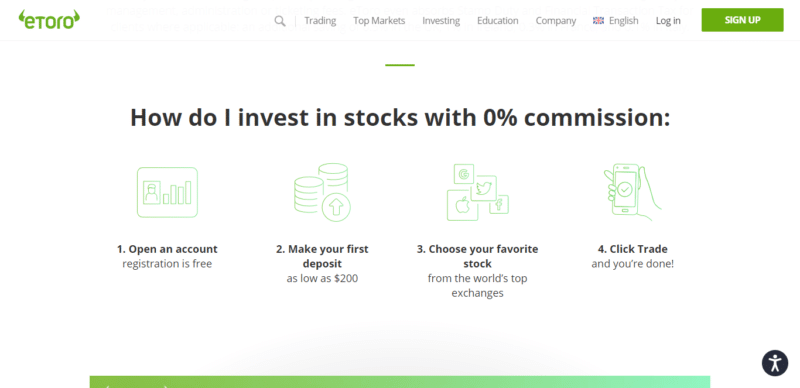
  • eToro – Zero commission on stocks makes eToro the largest discount broker for European traders. Regulated by UK Financial Conduct Authority (the FCA), CySEC (EU), and ASIC (AU), the broker has over 12 million active users. Seamless account opening with social trading experience makes eToro a top choice.

DEGIRO – Top online trader and discount trading

Trade on DEGIRO

DEGIRO is a privately owned discount broker that was founded in 2008 in the Netherlands. The Dutch online trade platform is popular for its low trading fees and free monthly ETF trades.

Some of the top-tier authorities regulating DEGIRO operations include the Dutch Central Bank DNB and Netherlands Authority for Financial Markets AFM. Additionally, the company is duly registered by the Amsterdam-based Chamber of Commerce and Industry.

DEGIRO provides its users with bonds, options, stocks, ETFs, leveraged products, and futures. You will get access to about 50 world exchanges on this platform.

If the company’s claim on their website is anything to go by, they have industry-leading commission rates and a trading platform suitable for beginner trading. If you’re looking to cut on costs while trading, DEGIRO offers an easy-to-use platform worth considering.

Fees

Trading fees on DEGIRO are among the lowest, but you can only enjoy one monthly commission-free ETF irrespective of your trade size.

The good news is that DEGIRO has zero deposit fees and no limit on the account minimums. What’s more, it does not charge you for withdrawing earnings from the platform. DEGIRO is also one of the cheapest platforms for account maintenance – there is zero annual maintenance and custody fee charged.

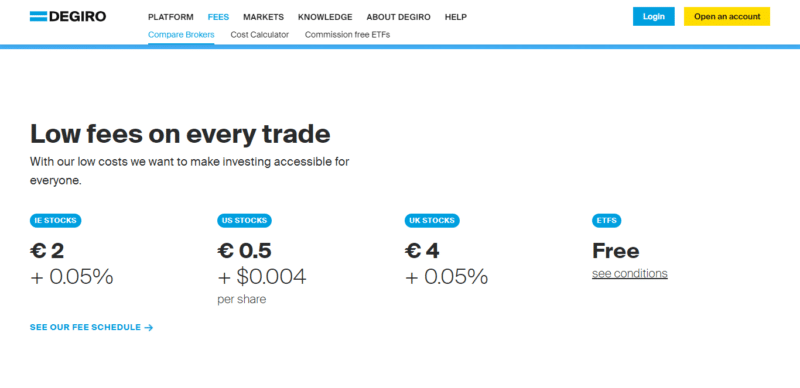
On the other hand, just like many other brokers, DEGIRO charges a small fee on international ETF trading. The charge includes a €2 cost in addition to 0.03% of the value of your order. The charges on stock trading vary widely, but they’re lower than the industry averages.

For instance, trading stock on the London Stock Exchange will cost you €1.75 and an additional 0.022%. If you were to go for another broker, say Xetra, it would cost you €4.00 and an additional 0.05%.

On DEGIRO, you’ll part with €2.5 as an annual connection fee for each exchange – except for the Irish Stock Exchange – and an extra 0.10% of the traded amount as a currency exchange fee.

DEGIRO features

  • Low trading fees
  • Products on offer include bonds, options, futures, shares, leveraged products.
  • Regulated by AFM
  • No minimum account deposits
  • No inactivity fee
  • 24-hour trading
  • Supports EUR, CHF, GBP, NOK, SEK, CZK, PLN, HUF and DKK.

Trade on DEGIRO

eToro – Zero-commission on Stocks

Trade on eToro

Your capital is at risk. Other fees apply. For more information, visit etoro.com/trading/fees.

eToro was formed in 2007 and has grown to become the largest international broker with over 12 million traders. It provides EU and UK traders with commission-free trading on stocks and ETFs. The platform offers a wide range of products, including cryptocurrencies, indices, forex, and commodities, at very favorable spreads.

Having been in the industry for over 13 years, eToro stands out as a reputable trading broker. Three top-tier authorities regulate it, including ASIC of AU, CySEC of EU, and FCA in the UK. Due to the Cyprus Securities and Exchange Commission regulation of eToro, investors have up to €20,000 protection. The UK regulator, on the other hand, protects up to €85,000.

Fees

If you’re looking for an investment brokerage with the lowest fees, eToro beats them all. The platform charges zero fees when you open or close a stock trade. This is for the non-leveraged positions.

It is worth noting that eToro’s USD-based accounts incur a flat rate fee of $5.00 on withdrawals. Unfortunately, deposits made in other currencies will have to incur an additional conversion fee.

eToro is a multi-asset platform that allows you to invest in stocks and crypto-assets as well as trading CFD assets.

eToro features

  • Zero commission on stocks and low transaction fees
  • Wide range of products, including forex, cryptocurrencies, CFDs, stocks, and indices
  • Excluding Serbia, all other European countries are supported
  • Regulated by FCA, CySEC, ASIC
  • Minimum deposit amounts of $200
  • Has a demo account for beginner traders to do some training
  • Charges a $10 inactivity fee for accounts that stay logged out for a year
  • Copy portfolios are designed to minimize your risk long-term while pointing you towards new opportunities
  • Copy-trading is available
  • Fractional shares are available

Trade on eToro

Investing in stocks, bonds, and ETFs involves risks including complete loss. Please do your research before making any investment.

Disclaimer: eToro is a multi-asset platform which offers both investing in stocks and cryptoassets, as well as trading CFDs.

Please note that CFDs are complex instruments and come with a high risk of losing money rapidly due to leverage. 76% of retail investor accounts lose money when trading CFDs with this provider. You should consider whether you understand how CFDs work, and whether you can afford to take the high risk of losing your money.

Past performance is not an indication of future results. Trading history presented is less than 5 complete years and may not suffice as basis for investment decision.

Copy Trading does not amount to investment advice. The value of your investments may go up or down.
Your capital is at risk.

Cryptoasset investing is highly volatile and unregulated in some EU countries. No consumer protection. Tax on profits may apply.

Don’t invest unless you’re prepared to lose all the money you invest. This is a high-risk investment and you should not expect to be protected if something goes wrong. Take 2 mins to learn more.

eToro USA LLC does not offer CFDs and makes no representation and assumes no liability as to the accuracy or completeness of the content of this publication, which has been prepared by our partner utilizing publicly available non-entity specific information about eToro.

Conclusion

Online trading allows you to invest your money in products whose performance you can track in real-time. Different brokerage firms vary in the way they charge for their services. These charges can be a deal-breaker when it comes to choosing your ideal platform.

DEGIRO is outstanding for its low fees and overall ease of use. eToro has an outstanding reputation as a commission-free platform with a plethora of features.

That said, your favorite platform should be based on your needs. Generally, the brokers mentioned above provide the industry’s best services in Europe.

Investing in stocks, bonds, and ETFs involves risks including complete loss. Please do your research before making any investment.

Filed under: Money, Stock market

  • « Previous Page
  • 1
  • 2
  • 3
  • 4
  • 5
  • Next Page »

Latest Padel Match

Jean Galea

Investor | Dad | Global Citizen | Athlete

Follow @jeangalea

  • My Padel Experience
  • Affiliate Disclaimer
  • Cookies
  • Contact

Copyright © 2006 - 2026 · Hosted at Kinsta · Built on the Genesis Framework