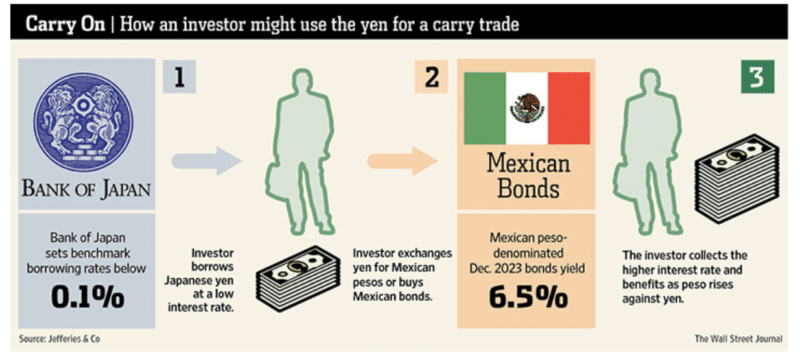
TL;DR: A carry trade means borrowing in a low-interest-rate currency and investing in a higher-yielding one, pocketing the difference. It’s been a staple of forex markets for decades — and now crypto traders use the same principle with stablecoin lending, Bitcoin futures basis trades, and DeFi yield strategies. The potential returns are real, but so are the risks. Just ask anyone who was short the yen in August 2024.
What is a carry trade?
A carry trade is one of the oldest strategies in finance. The concept is simple: you borrow money where it’s cheap and invest it where it pays more. The difference between what you pay and what you earn is your profit.
Here’s a concrete example. In 2023, Japanese interest rates sat near 0% while US rates climbed above 5%. A trader could borrow yen at almost no cost, convert it to dollars, and park it in US Treasuries yielding 5%+. That spread — roughly 5% annualized — was pure carry.
The strategy works across any asset class where a yield differential exists: currencies, bonds, commodities, and increasingly, crypto.
But here’s the catch. Carry trades look like free money until they don’t. The classic description is “picking up pennies in front of a steamroller” — small, steady profits that can get wiped out by a single violent move in the wrong direction. More on that later.
How carry trades work: step by step
Every carry trade follows the same basic structure:
1. Identify the yield gap. Find two currencies (or assets) with a meaningful interest rate differential. The wider the gap, the more attractive the trade.
2. Borrow in the low-yield currency. This is your “funding currency.” For decades, the Japanese yen has been the world’s favorite funding currency thanks to Japan’s rock-bottom rates.
3. Convert and invest in the high-yield currency. You swap the borrowed funds into the target currency and invest them — typically in government bonds, money market instruments, or other interest-bearing assets.
4. Collect the spread. As long as the exchange rate stays stable (or moves in your favor), you earn the difference between what you’re paying to borrow and what you’re earning on your investment.
5. Unwind the trade. Eventually, you close out — converting back to the funding currency, repaying the loan, and keeping whatever’s left.
The math is straightforward. If you borrow at 0.5% and earn 5.5%, your gross carry is 5% per year. Most institutional traders use leverage to amplify this, which is where both the big returns and the big blowups come from.
The classic yen carry trade
No discussion of carry trades is complete without the Japanese yen. Japan has maintained near-zero or negative interest rates for most of the past 30 years, making the yen the world’s preferred funding currency.
Between 2004 and 2008, Japanese rates hovered around 0.5% while the Fed hiked US rates from 1% to 5.25%. Traders borrowed yen by the truckload and poured it into dollar-denominated assets. The yen weakened 20% against the dollar during this period, adding currency gains on top of the interest differential. It was a golden era for carry traders.
Then the 2008 financial crisis hit. Risk appetite evaporated overnight. Traders unwound their positions en masse, rushing to buy back yen. USD/JPY plummeted from 108 to 87 in weeks. Years of carry profits were destroyed in days.
History rhymed in 2024.
The 2024 yen carry trade unwind: a cautionary tale
On August 5, 2024, the Japanese TOPIX index crashed 12% in a single day — the kind of move you associate with full-blown financial crises. The VIX spiked to levels not seen since the COVID panic. What happened?
The carry trade unwound. Again.
Here’s the sequence of events:
The Bank of Japan had kept rates pinned near zero for years, fueling an estimated $250 billion in yen carry trade positions. On July 31, the BOJ surprised markets by hiking rates and announcing plans to taper its bond purchases. The yen strengthened sharply.
Days later, a weak US jobs report raised recession fears. The Fed signaling rate cuts compressed the yield differential further. Suddenly, the math behind all those carry trades didn’t work anymore.
What followed was a cascade. Carry traders rushed to close positions. That meant buying yen, which strengthened the yen further, which triggered more forced liquidations. Hedge funds that were short yen dumped their most liquid assets — primarily US tech stocks — to cover their positions.
The whole episode took less than 48 hours. Months of steady carry profits, gone.
Carry trade risks you need to understand
The 2024 unwind wasn’t a one-off. Carry trade blowups follow a predictable pattern, and they will happen again. Here are the main risks:
Currency risk. Your entire profit can be erased (and then some) if the funding currency strengthens against your target currency. A 5% carry spread means nothing if the exchange rate moves 10% against you.
Interest rate risk. Central banks change policy. If the funding currency’s rates go up or the target currency’s rates go down, the spread compresses and the trade becomes less attractive — or outright unprofitable.
Leverage risk. Most carry traders use significant leverage to make the relatively small yield differentials worthwhile. A 5% carry with 10x leverage gives you a 50% return — but a 2% adverse currency move wipes out 20% of your capital. Leverage magnifies everything.
Liquidity risk. Carry trades are often crowded — lots of people doing the same thing. When the trade starts going wrong, everyone tries to exit at once. Liquidity disappears precisely when you need it most.
Correlation risk. During a carry trade unwind, assets that normally don’t move together suddenly correlate. In August 2024, a yen trade unwind crashed Japanese stocks, US tech stocks, and crypto simultaneously.
Bottom line: carry trades work until they don’t, and when they stop working, the reversal is fast and brutal. Position sizing and risk management aren’t optional — they’re the whole game.
Carry trades in crypto
The same carry trade logic applies in crypto, but the yield differentials are often much larger. That means bigger potential returns and bigger potential blowups.
There are three main flavors of crypto carry trades:
1. The Bitcoin futures basis trade (cash-and-carry)
This is the most popular institutional crypto carry trade and one I personally find compelling.
Bitcoin futures typically trade at a premium to the spot price — a condition called “contango.” This happens because traders are willing to pay more for future delivery, especially in bull markets. The gap between the spot price and the futures price is called the “basis.”
A cash-and-carry trade captures this basis by simultaneously:
- Buying Bitcoin spot (or a spot ETF)
- Shorting Bitcoin futures at the premium price
Because the futures price converges to the spot price at expiry, you lock in the premium as profit regardless of where Bitcoin’s price goes. It’s a delta-neutral trade — you have no directional exposure to Bitcoin’s price.
During bullish periods, this basis on Bitcoin futures has yielded 15-30%+ annualized — far above what you’d earn in traditional markets. Even in calmer conditions, 5-10% annualized is common.
You can execute this on platforms like Deribit, which offers both spot and futures markets. The CME also offers Bitcoin futures, and since 2024, institutions have been pairing spot Bitcoin ETFs with CME futures shorts to run this trade at scale.
The risk? In strongly bullish markets, the futures premium can expand before it contracts, meaning your short futures position shows a temporary loss (even though the trade converges at expiry). If you’re using leverage and get margin-called before expiry, you lose money on what would have been a profitable trade. Patience and adequate margin are essential.
2. Stablecoin yield carry
This is the closest thing to a traditional currency carry trade in crypto. The concept: borrow fiat at a low rate (say, a 3-5% personal loan or margin rate) and deposit it into a platform offering higher yields on stablecoins.
Centralized crypto lending platforms offer yields on stablecoins like USDC and USDT that have historically exceeded traditional savings rates by a wide margin. The execution is straightforward:
Step 1: Acquire fiat (borrowed at low rates or from existing savings earning near-zero at a bank).
Step 2: Convert to a stablecoin like USDC on the platform.
Step 3: Earn yield on the stablecoin deposit.
The spread between your cost of funds and the stablecoin yield is your carry. When traditional banks were paying 0.5% and stablecoin yields were 8-12%, this was a no-brainer for people comfortable with the platform risk.
But platform risk is the keyword here. These yields don’t come from nowhere — they’re generated by lending, market making, and other activities. The collapse of platforms like Celsius and BlockFi in 2022 showed what happens when the underlying risk management fails. Always consider: where is the yield coming from? If you can’t answer that question, you’re probably the yield.
For a comparison of current platforms and rates, see my roundup of the best crypto interest accounts.
3. DeFi carry strategies
Decentralized finance protocols enable carry trades without intermediaries. A typical DeFi carry trade might look like:
- Deposit ETH or stablecoins as collateral on a lending protocol (e.g., Aave)
- Borrow a lower-yielding asset against that collateral
- Deploy the borrowed funds into a higher-yielding opportunity (liquidity provision, staking, another lending protocol)
DeFi carry trades can be lucrative, but they come with smart contract risk, liquidation risk, and the constant possibility that yields compress faster than you can unwind. They also tend to get crowded quickly — when a yield farming opportunity looks attractive, capital floods in and the yield drops.
Carry trade opportunities in 2026
The carry trade landscape has shifted significantly since the zero-rate era:
Traditional FX carry: Emerging market currencies like the Brazilian real, Mexican peso, and Egyptian pound are offering attractive carry against the dollar and yen. One Bloomberg measure of EM carry trade returns topped 17% in 2025 — the best year since 2009. Low FX volatility has helped these trades perform.
Bitcoin basis trade: With CME now offering 24/7 crypto futures trading, the basis trade is more accessible than ever for institutions. Annualized basis yields fluctuate with market sentiment — during the July 2025 rally, front-month altcoin futures saw annualized basis readings spike to 50%. You can also use Bitcoin options to hedge carry trade positions. Bitcoin basis has been more modest at 5-15%, but still competitive with traditional fixed income.
Stablecoin yields: After the crash-and-consolidation cycle of 2022-2023, surviving platforms have generally improved transparency around how yields are generated. Rates are lower than the wild 2021 era, but the risk-adjusted picture is arguably better.
The BOJ factor: Japan’s path toward interest rate normalization continues to be the single most important variable for global carry trades. Every BOJ meeting is a potential catalyst for carry trade volatility. If you’re running any carry trade — forex, crypto, or otherwise — keep one eye on Tokyo.
How to manage carry trade risk
Whether you’re running a forex carry trade or a Bitcoin basis trade, risk management follows the same principles:
Size conservatively. The leverage available for carry trades is often enormous. Just because you can lever up 20x doesn’t mean you should. Start small. A 5% carry with 2-3x leverage is a solid return without the existential risk.
Set stop losses. Decide in advance how much of the carry you’re willing to give back. If the trade moves against you by more than a few months’ worth of carry, something has probably changed and you should reassess.
Diversify across pairs and strategies. Don’t put all your carry in one trade. Spread across different currency pairs, different time horizons, different platforms.
Watch the macro calendar. Central bank meetings, employment data, inflation reports — these are the catalysts for carry trade unwinds. Know when they’re coming and reduce exposure or hedge around them.
Keep dry powder. The worst time to be fully invested in a carry trade is right before a volatility spike. Maintaining some cash reserves means you can either weather the storm or add to positions at better levels.
The barbell strategy — combining ultra-safe assets with a smaller allocation to higher-risk trades — is a natural framework for carry trades. Your safe assets cushion the blow when carry trades go wrong.
Carry trade FAQ
What is a carry trade in simple terms?
A carry trade means borrowing money where it’s cheap and investing it where it pays more. You profit from the difference in interest rates. For example, borrowing Japanese yen at 0.5% interest and investing in US Treasuries at 5% gives you a roughly 4.5% annual return on the spread.
Is carry trading risky?
Yes. While the day-to-day returns are small and steady, the losses when things go wrong are sudden and severe. Currency moves can wipe out months of carry in a single day, and leverage amplifies the damage. The August 2024 yen carry trade unwind is a recent example — the TOPIX crashed 12% in one day as carry trades were forcibly liquidated.
What happened with the yen carry trade in 2024?
In August 2024, the Bank of Japan unexpectedly raised interest rates while US economic data weakened. This compressed the yield spread that yen carry trades depended on. Traders rushed to unwind an estimated $250 billion in positions, causing the yen to spike and triggering a cascading sell-off in global stocks. The Japanese TOPIX fell 12% on August 5 and the VIX hit levels not seen since the COVID crash.
Can you do carry trades with crypto?
Absolutely. The most common crypto carry trade is the Bitcoin futures basis trade, where you buy Bitcoin spot and short Bitcoin futures to capture the premium. This can yield 5-30%+ annualized depending on market conditions. Other crypto carry strategies include earning yield on stablecoins and DeFi lending/borrowing strategies. See my Deribit review for one platform where you can execute basis trades.
What’s the difference between a carry trade and arbitrage?
Both exploit price differences, but they differ in risk. Arbitrage is theoretically riskless — you buy and sell the same asset simultaneously at different prices. A carry trade involves ongoing exposure to interest rate changes, currency fluctuations, and market sentiment shifts. The Bitcoin basis trade sits somewhere in between: it’s structurally convergent (like arbitrage) but involves execution risk, margin risk, and the possibility of basis expansion before expiry.
How much money do you need to start a carry trade?
It depends on the approach. Institutional forex carry trades typically require large capital due to the thin spreads involved. But crypto carry trades have lower barriers to entry. You can run a Bitcoin basis trade on Deribit with a few thousand dollars, and stablecoin yield strategies on crypto lending platforms accept deposits as low as $100. The key isn’t the size of the position — it’s understanding the risks and not overleveraging.
Related






Leave a Reply