Spanish banking has improved, but it still has a long way to go. If you’ve lived here for any amount of time, you’ve probably dealt with opaque fee structures, branch-only services, staff who treat you like an inconvenience, and a general culture of extracting money from customers in ways that feel designed to confuse.
I’ve been living in Barcelona since 2012 and have been through the full Spanish banking experience — opening accounts, getting refused, watching fees appear out of nowhere, and eventually finding a setup that actually works. This guide is the result of that experimentation.
The good news: you no longer need to settle for a traditional Spanish bank as your primary account. Digital banks have matured significantly, and a combination of the right online bank plus one traditional option for backup will serve you better than anything a Caixabank branch can offer.
What You Actually Need From a Bank in Spain
Before getting into the options, it’s worth understanding what “working in Spain” actually requires from a bank account.
The key issue is the Spanish IBAN. Spain runs on SEPA direct debits, and a surprising number of Spanish companies — utilities, gym memberships, landlords, insurance providers, government services — will only accept a Spanish IBAN (starting with ES) for direct debits. Some will refuse a foreign IBAN outright, others will accept it in theory but fail in practice.
This is not a minor inconvenience. It affects your electricity bill, your internet provider, your health insurance, your Hacienda tax payments. If your bank can’t give you a Spanish IBAN, it cannot be your primary Spanish account.
Beyond the IBAN, you’ll want:
- No monthly maintenance fees (or very low fees for premium features)
- A debit card that works everywhere
- A decent mobile app
- English-language support (or at least a functional app that doesn’t require calling anyone)
- Access to Bizum (Spain’s peer-to-peer instant payment system — it’s used constantly here)
With that framework in mind, here are the banks I actually recommend.
1. N26 — Best Overall for Expats in Spain
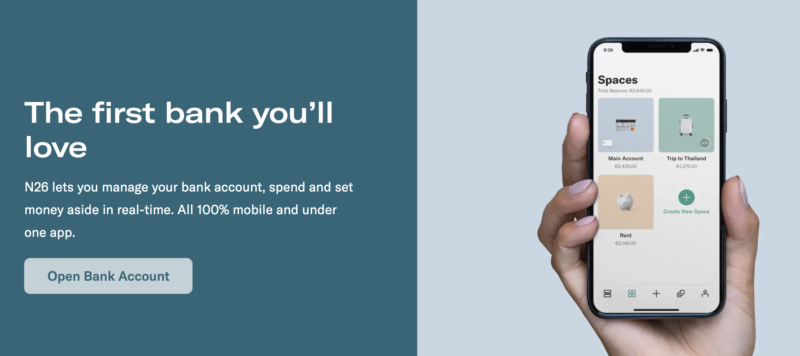
N26 is my top pick, and it has been for years. It’s a German bank (licensed by BaFin, Germany’s financial regulator), but it assigns every Spanish customer a genuine Spanish IBAN. You get all the protection of a German bank with an account that behaves like a local one.
This matters more than it might seem. I’ve had zero issues setting up direct debits with Spanish companies using my N26 IBAN — utilities, subscriptions, everything. It just works in the way a Spanish IBAN is supposed to work.
A few things that make N26 stand out beyond the IBAN:
- Desktop access. Most neobanks are mobile-only. N26 has a proper web interface, which matters when you’re doing anything requiring a real screen.
- Clean, fast app. Instant notifications, clear transaction history, easy controls for freezing your card or adjusting limits.
- Bizum support. Available on all plans, so you can split a restaurant bill or pay the plumber without friction.
- Wise integration. International transfers are handled through Wise directly inside the app, which means mid-market exchange rates when sending money abroad.
- €100,000 deposit protection under the German Deposit Guarantee Fund.
N26 has over 8 million customers across Europe, and it’s been operating since 2013 — this is not a startup experiment. That said, it’s Europe-only; if you move outside the EU, your account gets closed.
N26 Plans in Spain
- Standard — Free. No monthly fee, Spanish IBAN, Mastercard debit card, Bizum. This is all most people need.
- Smart — €4.90/month. Adds sub-accounts (Spaces), partner discounts, and a choice of card colors.
- Go — €9.90/month. Travel and purchase insurance through Allianz, unlimited free ATM withdrawals abroad.
- Metal — €16.90/month. Premium metal card, comprehensive insurance package, airport lounge access discounts, higher ATM limits.
The free Standard account is genuinely good. I’ve used it as my primary Spanish account without ever feeling like I was missing something essential.
Read my full N26 review for a deeper breakdown.
2. Revolut — Best for Everyday Spending and Travel
Revolut is the most feature-rich neobank out there and, with 70+ million customers, it’s become the de facto spending card for anyone traveling through Europe. Currency exchange at interbank rates, instant spending notifications, easy card controls, a solid budgeting interface — it’s genuinely excellent for day-to-day use.
Revolut now offers Spanish IBANs. If you open a Revolut account in Spain today, you’ll automatically get an ES IBAN. Existing customers with Lithuanian IBANs are being migrated to the Spanish branch — once migrated, you get an ES IBAN as your primary identifier (your old LT IBAN still works). So the old objection about Revolut not working for Spanish direct debits is no longer valid.
That said, I still rank N26 above Revolut as a primary Spanish account. N26 gives you desktop access (Revolut is mobile-only), BaFin regulation (the strongest in Europe), and a longer track record of seamless Spanish IBAN functionality. Revolut is the better spending and travel card; N26 is the better bank account.
That said, Revolut earns its place as a powerful companion account. Use it for:
- Spending abroad — currency exchange at interbank rates with no markup on the standard daily limit
- Splitting costs with friends through the app
- Holding and converting between multiple currencies
- Budgeting and analytics features
- Cryptocurrency and stock trading (paid plans)
One significant limitation: Revolut is mobile-only. There is no desktop interface. If you prefer to manage your finances from a computer, that’s a real constraint.
Revolut Plans in Spain
- Standard — Free. Currency exchange up to a monthly limit, basic card controls, Bizum.
- Plus — Low monthly fee. Priority customer support, purchase protection, higher limits.
- Premium — €8.99/month. Unlimited currency exchange, overseas medical insurance, higher ATM limits.
- Metal — €15.99/month. Metal card, cashback on card payments, comprehensive travel insurance.
- Ultra — €45/month. Concierge service, highest limits across the board, exclusive Ultra card.
The free Standard plan is useful for travel and currency exchange. Most expats living in Spain will find Standard or Plus sufficient as a secondary card.
Read my full Revolut review or the N26 vs Revolut comparison if you’re deciding between the two.
3. Wise — Best for International Transfers and Multi-Currency
Wise (formerly TransferWise) isn’t a bank — it’s an Electronic Money Institution regulated by the FCA in the UK. That distinction matters: your money is safeguarded but not covered by traditional deposit insurance schemes the way a licensed bank would be.
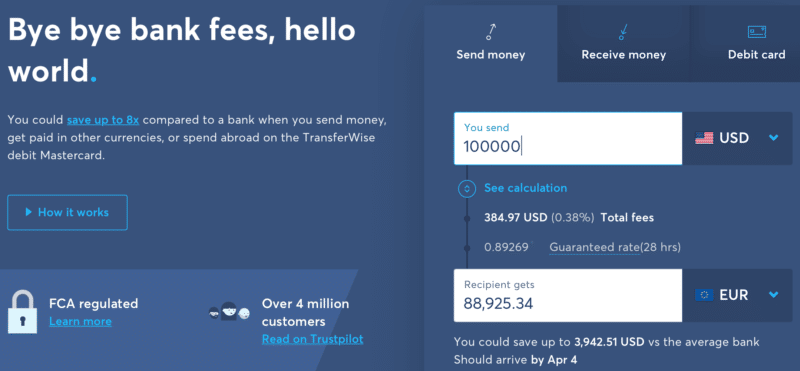
For international transfers, though, Wise is in a category of its own. It uses the mid-market exchange rate — the real rate you see on Google — and charges a transparent, low percentage fee. No hidden spread, no inflated exchange rates, no surprise charges on the receiving end.
The Wise account also gives you local bank details in over 10 currencies, including EUR, GBP, USD, and AUD. If you receive income in multiple currencies, or regularly send money to family abroad, this is genuinely useful.
Where Wise fits in a Spanish banking setup:
- Receiving international payments in foreign currencies
- Sending money internationally (especially outside the EU)
- Holding balances in multiple currencies simultaneously
- Complementing N26 when you need to do cross-currency transfers
I wouldn’t use Wise as a standalone Spanish account — it’s not designed for that. But as part of a multi-account setup alongside N26, it covers a gap that neither N26 nor Revolut quite fills for complex multi-currency needs.
Read my full Wise review for more detail on how it works.
4. BBVA — Best Traditional Spanish Bank
If you need a traditional Spanish bank — for a mortgage, for dealing with Spanish bureaucracy that insists on a “real” bank, or simply as a backup — BBVA is the one I’d point you toward.
Their Cuenta Online is genuinely commission-free — no maintenance fees, no minimum balance requirements, no conditions. This is notable in Spain, where even “free” accounts often have hidden strings attached. BBVA’s mobile app has consistently won awards and is far better than anything offered by Caixabank or Santander. They also offer English-language service, which alone puts them ahead of most Spanish banks.
BBVA won’t replace N26 as your primary account — the experience isn’t as clean, and you’ll occasionally have to deal with branch visits and Spanish-language bureaucracy — but it’s the most competent of the traditional options and worth having in your toolkit for situations where a local bricks-and-mortar bank is required.
Banks to Avoid (or Be Cautious About)
Sabadell
I had an account with Sabadell for a while and I’d steer clear. The fee structure is opaque, customer support is poor even by Spanish banking standards, and their online banking interface — despite recent updates — still feels like it was designed in 2008. There are better options at every price point.
ING España
ING used to be my top recommendation for commission-free banking in Spain, and for a while it genuinely was. Then things went sideways.
ING has a policy of letting all incoming international transfers through without question — and then, months later, suddenly demanding documentation about every single one of them. I’m talking about transfers that were already processed and settled. They wanted proof of origin, invoices, contracts — for transactions that in some cases were years old. Retrieving all of that is enormously time-consuming and stressful, especially when you’re a freelancer or business owner with complex income sources.
Worse, during the COVID crisis they blocked clients’ accounts while all of this was going on. People who needed access to their money — during a pandemic, when families were under real financial pressure — were locked out. I find that kind of behavior indefensible. A bank’s job is to help during difficult times, not pile on more difficulty.
Their customer support is phone-only, with long wait times, and the staff can barely answer basic questions. On top of all that, the Cuenta NÓMINA is now conditional — you need a minimum monthly salary deposit to keep it fee-free, which rules out most freelancers and self-employed people.
Stay away from this bank.
Caixabank, Santander, and the rest
Spain’s big traditional banks are fine if you have no choice — and sometimes you genuinely don’t, for certain mortgages or specific financial products. But as primary accounts for day-to-day use, they’re expensive, bureaucratic, and their digital products lag far behind the neobanks. Unless you specifically need something only they offer, there’s no good reason to use them.
Documents You’ll Need
This is where a lot of people get stuck. Here’s what each type of account typically requires.
Traditional Spanish Bank (First Account)
Opening your first account with a traditional bank in Spain usually requires:
- Valid passport or EU national ID card
- NIE (Número de Identificación de Extranjero) — your Spanish tax identification number
- Proof of address in Spain (rental contract, utility bill, or padron municipal certificate)
- Proof of income or employment (payslip, employment contract, or tax declaration)
- In some cases: proof of legal residence status
Getting your NIE is the critical step. Without it, most traditional banks won’t open an account for you. The NIE application process involves a trip to a police station (or a Spanish consulate if you’re applying from abroad) and can take weeks. Sort this out early.
Traditional Spanish Bank (Second Account, Once You Have NIE)
Once you have an NIE and an existing Spanish bank account to show, the process is much simpler. Most banks will only need:
- Passport or national ID
- NIE
- Your existing Spanish bank account details
Digital Banks (N26, Revolut, Wise)
This is where the neobanks shine. The requirements are minimal:
- Valid passport or national ID
- A smartphone for identity verification (selfie + document photo)
- An email address
No NIE required. No proof of address. No visit to a branch. The verification is done entirely in-app and usually takes less than 10 minutes. For most expats, this means you can have a working N26 account within a day of arriving in Spain, long before you’ve sorted out the Spanish bureaucracy required for a traditional account.
The Discrimination Reality
I want to be direct about something that gets glossed over in most expat banking guides: banks in Spain discriminate, and they do it routinely.
My wife is Russian. She was refused by multiple Spanish banks before we found one that would open an account for her — not because of any issue with her documentation or finances, but simply because of her nationality. The refusals came without explanation, in the way that Spanish bank staff sometimes refuse things without telling you exactly why.
I’m Maltese — an EU citizen. I was refused at one bank despite Malta being a full EU member state. The staff member apparently wasn’t familiar with Malta and decided that was grounds for refusal. No appeal, no escalation, just a polite no.
This is the reality for a lot of non-Spanish, non-Western European people living here. The discrimination is usually informal rather than codified policy, but it’s consistent enough that you need to account for it. Traditional banks have discretion in who they accept, and they use it.
The practical implication: digital banks like N26 and Revolut don’t have this problem. Their verification is automated and nationality-blind. If your documents are valid and you pass the KYC check, you get an account. This is one of the strongest arguments for making a neobank your primary account rather than trying to force a relationship with a traditional Spanish bank that may not want your business.
My Recommended Setup
Here’s what I’d suggest for most expats in Spain in 2026:
- Primary account: N26 Standard — free, Spanish IBAN, works for all direct debits, desktop access, Bizum. This is your main account.
- Secondary account: Revolut Standard or Plus — use it for travel, foreign currency spending, and any situation where the Revolut feature set is useful.
- International transfers: Wise — whenever you’re sending money outside Spain or receiving income in another currency.
- Traditional backup: BBVA Cuenta Online — keep one if you eventually need it for a mortgage, for Spanish bureaucracy, or as a fallback. But don’t pay fees for it.
For a broader look at digital banking options across Europe, see my guide to the best online banks in Europe. If you’re also looking at investment accounts, I’ve covered the best stock brokers in Spain separately.
Spanish Banking Glossary
Spanish bank documentation loves jargon. Here’s a quick reference for the terms you’ll encounter most often.
- Cuenta corriente — Current account. Your standard everyday bank account.
- Cuenta de ahorro — Savings account. Usually offers a small interest rate and may have withdrawal restrictions.
- Tarjeta de débito — Debit card. Linked directly to your account balance.
- Tarjeta de crédito — Credit card. Spend now, pay later. Spanish banks often push these aggressively — be careful about accepting credit products you don’t need.
- Domiciliación — Direct debit. The instruction you give to allow a company to pull payments from your account. This is why the Spanish IBAN matters — many Spanish companies will only accept domiciliaciones from ES IBANs.
- Transferencia — Bank transfer. Standard SEPA transfer.
- Bizum — Spain’s instant peer-to-peer payment system, linked to your phone number. Essential for splitting bills with Spanish people. Available on N26 and Revolut.
- NIE (Número de Identificación de Extranjero) — The tax ID number required for most financial and legal activity in Spain as a foreigner. Get this sorted early.
- DNI (Documento Nacional de Identidad) — Spanish national ID. Only applicable if you’re a Spanish citizen.
- Comisión de mantenimiento — Account maintenance fee. What you’re trying to avoid.
- Seguros — Insurance products. Spanish banks cross-sell these constantly. Home insurance, life insurance, payment protection — often attached as conditions to loans or mortgages. Read the fine print before agreeing to anything.
- Hipoteca — Mortgage. Spanish mortgage law changed significantly in 2019, giving borrowers more protections. If you’re buying property, get independent legal advice.
- Comisión por descubierto — Overdraft fee. Going into negative balance in Spain triggers automatic fees that can compound quickly. Keep a buffer.
Final Thoughts
Spanish banking in 2026 is genuinely better than it was a decade ago, largely because the neobanks forced the traditional players to improve. But the underlying culture — the bureaucracy, the discrimination, the preference for complexity over clarity — hasn’t changed much.
The smart move is to stop fighting the system and work around it. N26 gives you a Spanish IBAN without the Spanish banking experience. Revolut handles your travel and currency needs. Wise takes care of international transfers. And if you ever need a traditional Spanish bank, BBVA is the least painful option among the incumbents.
That combination covers everything. Use it.