Investing from Spain is perfectly doable. But it comes with a bureaucratic layer that investors in the UK, Germany, or the US simply don’t have to deal with. If you’re choosing a broker as a Spanish tax resident, you can’t just pick the cheapest option — you need to factor in tax reporting obligations, the Modelo 720, and how different broker structures affect your annual filing burden.
I started investing from Barcelona in 2013, and I’ve dealt with Modelo 720 filings, dividend withholding credits, and the joys of explaining foreign brokerage accounts to Spanish tax advisors. This article covers what actually matters for investors living in Spain — the tax context, which brokers make sense here, and why DEGIRO is my main pick for most investors living in Spain, along with the two Spanish advantages you give up by using it.
If you want deep-dive reviews of the major European brokers — Interactive Brokers, DEGIRO, Scalable Capital, eToro, and Trading 212 — I’ve covered those in detail in my Best Online Stock Brokers in Europe guide. This article focuses specifically on the Spain angle.
Why Spain Makes Broker Selection More Complicated
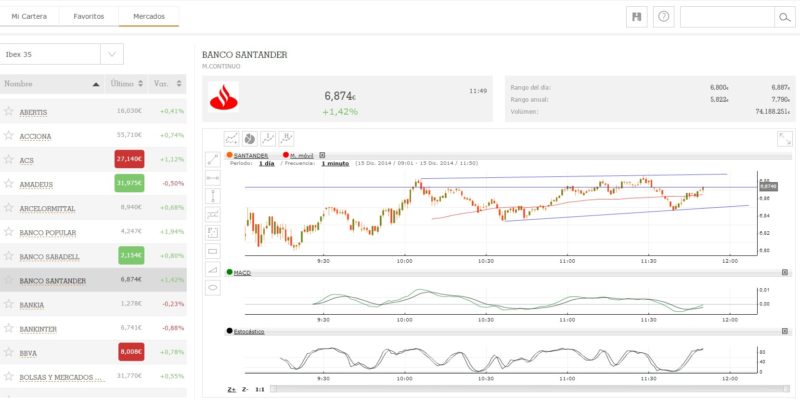
Spain has a functioning stock market and a reasonably sophisticated financial system, but Spanish banks and brokers are — in my experience — expensive, bureaucratic, and not particularly investor-friendly. The big banks (Santander, BBVA, CaixaBank) offer brokerage accounts as an afterthought, with commissions that have no place in a serious investment strategy.
The result is that most savvy Spanish investors end up with foreign brokers. That’s fine — and for many asset classes, it’s clearly the better choice. But it creates a reporting burden that doesn’t exist if your assets stay in Spain.
The two obligations you need to know about:
- Modelo 720 — Annual declaration of foreign assets (bank accounts, securities, real estate) with a combined value over €50,000. Filed with the Agencia Tributaria. Miss it or get it wrong and you’re looking at potential penalties.
- Modelo D-6 — Annual declaration of investments in foreign companies and funds. Less talked about than Modelo 720 but also mandatory. Filed with the Registro de Inversiones at the Ministry of Economy.
Neither of these declarations means you owe more tax — they’re disclosure obligations, not tax events. But they add administrative complexity and, if you’re paying an accountant to handle them, real cost. This is the lens through which you should evaluate broker choice in Spain.
The Modelo 720 Question
Modelo 720 was introduced in 2012 during Spain’s financial crisis, ostensibly to catch capital flight. The original penalty structure was savage — disproportionate to the point that the EU Court of Justice ruled it incompatible with EU law in January 2022. Spain revised the penalties. But the filing obligation itself remains.
The threshold is €50,000 per asset category (bank accounts, securities, real estate) held outside Spain as of December 31. If you hold more than €50,000 in a foreign brokerage account, you file. Once you’ve filed an initial declaration, you only need to refile if the balance has increased by more than €20,000 since the last declaration, or if you’ve closed positions.
In practice, if you’re a serious long-term investor with a growing portfolio, you’re filing Modelo 720 every year or every other year. It’s not the end of the world — I do it annually and it’s become routine — but it’s something to plan for. I have a full guide to Modelo 720 in Spain if you want the details.
The key broker implication: assets held at a Spanish-domiciled provider don’t trigger Modelo 720, so if your whole portfolio sits there, the filing goes away. DEGIRO doesn’t report to the AEAT, so as a Spanish tax resident you file Modelo 720 for your DEGIRO holdings once they’re above €50,000 at December 31. That’s the price of using a foreign broker, and in my view it’s worth paying.
International Brokers for Spanish Residents
For investing in individual stocks, ETFs, and assets beyond what Spanish brokers offer, international brokers remain the better choice. They’re cheaper for stock trading, offer broader market access, and have better platforms. The trade-off is the Modelo 720 and D-6 filing obligations if your holdings exceed the thresholds.
DEGIRO is the broker I know best for ETF and stock investing. It’s solid, low-cost, and the platform works well for buy-and-hold investing. For more active traders or those with larger portfolios, Interactive Brokers is the professional-grade option — deeper market access, better margin rates, more sophisticated order types.
For detailed reviews of each broker — fees, platforms, pros, cons — see my Best Online Stock Brokers in Europe guide. What follows here is the Spain-specific context for each.
DEGIRO — Spain Tax Notes
DEGIRO handles W-8BEN automatically, which reduces US dividend withholding tax from 30% to 15%. You’ll still need to declare this on your IRPF and claim a foreign tax credit for the 15% withheld — but at least you’re not giving the IRS 30% off the top. DEGIRO provides an annual tax report that makes this manageable.
Currency conversion costs are worth watching. DEGIRO charges a small FX fee when buying US-listed stocks in dollars. Not a deal-breaker for buy-and-hold investors, but it’s a real cost to factor in.
DEGIRO is part of flatexDEGIRO Bank AG, a German bank supervised by BaFin, and it’s registered with Spain’s CNMV. Because it doesn’t report to the AEAT, Modelo 720 applies once your DEGIRO holdings exceed €50,000 at December 31. Funds you buy there also don’t qualify for traspaso, which only applies to funds sold through Spanish entities (more on that below). Read my full DEGIRO review for platform details.
Interactive Brokers — Spain Tax Notes
Interactive Brokers is the strongest all-round platform for sophisticated investors. For Spanish residents, it offers something valuable: clear, detailed tax reporting that makes Modelo 720 preparation straightforward. Their annual reports break down positions, valuations, dividends, and transactions in the format you need.
IB also handles W-8BEN and offers direct access to a huge range of international markets including European exchanges that DEGIRO doesn’t cover. If you’re investing in anything beyond mainstream ETFs and stocks, Interactive Brokers is worth the slightly higher complexity.
eToro — Spain Tax Notes
eToro is fine for commission-free stock investing, and the social/copy trading features appeal to a certain type of investor. From a Spanish tax perspective, it works like any other foreign broker — Modelo 720 applies above the threshold. Their tax reporting has improved but is still not as clean as DEGIRO or Interactive Brokers. Read my eToro review for the full breakdown.
Tax Guide for Spanish Investors
Understanding how your investment income is taxed in Spain is non-negotiable if you’re going to do this seriously. The Spanish tax system treats investment income separately from earned income, which is actually favorable compared to countries that tax everything at the marginal rate.
Capital Gains Tax (Ganancias Patrimoniales)
Capital gains from investments are taxed at the following rates in 2025/2026:
- First €6,000: 19%
- €6,000 – €50,000: 21%
- €50,000 – €200,000: 23%
- €200,000 – €300,000: 27%
- Over €300,000: 30%
These rates apply to gains realized from selling shares, ETFs, and funds. Note that capital gains and losses can be offset against each other within the same tax year. Losses can also be carried forward for up to four years to offset future gains.
Dividend Taxation
Dividends are taxed using the same progressive scale as capital gains (the base del ahorro). Foreign dividends add a layer of complexity because they’re typically subject to withholding tax at source before they reach your account.
For US dividends specifically: without a W-8BEN form on file with your broker, the IRS withholds 30%. With a W-8BEN, it drops to 15% under the US-Spain tax treaty. That 15% withheld is claimable as a foreign tax credit in your Spanish Renta declaration, so you’re not paying double tax — you’re paying Spanish rates with a credit for what the US already took. Your broker should handle the W-8BEN; confirm that it does before investing in US-listed assets.
Modelo D-6
This one catches people off guard. Modelo D-6 must be filed annually with the Directorate-General of International Trade and Investments (part of the Ministry of Economy) whenever you hold investments in foreign companies or funds. The filing covers your position as of December 31 of the prior year and any transactions during the year.
It applies regardless of the amount — there’s no €50,000 threshold like Modelo 720. If you have a single share in a foreign company, technically you should file. In practice, enforcement has been patchy, but it’s a real obligation. If you work with a tax advisor (gestora), make sure they know about this one — not all of them do.
The Fund Switching (Traspaso) Advantage, Explained
This deserves more attention than it usually gets in personal finance discussions in Spain.
Most Spanish investors focus on fees and platform quality when choosing a broker. The traspaso advantage is less visible but potentially more valuable over a long time horizon.
Here’s a concrete example. Say you’ve built up €100,000 in a Vanguard Global Stock Index Fund over ten years. Your cost basis is €60,000 — so you’re sitting on €40,000 of unrealized gains. You decide you want to shift 20% into bonds as you approach your goals.
With an ETF (which you’d hold through DEGIRO or Interactive Brokers), selling €20,000 worth would trigger a capital gains event. Depending on your total gains for the year, you’d owe somewhere between 19% and 23% on the realized profit. That’s real money leaving your portfolio before you’ve even redeployed it.
With a mutual fund and a traspaso, you transfer the equivalent amount directly into a bond fund with no taxable event. The tax on those gains stays deferred — potentially for decades, continuing to compound in the meantime.
Over a 20-30 year investment horizon, the difference in after-tax outcomes is substantial. It’s the strongest argument for keeping part of a portfolio with a Spanish-domiciled provider.
The limitations are real. Traspaso only applies to funds sold through Spanish entities, and ETFs never qualify. Funds bought through DEGIRO don’t get it either, which matters less than it sounds, since DEGIRO is built around ETFs.
So the trade-off is this. DEGIRO gives you low costs and access to the full range of UCITS ETFs and individual stocks. A Spanish-domiciled provider gives you traspaso and no Modelo 720 filing, and those two advantages are only available there. For most investors, I think DEGIRO’s costs and range are worth more. If you’re a pure fund investor who expects to rebalance a lot over the decades, weigh the traspaso carefully before deciding.
My Recommendation
Here’s my take on investing from Spain, for whatever it’s worth.
DEGIRO is the broker I have the most hands-on experience with, mainly for broad market index ETFs from Vanguard and iShares. The platform is good, the fees are low, and once you’ve done the Modelo 720 filing a couple of times it becomes a routine part of the annual tax process rather than a burden.
My recommendation for most Spain-based investors is DEGIRO. It’s the cheapest route to global UCITS ETFs and individual stocks, and you’re giving up traspaso and taking on a Modelo 720 filing above €50,000 in return. Interactive Brokers is my second pick if you need professional-grade tools or access to non-standard markets.
One thing I’d avoid: putting serious investment capital with Spanish banks. The fees are still too high, the fund selection is often restricted to their own products, and the platforms range from mediocre to bad. There are better options.
If you’re new to investing in Spain and want broader context, my best banks in Spain guide covers the banking side. For those building a long-term passive portfolio, I’ve also written a full guide to index investing for European investors. And if you’re looking at crypto as part of your portfolio, see my guide to buying Bitcoin.
The Spanish tax system for investors is genuinely manageable once you understand it. The Modelo 720 sounds intimidating, but after the first year it’s routine. The traspaso is a real edge, but you only get it with a Spanish-domiciled provider, and for most investors DEGIRO’s low costs and ETF range are worth more. And the broker options available to Spanish residents today, such as DEGIRO and Interactive Brokers, are genuinely good.
Don’t let the bureaucracy stop you from investing. Figure out the filing requirements once, set up the systems, and get on with building your portfolio.
eToro is a multi-asset investment platform. The value of your investments may go up or down. Your capital is at risk. Past performance is not an indication of future results. Trading history presented is less than 5 complete years and may not suffice as basis for investment decision. Copy Trading does not amount to investment advice. Cryptoasset investing is highly volatile and unregulated in some EU countries. No consumer protection. Tax on profits may apply.
Related





Hi and an interesting article……
But here’s what is confusing me….I’m Spanish tax resident and fill out modelo 720, pay income tax and communist wealth tax out here.
I’ve got a bond set up with a broker out here that is supposedly Spanish tax compliant….
So that when I filed my tax return as long as I dont touch it is allowed to accumulate retained profits without taxation.
But…because it’s through a broker the fees are high and its not doing particularly well.
So I also have some investments that are based in the UK (Fundsmith) and through the Hargreaves Lansdowne app…
Problem is because these are non Spanish tax compliant I get taxed on any profits annually regardless of whether I take any money out or not, so they dont get the benefits of compounding the deferred tax.
So my question is if I open up the Spanish Degiro account :-
https://www.degiro.es
Does that mean investments in it are Spanish tax compliant and can benefit from retained profit taxation if they’re left in there…
Cant seem to find an answer anywhere 🤔