Late last year I was lost.
I’d spent the better part of a decade away from the tech space, and somewhere in those years I’d misplaced my sense of who I was. I don’t mean the day-to-day me, I mean the deeper one. What am I worth to this industry now? What can I contribute after so long on the outside? I genuinely didn’t know. I felt like a visitor in a room I used to own.
So I did what I always do when I’m stuck. I reached out to friends who are still active in tech. Part of it was practical, I wanted to hear what was working for them. Part of it was quieter than that. I wanted to find myself through their eyes, to see how the people I respect still saw me, because I’d lost track of it myself.
It worked. Talking to them, I started to recognize myself again.
The return had been brewing for a while. I’d been getting deeper into the AI playground, building again for the fun of it, and the conversations kept pointing the same way. Some were inside the Good Life Collective, the community I run, and on our retreats up at Montserrat. A handful of them, early in 2026, tipped the scales.
Two people pushed me over the line. Robert Abela of Melapress reignited my desire to build and pumped me up when I needed it. He was doing the exact thing I’d been avoiding, getting out to conferences, podcasting, posting on LinkedIn, all fairly new to him, and his energy rubbed off. Ben Pines, who spent years at Elementor, made me face it head on: blogs alone don’t cut it anymore, and founder-led marketing on LinkedIn is what’s working for his clients. I’m grateful to both of them for the time, the enthusiasm, and the tactics they shared so freely.
This part surprises people. I’m not shy about publishing. I’ve written for twenty years, I have my own site and a podcast, and I’m at home walking into a conference. But I’d always published on my own turf, on my own terms. I’d never stood in a public feed, next to everyone else, measured in real time by strangers. So I committed, and for the first time I started showing up somewhere that wasn’t my own.
The Short Version
If you read nothing else:
- A handful of posts carry everything. My top 5 posts are 56% of all my impressions. The bottom 50 are 6%.
- Posting more did nothing. My output doubled and my typical post didn’t budge.
- Personal stories win biggest. Anything where I’m genuinely in the story beat everything else.
- Original data never missed. Every post where I pulled my own numbers landed.
- Generic AI takes were my worst content, and I wrote the most of them.
- Two small fixes move reach a lot: open with “I” or a number, and keep links out of the post.
Six Months Ago, This Was Zero
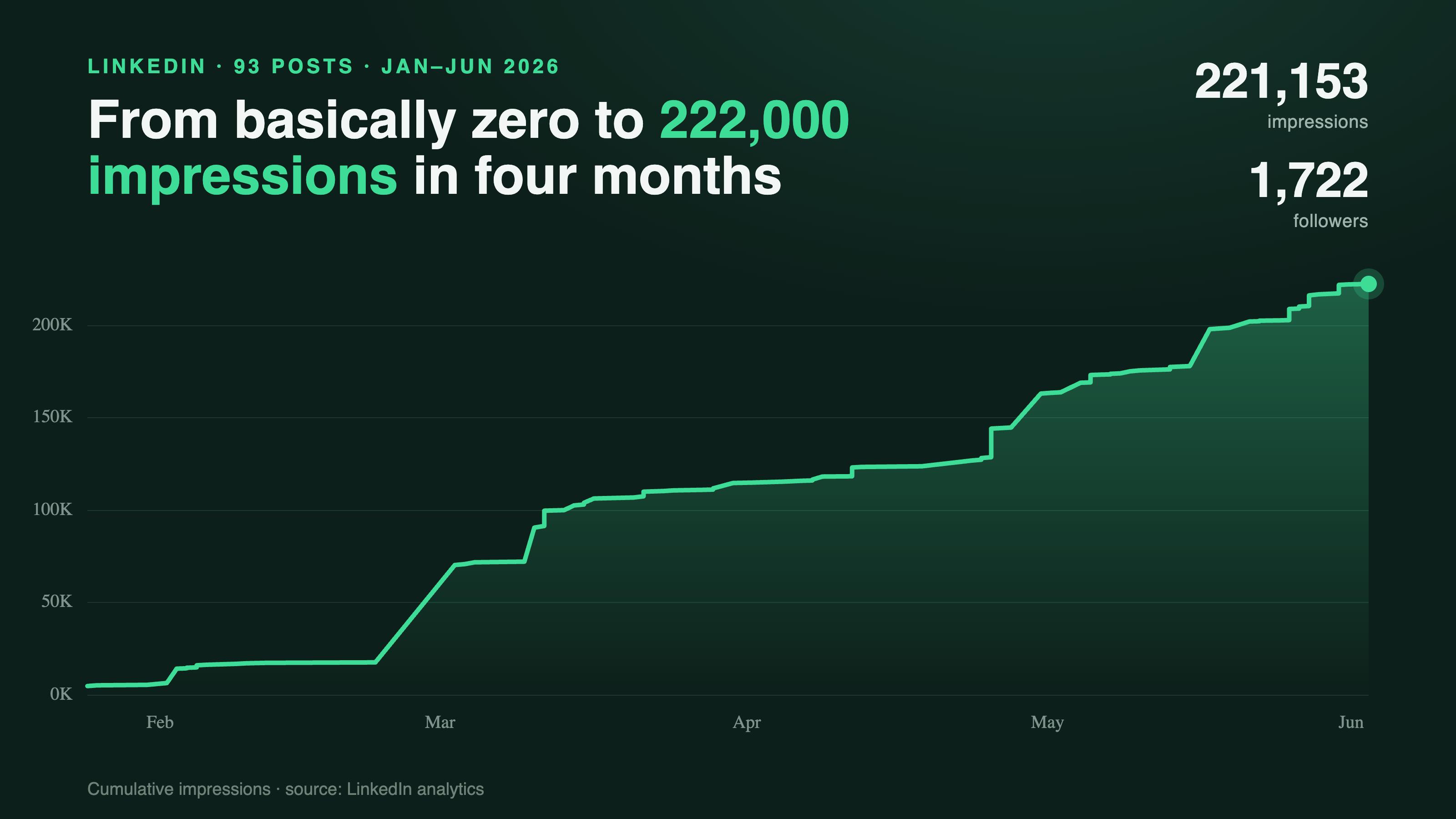
I started posting on LinkedIn in January 2026. Before that I’d never really used it. Six months later, here is where it stands, straight from LinkedIn, nothing massaged.


Across 93 posts I did about 222,000 impressions. That sounds like a lot until you see how it’s spread. Five posts account for 56% of the total. The bottom fifty, more than half of everything I wrote, account for 6%. The typical post did 471 impressions. The best did 52,661.
I want to be straight about that, because most “what works on LinkedIn” posts won’t be. I’m not a growth genius who cracked a formula. I had a few posts that broke through and a long tail that quietly did nothing. When I split the four months in half, my output doubled and the reach of my typical post stayed flat.
Volume is not the lever. The lever is which post you choose to write.
What Actually Worked
Sorted by subject, the picture is clear.
- Posts where I was in the story. My single best post opened with where I’m from and what I’d lost touch with. These personal posts averaged around 13,700 impressions. Nothing else came close.
- WordPress, reliably. A lower ceiling than my best posts, but the steadiest floor I have. Twenty years in that world gives me a real opinion grounded in real history, and those posts consistently landed well above my median.
- Things I’d actually built, not opinions about AI but things I made with it. The post about running nine websites without ever logging into them did nearly 20,000 impressions. Doing beats talking, and people feel the difference instantly.
- Original data. The most reliable format of all, the one that never once flopped. Every time I pulled my own numbers and showed the work, the post landed. If I could repeat one thing on demand, it would be this.
What Quietly Failed
- Generic AI commentary. My worst-returning category, and I wrote more of it than anything else. Twenty-seven posts of takes about where the industry is going, for a fraction of the reach of a personal story or a real build.
- My weekly community recap. It never landed. It didn’t go stale, it simply never worked, sitting around 400 impressions every time.
- Aphorisms and clever metaphors. If the post wasn’t about me, my work, or my data, it didn’t travel.
The Levers That Move Reach
Some of this is craft, and craft is learnable even when inspiration isn’t.
- Open with “I” or a number. First-person openers did roughly four times the reach of the rest. A number in the first line did about two and a half times better. The opening sentence does almost all the work.
- Drop the LinkedIn theatrics. The bold unicode font people use to fake emphasis did about three times worse, and not one of those posts broke out. The dressing-up signals “manufactured,” which is the tell that kills it.
- Keep links out of the post. Posts with a URL in the body did about a third of the reach. Put the link in the first comment.
- Length doesn’t matter. The correlation between word count and reach was essentially zero. Write as long as the idea needs.
- Timing helps a little. Early afternoon landed best for me, evenings worst, and my habit of posting first thing in the morning turned out to be mediocre. Treat it as a nudge, the sample is small.
The AI Part
I use AI to help me write and ship these posts. Some people see that as a mark against you. Used badly, it produces slop nobody asked for. Used well, it’s the difference between getting my message out and letting another busy day pass without saying anything, which is exactly where I sat for years.
The data also shows where AI stops mattering. The posts that traveled were the ones I genuinely believed in and had been chewing on for weeks. AI can shape a sentence, it can’t manufacture conviction, and conviction is what people respond to. The reach came from having something to say. The tools just made sure I said it.
What the Numbers Don’t Show
The personal posts won on reach, and the biggest of them pulled real discussion too. The Malta post drew dozens of comments from people telling me their own version of the same story. What I didn’t expect was how hard my WordPress posts punched above their reach in the comments, fewer impressions but a higher rate of genuine argument, threads where people pushed back and I came away having learned something.
The real return was never the impressions.
Over these months I locked in and gained traction across multiple businesses, AgentVania chief among them, now my main focus and doing very well. The work followed the showing-up. No single post went viral and handed me a client, that’s never how it works. Putting myself back in public put me back in the conversation, back in front of the people and opportunities I’d drifted away from.
So this is also a thank you. To everyone who has read, commented, argued, and engaged over these months, it has meant a great deal, and it has been more rewarding than I expected.
The lesson underneath the data is simpler than the data. I was lost, and I got unlost by reaching out to people, being honest about where I stood, and sharing the journey in public instead of hiding it. The platform almost doesn’t matter. Pick whichever fits your case. What matters is the willingness to be seen, including in the parts where you don’t have it figured out.
I didn’t find a growth formula. I found my way back into the conversation. That turned out to be the whole point.
Related




Leave a Reply