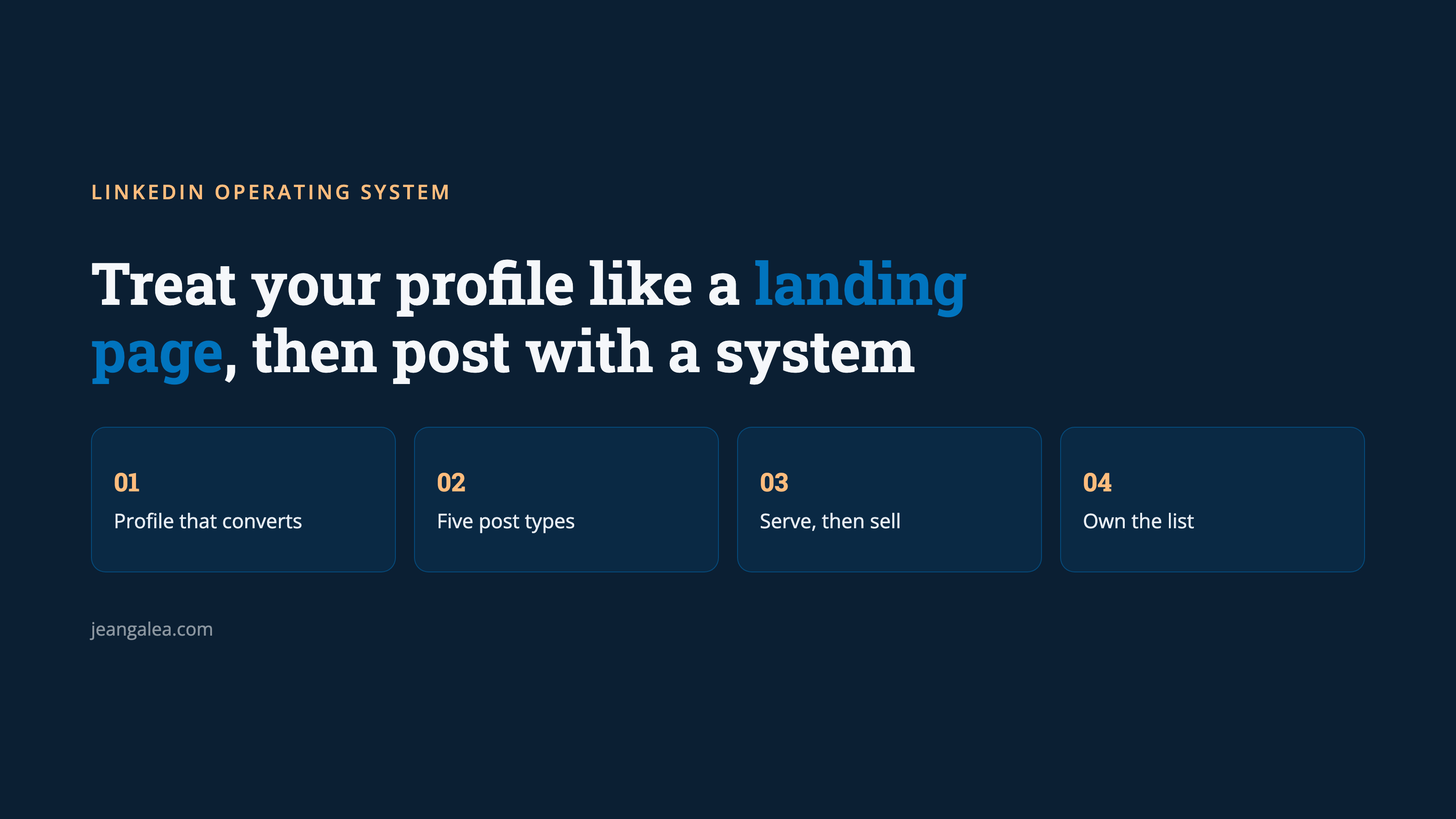
I don’t have a huge LinkedIn following. Roughly two thousand people. What I do have is a profile that works when someone lands on it, a clear idea of who I’m talking to, and a system for what to post so I’m not inventing a topic from scratch every morning.
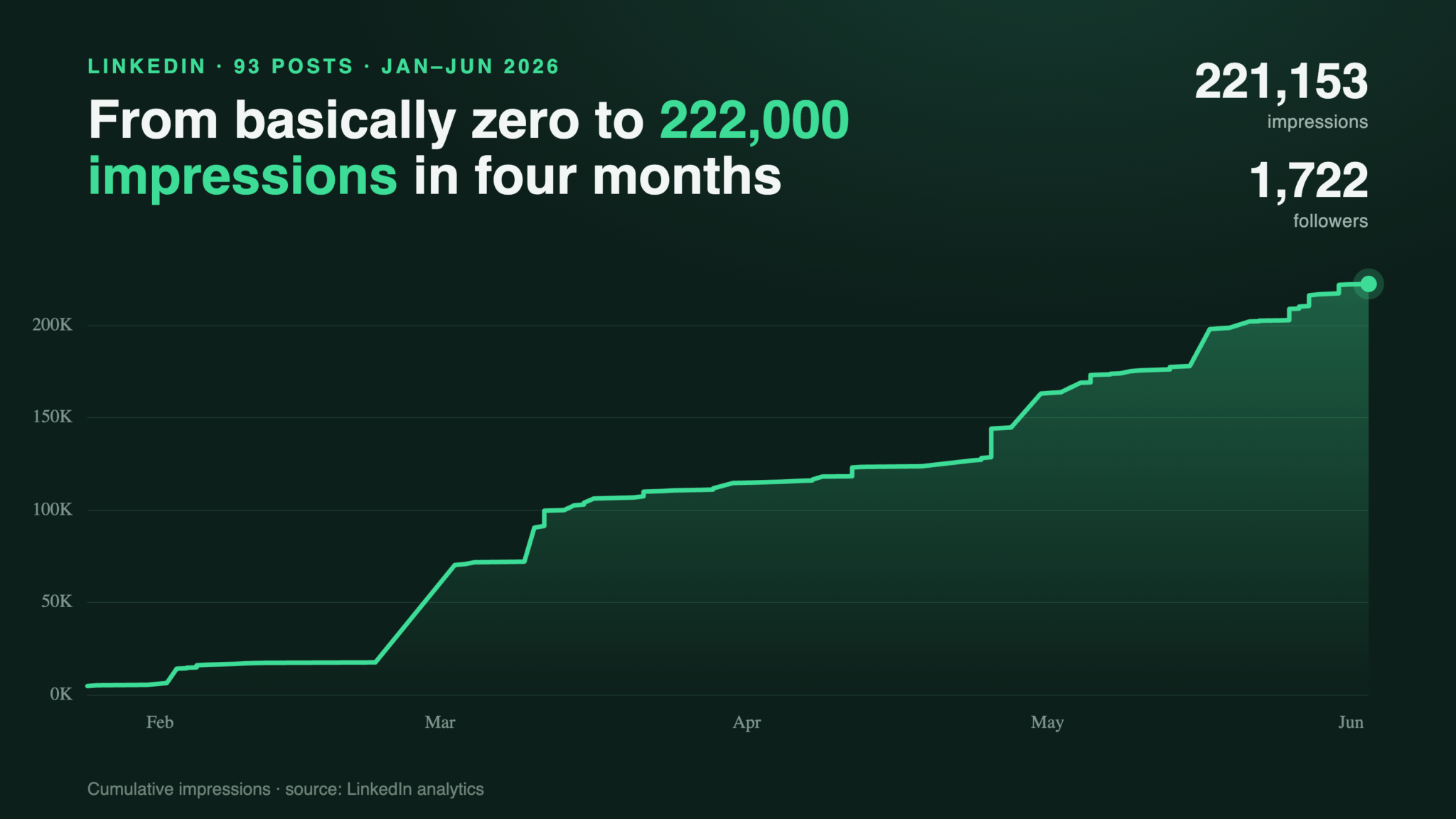
In the first stretch of taking LinkedIn seriously I pulled about 222,000 impressions across a few months of posts, with a long tail of quiet ones and a handful that carried most of the reach. I already wrote up what the numbers taught me. This is the other half: the operating system behind the account. Profile, content types, how I find ideas, how attention becomes a conversation, and the platform habits that help posts travel farther.
I’m writing this for founders, freelancers, and operators who want LinkedIn to support a real business. Follower count is a soft score. A couple thousand of the right people beat a huge audience that never turns into trust or work. If you’re mainly chasing vanity numbers, a different playbook will serve you better.
Set Up Your Profile as a Landing Page
My profile used to read like a résumé that never got updated. The shift that mattered was treating the page the way I’d treat a landing page: photo, banner, headline, about, featured, and experience all answer the same questions.
Who is this person? Who do they help? What do they want me to do next?
Photo and Banner
I use a clear headshot. Approachable and credible beats cinematic. If someone only sees a circle crop next to a comment, they should still recognize a real person.
The banner is free real estate. Bold and simple. Mine points at what I care about right now, not a collage of logos. A newsletter, product, or booking link can live in the design as a hint. Brand plus direction, not decoration.
Headline
The headline sits under every post and every comment you leave. People see it before they ever open your profile. One size doesn’t fit all. It depends on your goal.
If you want clients, get specific. A structure I use for founders and operators looks like this:
I’m a [role] that helps [who] achieve [result] by [how].
Example shape: founder who helps operators ship AI-backed workflows without hiring a team. Or: WordPress operator who helps agencies run client sites without living in wp-admin.
If your goal is mostly reach and a public brand, you can lead with who you are and what you post about. Something like: Founder of [product]. I write about building software, AI tools, and one-person businesses.
The test I use: when my ideal customer sees one of my comments under someone else’s post, does the line under my name tell them I’m relevant?
About Section
The headline does the short version. The about section carries the story.
I use it for a short arc: where I started, what I learned the hard way, who I help now, and a clear place to go next. Site, product, or newsletter goes in there. A portfolio of projects helps show depth. One-note accounts look thin once you scroll.
If I sell one offer, the destination sits in the last lines so nobody has to hunt for it.
Featured Section
Social platforms throttle reach. Even people who follow you won’t see every post. So I treat LinkedIn as rented land and push people somewhere I own.
In Featured, I want two kinds of tiles:
- Something long-form I control (newsletter, site archive, community, email list).
- One commercial action (booking form, waitlist, product, inquiry).
Those tiles can rotate when the priority changes. Right now that means AgentVania and whatever I’m actively shipping. The job is getting the relationship off the feed and into an inbox or a product surface, where the algorithm can’t sit between me and the people who already raised their hand.
Experience and Media
Under a role, LinkedIn lets you attach media. I use it: a screenshot, a case study, a landing page link. When someone scrolls the jobs, they should still be able to click into the offer.
When someone likes a post and opens my profile, I want them to understand within a few clicks what I do, what I offer, how to get more of my writing, and how to talk about working together.
Know Who You’re Writing For
Before content formats, pick the person.
I write for builders and operators: people running products, agencies, or one-person businesses who care about AI tooling, WordPress, and shipping without theater. That ICP decision filters almost everything. Tax tips for accountants are great content, for someone else. If I drift into generic “future of AI” takes, the feed punishes me, and my own data already showed that generic AI commentary was my worst category.
A practical trick that works for me: keep a short personal brand doc, even one or two pages. Who the ICP is. What problems they have. What topics I’ll cover. When that doc is clear, I almost never sit down and think “I have nothing to post.”
Topics I rotate through because they match that ICP: building in public, real tools I shipped, WordPress ground truth, original numbers from my own work, leadership and lifestyle tradeoffs that show up when you run things yourself. Leadership fluff with no stake in my life doesn’t make the cut.
Five Post Types I Actually Use
I don’t treat every post the same. Different posts do different jobs in the relationship with the reader.
1. Awareness Posts
Short, light, easy to like, easy to reshare. Capture a big idea in a small, quotable form. These are top of funnel. They get strangers into the room.
They work when the idea is already floating in the culture, then tied to my brand. Habits, focus, shipping, ownership, independence. I don’t invent a new philosophy from scratch every day. I take ideas people already feel and say them in my voice, tied to the work I do.
2. Personal Posts
I post stories about the actual work, family constraints, leaving Malta, getting unlost in tech, the days when the stack is messy. Those posts humanize the account.
My own data put personal identity posts at the top of the board. If a page looks like a meme account or a pure tip dump, people follow for the tips and never care who you are. When they care who you are, the later posts land harder.
3. Education Posts
This is the middle of the funnel, and the type I underused for years. Take your ICP from A to B on a concrete skill: how to run sites without living in admin, how to wire agents into a real workflow, how I think about publishing after twenty years of blogging.
Educational posts build trust. They also create the “I learned something” comment that keeps a thread alive. When an education post lands, it tends to bring better followers than a pure viral quip.
4. How We Do It (Your IP)
Once people know I exist and I’ve taught them something useful, I show my specific way of working. Frameworks, checklists, architecture decisions, the actual system behind the results.
This is where differentiation lives. I show the exact config layer, the exact WP-CLI pattern, or the exact content rule that came out of my numbers. That’s the IP. On LinkedIn it reads as depth. In sales conversations it becomes “you clearly do this for real.”
5. Conversion Posts
Case studies, results, invitations. I used to post these with no setup, and they flopped. Conversion works when the person already found me, learned from me, and recognizes my approach. Then a real case study or a clear offer line is a natural next step.
Rules I won’t break on case studies: they have to be checkable. Named results, real profiles, real products. Logo walls with “NDA” next to them don’t convince me when I’m the buyer, so I don’t use that move when I’m the seller. If the product works, you can show a transformation people can verify.
Pre-Validated Content: Stop Inventing From Zero
When I want a strong post on a topic, I look at what already worked on that topic: books that sold, posts that traveled, talks that got clipped, my own earlier posts that overperformed. I’m not copying. I’m studying the angle that made a dry subject useful, then writing the version that only I can write from my stack and my scars.
The same themes keep returning in business writing because there are only so many story shapes. Trying to invent a completely new form every day is mostly wasted motion. I pick topics my ICP already cares about, study the best treatments of those topics, then ship my version with my receipts.
That’s how I avoid running out of posts. The calendar fills from the brand doc and from pre-validated themes.
How I Think About Selling on LinkedIn
Content alone doesn’t close anything. It’s only the top of a sales process.
Serve First
What I try to do in practice: show up consistently, educate, relate to their needs, put value ahead of the transaction, engage like a person. Leave people better than you found them. If the only posts I publish are “book a call,” I’m training the feed to ignore me.
Social Selling
Before social media, B2B sales was relationships. On LinkedIn that still holds. I filter my feed toward my ICP. Comment with substance. Send the useful link. Notice what a marketing lead or founder just shipped and say something specific.
Cold connection plus empty “let’s partner” messages is noise. Cold connection plus a comment that actually helps is how people remember you when they need the thing you sell.
I treat this as a daily habit: real comments on real posts from people in my world. Short, specific, human sentences about the post. AI spam comments hurt. “Great share!” does nothing. The time sink is usually the feed, not the comments. I keep the feed tight so the habit stays light.
Clear Positioning
If I try to help everyone, my ICP won’t see themselves in the headline.
When I position AgentVania or a service, I cut the market on purpose. Better to be the obvious choice for a defined group than a vague option for the whole internet. You can widen later.
I keep a one-line version of who I help and what changes for them. It shows up on the profile, in the content, and on the page Featured points to.
Lead Magnets and Owned Lists
Education posts that people want to keep become lead magnets: checklists, teardown PDFs, data writeups, templates. The download or email capture is how I get people off the feed and onto something I control.
Once someone is on a list, I don’t leave them in one generic bucket. A few questions after signup help: what they’re building, company stage, how they like to learn. Then offers can match. A six-figure solo operator and a team lead at a larger company don’t want the same pitch. Matching the message to the person is how I avoid burning a list.
I care about this because follower counts on LinkedIn are a soft metric. Large accounts often only reach a thin slice of their own audience on any given post. An email list of people who opted in is a direct line. I build that line while the feed is still giving free distribution.
Platform Habits That Help Distribution
I pay attention to the algorithm without treating it as the whole game. Weak writing does not get fixed by a format trick, a Premium badge, or a “warm-up” ritual. The habits below are the ones I actually run.
Writing quality beats format. Carousels, cheatsheets, and diagrams can hold attention when I’m teaching a system. Text posts still carry most of my biggest hits, especially personal and data posts. I pick the format that fits the idea. I don’t force a carousel because someone said carousels win.
The first two lines do most of the work before “see more.” I open with a first-person line or a hard number when I can. My own posts that started that way traveled farther than clever abstractions.
Links: I still put the main CTA in the first comment when the post exists to send people somewhere. When the whole post was built around an outbound URL, reach dropped hard for me. A link that is part of the post, not the purpose of the post, is a different beast. I don’t treat every URL as poison. I do treat “click here is the whole point” as a bad default.
I skip hashtags. I don’t warm up the algorithm with a fake engagement routine before publishing. I don’t expect Premium to buy me distribution. Follower count is a soft score. A few thousand of the right people beat a huge audience that never buys or replies.
I’m not posting to become an “influencer.” I’m posting so people in my industry know who I am and can decide whether to trust me. Trusted operators have influence as a side effect. The goal is trust and work, not a title.
Commenting is cheaper when the feed is clean. Scrolling an unfiltered mess is what burns the hour. I follow people worth learning from, unfollow the rest, and leave short, specific comments on ICP posts. Presence compounds. Ghosting my own thread leaves distribution on the table. Liking my own post when I mean it is fine.
When a post underperforms, I look at the writing, the topic, and whether I showed up for other people that week. Blaming “the algorithm doesn’t like me” is usually a way to skip that review.
Unicode bold and other LinkedIn theatrics underperformed hard in my set. I write like a person. The feed does not need to be pure corporate. Serious work and a human tone can live in the same post.
LinkedIn is not only for job seekers, and it’s not a pure support group either. Write for builders and operators, tell a real story, teach something, and you’ll find out who is reading.
For a deeper split on where founders should spend time across platforms, I wrote LinkedIn vs X for founders. For the broader philosophy of attention, see how I stripped social media down.
Putting It Together
The system as I run it:
- Profile is a landing page with a destination I own.
- ICP and topics live in a short doc so posting isn’t improvisation.
- Five post types cover awareness, person, education, IP, and conversion.
- Ideas come from pre-validated themes plus my own work.
- Selling is service, relationships, clear positioning, and a list I control.
- Format and habits give good posts a better chance to travel.
I started from near zero on the platform with a normal-sized network. I’m still not a mega-account. I don’t need to be. I need the right people to understand what I do, trust the work, and know how to reach me when they’re ready.
If you only change one thing this week, fix the profile so a cold visitor can answer “who is this for and what should I do next?” in under a minute. Then write the next post for that person.
Curious how others with small-to-mid accounts run this. What part of the profile or the posting mix has moved the needle for you?
Related






Leave a Reply