
- Mintos is still the largest and most diversified P2P lending marketplace in Europe, and it’s a properly licensed MiFID II investment firm in Latvia.
- Over nine years and more than €150,000 invested, my net annual return averaged around 9%.
- Expect roughly 9% on loans before losses. Mintos shows a 9.2% weighted average APY on available loans right now.
- The weak spot is originator risk. Around €190 million, close to 29% of the outstanding loan portfolio, is in recovery, and the Nera Capital payment stop in 2026 added to it.
- It suits investors who diversify across many lending companies and treat P2P as a small, high-risk slice of their portfolio. It isn’t a savings account.
Mintos at a Glance
| Founded | 2015, Riga, Latvia |
| Regulation | Licensed investment firm under MiFID II since 2021, supervised by Latvijas Banka |
| Investor protection | Investor compensation scheme up to €20,000 (covers Mintos failing to return your assets, not loan losses) |
| Size | 700,000+ registered users, €800 million+ under management, €13 billion+ invested since launch |
| Products | Loans (as Notes), bonds, ETFs, crypto ETPs, real estate, Smart Cash |
| Loan returns | 9.2% weighted average APY on available loans (October 2026) |
| Minimum investment | €50 per loan on the primary market, €1 on the secondary market, €1 for ETFs, €5 for crypto ETPs |
| Main fees | 0.29% a year on Custom Loans, 0.39% a year on Core Loans and other ready-made portfolios, 0.85% when you sell on the secondary market, currency exchange from 0.50% |
| Funds in recovery | About €190 million, roughly 29% of outstanding loans (September 2026) |
Mintos is a multi-asset investment platform based in Riga, Latvia. It started in 2015 as a marketplace for loans from lending companies across Europe and beyond, and has since added bonds, ETFs, crypto ETPs, real estate and a cash product.
Over nine years I put more than €150,000 into the platform. That’s long enough to have lived through the early high-yield years, the COVID payment freeze in 2020, the Russian originator defaults in 2022 and the changes since. This review is based on that experience plus Mintos’s own published figures, which I’ve checked against the Mintos website as of October 2026.
I have also interviewed CEO Martins Sulte on my podcast Mastermind.fm, so be sure to check out that episode if you like podcasts.
Is Mintos Safe?
Mintos itself is a regulated business, and that part is solid. It obtained its investment firm license in 2021 and operates under MiFID II, the same EU framework that governs brokers. Loan investments are structured as Notes, which are financial instruments under EU securities law, and client assets are held separately from the company’s own money. If Mintos failed and couldn’t return your assets, the investor compensation scheme covers up to €20,000.
That protection doesn’t cover the main risk, which is the lending companies behind the loans. If a loan originator goes bust, its buyback obligation goes with it, and your money moves into a recovery process that can take years. This has happened repeatedly on Mintos. According to P2P Empire’s tracking of the Mintos statistics, about €190 million was in recovery in September 2026, close to 29% of the outstanding loan portfolio.
The biggest new case is Nera Capital, an Irish lender that funds UK law firms handling consumer claims. Mintos investors had more than €60 million in Nera Notes. Interest payments stopped in March 2026 after the UK Solicitors Regulation Authority opened a solvency review of the law firms Nera lends to, and the principal repayments due in May weren’t made. Mintos has said a restructuring is a realistic possibility and a full resolution isn’t expected soon. Investors trying to sell Nera Notes on the secondary market couldn’t find buyers even at a 30% discount.
The company’s own finances are worth a look too. Mintos’s audited accounts show a net loss of about €2.1 million in 2024 and €2.0 million in 2025, on revenue that grew 17% to €14.1 million. The losses are small and tied to building out the multi-asset platform, but it’s no longer accurate to call Mintos profitable. In February 2026 Mintos started applying for a banking license from the European Central Bank, a process it expects to take 12 to 18 months. If granted, it would let Mintos take deposits covered by the EU deposit guarantee up to €100,000.
My answer to “is Mintos safe” is this: the platform is about as safe as a P2P marketplace gets, and the loans on it are not. Your results depend on which lending companies you back and how widely you spread your money.
Mintos Returns: What to Expect
Mintos shows a weighted average APY of 9.2% on the loans currently available. Its statistics page lists a 10.29% average interest rate. Both are figures before any losses from originators that fail.
Over nine years of investing on Mintos, my average net annual return was around 9%. That includes the good years (11-12% in the early days), the rough patches (COVID in 2020 and the Russian originator defaults in 2022), and the recovery since. The originator defaults that hit me directly were relatively minor, around €600 in total, because I spread my money across many originators and countries and stuck to loans with a buyback obligation.
I think 7-9% net is a realistic target for a well-diversified loan portfolio today. Anyone heavily exposed to a single failing originator, like Nera Capital in 2026, can do much worse. For the cash you don’t want in loans, Smart Cash invests in a BlackRock euro money market fund and was yielding 2.5% at the time of writing.
Mintos Fees
Mintos used to be free for loan investors. That changed in 2025, and these are the fees that apply now:
| Manual loans and bonds, ETFs, real estate | Free (ETFs carry their own fund costs) |
| Custom Loans portfolio | 0.29% a year (since May 2025) |
| Core Loans, High-Yield and Conservative portfolios, High-Yield Bonds Portfolio | 0.39% a year |
| Smart Cash | 0.19% a year |
| Selling on the secondary market | 0.85% of the sale price |
| Currency exchange | From 0.50%, depending on the currency pair |
| Bank transfer deposits and withdrawals | Free |
| Card, Apple Pay or Google Pay deposits | 2% |
| Inactivity | €4.90 a month after 360 days with no activity and only loans in the account |
These are modest compared to most funds, but on a 9% loan return, a 0.39% portfolio fee is a noticeable bite. Check the Mintos fees page before you invest, since they’ve changed twice in two years. Taxes are to be declared and paid in your country of residence, as Mintos doesn’t withhold any.
How Does Mintos Work?
Mintos is a loan aggregator. It partners with lending companies worldwide, which issue loans to their customers and then list them on Mintos so investors can fund them. You invest in these loans through Notes, which pass the loan payments on to you.
Mintos reviews each lending company before listing it and keeps monitoring it, and publishes a page on each one so you can learn more about them. Mintos lists more lending companies than any other European platform, more than 60, which keeps the loan pool large and liquid.
Every loan originator must keep skin in the game, and most also provide a buyback obligation. This means that if a borrower is more than 60 days late, the originator buys the loan back from investors and pays the interest owed for that period.
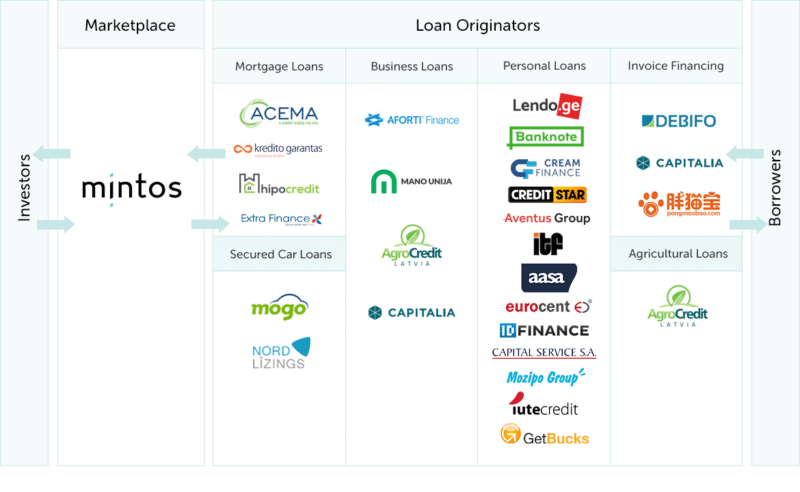 So where’s the risk if loans come with a buyback obligation? It’s that the loan originator itself goes out of business, which is what the safety section above is about. The safe assumption is that funds tied to a defaulted originator won’t come back, and anything recovered is a bonus.
In simple terms, here’s how loan investing on Mintos works:
- Lenders place loans on Mintos to finance their operations
- You invest in loans, thus providing financing to lenders
- Borrowers pay back loans in monthly installments
- You get the earnings and invest again or withdraw
Mintos is open to private and corporate investors from the EU and many other countries, so you can also invest through your company.
What Can You Invest in?
Loans are still the core of Mintos, but it’s now a multi-asset platform.

- Loans: consumer, short-term, car, business, mortgage, invoice financing, agricultural and Buy Now Pay Later loans from lenders in Europe, Latin America, Africa and Asia. You can pick them by hand, use a ready-made portfolio, or build your own automated strategy.
- Bonds: fractional corporate bonds, plus the High-Yield Bonds Portfolio launched in November 2025.
- ETFs: more than 1,000 ETFs with fractional investing from €1.
- Crypto ETPs: added in March 2026 with Upvest, from issuers such as iShares and VanEck, starting at €5.
- Real estate: rental residential properties from €50, where you earn a share of the rent and any capital gain. I didn’t use this much, since I kept my Mintos money focused on loans, but it’s an easy way to add property exposure. These investments can also be sold on the secondary market.
- Smart Cash: a money market fund for uninvested cash.
How I Invested on Mintos
I used several custom automated strategies and tweaked them every few months. If you don’t want to set the parameters yourself, Core Loans is the ready-made option, covered below.
The first step in a custom strategy is choosing the loan originators. Several of them aren’t profitable and are living off their funding until they get there. I preferred lenders that had already proven they could turn healthy yearly profits, and checked their Mintos Risk Score and financial statements. P2P lending is risky enough without backing unprofitable lenders, and after filtering you might end up with 15-20 originators you’re comfortable with.
Beyond that, you can set the loan duration, interest rate, countries, loan types, buyback and more. A lot of these depend on your goals, so there’s little sense in copying my exact parameters, which I changed depending on what I wanted to achieve at the time. I kept things simple and stuck to loans in euro.
If it’s your first time on a P2P platform, it’s fine to invest a small amount manually, wait a month or two, and learn how things work before setting up automation.
Core Loans: The Premade Portfolio
If you don’t want to build your own strategy, Core Loans is a ready-made automated portfolio. You choose the amount, and Mintos handles loan selection, diversification across originators and countries, and reinvestment. Mintos also offers High-Yield and Conservative portfolios on the same basis. All three charge 0.39% a year.
Core Loans includes a cashout option that lets you access your money faster, subject to market demand. It’s the simplest way to start on Mintos if you want a hands-off approach.
The Mintos Secondary Market
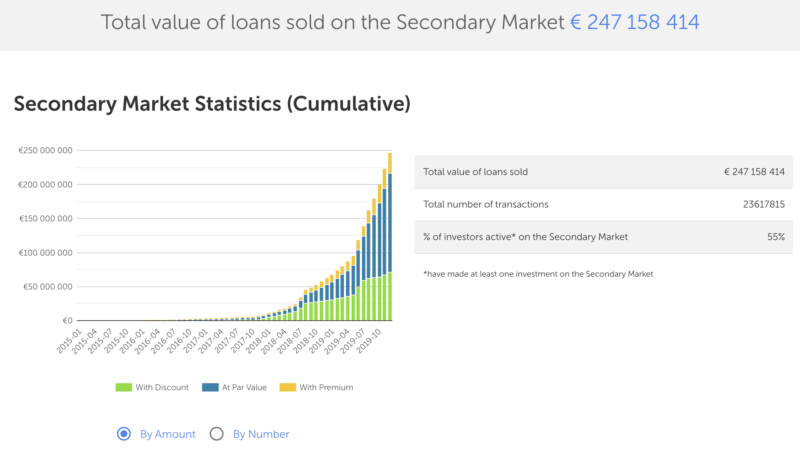
The secondary market is what gives Mintos its liquidity. If you need cash, you sell your investments to other investors, and it usually has more loans listed than the primary market.
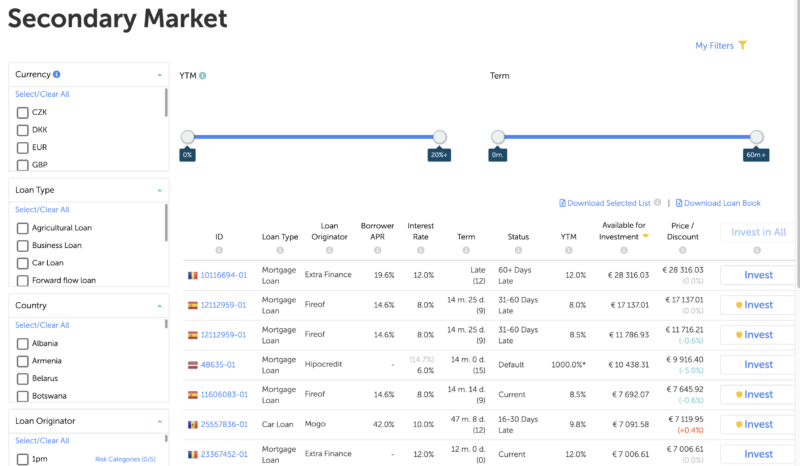
You can buy on the secondary market manually from the page shown above, or set up an automated strategy to buy there with the same criteria as on the primary market. Many investors pick up loans at a discount to improve their return.
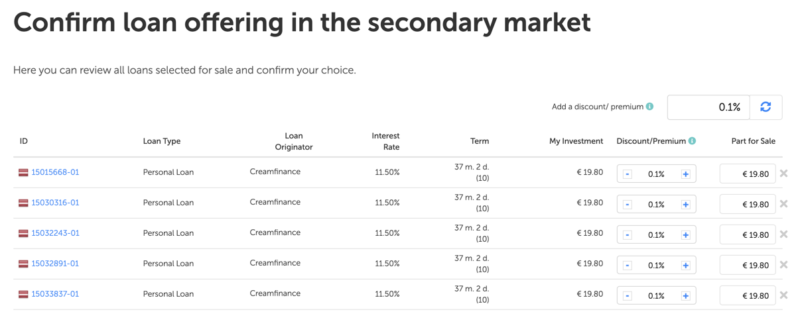
To sell, select your investments and list them, ideally at a small discount so other investors pick them up quickly. Selling costs 0.85% of the sale price.
When I tested it, selling a whole portfolio of healthy loans took one to three days. Liquidity depends on the loans being wanted, though. Loans from an originator in trouble, like Nera Capital in 2026, can become impossible to sell at any reasonable price. If Mintos didn’t have such a good secondary market, I wouldn’t have invested as much as I did there.
Depositing and Withdrawing Money
Bank transfer deposits and withdrawals on Mintos are free. Card, Apple Pay and Google Pay deposits cost 2%. You can deposit in euro or other currencies, and exchanges cost from 0.50%. If your bank charges for SEPA transfers, a digital bank like N26, Revolut or Wise avoids those costs. My guide to depositing and withdrawing money from P2P platforms has more detail.
Mintos Risk Score
Every loan originator on Mintos gets a Mintos Risk Score, the platform’s own assessment of the risk that a lending company fails to service its loans, pass on borrower payments or honor its buyback obligation.

The score is driven by five factors: operating environment (10% weight), company profile (15%), management and strategy (15%), risk appetite (20%) and financial profile (40%), with an extra support factor for lenders backed by a group guarantee. It’s based on due diligence and ongoing monitoring, including management interviews, site visits and audited and interim financial statements, and is updated at least once a year.
For smaller amounts, the Risk Score is a reasonable guide for choosing originators. If you’re investing big sums, do your own research on each lender as well. Keep in mind that originators with decent scores have still failed in the past.
Potential Downsides of Investing with Mintos
Loan Originator Risk
This is the big one, covered in detail above. The buyback obligation is only as good as the lending company behind it, and with about 29% of outstanding loans in recovery, the risk is real. Spread your money across many originators and countries, and favor profitable lenders with audited financial statements.
Many originators are young companies that haven’t been through a serious recession. Credit companies are among the hardest hit in a downturn, when borrowers lose their jobs or see their pay cut.
Liquidity Risk
Healthy loans usually sell within days, but in a crisis buyers disappear, and you may only be able to sell at a steep discount or not at all. Invest money you won’t need in a hurry, so you’re never forced to sell at a bad moment. The same applies if interest rates rise and your older, lower-rate loans become less attractive to buyers.
Cash Drag
Cash drag, money sitting uninvested in your account, hasn’t been a problem on Mintos for me thanks to the size of its loan pool. It could become one if investor demand outgrows the supply of loans. Smart Cash is a way to earn something on idle cash in the meantime.
Foreign Exchange Risk (or Opportunity)
You can invest in loans in currencies other than the euro. When you convert back, you might lose or gain money depending on how rates have moved. If you want to invest in other currencies, a service like Wise can be cheaper than the Mintos exchange fee.
Mintos Mobile App

The app is one of Mintos’s real advantages over competitors. My background is in building software, and I’ve cursed at plenty of banking apps with horrible interfaces. The Mintos app is well made: you can deposit, withdraw and trade on the primary and secondary markets, and its stats section shows your countries, lending companies, average interest rate, remaining term and late loans at a glance. You may never need to log into the website.
What Improvements Would I Like to See from Mintos?
Clearer Statistics
The statistics page shows cumulative investors and investment volumes, but not how many investors are active or how much new lending happens each month. Its split between Current and Delayed loans also lumps recently issued loans that haven’t reached a first repayment in with loans that are being repaid, and those carry different risk.
Faster, Fuller Information on Troubled Originators
When an originator runs into trouble, as Nera Capital did in 2026, investors depend on Mintos for updates. Those updates have been slow and thin at times. I’d also like to see audited statements for every originator, plus default and recovery rates broken down by lender and country.
How Does Mintos Compare?
See how Mintos stacks up against other popular platforms:
- Mintos vs PeerBerry — Which Is Better in 2026?
- Mintos vs Bondora — Which Is Better in 2026?
- Mintos vs Robocash — Which Is Better in 2026?
- Mintos vs ViaInvest — Which Is Better in 2026?
- Mintos vs Twino
- Nectaro vs Mintos
- Afranga vs Mintos
Mintos Alternatives
Spreading your money across more than one platform is the best protection against something going wrong on any single one. These are good platforms to use alongside Mintos:
I compare more options in my list of Mintos alternatives and my ranking of the best European P2P lending platforms.
Final Thoughts on Mintos
I’ve followed Mintos for more than nine years, and over that time I invested more than €150,000 there with an average net return of around 9%. The platform has grown from a loan marketplace into a regulated multi-asset investment platform, and the ECB banking license application is the next step in that direction.
The loans on it remain high-risk. Originator failures are a recurring part of investing here, the Nera Capital case shows they still happen in 2026, and the fees introduced since 2025 take a slice of your return. Mintos is still the platform I’d point to for the widest choice of P2P loans, thanks to its size, regulation, secondary market and app, as long as you diversify widely, keep P2P to a small part of your net worth, and assume some of your money will end up in recovery.
Please leave any questions you have about the platform below and I’ll be happy to answer them.
Frequently Asked Questions about Mintos
Is Mintos safe to invest in?
Mintos is a licensed investment firm under MiFID II, supervised by Latvijas Banka, and your assets are protected up to €20,000 by the investor compensation scheme if Mintos fails. That scheme doesn’t cover losses on loans. About €190 million, close to 29% of outstanding loans, was in recovery in September 2026, including the Nera Capital payment stop, so originator risk is real and you should diversify widely.
What returns does Mintos offer?
Mintos shows a weighted average APY of 9.2% on available loans in October 2026, before any losses from failed originators. Over nine years of investing, my own net average was around 9%. Smart Cash, the money market option, was yielding 2.5%.
What are the Mintos fees?
Manual loans, bonds, ETFs and real estate are free to buy. Custom Loans portfolios cost 0.29% a year, Core Loans and the other ready-made portfolios 0.39% a year, and Smart Cash 0.19% a year. Selling on the secondary market costs 0.85%, currency exchange starts at 0.50%, and an inactivity fee of €4.90 a month applies after 360 days with no activity.
What is the minimum investment on Mintos?
The minimum is €50 per loan on the primary market and €1 on the secondary market. ETFs start at €1, crypto ETPs at €5, and real estate at €50.
Is Mintos regulated?
Yes. Mintos has been a licensed investment firm under MiFID II since 2021, supervised by Latvijas Banka. Loan investments are structured as Notes, which are financial instruments under EU securities law. In February 2026 Mintos started applying for a banking license from the European Central Bank, which it expects to take 12 to 18 months.
Does Mintos have a buyback guarantee?
Most loans on Mintos come with a buyback obligation from the loan originator. If a borrower is more than 60 days late, the originator has to repurchase the loan at par plus accrued interest. The buyback is only as strong as the originator behind it, and it disappears if that company fails.
How long does it take to sell my Mintos investments?
A portfolio of healthy loans usually sells on the secondary market within one to three days, especially if you add a small discount. Selling costs 0.85%. Loans from troubled originators can be very hard to sell at any reasonable price.
What are pending payments?
Pending payments are borrower repayments that a lending company has collected but not yet passed on to Mintos. You earn extra interest on them after the settlement period, paid once the lending company transfers the money. If pending payments keep growing, treat it as a warning sign about that originator.
How are Mintos returns taxed?
Mintos pays your returns gross and doesn’t withhold tax, so you declare the income in your country of residence. My post on P2P lending taxation explains how, and I’ve also covered how crowdlending is taxed in Spain.
Is it normal to have many late loans on Mintos?
Yes. On a diversified portfolio it’s common to see a good share of loans in some stage of lateness, mostly 1-15 days late. What matters is that they’re covered by a buyback obligation from a healthy originator. Loans more than 60 days late with a buyback obligation usually mean the originator is in trouble.
Summary
Mintos is the largest P2P platform in Europe by volume, and the one I invested the most on: over EUR 150,000 across nine years. It's licensed under MiFID II with EUR 20,000 investor compensation and has applied for an ECB banking license. The widest choice of loans in European P2P, but expect some money tied up in recovery, and weigh the fees on automated portfolios.
Pros
- Widest choice of loans, bonds, ETFs and other assets
- MiFID II licensed, supervised by Latvijas Banka
- Investor compensation up to EUR 20,000
- Active secondary market for liquidity
- Long track record and mobile app
Cons
- Around 29% of outstanding loans in recovery
- Nera Capital stopped paying interest in 2026
- Annual fees of 0.29-0.39% on automated portfolios
- Platform still loss-making (about EUR 2M in 2025)
Related




Os 9% líquidos ao ano como média de nove anos é o número mais honesto que já vi publicado sobre a Mintos. Inclui os anos bons e os anos com defaults de originadores russos e ucranianos. É esse o benchmark realista, não os 12-14% do título.
O que me faz manter posição aqui é a regulação MiFID II e o mercado secundário. Para crédito com garantia real por operação, uso a Maclear onde a plataforma atua como Collateral Agent em cada empréstimo P2B. Para diversificação entre originadores independentes a preços menores, PeerBerry complementa bem. E para crédito empresarial regulado com ABS, o Debitum fecha o conjunto.
Os 130 milhões em defaults por resolver continuam a ser o número que mais importa vigiar. A licença bancária em 2026 pode mudar bastante a equação se se concretizar.