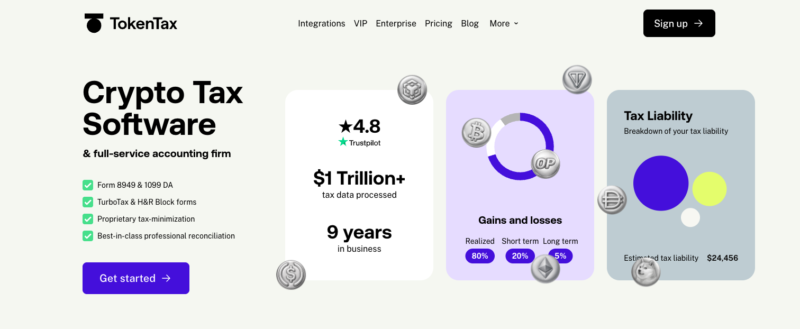
TokenTax sits in a different part of the crypto tax market from most of the tools I cover. It is both a software platform and a full-service accounting firm: you can use it to crunch your own numbers, or hand the whole return to its in-house CPAs and have them file for you. That combination is what makes it worth knowing, and also what makes it the priciest option in the category.
This review covers what TokenTax does well in 2026, where it falls short, what it costs now, and who should actually use it.
What TokenTax Is
At its core, TokenTax imports your transaction history from exchanges, wallets, and DeFi protocols, works out your capital gains and income, and generates the tax documents you need to file. So far that is the same job CoinTracking, Koinly, and CoinLedger do.
What sets it apart is the human layer. TokenTax employs CPAs and enrolled agents in-house, and its top plans (plus an optional full-filing add-on) let those experts prepare and file your entire return, crypto and non-crypto alike. None of the pure-software tools offer that. If your situation is messy enough that you would otherwise hire an accountant who understands crypto, TokenTax rolls the software and the accountant into one product.
Who It’s For
TokenTax is built for the complicated end of the market:
- High-volume traders with thousands of transactions across many venues.
- Margin and derivatives traders, where calculating gains is genuinely hard and most tools give up.
- Heavy DeFi and NFT users whose activity confuses simpler importers.
- Anyone who wants to go hands-off and have a professional file the whole thing.
If you are a buy-and-hold investor with a handful of trades, this is overkill, and a cheaper tool will serve you better.
How It Works
The flow is the familiar one, with the option to bring in a human at the end:
- Connect your accounts. Link exchanges and wallets by API, or upload CSV files. TokenTax supports every major centralized exchange plus DeFi and NFT platforms.
- Reconcile. The platform matches transfers, flags missing data, and lets you pick an accounting method (FIFO, LIFO, specific identification, and average cost for UK and Canadian filers).
- Generate your forms. It produces IRS Form 8949 or the relevant international report, an income report, and an audit-trail transaction report, and integrates with TurboTax.
- Optionally hand it off. With a VIP plan or the full-filing add-on, TokenTax’s tax team takes over and files your complete return.

Where It Stands Out
Margin and derivatives
This is TokenTax’s strongest suit. Margin trades on venues like BitMEX, plus options and futures, are notoriously awkward to report, and most crypto tax tools either skip them or get them wrong. TokenTax calculates margin and options PnL directly, and on its higher tiers its accountants can sort out the cases that software alone cannot.
Full-service filing
The add-on that lets TokenTax’s CPAs file your entire return is the feature you are really paying for. For someone with a complex portfolio and no desire to touch a tax form, that is a genuine convenience the DIY tools cannot match.
DeFi and NFT coverage
TokenTax handles DeFi and NFT activity across its plans, including an Ethereum gas fee report and tax-loss harvesting tools to surface positions you could sell to offset gains. See my guide to crypto tax-loss harvesting for how that works.
TokenTax Pricing in 2026
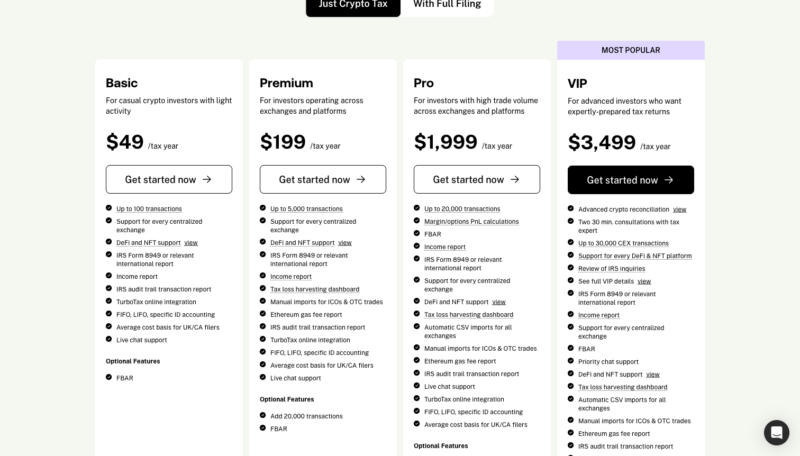
There is no free tier, which is the first thing to know. You pay per tax year, and the plans split into self-serve software and optional full-service filing.
| Plan | Price / tax year | Transactions | Best for |
|---|---|---|---|
| Basic | $49 | Up to 100 | Light activity |
| Premium | $199 | Up to 5,000 | Multi-exchange investors |
| Pro | $1,999 | Up to 20,000 | High volume, margin/options |
| VIP | $3,499 | Up to 30,000 | Hands-off, expert-prepared |
VIP includes two 30-minute consultations with a tax expert and a review of any IRS inquiries. On top of these, the optional Full filing by TokenTax add-on has the team file your complete return, and an Enterprise tier covers crypto businesses, high-net-worth individuals, and very large or cross-chain transaction sets. Multi-year purchases get 10% off.
The pattern is clear: the software tiers are competitive at the bottom, but the real value, and the real cost, is the human filing service at the top.
The European Caveat
TokenTax is US-first. It is built around IRS forms (8949, FBAR), TurboTax integration, and US filing, with average-cost support for UK and Canadian filers and a generic gain/loss report for other countries. It does not generate the national tax forms that European filers often need.
If you are based in Europe, that matters. For Spain, Germany, France, and most EU jurisdictions, you will usually be better served by Koinly or CoinTracking, or by Divly if you want your country’s actual form. See my best crypto tax software comparison for how they stack up.
Verdict
TokenTax is the tool I would point you to in one specific situation: your crypto taxes are complicated, you file in the US, and you would rather a competent professional handle them than wrestle with software yourself. For high-volume traders, margin and DeFi users, and anyone who wants a hands-off return, the pairing of solid software with in-house CPAs is hard to beat, and the price reflects that.
For everyone else, especially European investors and straightforward buy-and-hold portfolios, it is more tool and more money than you need. Start with one of the cheaper, more localized options instead.
Frequently Asked Questions
Does TokenTax have a free trial?
No. TokenTax has no free tier, and plans start at $49 per tax year. You pay before you can download your reports, which is a difference from tools like CoinTracking and Koinly that let you import and preview your numbers for free.
Is TokenTax good for European investors?
Only partially. It is built around US filing and offers average-cost support for the UK and Canada, but it does not generate the national tax forms most EU countries require. European filers are usually better off with Koinly, CoinTracking, or Divly.
What makes TokenTax different from Koinly or CoinLedger?
The full-service option. TokenTax employs CPAs and enrolled agents who can prepare and file your entire return, not just generate reports. Koinly and CoinLedger are software-only. That human layer is TokenTax’s main advantage, and why its top plans cost much more.
Can TokenTax handle margin and DeFi trades?
Yes, and this is one of its strengths. It calculates margin and options PnL and supports DeFi and NFT activity, including complex cases that simpler tools struggle with. On higher tiers its accountants can resolve the trickiest reconciliations.
Summary
TokenTax can make your crypto tax preparation process a breeze. The software truly shines in terms of automation and user experience. TokenTax also has in-house CPA counsel that can offer you all the assistance you need, and this is especially recommended for those with large crypto holdings or those who make a lot of trades and use a diverse set of crypto-related products such as lending, staking, margin trading, CFDs, futures, etc.
Pros
- A trusted player in the crypto tax space
- Professionals available for extra assistance
- Easy-to-use software
- Many integrations
Cons
- Limited features on the free plan
Related









Dear Jean,
Thank you very much for the interesting information. I have a furthermore question to you. If we want to cash out via e.g. Santander Bank which documents are required? Is it necessary to open the exchange account to show all transactions? Is it possible that Santander rejects the transaction? If yes, what are the the major mistakes ?
It would be great if you can help me.
Greetings
Simone
Typically they will want to see all the transaction history and potentially even the source of initial funding.
Some banks prevent their clients from cashing out from crypto exchanges altogether. It’s always best to contact your manager about any cash out plans beforehand to avoid nasty surprises.