
Jean Galea

Health, Wealth, Relationships, Wisdom

  • Start Here
  • Guides
    • Beginner?s Guide to Investing
    • Cryptocurrencies
    • Stocks
    • P2P Lending
    • Real Estate
    • Forex
    • CFD Trading
    • Start and Monetize a Blog
  • My Story
  • Blog
    • Cryptoassets
    • P2P Lending
    • Real estate
  • Consultancy
    • Consult with Jean
    • Consult a Lawyer on Taxation and Corporate Setups
    • AI Consultancy for Business
  • Podcast
  • Search

A Guide to Renting an Apartment in Barcelona

Last updated: April 14, 2020Leave a Comment

Barcelona is currently my favorite city in Europe, and I thought it would be fun to do some research into renting an apartment in Barcelona. I’ll be focusing on long term rentals as short term rentals have been covered to death, and anyway, we all know that nowadays companies like Airbnb have completely dominated short term rentals.

Let’s say you want to spend more than 3 months in Barcelona, a year even. What should you know before you get to Barcelona?

The Importance of Agents

Your best bet for finding an apartment in Barcelona is through an agent. These agents can either be independent or be employed by one of the big agencies. This holds especially true if you are looking for a mid to high-end apartment and don’t want to waste time trawling the various property rental listing websites.

Upon finding an apartment, the new tenant pays the agent’s fee, and it’s usually the equivalent of one month’s rent, but can be up to 10% of the annual cost of the rental. VAT at the rate of 21% will be added on top of that.

Any reasonably priced flat that’s in a good condition will rent out quickly. Spain might be in a recession but the rental market in Barcelona certainly doesn’t seem to be affected, things here move fast. If you find something you really like, go for it. A good property can be gone in a matter of days, hours even.

Properties are available for viewing when the previous tenants have moved out. That means you’ll be seeing the apartment in a ready-to-rent state and also implies that you should be ready to move immediately.

When you find a property you like, you’ll probably want to dig a little deeper. Here’s a handy checklist:

  • Are communal charges included in the rent? (usually yes)
  • Are utility bills included? (usually not, ask about electricity, water and gas)
  • Is there an extra cost for central heating?
  • Is the agency fee 1 month’s rent or 10% of the annual rent? (the latter works out more expensive)
  • What are the deposit terms? (usually two months rent)

I would also suggest checking if there are any planned works (construction) nearby, and see what kind of neighbors you would have. It’s also important to have a good look at the state of the building itself. Some rental apartments can be in great condition, but the building itself would have some serious problems.

For example, I rented an apartment that was absolutely excellent and we were the first tenants in, however, after a few weeks we discovered that if someone smoked in any of the other apartments, the smoke would seep through into our apartment through the kitchen extraction fan tubing. Ridiculous, I know, but it’s just an example of the many non-obvious problems that you can have.

I also suggest speaking to the owner about how they handle repairs, especially if it’s not a new apartment. Some owners that are not professional will leave you waiting for days, while others offer same day (usually within the hour) repairs because they have someone on call for such incidents.

Prices

Prices have been on the rise in recent years. As of August 2018, you can expect to pay between 900 and 2000 euros for an apartment, depending on the size and condition. A reformed three bedroom apartment in a good area will fetch between 1500 and 2000 euros. A reformed one bedroom will be closer to 900 euros.

Renting a Room

If you’re strapped for cash and don’t mind living with other people, you can also rent a room in an apartment. One of the best apps for finding such rooms is Badi. Expect to pay 400-800 euros for a good room.

Good luck with your apartment or room search, and if you have any questions just leave a comment below and I’ll do my best to answer.


Filed under: Expat life

The Best Books and Resources for Learning Exercise Physiology

Last updated: March 13, 2026Leave a Comment

As I continue to immerse myself in padel and strive to improve every year, I’ve taken it upon myself to really learn how the human body works, especially in relation to exercise and sport.

Understanding exercise physiology has changed the way I train. Instead of blindly following workout programs, I can now evaluate whether an exercise makes sense for my goals, understand why certain recovery protocols work, and make informed decisions about my training. Whether you’re an athlete trying to optimize performance or just someone who wants to train smarter, these resources will give you a solid foundation.

Exercise Physiology Textbooks

These are the go-to academic texts in the field. They’re dense, but incredibly comprehensive if you want to truly understand how the body responds to exercise.

  • Exercise Physiology: Theory and Application to Fitness and Performance — by Powers and Howley. This is the textbook used in many university exercise science programs. It covers everything from cellular metabolism to cardiovascular responses to training adaptations. Excellent diagrams and chapter summaries make the complex material digestible. I’d recommend this as your first textbook if you want a thorough but readable introduction.
  • Exercise Physiology: Nutrition, Energy, and Human Performance — by McArdle, Katch, and Katch. Another heavyweight textbook that puts more emphasis on nutrition and energy systems than the Powers book. Particularly strong on body composition and the metabolic aspects of exercise. A good complement to Powers if you want the full picture.
  • Physiology of Sport and Exercise — by Kenney, Wilmore, and Costill. This one takes a more practical, sport-focused approach. Great chapters on training for different sports, environmental considerations (heat, altitude, cold), and age-related changes in exercise capacity. If you’re primarily interested in sports performance rather than clinical exercise physiology, start here.

Sport-Specific Training

  • Advanced Strength and Conditioning for Tennis — While specifically about tennis, much of the content applies directly to padel and other racquet sports. Covers movement patterns, injury prevention, periodization, and sport-specific strength exercises. One of the few books that bridges the gap between academic exercise science and real-world racquet sport training.
  • Strength Training Anatomy — by Frederic Delavier. Not a textbook in the traditional sense — it’s essentially an atlas of exercises with detailed anatomical illustrations showing exactly which muscles are working during each movement. Invaluable for understanding your own training and for identifying which exercises target specific muscle groups. I reference this one constantly.

Online Courses

If you learn better through video and structured lessons than through reading, these Coursera courses are excellent starting points:

  • Science of Exercise — A well-structured course that covers the fundamentals of how exercise affects the body. More accessible than the textbooks and a great entry point if you’re new to the subject.
  • Introductory Human Physiology — Broader than just exercise, this covers how the major body systems work. Understanding the cardiovascular, respiratory, and musculoskeletal systems at a fundamental level makes everything else click into place.

Practical Fitness Books

These are less academic but still grounded in solid science. If the textbooks above feel like too much, these are a more approachable way to improve your training knowledge:

  • Starting Strength — by Mark Rippetoe. The definitive guide to barbell training. Even if you don’t follow Rippetoe’s specific program, the detailed breakdowns of squat, deadlift, bench press, and overhead press form are essential knowledge for anyone who lifts weights.
  • Becoming a Supple Leopard — by Kelly Starrett. Focuses on mobility, movement quality, and fixing common dysfunction patterns. If you sit at a desk all day (like most of us) and then try to perform athletically, this book will help you identify and address your mobility limitations.
  • Calisthenics for Beginners — A practical guide to bodyweight training with progressive exercises. Good if you want to build strength without a gym.
  • The Practice of Natural Movement — by Erwan Le Corre. A different approach to fitness that focuses on natural, functional movement patterns rather than isolated gym exercises. Thought-provoking and a good counterbalance to traditional training methods.
  • How to Build Strong & Lean Bodyweight Muscle — Another solid bodyweight training resource with clear progressions for different skill levels.

Where to Start

If you’re coming to this with no background in exercise science, I’d suggest starting with the Coursera Science of Exercise course and Strength Training Anatomy. The course gives you the foundational knowledge, and the anatomy book makes it tangible.

Once you’re comfortable with the basics, pick one of the three textbooks based on your interest — sport performance (Kenney), general fitness (Powers), or nutrition-focused (McArdle).

Do you have any other resources to recommend? Let me know in the comments section.

Filed under: Health & Fitness, Padel

Best UK Real Estate Crowdfunding Platforms in 2026

Last updated: March 10, 202611 Comments

The United Kingdom remains one of Europe’s most economically significant property markets — a strong legal system, a globally recognized capital city, and a chronic housing shortage that shows no sign of resolving itself. All of that makes it a compelling place to invest in real estate, even if the landscape has shifted considerably since I first wrote about these platforms.

In a separate article, I’ve listed the best European-wide real estate crowdfunding platforms, but this article focuses specifically on UK platforms. I’ve invested in several of them personally, and my experience has been mixed — more on that below.

The UK Property Case in 2026

The fundamental supply-demand imbalance that underpins the UK property investment thesis is still very much intact. The government’s own statistics show England delivered just 208,600 net additional dwellings in 2024–25 — a 6% drop year-on-year. Labour has pledged 300,000 new homes per year and a total of 1.5 million homes over the current parliament, but the Office for Budget Responsibility has already forecast that target will be missed. Housebuilding is expected to hit a 12-year low in 2025–26 before gradually recovering toward the end of the decade.

The UK housing supply gap, in short, is not going away. That structural undersupply continues to support long-term property valuations, particularly in areas with strong employment and population growth.

A few caveats worth naming up front: Brexit did hurt valuations for some platforms in the short term, and the interest rate environment of 2022–2024 added stress to property development loans across the industry. Several platforms that existed when I first published this article have since collapsed or run into serious trouble. I’ll call those out explicitly below.

A Word on My Own Experience

My biggest UK property crowdfunding position was in Property Partner — now rebranded as London House Exchange. I’m going to be direct: it went badly. The platform has been in effective wind-down mode for years, selling properties at significant discounts, and investor sentiment has collapsed (Trustpilot rating of 1.3 stars as of early 2026). I’ve written a full, detailed account in my London House Exchange review — read it before you consider putting money there.

That experience made me more selective. The platforms I recommend below are the ones I’d consider today, given what I now know about how this industry operates under stress.

Platforms to Consider in 2026

CrowdProperty

CrowdProperty has been operating since 2014 and is FCA-authorized. It focuses on property development lending — matching retail and institutional capital with SME property developers across England and Wales, secured by first charge on the assets.

As of early 2026, CrowdProperty has funded over £832 million in property projects and backed the development of nearly 3,000 homes. Those are meaningful numbers for a specialist lender in this space. The minimum investment per loan is £50, which makes it accessible for portfolio diversification.

That said, I’d encourage you to go in with clear eyes. The platform has recorded 81 technical defaults on development loans between 2018 and 2024 — a figure they publish openly, which I respect. Co-founder and longtime CEO Mike Bristow stepped down in January 2025, replaced by Steve Deutsch. The platform has also seen a reduction in large-deal activity compared to its growth years. None of this means CrowdProperty is in trouble, but it does mean the easy tailwind years are behind it.

If you’re investing here, focus on the loan-level security (first charge matters), understand that development loans carry more risk than buy-to-let loans, and don’t concentrate heavily in any single project.

Invest with CrowdProperty

CapitalRise

CapitalRise is the platform I find most interesting for investors with higher ticket sizes. It focuses exclusively on prime property developments in London and the Home Counties — the kind of projects in areas like Chelsea, Kensington, and the surrounding counties where demand is structurally resilient.

FCA-authorized and operating since 2016, CapitalRise has now facilitated over £305 million in investments and returned over £300 million in capital to investors — a notable milestone. Average historical returns on repaid loans have been approximately 9% per year, with current opportunities typically in the 7–9% range depending on the project and term.

The minimum investment is £1,000 per opportunity. Importantly, CapitalRise restricts access to self-certified sophisticated investors and high net worth individuals — this is not a platform for first-time investors dipping their toes in. All loans are secured, and the platform has maintained a clean repayment record through a difficult period for the wider market.

If your focus is prime London property with a strong track record and transparent deal structuring, CapitalRise deserves serious attention.

Shojin

Shojin is an FCA-regulated fractional real estate investment platform that gives investors access to mid-tier UK development projects, including residential and mixed-use schemes. The minimum investment is £5,000, and the platform operates a transparent co-investment model where Shojin itself invests alongside its investors — an alignment of interests that matters.

The platform has been active in returning capital to investors through 2025, which in a stressed market is a meaningful signal. Shojin has also been building international partnerships, including with German and Estonian platforms, which suggests a stable and growth-oriented operation rather than one in wind-down.

Returns vary by project and structure, but are generally in the 8–12% range, reflecting the development-stage risk. As with any development lending, illiquidity is a feature not a bug — investments are typically locked up for the duration of the project.

Platforms I’m Not Recommending

London House Exchange (formerly Property Partner)

I’ve already mentioned this above. The short version: avoid it for new investment. The platform is in a de facto wind-down, selling properties at discounts, and existing investors have faced years of illiquidity and value erosion. Read my full London House Exchange review for the details.

Kuflink

Kuflink is FCA-authorized and technically still operating, but the picture has deteriorated significantly. As of mid-2025, approximately 38.6% of net principal was over 30 days overdue, and the FCA-defined default rate reached roughly 16% in 2024. More critically, from September 2025, Kuflink stopped using its own funds to cover investor losses — a protection that had been a central part of its pitch for nine years. Investment returns now depend directly on borrower repayments, which is a very different risk proposition than what many investors signed up for.

Sourced Capital

Sourced Capital gained direct FCA authorization in 2022 and markets itself as the UK’s largest property investment platform (largely by reference to its broader franchise network, not just the P2P lending arm). However, I’ve grown wary of recommending it. The platform has become opaque — it no longer provides its data to independent review sites like 4thWay, its financials are unclear, and there have been past concerns about website security. Without transparency, I can’t evaluate it properly, and when I can’t evaluate something I don’t invest in it.

The House Crowd

The House Crowd went into administration in February 2021 and was formally placed into liquidation in February 2024 with no prospect of returning the £52.7 million owed to investors. It’s gone. I mention it here as a reminder that platform risk is real in this space.

What to Look for in a UK Property Crowdfunding Platform

After years in this space — and after watching platforms fail — here’s how I now evaluate any new platform before investing:

  • FCA authorization: Non-negotiable. Check the FCA register directly, not just the platform’s claims.
  • Security structure: First charge security is significantly better than second charge. Know what you hold.
  • Track record under stress: Any platform can look good in a rising market. How have they handled defaults? Do they publish outcomes data?
  • Transparency: Do they share financial information openly? Do they cooperate with independent review sites? Opacity is a red flag.
  • Loan-to-value ratios: Lower LTV means more cushion if a property needs to be sold at a discount. 60–70% LTV is a reasonable benchmark.
  • Investor alignment: Does the platform co-invest? Does it have skin in the game alongside you?

Final Thoughts

The UK property crowdfunding market in 2026 is smaller and more cautious than it was five years ago — and that’s not necessarily a bad thing. The platforms that survived the interest rate shock and the post-COVID property market slowdown have done so because their fundamentals were sound. The ones that didn’t are a case study in what happens when growth gets prioritized over credit discipline.

The structural case for UK property investment — chronic undersupply, strong rental demand, a globally liquid legal environment — hasn’t changed. But the platforms you access it through matter enormously. I’d focus on CrowdProperty for development lending at accessible minimums, and CapitalRise if you meet the sophisticated investor criteria and want prime London exposure.

For broader European options, check out my list of best European real estate crowdfunding platforms. Geographic diversification across property markets is something I practice myself, and it’s worth taking seriously.

Have you invested in UK property through any of these platforms? I’d be interested to hear your experience — particularly if you’re a current Kuflink or Sourced Capital investor navigating the recent changes.

Filed under: Money, Real estate

Taking a Sports Medical Test Before Training Hard and Competing in Padel

Last updated: September 29, 2022Leave a Comment

medical test for padelWhenever you are practicing any sport in a serious manner, it’s important to undergo a medical test to make sure you don’t have any conditions that can endanger your health while practicing that sport.
Practicing a sport seriously usually necessitates pushing yourself to the max in order to improve your thresholds for power, resistance etc and thus make improvements to your overall performance. Having an underlying deficiency means you would be putting yourself at risk as that high stress can trigger a failure in that weak aspect of your body.

Sadly, we’ve seen many athletes over the years collapse and sometimes die while practicing their sport, and some of those incidents could have been avoided by better testing of the athlete and detection of underlying problems (usually related to their heart).

To keep on the safe side, I like to undergo a medical sports stress test at the start of every year so that I can set my mind at rest and also understand which areas I need to improve in.

Sanitas also offers some of these tests, you can find more info here. They have a Sport Medicine Unit headed by Dra. Bellver in the Millennium Centro Medico Iradier. You need to contact them at 932 55 46 00 or email [email protected]. If you’re with Sanitas the basic test is covered but if you want to take the advanced test with gases then you need to pay 120 euro.

Here’s a good article about stress testing in sports.

Filed under: Padel

Jump Rope Training for Padel and Other Sports

Last updated: February 10, 2023Leave a Comment

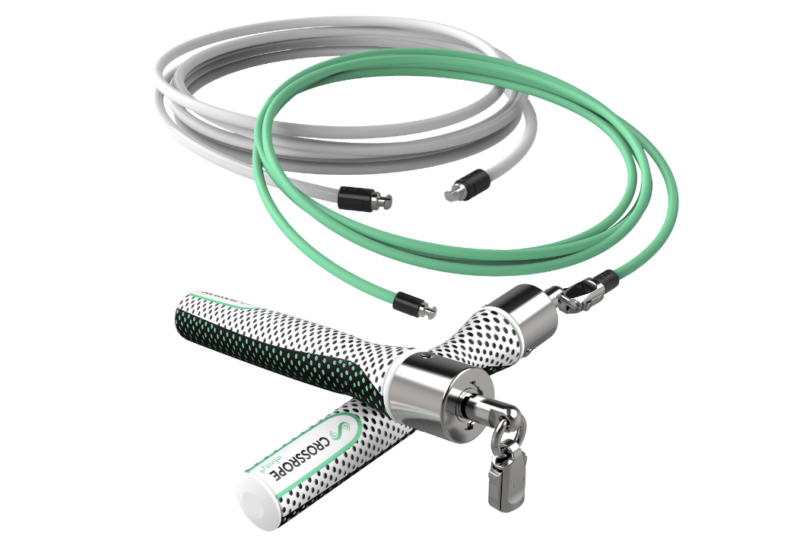
I use jump rope training to improve my fitness and agility for padel. My rope of choice is the Crossrope Lean set.

When I started out I couldn’t even jump more than 5 skips and I did ridiculously huge jumps, which is normal for a beginner.

I now can do the basic technique around 50x times continuously with no mistake. Unfortunately, it took me a while till I found a jump rope I liked, and I was also trying lots of other new things and ended up dedicating much less time than I wanted to this activity.

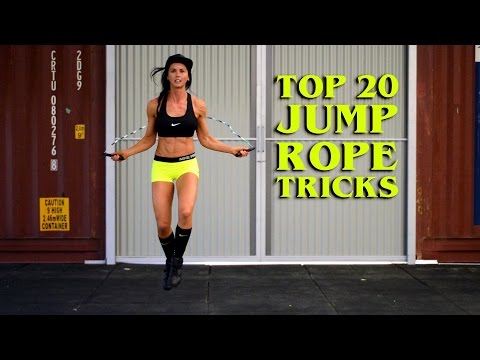
It’s important to get the rope sizing right before you start, so watch this video first:

YouTube video

Here are some videos of skipping rope techniques:

YouTube video
YouTube video

Here’s the plan to follow if you want to begin with jumping rope:

Basic Jump Rope Proficiency

Bounce Step

This is the basic step for jumping rope that you’ve undoubtedly seen performed multiple times. Bounce only once per swing of the rope and make sure you’re only lifting your feet just enough for the rope to pass under them.

Alternate Foot Step

Begin by balancing weight on one foot, swing rope around and jump with opposite foot then alternate feet as if running in place. Make sure you don’t kick backwards or you’ll get tangled in the rope. Count only the right foot and multiply by 2 to get the total number of jumps.

Once you can do 140 jumps of each of these aforementioned techniques without error or fatigue, you’ll have achieved a basic jump rope proficiency.

Make sure you can do these two skills at different speeds and switch between them by doing 4 jumps of each before switching. You should be able to do 500 consecutive jumps while alternating these two techniques.

Intermediate Jump Rope Skills

High Step

Begin with the alternate foot step and lift your knee to the waist level and keep alternating your feet while keeping your back straight and landing on the balls of your feet.

Side Straddle

Start with the bounce step technique and spread your feet to shoulder width and back to original position.

Forward Straddle

Start with the bounce step stance and shift the right foot forward while the left foot shift back and vice versa to continue the exercise.

Skier’s Jump

Start with the bounce step stance, keep feet together and jump a few centimeters right on the first rope swing and to the left on the second rope swing and keep up this rhythm. It should resemble a ski slalom.

Bell Jump

Keep your feet together and jump a few inches forward and then backward. The movement should resemble the action of a bell clapper.

Half Twister

Twist the lower half of your body so that the toes land pointing 45 degrees to the right, then forward on the second jump and 45 degrees to the left on the third jump, then reverse.

Full Twister

Same as half twister but with no middle jump.

X-Foot Cross

Cross your feet under the rope.

Forward Shuffle

Made famous by Mohammad Ali, shift the right foot forward on the first jump and the left on the second jump with the knee extended.

Backward Shuffle

Low backward kicking motion like jogging on the spot.

Heel to Toe

Start with the bounce step, on the first jump hop on the right foot and touch the left heel to the floor in front of you, on the second jump hop on your right foot again touching your left toe to the floor next to your right foot, repeat on the opposite side.

Backward Jumping

Reverse the bounce step by looping the rope in the opposite direction. Remember to pull your shoulders backwards.

Arm Crossover

Start from the basic bounce stance. On the first jump swing the rope around and cross your arms at waist level while your feet jump over the rope. After the rope has passed under your feet on the first jump extend your arms to the sides of your body to uncross as if you’re executing the bounce step creating a wide loop to jump through on the second jump. The feet should be doing a jogging motion as in the alternate foot step.

Measuring Your Jump Rope Skill Level

There is no specific level of jump rope fitness that is considered “good,” as it depends on individual factors such as your age, fitness goals, and starting level of physical activity. However, some general guidelines can provide a way to measure your jump rope fitness:

  1. Endurance: Start with jumping rope for 1-2 minutes without stopping, and gradually increase the time as you get stronger. A goal of 10-15 minutes of continuous jumping is considered a good level of endurance.
  2. Speed: Measuring the number of jumps you can perform in 30 seconds is a way to gauge your speed. A goal of 100 jumps in 30 seconds is a good starting point, and you can work on increasing the speed as you get fitter.
  3. Complex movements: Incorporating different jump rope movements, such as double unders or crossovers, can add an extra challenge to your workout and improve your coordination. A goal of performing 10-20 double unders or crossovers in a row is considered a good level of skill.

This is a good shop for buying skipping ropes in Europe. In the USA they are really popular. If you want something basic, check out Amazon or Aliexpress.

Filed under: Padel

  • « Previous Page
  • 1
  • …
  • 64
  • 65
  • 66
  • 67
  • 68
  • …
  • 90
  • Next Page »

Latest Padel Match

Jean Galea

Investor | Dad | Global Citizen | Athlete

Follow @jeangalea

  • My Padel Experience
  • Affiliate Disclaimer
  • Cookies
  • Contact

Copyright © 2006 - 2026 · Hosted at Kinsta · Built on the Genesis Framework