TL;DR: True anonymity in Bitcoin is harder than ever. Regulators shut down Samourai Wallet in 2024, Binance now requires full KYC, and the EU’s MiCA regulation plus Travel Rule mean exchanges must collect identity data on transactions over 1,000 euros. Your best options in 2026: a Ledger hardware wallet for long-term storage, Sparrow Wallet for privacy-focused desktop use, Edge for mobile convenience, and Exodus for a polished multi-platform experience. Self-custody wallets that don’t require KYC remain legal in most jurisdictions — but the privacy landscape is shifting fast.
If you plan to buy and hold Bitcoin or alternatives like Ethereum, you’ll need somewhere to store your coins. Depending on your needs, there are dozens of wallet options — but if privacy matters to you, the field has narrowed significantly since I first wrote this guide.
The one you choose comes down to the trade-off between safety and convenience. If you’re investing a substantial amount into Bitcoin, a hardware wallet is the way to go. If you need frequent access, a mobile or desktop wallet makes more sense.
With that in mind, here are the best anonymous Bitcoin wallets for each use case in 2026.
What Do I Mean by “Anonymous”?
Before jumping into the list, a quick clarification on what “anonymous” means in this context. These are Bitcoin wallets that let you download, install, and use them without providing personal information or ID.
In theory, you can store, send, and receive Bitcoin without revealing your identity. In practice, it’s not that simple — there’s almost always some trail:
- If you buy a hardware wallet with your debit/credit card, the purchase is linked to your identity.
- If you buy Bitcoin from an exchange like Coinbase and then withdraw to your anonymous wallet, the original purchase is still tied to your name.
Bitcoin as a network is “pseudonymous,” not anonymous. Wallet addresses, balances, and transaction histories live on a public blockchain and can often be traced or linked over time. Your actual privacy depends less on the wallet itself and more on how you fund it, how you use it, and whether that activity gets connected to your real identity.
Important: The Regulatory Landscape Has Changed
Since I originally wrote this guide, the privacy wallet space has shifted dramatically:
- Samourai Wallet was shut down in April 2024. Its founders were arrested and later pleaded guilty. The DOJ alleged it facilitated over $2 billion in transactions, including $100 million in criminal proceeds. This sent shockwaves through the privacy wallet community.
- Tornado Cash faced similar enforcement. Co-founder Roman Storm was convicted in August 2025.
- Wasabi Wallet discontinued its built-in CoinJoin coordinator in 2024 due to regulatory pressure (though third-party coordinators still exist).
- The EU’s MiCA regulation went into full effect in December 2024. The Travel Rule now requires crypto service providers to collect and share identity information on transactions. For transfers over 1,000 euros involving self-hosted wallets, providers must verify wallet ownership.
- Binance now requires full KYC on all accounts for any meaningful activity. The days of anonymous Binance accounts are over.
The bottom line: self-custody wallets that don’t require ID remain legal in most places. But the on-ramps and off-ramps (exchanges, banks) increasingly require identity verification. Plan accordingly.
Best Bitcoin Wallet for Large/Long-Term Holdings — Ledger Hardware Wallet
If you’re investing a significant amount into Bitcoin or holding for years, a hardware wallet is non-negotiable. It’s the safest option available because it keeps your private keys offline, virtually eliminating the threat of remote hacks.
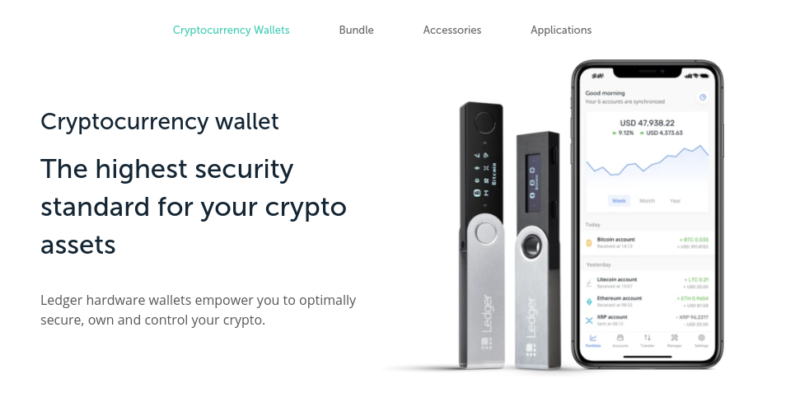
Ledger’s current lineup in 2026 includes several models:
- Ledger Nano S Plus (~$79) — The affordable entry point. Does everything you need for cold storage.
- Ledger Nano X (~$149) — Adds Bluetooth connectivity for mobile pairing.
- Ledger Nano Gen5 (~$179) — Newer model with a touchscreen.
- Ledger Flex (~$249) — E-Ink display with NFC and wireless charging.
- Ledger Stax (~$399) — Premium design with a large E-Ink display and magnetic stacking.
For most people, the Nano S Plus or Nano X is more than enough.
Security
The key safeguard: you must physically enter a PIN on the device every time you make a transaction. If someone steals your Ledger, the PIN time-lock increases after each failed attempt — from seconds to minutes to hours. Meanwhile, you can recover your funds from any device using your recovery passphrase.
- Choose a PIN between 4 and 8 digits (more is better).
- The PIN cannot be accessed remotely.
- Each incorrect attempt increases the lockout period.
- Your recovery passphrase lets you restore funds on a new device if needed.
Keep your passphrase somewhere safe — physically separate from your PIN.
The Trade-Off
Hardware wallets aren’t convenient. You need the physical device for every transaction. If you’re away from home, your options are limited. That’s exactly why they’re secure — and it’s why I recommend them only for large holdings or long-term storage.
Important: Only buy through the official Ledger website. Imitation devices have been spotted for sale online, and using one could compromise your funds.
Best Privacy-Focused Desktop Wallet — Sparrow Wallet
If you’re serious about Bitcoin privacy on desktop, Sparrow Wallet is the standout choice in 2026. It’s a Bitcoin-only, non-custodial desktop wallet built specifically for users who want maximum control over their transactions and privacy.
No KYC, no account creation, no personal information required.
Why Sparrow Stands Out
Sparrow doesn’t try to be everything to everyone. It’s built for Bitcoin users who care about privacy and want granular control:
- UTXO control: You can see and manage individual unspent transaction outputs — the building blocks of Bitcoin transactions. This lets you decide exactly which coins to spend, preventing accidental linking of your transactions.
- Built-in Tor support: Routes your network traffic through Tor, masking your IP address from servers and other parties.
- Flexible server connections: Connect to public Electrum servers for convenience, or run your own Bitcoin Core node for maximum privacy.
- PayNym support (BIP47): Reusable payment codes that enhance privacy for recurring payments.
- Hardware wallet integration: Works with Ledger, Trezor, Coldcard, and other major hardware wallets, giving you Sparrow’s privacy features with hardware-level security.
- Multisig support: Set up wallets that require multiple signatures to authorize transactions.
Who It’s For
Sparrow is aimed at intermediate to advanced Bitcoin users. If you want a polished, user-friendly interface, look at Exodus below. But if you’re willing to invest some time learning, Sparrow gives you privacy tools that no other desktop wallet matches.
It’s open-source, actively maintained, and has become the go-to recommendation in the Bitcoin privacy community since the Samourai Wallet shutdown.
Best Anonymous Bitcoin Wallet for Mobile — Edge
Mobile Bitcoin wallets are the most convenient option by far. Having a wallet on your phone means you can send and receive funds anywhere, pay for things in-store with Bitcoin, and check your holdings in seconds.
Edge remains my pick for mobile. It’s available on both Android and iOS and has been consistently updated through 2026.
Main Features
Edge lets you store, send, and receive Bitcoin along with dozens of other cryptocurrencies. Download the app, and you get a wallet address immediately — no personal information required.
Transferring Bitcoin to Edge takes about 10 minutes. Sending is straightforward: enter the recipient’s address or scan their QR code.
Edge also lets you buy, sell, and swap crypto within the app, though these features will typically trigger a KYC process — which means you’re no longer truly anonymous if you use them.
Security
- Your private keys are stored on your device — Edge never has access to them.
- The keys are generated from a hash of your username and password.
- Built-in 2FA that generates tokens directly on your device (no Google Authenticator or SMS needed).
- Standard phone screen lock adds another layer.
- If you lose your phone, you can recover your wallet on a new device using your security questions and email.
Best Anonymous Bitcoin Wallet for Desktop — Exodus
If you prefer managing your Bitcoin on a desktop or laptop and want something more polished than Sparrow (with less of a learning curve), Exodus is a strong option.
Exodus is a non-custodial wallet available across desktop, mobile, and browser extension — supporting over 260 cryptocurrencies. No personal information needed to set it up. As long as you don’t use the built-in purchase features (which require KYC), you can remain anonymous.
Portfolio Management
One area where Exodus excels: its portfolio dashboard. You get a clean, chart-based view of all your holdings with real-time values.
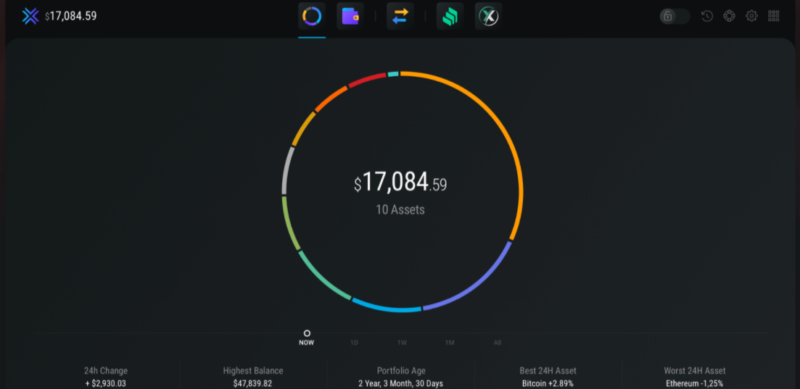
You can see your portfolio’s all-time high, 24-hour changes, and best/worst performing assets at a glance. If you hold multiple cryptocurrencies, this is genuinely useful.
Recent updates include a Web3 mobile browser covering major chains (Ethereum, Solana, Polygon, Base, and more), staking support, NFT management, and even a debit card through a partnership with Baanx and Visa/Mastercard.
Security
- Private keys stored locally on your device — Exodus never sees them.
- You’re fully responsible for your own security, which means protecting your device from malware.
- Trezor hardware wallet integration gives you the best of both worlds: Exodus’s interface with Trezor’s offline security.

Exodus receives biweekly updates and has been through 200+ product iterations, which is reassuring for a wallet you’re trusting with your funds.
What About Binance?
In the original version of this guide, I recommended Binance as an option for anonymous cryptocurrency storage and exchange. That’s no longer the case.
As of 2025, Binance requires full KYC (Know Your Customer) verification — government-issued ID, proof of address, and facial verification — for any meaningful account activity including trading and withdrawals. Unverified accounts are severely limited.
If you need an exchange, check out my Binance review or explore other options in my guide on how to buy Bitcoin in Europe. But don’t expect anonymity from any major exchange in 2026.
What About Wasabi Wallet?
Wasabi Wallet deserves a mention since it’s been one of the most well-known Bitcoin privacy tools. It’s still available and still routes traffic through Tor, offers coin control, and uses client-side block filtering.
However, Wasabi discontinued its built-in CoinJoin coordinator in 2024 due to regulatory pressure. You can still connect to third-party CoinJoin coordinators, but the out-of-the-box privacy setup that made Wasabi famous is gone. If you’re comfortable with that extra step, it remains a solid option alongside Sparrow.
The Verdict
Choosing the right wallet depends on what you need:
- Large holdings or long-term storage: Ledger hardware wallet — nothing beats offline storage.
- Maximum privacy on desktop: Sparrow Wallet — the best privacy tooling available for Bitcoin.
- Mobile convenience: Edge — quick, easy, no ID required for basic use.
- Multi-coin desktop/mobile: Exodus — polished interface, 260+ coins, Trezor integration.
The trade-off between security and convenience still applies: as one goes up, the other typically goes down. But the bigger shift is regulatory. Self-custody wallets remain your best option for privacy, while exchanges and on-ramps are moving firmly toward full identity verification.
Whatever you choose, make sure you understand the risks of storing Bitcoin and enable every security feature the wallet provides.
For a broader comparison of Bitcoin wallets (not just anonymous ones), check out my full guide to the best Bitcoin wallets.
FAQ
Are anonymous Bitcoin wallets legal?
In most countries, yes — using a self-custody wallet that doesn’t require ID is perfectly legal. What’s changing is the regulatory environment around the on-ramps and off-ramps. Under the EU’s MiCA regulation, crypto service providers must collect identity information on transactions over 1,000 euros involving self-hosted wallets. The wallet itself isn’t illegal, but moving money in and out of it anonymously is becoming harder.
Is Bitcoin truly anonymous?
No. Bitcoin is pseudonymous, not anonymous. Every transaction is recorded on a public blockchain. Wallet addresses, balances, and transfers can be traced. Sophisticated chain analysis tools (used by governments and companies like Chainalysis) can often link transactions to real identities. Privacy depends on how carefully you manage your coins, not just which wallet you use.
What happened to Samourai Wallet?
Samourai Wallet was shut down by U.S. authorities in April 2024. Its founders were arrested on charges of money laundering and operating an unlicensed money-transmitting business. They pleaded guilty in July 2025, with one founder receiving a five-year sentence. The case sent a clear signal about the risks of operating privacy-focused crypto services.
What’s the safest way to store Bitcoin privately?
A hardware wallet (like the Ledger) combined with good operational security practices. Buy Bitcoin through a peer-to-peer platform if possible, withdraw immediately to your hardware wallet, and avoid reusing addresses. For additional transaction privacy, use Sparrow Wallet with Tor enabled and connect to your own Bitcoin node.
Do I need KYC to use a Bitcoin wallet?
Not for the wallet itself. Self-custody wallets like Ledger, Sparrow, Edge, and Exodus don’t require any personal information. However, most exchanges and services where you buy Bitcoin (Coinbase, Kraken, Binance) require full KYC verification. The distinction: the wallet is private, but how you get Bitcoin into it often isn’t.
What is the EU Travel Rule and how does it affect me?
The EU’s Transfer of Funds Regulation (the “Travel Rule”), enforced since December 2024, requires crypto service providers to collect and transmit sender and recipient information for crypto transfers — similar to how banks handle wire transfers. For transactions over 1,000 euros involving self-hosted wallets, providers must also verify that the wallet belongs to the customer. This doesn’t make self-custody illegal, but it does create a paper trail when you move crypto between exchanges and personal wallets.
Related





Leave a Reply