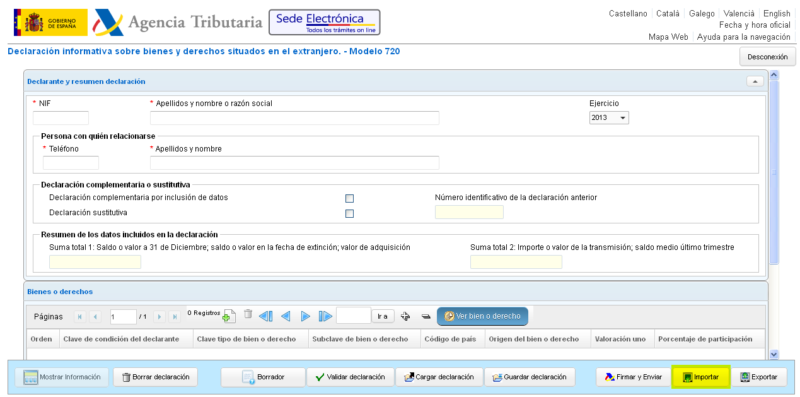
If you’re a Spanish tax resident with assets outside Spain, you probably have to file Modelo 720, the informational return that lists your foreign bank accounts, investments and property. I filed it every year while I lived in Spain, and this guide covers how it works now, after the 2022 changes, plus the practical questions expats tend to get stuck on.
- Who files: Spanish tax residents (and some others who pay IRPF) holding assets abroad.
- What goes on it: three categories, namely foreign bank accounts, foreign securities, insurance and annuities, and foreign real estate. Crypto held with custodians abroad goes on a separate form, Modelo 721.
- Threshold: you file a category when its total value at 31 December is more than 50,000 EUR (for accounts, either the year-end balance or the fourth-quarter average).
- Deadline: 1 January to 31 March, covering your position at 31 December of the previous year.
- Later years: you only file again for a category whose total has risen by more than 20,000 EUR since your last return, or when you stopped holding an asset during the year.
- Penalties: since Ley 5/2022 followed the EU Court of Justice ruling in case C-788/19 (27 January 2022), the general rules for informational returns apply: 20 EUR per missing data item, with a minimum of 300 EUR and a maximum of 20,000 EUR, halved if you file late before Hacienda asks you to. The 150% surcharge and the rule treating undeclared assets as income with no time limit are gone.
Since I received so many requests about this form, I arranged to forward them to tax professionals I trust, so you get professional advice and help (at a reasonable fee) with this complicated declaration.
Click here to get in touch if you want to speak with a tax lawyer or accountant. I’m not qualified to handle individual filings myself, given how different everyone’s financial setup is.
If you want to learn more about Modelo 720 before trusting anyone else with your obligations, read on. My advice is to understand your own tax position, but given the amounts involved, it’s usually worth paying a professional to file.
Spanish tax resident individuals are obliged to report (720 Form) the following assets and rights (including any investments) located outside of Spain to the Tax Authorities:
- Accounts in which the individual is the titleholder, or in which he is representative, authorized person or beneficiary, or in which he has disposal powers.
- Securities, rights, insurance and life or temporary annuities.
- Real estate or rights on real estate.
There will be no reporting obligation for those assets or rights which value (considered in aggregate for each group of assets listed above) is lower than Euros 50,000. The deadline for filing the 720 Form is from 1 January to 31 March of the year following that for which the information must be reported.
In subsequent years you only need to file again for a category whose total value has risen by more than 20,000 EUR since your last return. You must also file whenever you stopped holding an asset during the year, for example when you close an account or sell an investment.
What Changed in 2022
The European Commission challenged Spain’s Modelo 720 penalty regime, and on 27 January 2022 the EU Court of Justice ruled in case C-788/19 that the penalties were disproportionate and restricted the free movement of capital. Spain responded with Ley 5/2022 (in force since 11 March 2022), which:
- Removed the special Modelo 720 penalties, including fixed fines of 5,000 EUR per data item and the 150% surcharge, so the general penalties for informational returns in articles 198 and 199 of the General Tax Law now apply.
- Changed article 39 of the IRPF law so you can rebut a charge on undeclared foreign assets by showing you held them before the limitation period, instead of having them taxed as unjustified income with no time limit.
The court didn’t strike down the reporting obligation itself, so the form still has to be filed. Before 2022 the stakes were high enough that people facing large fines took Spain to court; today a late or incomplete return is an ordinary administrative penalty, not a financial disaster.
Filling it in is still fiddly, especially the first time. Many accountants and gestores don’t handle it, and those who do charged anywhere from around 150 EUR to over 1,000 EUR when I asked for quotes. You still provide all the documents and figures yourself; the adviser guides you on what’s needed and files the form for you.
If you want to dig deeper, the Agencia Tributaria has an extensive Modelo 720 FAQ (in Spanish). Below are the questions expats ask most often. They aren’t official answers, just the cases I’ve come across and how they’re treated, with the official source where there is one.
Question: When is the Modelo 720 deadline?
Between 1 January and 31 March each year, covering the assets you held abroad at 31 December of the previous year. Crypto on Modelo 721 has the same window.
Question: What are the penalties for Modelo 720 now?
Since Ley 5/2022, missing or late returns fall under the general penalty for informational returns: 20 EUR per data item, with a minimum of 300 EUR and a maximum of 20,000 EUR. If you file late before Hacienda contacts you, the penalty is halved to 10 EUR per item, with a minimum of 150 EUR and a maximum of 10,000 EUR.
Question: Do you need to report money invested in crowdlending platforms like Mintos, Twino, Bondora etc?
Hacienda says you don’t need to declare the loans themselves. You only need to declare them if they’re represented by securities. For example, some property crowdfunding platforms issue you shares or notes for your investment, and in that case you have to declare those.
However, if the cash balance in your account on the platform is stored in an omnibus account like Lemon Way and it is directly linked to you, you then need to declare that cash balance as at end of year. The platform should be able to give you this information.
Source (Agencia Tributaria FAQ)
Question: Should your spouse fill in the modelo 720 if the assets are in your name?
If you are married under the community of property regime (gananciales), both spouses must file separate Modelo 720 declarations covering the same assets. The declared value is always the full amount, never prorated. Both spouses declare the same total value for each asset, and the ownership percentage is noted separately on the form.
Assets in one spouse’s name: The spouse who is the actual owner (titular) declares the asset with condition code 1 and 100% participation. The other spouse declares the same asset with condition code 8, noting “gananciales” as the type of ownership, and 50% participation.
Joint accounts (for example, a brokerage account held in both names): Both spouses declare with condition code 1 and 50% participation each, since both are titulares.
Shares in a foreign company owned by one spouse: The owning spouse declares as titular (condition 1, 100%). The other spouse declares the same shares under gananciales (condition 8, 50%). If that company in turn owns another company, the second company is also declared by both spouses: the owning spouse notes “indirect title” and the other spouse notes “gananciales indirect.”
Securities held through a brokerage: Each individual security (stock, ETF, fund) is declared as a separate record with its own ISIN. They are not declared as a single brokerage account. If the brokerage account is joint, both spouses declare each holding at 50%.
Because both declarations contain the same assets at the same full values, the total valoracion on both declarations will be identical. Only the condition codes and participation percentages differ between husband and wife.
Question: Should bank accounts with a balance of zero be declared?
Yes, you need to declare all accounts outside of Spain once the sum total is 50,000 euro or higher. Empty accounts will still have to be declared.
Question: Should you declare life assurance accounts held with banks?
Yes, provided that it’s an account where you automatically deposit money every month. These are mixed savings and life assurance accounts, so you declare them. If you’re just paying a monthly or yearly premium to an insurance company for a life assurance policy, then you don’t declare it.
Question: If there is a change of 20,000 euro or more in any category, do you declare all the items in that category or just the particular item that changed its value?
When the total value of a category has risen by more than 20,000 euro compared to the last declaration, you must re-declare all items in that category with their current values, not just the item that triggered the change. For example, if you open a new brokerage account worth 30,000 euro and your last full investment declaration was three years ago, every investment in that category needs to be re-declared with updated amounts.
Assets you stopped holding during the year (sold investments, closed accounts) must always be declared, whatever the 20,000 euro test says.
Question: Should cryptocurrencies be declared on the Modelo 720?
Not on the Modelo 720. Since the 2023 tax year, crypto held with custodians outside Spain goes on a separate form, Modelo 721 (Orden HFP/886/2023), with the same 50,000 EUR threshold and the same 1 January to 31 March deadline. Crypto you hold in your own wallet, where you control the private keys, is outside its scope.
Question: A resident in Spain is a partner of a non-resident society (first level) that in turn is a partner of other non-resident societies (second level) What obligations to inform does the resident have with respect to the non-resident organisations and the goods owned by said organisations?
The resident must declare his or her participation in the first non-resident company. The prior must be applied as long as the non-resident companies carry out an economic activity through the corresponding organisation of material resources and staff, that is, that they do not have an instrumental character whose purpose is merely the indirect control of the goods on behalf of the real owner.
Question: Do I need to declare the bank accounts of a foreign corporation in which I am a 100% shareholder?
Yes, since you would be considered the beneficial owner of the bank accounts, even though they are in the name of your company.
Question: Do you need to declare money in virtual bank accounts such as Wise, N26 or Revolut?
If the virtual account has all the details of a traditional bank account, you should declare it along with the rest of your bank accounts.
Question: Do you need to declare the balance of your PayPal account?
PayPal accounts don’t fit any of the category definitions that apply to the modelo 720 and are thus not included. However, unfortunately, Spanish Hacienda loves to leave grey areas in these matters and have people worry unnecessarily instead of explaining exactly what to include and what not.
In a question that was sent to Hacienda, they hinted that you might need to include PayPal accounts, by replying in the following manner:
Por su parte, el portal de “PayPal” define el servicio que presta del siguiente modo:
“PayPal permite a las empresas o consumidores que dispongan de correo electrónico enviar y recibir pagos en Internet de forma segura, cómoda y rentable. La red de PayPal se basa en la infraestructura financiera existente de cuentas bancarias y tarjetas de crédito para crear una solución global de pago en tiempo real. Le ofrecemos un servicio especialmente pensado para pequeñas empresas, vendedores por Internet, particulares y otros a los que no satisfacen los mecanismos de pago tradicionales.”
Finalmente, respecto de la declaración de la cuenta PayPal, podría entenderse, en su caso, que dicha cuenta debe tomarse en consideración a efectos del Impuesto sobre el Patrimonio, o de la obligación de declarar bienes situados en el extranjero.
In my view, if you have significant amounts of money in your PayPal account and use it as you might use a savings account at a bank, you might want to declare it just to be safe. Having said that, I don’t know how you would actually go about declaring it since PayPal does not give you any account number that you would need to put in on the modelo 720 form. So, in the end, you’re just left with doubts.
Question: How is the value of a foreign company determined, given that it is not quoted on any stock exchange and is hence a private company.
The valuation will be calculated with the rules established in the Spanish Law 19/1991 regarding Wealth Tax. Insofar as it is not a company with representative securities traded on organized markets or other specific features, it is necessary to refer to article 16 on other securities that represent the participation in equity of any type of entity.
“En el caso de que el balance no haya sido auditado o el informe de auditoría no resultase favorable, la valoración se realizará por el mayor valor de los tres siguientes: el valor nominal, el valor teórico resultante del último balance aprobado o el que resulte de capitalizar al tipo del 20 por 100 el promedio de los beneficios de los tres ejercicios sociales cerrados con anterioridad a la fecha del devengo del Impuesto”.
This article indicates that the valuation of this type of shares will be carried out at the theoretical value resulting from the last approved balance, provided that it has been submitted to review by auditors. If this is the case of the company, the valuation must be made in accordance with the last approved and audited balance sheet available. As an aside, note that for wealth tax purposes, you can use either the value of the company as at 31st December of the previous year, or the value of the company as determined by the latest published accounts, even if they were published after the 31/12, as it is deemed that the later accounts would be even more accurate as a valuation method. See this page (in Spanish) where this update is explained.
The theoretical value is obtained by dividing the net equity figure by the number of shares, by performing the following operation:
Theoretical value = Net equity / Number of shares in which the share capital is divided.
However, in case the last approved balance has not been audited, the valuation should be made for the greater value of the following three:
- The nominal value.
- The theoretical value resulting from the last approved balance.
- The result of capitalizing at a rate of 20% the average of the net profits of the three fiscal years closed prior to the date of accrual of the tax.
This is a simplified way of valuing a company, when compared to more complex methods used by investors, but it’s the one we need to use to calculate the value for the modelo 720 form.
Filling in the form yourself VS Hiring someone to do it
Be aware that lawyers and accountants can charge very random fees for helping out with this report. I’ve been given quotations ranging from €150 to €1500 and upwards, and that was sight unseen, not taking into consideration the complexity or lack of for each individual’s declaration. It was hard to find someone that I could trust and that wouldn’t fleece me with charges for what essentially is a simple model to fill in, especially for someone knowledgeable like an accountant or lawyer. If you’re looking for someone to help out with your declaration, get in touch and I’ll put you in touch with a tax professional I trust.
You could fill it in yourself too, but even though I knew how to, I preferred hiring a well-known firm to do it for me. When you make a submission the form includes the name of the person or company submitting the form. My opinion is that Hacienda is more likely to go after foreign-sounding names who submit the form without any outside help, rather than if they see a form being submitted by a Spanish company.
The EU Court of Justice only struck down the penalties, and the reporting obligation itself stands, so the best you can do is fill it in properly and avoid complications with Hacienda. Keep in mind that even if you get accused unjustly of filling it out wrongly, you will still need to spend a lot of time and hassle to go through the Spanish courts and depend on them to issue the final ruling. It’s better to do it right the first time around.
Note that this is just a summary of my research on the topic and my discussions with various tax consultants. It should not be taken as tax advice. When in doubt, you should always consult a trusted tax consultant to help you fill out this submission. The information could also be out-of-date as new laws and changes to existing legislation happens regularly.
Further reference
- Agencia Tributaria: Modelo 720 filing page (in Spanish)
- Agencia Tributaria: Modelo 720 FAQ (in Spanish)
- Ley 5/2022, which changed the penalty regime (BOE)
- Orden HFP/886/2023, which created Modelo 721 for crypto (BOE)
- REAF – More questions and answers (in Spanish)
Related







With reference to a Modelo 720 filed in 2018 (and not needed to be filed since) …
Q1. If the 2021 GBP/EUR exchange rate has created the increase of €20,000+ ie. property that has not changed but it’s original value has gone up now to over €20,000 only due to the 31Dec21 rate used for Modelo 720 (versus 2018), do we still need to file again?
I had read previously from CAB Spain: In subsequent years you are required to report the following changes: your assets have increased in value by €20,000 or more in any group previously declared. Note, this includes increases as a result in the change of exchange rate.
Q2. If the exchange rate has caused the increase in property to over €20,000 but that property is shared by two people so in fact it’s just over €10,000 each – do we need to declare?
Thanks in advance for any insight or sources of information to confirm or deny the above.
Hello! I’ve been following this article for a few years now; its been so helpful thank you so much!
And this time, could you or anyone please share the link of the BOE exchange rates that should be used for the filing for 2021? TIA!
Hi Jean,
I started working in Spain in October 2020. I have an apartment abroad, but I did not submit the modelo 720 in 2021 (because I did not even know I had to…). If I submit it now in 2022 can I get a fine?
Thanks a lot for your help!
It’s best to fill in the form to have my recommended tax advisors look into your case and decide on the best way forward.
There is no way to fill this form correctly, you will be always in risk of facing a huge fine even for empty accounts (that already happened)
Hopefully this was sentenced by EU as a violation of EU rights.
If you move your residency to Guipúzcoa (Vasque Country) you can reduce a lot the fine.
It is a totally ridiculous form in many ways. The good news is that after being scolded by the EU, the Spanish authorities have drastically reduced the number of fines issues in the last couple of years.
Hello Jean,
I bought a property in the USA, and my closing date for that property was during the first week of January 2021. Would I have had to declare that in the modelo 720 of this year or would that apply for next year´s model 720?
Thank you
Hi Samantha,
The submission for 2021 is based on the ownership of property/capital/shares outside of Spain on 31 December 2020. As the purchase was completed in January 2021, it is my understanding that you would need to declare the ownership on your Modelo 720 in 2022.
Regards,
Damian
Hello Jean,
I had two questions related to filling in fields for Modelo 720 and I was wondering if you can possibly help to clarify them.
1. My bank accounts are located in the United States and do not have IBAN or BIC codes, do you know what am I supposed to enter in the BIC field Modelo 720?
2. If my name is on the account that is shared between myself and my relative, but the entire account balance does not belong to me. What number am I supposed to enter in the percentage of participation option field? Modelo 720 does not accept 0 in this field.
Thank you!
Hi Jean,
This is the best summary of the modelo 720 that I’ve found! Answering questions that I’ve struggled to find answers for elsewhere.
Paul
Glad to be of help 🙂
Dear all,
Could you please advice me on the field ‘Origen del bien o derecho’ in the form 720? In 2018, I’ve acquired a cooperative share in the inheritance proceedings. That’s why in 2019 I filled out the 720 model for the first time choosing the option A (bien o derecho que se declara por primera vez o que se incorpora en el ejercicio de la declaracion) in the field ‘Origen del bien o derecho’. When filling the form 720 for 2020 I am not sure whether the same option A should be selected or if I should select option M – bien o derecho que ya ha sido declarado en ejercicios anterios.
Thank you very much,
Tereza
Hi,
I struggled with the same question.
In the “BOE” (official bulletin of the State of Spain) it is said that one should chose option “M” when there is a raise of 20.000 or more in the said category.
One is also obliged to declare when one discontinues a bank account, then one should chose option “C”
For me it is not clear if one should only declare the closed accounts or all accounts at the specific year (2020) .
I chose to declare the active accounts with option “M” although they don’t have a raise of more then 20.000 euros. Option A is not the right choice i think.
So, question comes down to: declare the active accounts with “M” or not declare them again.
The tax office could not give me a straight answer.
I think its better to declare too much then too little.
The biggest problem with the modelo 720 is that there are many things absolutely unclear and nobody can give you the right answer.
If you work with a competent tax consultant they will give you all the answers. I struggled a lot myself until I found my current tax lawyer. Contact me if you want me to put you in touch.
Cuando se trata de impuestos y España el mejor consejo es :
Run Forest , run!!
jajajaj
Muy cierto eso.
Hi Jean,
It seems that there is an official stance on cryptocurrencies now and that they should be included?
Thanks,
John
Hi John, can you link me to it?
Thank you for your article. Just one question: “if the cash balance in your account on the platform is stored in an omnibus account like Lemon Way and it is directly linked to you, you then need to declare that cash balance as at end of year.”, what do you mean by “it is directly linked to you”?
For example Mintos, but also others have an omnibus account (or at least, I think they do), but how can I know if it’s directly linked to me? Does it require extra steps from my end to open such account or should I find about it somewhere? Does it mean that I have some kind of IBAN or other coordinates that are unique to me (instead of a shared one with all other investors)?
Welcome. The latest advice I have is that it is prudent to share the details of such accounts. If you don’t have the IBAN you can share the investor account of the platform, for example Mintos.
Thanks for the information Jean. Very useful. You mention “In all probability, the EU courts will make Spain remove the modelo 720 within the next two years”. Are there any developments on this challenge that you are aware of, or is it still in the process?
Still in process unfortunately Damian.
You can use Google Translate on this article for more information on the latest: http://fiscalblog.es/?p=5968
I am a French expat under Beckham law: This year I am planning to quit my job in October and so I will lose Beckam status. If i stay in Spain till end of the year will have to submit form 720? And what If i leave Spain few days after I have quitted my job?
Hi, I am looking into the Beckham law myself, would you mind sharing the firm that helped you with the process ?
I have lived and worked in Spain since August 2019. I benefit from the Beckham law tax regime. Do I need to declare any assets and/or savings I have in the UK?
Under Beckham rule I believe you are exempt from this declaration.
If a property is in your name in the uk but it is mortgaged and the equity is only 20,000 pounds so i need to declare it? If yes i am late doing the paperwork because of the coronavirus. Will i be fined?
Thanks
Hi Jean,
my wife and I became Spanish resident from the UK at the end of May2019. I have not submitted a Modelo 720 and I am currently completing a Tax return online for completion by end of June 2020 in Spain. Our income and any savings would be significantly below 50,000 euro and we do not own property except in Spain. Am I correct that in this case the Modelo720 was not required or should I have completed year 1 by March 31st 2020 anyway and then not a subsequent one.
Hi Dave, as you have no foreign assets above 50,000 then you should not complete the Modelo 720.
Hi.
I bought a piso in Portugal in May 2019 for 64,000 euros. I mistakenly thought I could declare it in the renta this year in June and have just discovered that I needed to declare it using the modelo 720 before the 31st March.
I’m not sure what my consequences and penalties are for this misjudgement. What should I do? I want to be transparent with my earnings and from what I am reading this error could cost me a huge amount of money for just two months late filing.
Am I looking at a big penalty for my error?
Any advice really appreciated.
Andrew
I note that you state if any of your asset groups increase by 20,000euro then you need to submit a revised 720. No mention of a reduction in equivalent value. After searching many sources I cannot determine for instance if a bond matures it is a requirement to make a declaration showing that it has matured? Needless to I am reluctant to pay a gestor fee just to declare something no longer exists!
Yes it is a requirement to declare that.
what about a reduction of more than 20,000euros in say an investment due to a revaluation or as a result of a partial withdrawal?
Thanks
No that wouldn’t necessitate a submission.
Once you have submitted your first Form 720, you will only have to do it again, if:
Hi Jean,
I became a resident in Spain in February 2020. Must I submit the 720 in 2020 or next year?
Regards,
Dag
Next year.
Hi the paper i have been given in relation to filling in the model 720 seems to be a conflict of information, my wife and i have a joint bank account in England that is below the 50,000 threshold, but other financial assets shares, life insurance bond,
that in themselves are probably over the threshold, do we add them together or only declare the other financial assets, shares etc
Hi Anthony, in this case I’d rather you contact a qualified advisor to make sure you get everything right. Feel free to contact me if you want to get in touch with my tax lawyer.
Thanks been in today each one a separate item, so if you haven’t got the max amount in any of the 3 categories don’t need to declare
Do Prudential income draw down plans have to be declared on a Modelo 720?
Hi Susan, unfortunately I don’t know enough about that to be able to help you. Feel free to contact me via email and I’ll put you in touch with my advisor.
Hello Jean,
I am very much in doubt if i am obliged to fill in the form 720 or not.
I myself have a current account still abroad with some 4000 euros on it 31 december 2019. Further i had a limited authorization (only allowed to make payments in his name) of an account of my father with some 3000 euros on it 31th december 2019. (was only for a short time due to his illness)
Also my wife had a saving account outside Spain with 44.000 euros on it.
We are married.
The authorization is only on my name, she cannot access the account of my father.
The savings account is only on her name. I declare only half?
Is there an obligation to declare for both? Only me? Or neither of us?
If the answer is yes, do you know of some good advisor in Madrid?
Hi Carlo,
send me an email via the contact form and I’ll be happy to refer you to my trusted advisor.
Good morning Jean Galea,
First of all, I’d like to thank you for your blog, very interesting one! Thanks for your time dedicated to others.
I would like to clear some doubts that I have regarding the Modelo 720 and its three groups (bank accounts, insurance/rights and real estate).
First, I understand from the Spanish laws that every foreign account having an IBAN number enters, by default, in the first category of “bank accounts”. Is that right, or could there be exceptions implying that, even though a bank account has got an IBAN number, it may not be considered as entering in the first category?
Finally, I also have a pension plan outside of Spain, with the possibility of surrender at any time (surrender can be done in cases not covered by the Spanish law), and whose financial entity does not operate in Spain as a free service provision. I know it is necessary to declare that plan in the Mod. 720 though, does it enter in the second category “insurance/rights” or could it enter in the first category “bank accounts”?
Thanking you a lot in advance for your time.
Best,
André
Hi Andre,
As far as I know all bank accounts go into the first category if they have an IBAN number.
I’m not very familiar with the intricacies of pension plans, so I would recommend contacting a specialist. Many Spanish accountants and gestors might not be familiar with foreign pension plans, so I would recommend asking a company like Blevins Franks, as they specialise in these kinds of setups, especially for nimimising wealth tax burden and potentially that would also have implications on the modelo 720 declaration.
Do we have to declare a private pension scheme contracted abroad like 401K in US? If so, in which category?
From the FAQ page, it looks like it is not necessary but I have seen in some sites and also from a tax consultant that it needs to be declared. Is it in the grey zone, meaning it is safe to declare?
If you want to be a 100% safe you can declare it, although it is not mentioned as a requirement. The model tries to catch the obvious assets: bank accounts, shares and real estate. It leaves out many others and that’s one of the bad things about it. By doing that it puts many people in doubt and instills unnecessary fear. That in turn makes people seek expert advice, sometimes getting fleeced for it and encountering conflicting opinions.
Hello I am Spanish with an ownership of an apartment in Ireland and tenants paying rent. Because my tenants are paying the rent to a Spanish account,according to Irish revenue 20% of the total amount of rent must be withhold by the tenant or by a designate agent for tax purpose,and then, at the end of tax year revenue with to their math with me.
Can I declare to the Spanish agencia tributaria(Revenue) my income from the property in IRELAND and pay all my taxes in Spain(Irish and Spanish) in one go and all together, instead to pay my taxes for that tenancy in Ireland and then declare that income to the Spanish system .I am aware because of the agreement between Spain and Ireland I do not need to pay taxes in both places but as previously said.Is there a way that I can pay everything in Spain and them Irish revenue claim that money from the Spanish revenue?
I am a foreigner and will be a resident of Madrid next year. Will I need to fill out this form? I understand that Madrid residents have an exemption, is that correct?
No they don’t have an exemption. They are only exempt from paying wealth tax through a 100% refund in place in this region.
Hi
I was a resident in spain 2012-2013 when this modelo 720 started. I left spain in 2014.
I now want to come back and live in Spain again.
Any idea if I will have a problem with submitting the 720 from 2019? Will it trigger an alert from 2013? And then multas!?
Thanks
I doubt it will but to be sure obtain the advice of a lawyer in Spain.
Hi Jean,
what is the process to ask for an extension of the deadline?
My bank won’t give me the necessary information until end of April and tells me I have to ask the authorities for an extension of the deadline for the modelo 720…
many thanks,
Jacob
Hi Jacob, I’m not familiar with that procedure, although I would strongly encourage you to submit it within the timeframe as there are fines for submitting it late.
Regarding the 720 declaration firm: Do we have to declare RRSP accounts in Canada when one has become a resident in Spain?
Sorry I’m not familiar with what those accounts are.
Hello Mabel,
Have you found any info on declaring Canadian RRSPs on a 720 _
regards,
Shane
amazing how liuttle information it is about rrsp withdrawls and hacienda , its been 2 years im trying to get an anwser ….
Hi Maria, I was told that RRSP don’t have to be declared in the 720 form. Only cash or investments over 50.000€
Hi Jean,
At first paypal accounts look like they don’t need to be declared but researching the issue I found this information
http://blog.legisconsulting.com/2018/03/modelo-720-cuestiones-y-casos-especiales/
which links to the following page
https://petete.minhafp.gob.es/consultas/consultas/?num_consulta=V1419-15%20
saying that paypal accounts must also be declared.
I see, that seems correct. In my opinion, the modelo 720 is very problematic as it is not clear what should go in and what should not, and secondly it is almost impossible not to make mistakes when filling it in.
How many people have time to search through all the questions asked and then interpret the vague answers given before deciding what to put in? Not to mention that the process of filling in the forms can be quite cumbersome which means that you’ll probably have to hire a consultant to hope to get it right, and the going prices for filling in the modelo 720 seems to be in the region of 400-600 euro each person, which is scandalous. I hope that eventually this form will be eliminated, although the case in the European Parliament is taking a long time to be processed.
Hi Jean,
Is there a website where modelo 720 can be downloaded to be filled in?
Thank you in advance,
Tereza
No it’s something you fill in and submit online.
Thank you very much Jean. I am now trying to access the online form: https://www.agenciatributaria.gob.es/AEAT.sede/procedimientoini/GI34.shtml and then selecting con cl@ve IPIN, then I enter my NIE number and then the support number. The page tells me then that in order to receive the PIN they need to send me the invitation letter to my address.
Is there a way on how I can access the online form without having this invitation letter as I am now living in Germany?
Thanks a lot for your help,
Tereza
Unfortunately I don’t know the answer to that question.