
Spain has one of the most compelling property markets in Europe right now. Prices have risen roughly 27% over the past five years, rents are climbing faster than inflation, and demand continues to outstrip supply in every major city. For investors who want exposure to Spanish real estate without buying a full apartment in Madrid or Barcelona, crowdfunding platforms have matured into a serious option.
I’ve been investing through Spanish real estate crowdfunding platforms since 2017. The market has changed dramatically since then — some platforms from the early days are gone, the regulation has been completely overhauled, and a new generation of professionally run platforms has emerged. This article is my current, honest take on where things stand in 2026.
How the Regulation Changed Everything
The old regulatory framework (Spain’s 2015 Crowdfunding Law, Ley 5/2015) was a starting point, but it was patchy and didn’t give investors much protection. In 2022, Spain implemented the EU Crowdfunding Service Providers (ECSP) Regulation through the “Crea y Crece” law, bringing Spanish platforms in line with the rest of Europe.
Today, every legitimate Spanish real estate crowdfunding platform must be authorized by the CNMV (Comisión Nacional del Mercado de Valores — Spain’s securities regulator) as a Participatory Financing Service Provider (PSFP). The CNMV maintains a public register of authorized platforms. If a platform isn’t on that list, walk away.
The ECSP framework also sets firm limits for non-professional investors: a maximum of €3,000 per project and €10,000 per year per platform. You can exceed these limits if you self-certify as a sophisticated investor, but the framework is designed to protect retail investors from overcommitting to illiquid, higher-risk assets.
The Spanish Property Market in 2026
The fundamentals haven’t changed — they’ve strengthened. Average house prices in Spain grew by over 10% in 2025, reaching levels not seen since 2008. Barcelona is generating gross rental yields of around 7.17% and Madrid around 5%, both driven by persistent demand and a chronic undersupply of new housing.
Construction permits for 2025 totalled around 140,000 — well below the estimated 180,000 new households forming each year. That gap isn’t closing anytime soon. New housing stock is expensive to build, planning permission takes time, and political will to fix the supply problem is weak.
Rents have risen more than 34% since 2020. The 2023 Housing Law introduced rent caps and “stressed market” designations in cities like Barcelona and Madrid, which has complicated things for landlords of direct property. Crowdfunding platforms, by investing through a corporate structure rather than as a direct landlord, largely sidestep the stress of rent controls — though investors should be aware the regulatory environment for Spanish residential property is increasingly activist.
The luxury segment and commercial real estate remain largely unaffected by rent controls and continue to attract strong interest from international buyers.
What Returns Can You Expect?
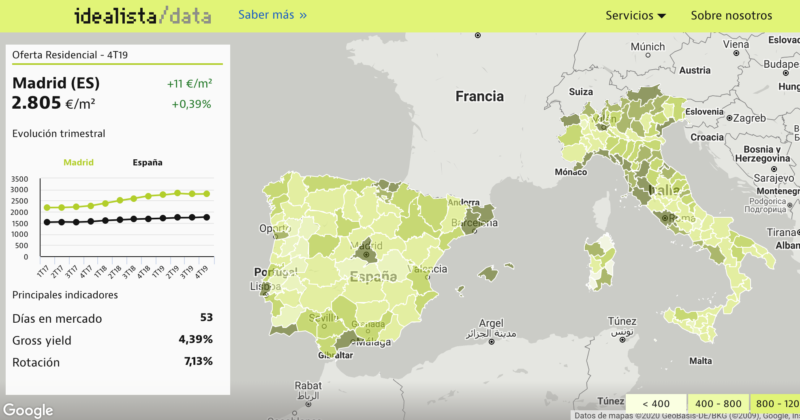
The baseline expectation for direct Spanish residential rental yields has historically been around 4-5%, as Idealista’s long-running data shows — rising from a low of 2.8% at the 2008 crisis trough to a current average around 4-5% in most cities.
Crowdfunding platforms tend to target higher returns than passive buy-to-let because they take on development, renovation, or promotion risk. Depending on the platform and project type, target returns typically range from 10% to 18% annualized. Debt projects (lending to developers) tend to offer 8–12% with more predictable timelines of 6–24 months. Equity projects (co-owning the development) target 12–18%+ but tie up your capital for 2–4 years and carry more uncertainty.
I’d treat the advertised returns as targets, not guarantees. Delays are common in Spanish property development due to planning and bureaucracy. Projects that were supposed to complete in 18 months often run 24–30 months. Factor that into your effective annual return calculations.
Taxes on Your Returns
Returns from crowdfunding platforms are taxed under the Spanish savings income scale (base del ahorro) as part of your IRPF declaration. The 2025 rates, which remain in effect for 2026, are:
- 19% on the first €6,000 of savings income
- 21% on €6,001 to €50,000
- 23% on €50,001 to €200,000
- 27% on €200,001 to €300,000
- 30% on savings income above €300,000
Note that the top two bands — 27% and 30% — were added in 2025. The old article on this page listed three bands; there are now five. As a retail crowdfunding investor, you’ll almost certainly sit in the 19% or 21% bracket.
Platforms operating in Spain are required to withhold tax at source (the retención) and send you an annual certificate detailing your income and withholdings. You still need to declare this in your IRPF, but the platforms make it relatively painless. All platforms covered in this article provide this documentation.
There’s also Actos Jurídicos Documentados (AJD — stamp duty) on underlying property transactions, typically around 1% of the deed price. This is handled at the corporate level within the project structure, so it’s baked into the economics of each deal rather than something you pay directly.
My Top Spanish Real Estate Crowdfunding Platforms for 2026
Urbanitae
Urbanitae is the standout Spanish platform right now and by some distance the largest. It’s registered with the CNMV as PSFP number 4, fully compliant with the ECSP regulation, and has financed over €280 million in projects as of the end of 2025.
The platform offers several investment structures. Debt projects lend money to developers at fixed interest — typically 8–12% annualized with terms of 6–24 months. Equity projects make you a co-owner of the development, with returns tied to the eventual sale — these target 12–18%+ but run 2–4 years. They also offer a “preferred IRR” structure that blends both approaches, giving investors priority on returns before the developer takes their share.
The average annualized return across completed projects is cited at around 14%, though this is a weighted average across a mix of project types and vintages. More recent debt projects have been completing in the 10–13% range.
Minimum investment is €500. The platform is available in English and Spanish, which matters if you’re not a native Spanish speaker. Projects fill fast — usually within hours of launch — so you need to move quickly when something interesting goes live.
Wecity
Wecity (operated by Cityprive PFP, SL) is registered with the CNMV as PSFP number 9, founded in 2019 and based in Madrid. It focuses on residential, commercial, and office properties across Spain.
The platform runs two main models: short-term buy-renovate-sell projects (12–36 months) targeting capital gains of 10–15%, and mid-term buy-rent-sell projects (3–5 years) with rental yields of 3–7% plus capital appreciation. Recent projects have offered fixed-rate loans in the 10–11% per annum range.
Minimum investment is €500 in practice, though some projects allow entry from €100. Like Urbanitae, Wecity operates under the ECSP retail limits of €3,000 per project unless you self-certify as a sophisticated investor.
Civislend
Civislend is registered with the CNMV as PSFP number 8. It focuses on debt financing — lending to real estate developers — and reports a weighted average return of around 10% across its completed projects, with typical project terms of 12–18 months.
The platform had a strong 2025: it exceeded €60 million in financing in the first half of the year alone and raised €32.5 million in a single tranche for hotel and office assets in November. That scale is meaningful. It suggests the platform is attracting institutional-quality deal flow alongside retail investors.
Civislend’s model is deliberately straightforward — debt-only, fixed returns, defined timelines. If you want predictability over upside, it’s a solid option. Average returns have been in the 10–13% range annualized.
StockCrowdIN
StockCrowdIN was the first platform I invested in back in 2017, so I have a long history with it. It’s still operating in 2026, registered with the CNMV as PSFP number 24, and has financed over €126 million across more than 900 projects.
I have to be honest though: the picture has gotten murkier. Some investors report significant portions of their portfolio in default or “in recovery” status. The platform continues to publish new projects, but the default metrics are worth scrutinizing before you commit capital. A €50 minimum makes it easy to start small and test the waters.
I’d rank it below Urbanitae and Civislend right now based on what I’ve seen from investors’ experiences, but it remains a licensed, operational platform with a real track record. My full StockCrowdIN review covers my personal experience and the platform’s history in detail.
Platforms to Avoid or Be Cautious About
Housers
I’ve written extensively about my experience with Housers and won’t repeat the full story here. The short version: Housers started as the most prominent Spanish platform, grew fast, and then stopped doing proper due diligence while continuing to market aggressively to new investors.
The platform is technically still active and holds a CNMV license. But look at the numbers: roughly 7% of the portfolio is classified as “in recovery,” another 7% as overdue, and over 19% has been restructured. Investors who put money in around 2019–2020 report recovering only 60–70% of their capital after five years, at annualized returns of 2–3%.
Housers became exactly what I described years ago — a marketing machine that forgot to protect its investors. I have no current investment with them and wouldn’t recommend starting one.
Brickstarter
Brickstarter is a Spanish vacation rental investment platform that has been around since 2017, but I no longer recommend it. Despite over eight years of operation, the platform has only funded around EUR 2M total, which is an extremely low volume that raises serious questions about viability. It is not regulated under the ECSP framework (no CNMV license), offers zero transparency on default rates or financial performance, and is rated 0.8/10 by P2PEmpire. I’ve moved Brickstarter to my worst platforms list.
Privalore
Privalore ended all crowdfunding investment activities in December 2019. The Barcelona-based developer continues to operate as a real estate company buying and selling apartments, but it no longer offers crowdfunding to retail investors. If you encounter references to Privalore as a crowdfunding option, they’re out of date.
Diversifying Beyond Spain
I also invest in European real estate crowdfunding platforms outside Spain. The Baltic platforms and some Central European platforms offer impressive headline returns, though with different risk profiles. I’ve written a separate article covering the best European real estate crowdfunding platforms which covers Raizers, Fintown, LANDE, and others.
The Spanish platforms covered here complement rather than replace a broader European allocation. The markets are different, the regulatory environments differ, and spreading across both geographies gives you better diversification.
A Few Practical Notes for Non-Spanish Investors
Spanish crowdfunding platforms are generally open to EU residents, not just people living in Spain. If you want to invest but aren’t a Spanish resident, you’ll need a NIE (Número de Identificación de Extranjeros) — essentially a tax identification number for foreigners in Spain. You can obtain one from the Spanish consulate in your country. It’s a bureaucratic step, but a one-time requirement.
All platforms covered in this article operate in Spanish at minimum; Urbanitae also has solid English-language support.
Finally, remember that all investments in these platforms are illiquid. There’s no secondary market on most platforms — once you’re in a project, your money is tied up until the project completes. Factor that into how much you allocate.
Summary
The Spanish real estate crowdfunding market has professionalized significantly since 2022. The ECSP regulatory framework has raised the bar, weeded out some weaker operators, and given investors more clarity about what they’re buying.
My current ranking for 2026:
- Best overall: Urbanitae — largest, most established, best project variety
- Best for predictable debt returns: Civislend — straightforward fixed-rate model, strong 2025 activity
- Good second option: Wecity — solid platform, good project variety
- Established but watch carefully: StockCrowdIN — pioneer platform, but default concerns in recent years
- Avoid: Housers — technically still operating but deeply troubled
- Avoid: Brickstarter — unregulated, negligible volume, zero transparency
As with any investment, don’t put money into crowdfunding platforms that you can’t afford to leave locked up, and don’t treat advertised returns as guaranteed. The Spanish property fundamentals are genuinely strong right now, but individual projects can and do run into problems.
If you have questions about any of these platforms or your own experience investing through them, leave a comment below.
Related







Hi Jean,
Very great post. Of the platforms described, which would be your recommendation today? I understand that Housers not.
Thank you!!
StockCrowdIN would be my current choice.
Have you any experience of Civislend?
Thanks for all the info, crisp and clear.
I haven’t looked into that one Dee, I’ll add it to my list.
Hi Jean, regarding the link in your article, which provides a 25€ bonus for registering new at Inveslar: does this require a minimum first investment of 100€ or is it valid only from first investment of 1000€ (as I’ve read the latter condition currently promoted on their website). Thanks for confirming!
It’s after the first investment of €1,000. Thanks for pointing it out.
Sometimes their conditions change and I forgot to update the post, will do so right away.
Thanks for confirming! I’ll hold of a bit for now then. Hopefully they will lower the minimum again in the future (i.e. to 500€ from last year). Love your blog by the way, will be following!
dear Jean,
As a Spain lover, i enjoy reading this blog
A question: Did you make an account at PropCrowd ? Any possibility you’ll make a review?
I was looking for more info about them, but was unable to receive the cost-structure from them (by mail), or from their website.
regards,
stijn
Hi Stijn,
Glad you like the blog. I am invested with PropCrowd but it’s too early for me to review them as I haven’t seen any real results yet. I will probably review them at a later stage once some of my projects close.
Informative article, Jean, thanks.
I’m on the other side of the fence, looking to secure a mortgage via a p2p or crowdfunded loan for a property in Spain. Any idea where to go for this?
Hi Jonathan, you should be able to approach a platform like Housers with your proposal, then it’s up to them whether they offer it to the public or not.
Do you have a more current or follow-up article available?
The information here is still current, do you have any particular questions?
I live in Italy and I started with Housers. They also offer properties investment in Italy (where I live). I have started with a few hundred euros, but I love Housers so much that right now I have over €4000 invested in 12 different opportunities. Also, I am buying and reselling shares on the marketplace, which brought extra profits.
SO, so far my net return for 2 months shows almost €50 and I received €100 plus in bonuses. Pretty satisfied, but I would want to find another platform, having all my money in one place is not the best.
Good to hear about your good results in Italy! I’m not aware of any other platforms operating in Italy, perhaps you can share any others here when you get to know of them. I can, however, recommend iFunded in Germany and Privalore in Spain.
A lot of people think that there has to be this perfect platform wherein you can train your skills as a real estate investor. If you are still asking where to train real estate, well the answer is simple, you can look at everything as a form of training. Even conversation! Yes, although hard to believe, talking with other real estate investors usually help you improve and also serve as a training for you.
Don`t forget the first aggregator of real estate crowdfunding!, BrickFunding.com is spanish.
Thanks Alin, that’s also a good option to see what platforms there are at any given moment.