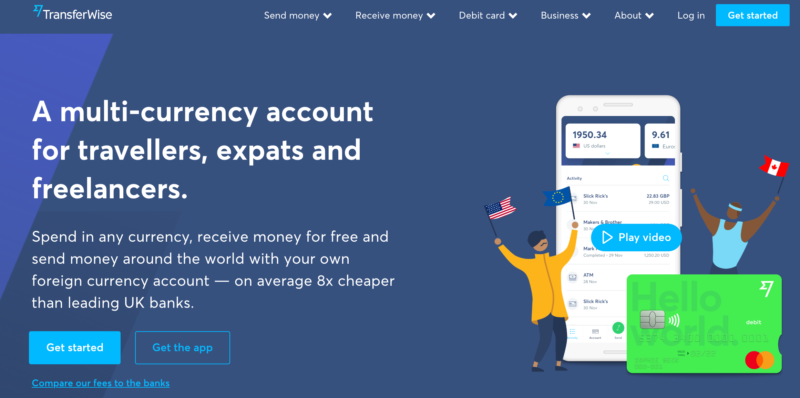
I’ve had a Wise account for years, and it sits in my financial setup for one specific reason: nobody else does international money transfers as cleanly or as cheaply.
I use Revolut as my primary everyday account and N26 as my European banking backbone — if you’re still deciding between those two, my N26 vs Revolut comparison covers how they stack up today. Wise does something different. It’s the account I reach for when I need to move money across currencies, receive a payment from a client in the US, or hold funds in a currency that isn’t euros. It doesn’t try to replace your bank — and that’s exactly why it’s worth having.
This review covers everything you need to know about the Wise Account in 2026: what it actually does, where it genuinely excels, and where its limits are. No fluff — just honest experience from someone who’s been using it alongside the major neobanks for years.
What Is Wise?
Wise was founded in 2010 in London by two Estonians — Kristo Käärmann and Taavet Hinrikus — who were frustrated by the hidden fees banks charged on international transfers. The core insight was simple: instead of moving money across borders, use local bank accounts in each country to settle transfers domestically. It’s cheaper, faster, and more transparent.
The company operated as TransferWise for its first decade before rebranding to Wise in 2021. That same year it completed a direct listing on the London Stock Exchange — one of the largest tech listings in UK history at the time. Being publicly listed matters: it means audited financials, regulatory scrutiny, and a level of accountability that private fintechs don’t have.
Today Wise serves over 16 million customers and processes more than £100 billion in cross-border payments every year. It’s not a startup experiment anymore. It’s an established, scaled business with a clear and focused product.
The Wise Account
What used to be called the “borderless account” is now simply the Wise Account. The rebrand reflects a product that has matured and expanded well beyond just sending money abroad.
Multi-Currency Balances
You can hold balances in over 40 currencies simultaneously. Switch between them instantly at the mid-market rate when you need to. For anyone who earns in one currency and spends in another — or who deals with clients across multiple countries — this alone is genuinely useful.
Local Bank Account Details
This is the feature that sets Wise apart from almost everything else. You get real local bank account details in over 10 currencies: a US account number and routing number for ACH and wire, a European IBAN, a UK sort code and account number, and details for AUD, NZD, SGD, CAD, HUF, TRY, RON, and more.
The practical implication of this is huge. If you’re based in Spain like me and have a US client, you can send them your US bank details. They pay you as a local US transfer — no international wire, no fees on their end, no delays. The money arrives in your USD balance on Wise, and you convert it to euros whenever the rate suits you. For a broader look at account options available to people in Spain, I’ve also written about the best commission-free banks in Spain.
Getting local bank account details in a country where you’re not a resident used to be difficult or impossible. Wise has solved this, and it’s a genuine edge over most banks and even many fintechs.
The Wise Debit Card
The Wise Visa debit card lets you spend in any currency at the mid-market rate. When you pay in a currency you’re holding, it draws from that balance directly. When you pay in a currency you’re not holding, Wise converts at the mid-market rate and charges a small, clearly displayed fee — typically 0.35–2% depending on the currency pair.
Apple Pay and Google Pay are both supported. You get instant push notifications on every transaction. ATM withdrawals are free up to £200 per month (or equivalent), after which a small fee applies.
I wouldn’t use the Wise card as my daily driver — Revolut’s fee-free spending in most currencies is more convenient for everyday use. But for specific situations, particularly when spending in a currency I’m already holding on Wise, it’s the right tool.
International Transfers — Still the Core Strength
Everything else Wise does is built around this. International money transfers are where it genuinely leads the market, and that hasn’t changed in the years I’ve been using it.
How the Fee Structure Works
Wise charges a small, transparent fee shown upfront before you confirm the transfer. There is no exchange rate markup — you get the mid-market rate, full stop. The fee varies by currency pair but is consistently among the lowest available anywhere.
Compare this to a traditional bank, which typically charges a flat transfer fee plus a 2–4% exchange rate spread that never appears on your statement as a fee. Wise’s approach is the opposite: one honest number, shown clearly, before you commit. I’ve written a broader guide on saving money on currency conversions if you want to compare tools and approaches side by side.
How the Transfer Actually Works
Wise avoids SWIFT wherever possible. Instead of sending money across borders, it uses local bank accounts on both ends. You pay into Wise’s local account in your country. Wise pays out from its local account in the recipient’s country. The net result is the same — your recipient gets the money — but it’s faster and cheaper because no correspondent banks are involved.
For major currency pairs like EUR/USD or GBP/EUR, transfers typically arrive same-day or next business day. More exotic pairs take longer, but Wise is transparent about estimated arrival times before you send.
N26 Integration
Worth noting: N26 uses Wise’s infrastructure for its international transfers. If you already use N26, you’re indirectly using Wise every time you send money abroad. But going direct through Wise gives you more control, more currency options, and access to the full multi-currency account.
Interest on Balances (Wise Assets)
Wise now offers interest on GBP, USD, and EUR balances — something that was noticeably absent for years and made holding large amounts on the platform less attractive.
It works by investing your idle balance in government-backed money market funds. The rates are competitive and vary with market conditions. You can opt in and out, and the interest accrues daily.
One important caveat: this is not a savings account. Your funds are invested, not held as cash. Government money market funds are about as low-risk as investments get, but they are not covered by any deposit guarantee scheme. The value can — theoretically — fall. In practice the risk is minimal, but you should understand what you’re opting into. This is materially different from a savings account at a licensed bank.
Wise Business
Wise has built a solid business product that extends the core functionality for companies and freelancers. A Wise Business account gives you everything in the personal account plus batch payments for payroll, team expense cards, API access via the Wise Platform for integrating transfers into your own software, and accounting integrations with Xero and QuickBooks.
For businesses paying international contractors or employees, this is one of the more practical and affordable setups available. You’re not paying per-SWIFT-transfer fees, and your contractors receive funds in their local currency without the friction of international wires.
Fees and Pricing
There is no monthly fee for a standard Wise Account. You pay only for what you use:
- Transfers: Small percentage fee + fixed fee, shown upfront, no exchange rate markup
- Card spending in a held currency: No fee
- Card spending in a non-held currency: Mid-market rate + typically 0.35–2% conversion fee
- ATM withdrawals: Free up to £200/month equivalent, then ~1.75% + £0.50 per withdrawal
- Receiving money: Free for most currencies; small fee for wire transfers to your USD account
- Opening local account details: A one-time fee applies for certain currencies (e.g., USD account details)
The overall principle is consistent: you know exactly what you’re paying before you do anything. There are no surprise charges buried in exchange rates.
Regulation and Safety
Wise is authorized and regulated by the Financial Conduct Authority (FCA) in the UK as an Electronic Money Institution. It holds additional licenses in the US, EU, Singapore, Australia, and other jurisdictions.
Here’s what that means in plain terms: Wise is not a bank. It does not hold a banking license in most of the countries where it operates. That has practical consequences.
Your money is safeguarded, not insured. Wise is required by its regulators to hold customer funds in ring-fenced accounts, separate from its own operating funds, at major established banks. If Wise went under, your funds would be protected from creditors and returned to you. This is meaningfully safe, and it’s a legal requirement.
But it is not the same as deposit insurance. If you hold money in an account at N26 (German banking license) or Revolut’s EU entity (Lithuanian banking license), your deposits are covered up to €100,000 by the relevant government guarantee scheme. With Wise, there is no equivalent insurance backstop. Safeguarding is robust, but it relies on the ring-fencing working as intended rather than a government guarantee.
For most people, in practice, this distinction doesn’t matter day-to-day. But it’s worth understanding, especially if you’re holding large amounts. I keep working balances on Wise, not savings.
One update worth flagging: Wise now reports under CRS (Common Reporting Standard) and FATCA. Older articles may suggest otherwise — that information is outdated. Your Wise account is reported to tax authorities in the same way as any other financial account.
What Wise Does Well
- International transfers: The best combination of low fees, mid-market rates, and speed available anywhere
- Local bank details as a non-resident: A genuinely rare and valuable feature — get a US account number without being in the US, a UK account without being in the UK
- Transparent pricing: One fee, shown upfront, no markup on the exchange rate
- Multi-currency flexibility: Hold 40+ currencies, switch between them, spend from them directly
- Web app: Unlike Revolut, Wise has a full-featured desktop browser interface — useful for businesses and anyone who prefers managing finances on a computer
- Publicly listed company: Audited financials, regulated, accountable in a way private fintechs aren’t
- PayPal alternative: If you receive payments from clients who use PayPal and dislike the fees, Wise is a strong alternative — I’ve written about PayPal vs Wise in detail
Where Wise Falls Short
- Not a full bank: No banking license, no deposit insurance — fine for most uses, but not where I’d park savings
- No crypto or investing: Wise doesn’t do stocks, crypto, or any investment products beyond the money market interest feature
- Interest is not deposit-protected: The Wise Assets feature is useful, but understand it’s an investment product, not a savings account
- Limited budgeting tools: Compared to Revolut’s analytics or N26’s spaces, Wise is basic here
- No travel perks: No lounge access, no travel insurance, no premium card benefits
- Customer support: Fine for straightforward issues, but complex problems can take time to resolve
- ATM limits are modest: The £200/month free threshold is limiting if you rely on cash
- No junior accounts: Nothing equivalent to Revolut Junior for families
Who Should Use Wise
Wise is not trying to be your only account, and it works best when you don’t try to force it into that role. The people who get the most from it are:
- Freelancers and remote workers who receive payments from clients in different countries and currencies
- Anyone sending money internationally on a regular basis — whether to family, employees, or service providers
- Digital nomads and expats who need to operate in multiple currencies simultaneously
- Businesses paying international contractors or managing multi-currency cash flows
- People who want a PayPal alternative for receiving international payments without the fee bite
It works exceptionally well as a complement to Revolut or N26 — not as a replacement for either. My setup: N26 for Spanish banking requirements and direct debits, Revolut for everyday spending and travel, Wise for receiving international payments and sending money abroad.
Conclusion
Wise does one category of financial product better than anyone else: international money transfers and multi-currency accounts. The mid-market exchange rate, the transparent fee structure, and the ability to hold real local bank account details in 10+ currencies as a non-resident are features that genuinely solve problems that banks and most fintechs haven’t addressed.
It’s not a full bank replacement. There’s no deposit insurance, no investment platform, no budgeting features worth mentioning. If you need those things, Revolut and N26 cover them better — you can find my overview of the broader landscape in my guide to the best online bank accounts in Europe. But if you send money internationally, work with clients across currencies, or need a US or UK account without living there, Wise is the clearest answer I’ve found.
I’ve been using it for years. It’s earned its place in the setup.
Frequently Asked Questions
Is Wise safe?
Wise is publicly listed on the London Stock Exchange, which means audited financials and regulatory scrutiny. It is authorized by the FCA in the UK as an Electronic Money Institution and holds licenses in the US, EU, Singapore, and Australia. Your money is safeguarded in ring-fenced accounts at major banks, separate from Wise’s operating funds. However, Wise is not a bank and does not offer deposit insurance like the EUR 100,000 guarantee at licensed banks.
What are Wise’s fees?
There is no monthly fee for a Wise Account. International transfers charge a small percentage fee plus a fixed fee, shown upfront with no exchange rate markup. You always get the mid-market rate. Card spending in a currency you hold is free. Spending in a non-held currency costs 0.35-2% conversion fee. ATM withdrawals are free up to GBP 200/month equivalent, then approximately 1.75% plus GBP 0.50 per withdrawal.
What is the Wise multi-currency account?
The Wise Account lets you hold balances in over 40 currencies simultaneously and switch between them at the mid-market rate. You also get real local bank account details in 10+ currencies: a US account number, European IBAN, UK sort code, and details for AUD, NZD, SGD, CAD, and more. This means clients can pay you as a local transfer with no international wire fees or delays.
Does Wise offer a debit card?
Yes. The Wise Visa debit card lets you spend at the mid-market rate in any currency. When you pay in a currency you hold, it draws from that balance directly with no fee. Apple Pay and Google Pay are both supported. ATM withdrawals are free up to GBP 200/month. The card is best used for spending in currencies you already hold on Wise.
Does Wise offer a business account?
Yes. Wise Business includes everything in the personal account plus batch payments for payroll, team expense cards, API access for integrating transfers into your software, and accounting integrations with Xero and QuickBooks. For businesses paying international contractors or employees, it eliminates per-SWIFT-transfer fees and delivers funds in the recipient’s local currency.
How does Wise compare to PayPal for international payments?
Wise charges a small transparent fee with no exchange rate markup, using the mid-market rate. PayPal typically adds a significant markup on exchange rates plus transaction fees. For receiving international payments from clients, Wise’s local bank details mean the sender pays nothing extra. If you regularly receive payments from abroad, Wise is considerably cheaper than PayPal.
Summary
TransferWise Borderless is an essential product for all those of us who deal with clients and payments from all over the world, as it allows us to optimize the receipt and sending of multiple currencies. Moreover, having the convenience of a debit card that can be used all over the world while guaranteeing low fees is super handy if you travel a lot.
Pros
- Great mobile app
- Low conversion fees
- Can be used to avoid using PayPal
- Good email support
Cons
- No option to set up direct debits
Related







I have a friend who have make a transfer but I have not received anything
Hi,
I have a Spanish bank account with Santander in Spain can I get the account transferred to Wise Spanish bank account?
Regards
GC
Spouse and I are US expats retired in Australia 23 years now. The ONE TransferWise function that I’m after is the US bank account number, to solve some really aggravating problems accessing our US moneys.
I tried everything. The latest was an Ozforex account, but the US Account number they issue is only a generic OzForex owned account, not an account number that is unique and attached to you as an individual. OzForex requires the sender to put your Member number in the comment field. In practice this is cumbersome and does not always work.
I tried it with a private US pension fund. They issued the payments to the OzForex US account but my pension fund (a well known Insurance Company) use a payment system that has “no field” for comment so payments just became “lost” within OzForex for a long while. I retrieved them funds after 6 months. OzForex ‘s complex paper exchange every single time a transfer went through… just not workable on a monthly payment.
I get those payments in the mail now, monthly checks from $US … what a major pain. … 30 days to get here, often lost in the mail, take months to clear, large per check foreign collection fees.
Other foreign check payments we are still stuck with are IRS refunds and if we withdraw from IRAs etc…
Now even the dreadful foreign checks are coming to an end : This hasn’t been broadcast by the Australian Banks but in the last month at least 2 major Australian banks, Westpac and ANZ, have issued notices to this effect. My local Westpac branch gave me30 days notice not to bring my checks in and told me that there was a high level agreement that all Australian banks will soon follow.
Spouse and I are permanent US ex-pats. Aby 10 years ago our US bank accounts were closed by the banks because we have no US address.
On the up side, our US Social Security is, as of a few years ago, finally being sent as a foreign transfer (through Manila for some reason) and finds its way straight into our AU accountsin AU dollars, so that’s a good start.
However, for various private US pension disbursements, investments IRAs, IRS refunds etc we can only access our own money by a check drawn on a US Bank and mailed to us in Australia or by a direct deposit into a US bank account.
The underlying problem seems to be these US institutions and often archaic legacy systems and/or perhaps basic lack of interest of supporting expat clients by doing overseas transfers.
Anyway, I will see how things go with Transfer Wise with respect to a functional US account number.
Very long transfer time. TransferWise took my money 02/19/2021
Today 03.03.2021 my money has not been paid. (((Very low technical support qualifications. TransferWise where is my money?????
I hope transferwise get this as I keep replying to these emails and none of them are published. I have never known transferwise keep any of my funds in 4 or 5 years Gilly
I have been trying to get to speak to someone re a problem at (Transfer) Wise but it’s impossible.
Customer service is totally none existant. So what do I do?
I’m not sure what to suggest as to me they’ve always replied within a day over chat or email.
Can I use TransferWise for paying my electric bills etc in Spain I have a house in Spain but am a UK citizan and live in the UK my Spanish bank is charging me 200 euros a year for a few direct debits I have to pay.
I use my transferwise borderless euro balance account to pay Spanish electric water community fees etc.
Hi Jean,
Very interesting article. I loved Transferwise and their borderless account. I used mostly for receiving USD in the US while being an EU resident. The debit card was awesome: it allowed me to spend my USD in the EU while paying in EUR.
Unfortunately, they closed my account (it should be a mistake, and I’m appealing).
In the meantime, do you know of any alternative (multicurrency account)?
Thanks and regards
Pietru
I have a Borderless account with Transferwise, into which I transfer USD. The money is not converted, just transferred. This used to take seconds. But lately I’ve noticed the transfers are taking much, MUCH longer. The last one I tried told me I’d be waiting 8 days for a payment of less than $1000. Unacceptable. Transferwise does not tell its customers that it hangs onto their money so it can gamble on currency futures. The low fees are just to lure suckers in. I don’t recommend anybody trust these fraudsters with their money.
Transferwise have never hung onto any of my money. I have a £ balance $ balance and a € balance Any payments made from those accounts are sent within 5 seconds. Have been with them for a few years. Have a debit cards can set up direct debits and the fees are really low. I would not use anyone else. Previously I used to just send euros to my Spanish bank. Even then it only took seconds. I now convert into dollars and euros from my pound balance which comes from my uk bank. All works really well.
I have replied to this twice. Neither of my replies are being printed. Disappointed in transferwise when just trying to help and commend the company at the same time !
Gilly
“All TransferWise borderless account customers will have the option of applying for a prepaid debit card” but only if you live in one of the supported countries. Sadly, my country is on a wait list.
I have used the TW borderless account for years for simple bank to bank transfers. TW does not work for transfers that require “for further credit to” bank sub-accounts.
Business debit card is free.
15 £ setup fees for business account
For personal account you must send minimum 20£ from any of the personal account under your name via swift, if international otherwise your personal account will not opened.
Personal debit card 5£
Great report. Are you aware of interest bearing accounts and or accounts allowing cash deposits? I have USA & EU citizenship but pay US taxes so I have limits in Europe. Looking for a free savings account in Europe. Can’t seem to find one
Best,
Scott
Wish someone would talk instead of pre text messages that are not applicable. I’m told I’m drawing more than aslef per day and still fees above that too. How can I draw more than my daily allowance?
Live in Spain full time, have used TW for a good few years with no problems, my query is our pensions are paid weekly/monthly into our English bank, if our English bank closed the bank account and we transferred the money to TW would our pensions be able to pay into a TW account directly.
I don’t think TW will have any problem with that, you’d need to check with the English side if that’s ok.
Another Transferwise limitation vs an actual bank account: you cannot deposit cash. That said I am a big fan of the service.
Good point, although nowadays banks are not very happy to receive cash in bigger amounts due to excessive AML rules.
Please, be aware of Transferwise….
I am a Brazilian and due to the COVID19 pandemic, I was unable to return to my country and had used Transferwise services to get money around.
They canceled my account without details or further notice… they simply canceled…
I tried to contact the company to know why they took such an aggressive stance, but it was fruitless…
Although I think it service is good, I am really sad about the company approach to solve any problems that it may have with its clients…
So, if anyone wants to try Transferwise, please be careful because it can cancel your account without details for doing so.
what!? thank you for mentioning. i am thinking of the security feature as well/
For note than two months now, I can’t access the money in my account just because I forgot my password. Transfer wise keeps turning me around same process without sending password reset link. I have tried many times and it’s frustrating I just had to let the money go.
Thank you Jean for this useful info. However a minor correction, today (28 July 20) when trying to open TW Borderless account, I was informed there is a £5 charge for ordering a debit card. My daughter tried and got the same charge. Is this a newly added cost? as everywhere I had researched (including here )said it was free 🙁
It could be Rosie. Perhaps it depends on where you live. In any case, I think it’s a minor cost that doesn’t change my appreciation of this service at all.
Thanks for that well researched and easy to understand article! This is as financial journalism should be.
Thanks Jan, appreciate it.
Hi Jean, great and insightful blog you have here. It appears you now need to pay a £5 fee to order a Transfer Wise debit card. Might be worth checking out yourself as your blog suggest there isnt a fee. All the same, appreciate the info you share via your blog.
Yes, they introduced this fee recently, but it doesn’t change my views on this service. It’s not a significant cost and is a one-time fee.
I very happy .
Getting my rewardprize is thank you !!!
Transferwise $$$$$
Re my previous comment I have now found the following info in an email from t.wise
When you set up a Direct Debit, you give a company permission to take regular payments from your account. You might use Direct Debits to pay for a monthly subscription like the gym, or to pay your phone or energy bill.
Find your TransferWise bank details
To find these details in the app:
Go to Activity
Tap the balance at the top of the screen — at the moment, you can only set up Direct Debits from the GBP and EUR balance (if your IBAN starts with BE)
To find these details on the TransferWise website:
Go to Balances
Choose which balance you want to send from — at the moment, you can only set up Direct Debits from the GBP and EUR balance (if your IBAN starts with BE)
Give these bank details to the company you want to pay
It would seem your info is put of date
Thanks for pointing it out Gill, I have double-checked and you’re right: they have been introduced in January 2020.
Have been speaking to transferwise this last week or so and 4 of their advisers both by telephone message and email have assured me I can operate direct debits with this account because I get an IBAN number so utility companies etc can take that IBAN number to take the money. I am therefore very disappointed to read this as I was opening the account tomorrow but now cannot.