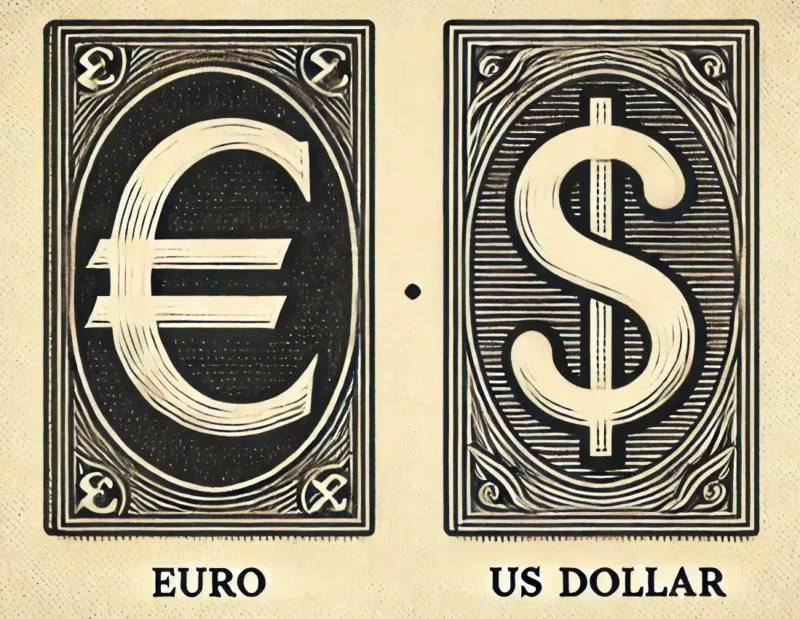
 If you’ve ever needed to convert currencies, you’ve probably considered services like Wise, Revolut, or maybe even a crypto exchange like Kraken. But have you ever thought about using Interactive Brokers (IB) to trade the currency pairs directly? Let’s dive into how Interactive Brokers stacks up as a tool for currency conversions and compare it to popular alternatives.
Why Interactive Brokers for Currency Conversion?
Interactive Brokers isn’t just for buying stocks or trading options; it’s also a powerful tool for converting currency. Unlike Wise or Revolut, where you’re charged a margin on the conversion rates plus a small fee, Interactive Brokers allows you to directly trade currencies on the foreign exchange market, meaning you can often get closer to the interbank rate—the most favorable rate available.
When you want to convert from, say, USD to EUR, you simply trade the currency pairs like you would with any other financial asset. This direct approach has some advantages:
- Lower Spreads: Interactive Brokers gives you access to live FX spreads, which are often tighter than the margins applied by consumer currency conversion services.
- Transparent Fees: IB charges 0.2 basis points (0.002%) of the trade value, with a $2 minimum per order. This transparency can help you avoid the surprise markups that might be embedded in other conversion tools.
Comparing Costs: Interactive Brokers vs. Wise, Revolut, and Kraken
Let’s take a look at a simple comparison using an example conversion of $1,000 to euros. Here’s how the different options stack up:
- Interactive Brokers: IB’s fee structure is typically a very small commission, and the exchange rate is practically at market value, making it extremely competitive for larger amounts. The commission is 0.002% of the trade value with a $2 minimum, so on a $1,000 conversion you pay the $2 minimum. On $100,000 the 0.002% also works out to $2, and on $500,000 it’s about $10.
- Wise and Revolut: Both of these platforms tend to offer exchange rates close to market rates, but they add a small markup. Wise charges a transparent conversion fee, and it discounts large amounts automatically: in October 2026 Wise quoted a fee of $1,002 to convert $560,000 to euros, about 0.18%. Revolut may depend on your account type—standard accounts might have weekend markups or fees for larger amounts.
- Kraken (Crypto Exchange): Crypto exchanges like Kraken can also be used to convert currencies, albeit indirectly. You’d need to convert your USD into crypto (like USDC) and then trade it for another fiat currency, such as EUR. The fees can vary significantly, ranging from trading fees (often 0.1% to 0.26%) to withdrawal fees, and there is also the added volatility risk when handling crypto as an intermediary.
Example Calculation
Let’s assume you are converting $1,000 to euros on each platform:
- Interactive Brokers: If the EUR/USD rate is 1.10, you could receive approximately €907 after the $2 minimum commission.
- Wise: You might receive around €906, after the service fee of around 0.5%.
- Revolut: You could receive a similar amount as Wise during weekdays, but if it’s the weekend, there might be an extra charge, bringing it down to about €903.
- Kraken: With Kraken, after trading and withdrawal fees, you might end up with around €900, though this could vary depending on market conditions and the crypto route you choose.
On large amounts the gap widens. Converting $560,000 to euros costs about $11 in commission at IB against Wise’s quoted $1,002, before counting the wire fees and the days your money spends in transit if it has to move out of your brokerage account and back.
Convert First, Then Buy
If you’re buying something priced in another currency on IB, say a euro-denominated ETF from a dollar account, you have two ways to pay for it.
You can place the order straight from your dollars and let IB convert automatically. That’s the convenient route, but the automatic conversion adds 0.03% to the exchange rate. On a $500,000 purchase that’s about $150.
Or you can convert first. Place a USD.EUR currency order, which IB routes to its IDEALPRO forex venue, and wait for it to fill. Then buy the ETF with the euros now in your account. You pay the 0.002% commission instead, about $10 on the same $500,000.
Below roughly $6,700 the automatic route is cheaper, because the manual order’s $2 minimum is more than 0.03% of the amount. Above that, convert first.
Converting Once vs. Hedging Ongoing Exposure
A cheap conversion only fixes the cost of the exchange itself. Once your euros sit in a dollar-denominated ETF, the value of that holding still moves with EUR/USD every day. If you want to take that swing out, the simplest tool is a currency-hedged share class of the same fund, usually with “EUR Hedged” in the name. The fund rolls forward contracts every month, so you get the underlying market’s return without the currency effect.
Hedging has a cost. It roughly tracks the interest-rate gap between the two currencies, on top of a slightly higher fund fee, so it suits bonds and shorter holding periods better than long-term equity positions. For those, many investors accept the currency exposure as part of being globally diversified.
Speed and Convenience
- Interactive Brokers: While IB offers great rates, the process might feel a bit more technical. You have to be comfortable with the trading interface.
- Wise and Revolut: Both are extremely user-friendly. Wise, in particular, is designed to make international transfers simple, even if you pay slightly more for that convenience.
- Kraken: Converting via a crypto exchange involves more steps and comes with crypto-specific risks, like market volatility. It’s probably not the most convenient choice unless you’re already comfortable with crypto trading.
Downsides to Using Interactive Brokers for Currency Conversion
While using Interactive Brokers for currency conversion can lead to substantial savings, there are a few downsides to consider:
- Not Intended for Currency Conversion: Interactive Brokers is primarily a brokerage platform for trading stocks, options, and other assets. Using it purely for currency conversion is sometimes seen as a “hack” and not its intended use. In fact, Interactive Brokers has been known to discourage users from exploiting this feature solely for currency exchange purposes, and they may even limit your account activity if this behavior is detected.
- Complexity: The trading interface is not as intuitive as dedicated currency conversion platforms. It may feel overwhelming for users who are not already familiar with the intricacies of forex trading.
- Regulatory and Compliance Risks: Depending on your country, there may be specific regulations around currency trading that could complicate things if you’re only looking to convert funds. Interactive Brokers might also scrutinize your transactions more closely if it appears that you’re primarily using the platform for currency conversion.
Final Thoughts: Best Option for Currency Conversion?
If you’re converting large amounts and want the lowest possible cost, Interactive Brokers is likely your best bet. It offers near-market rates with very low commissions, which adds up to considerable savings, especially if you’re converting a significant sum. However, if ease of use and speed are priorities, Wise and Revolut are still excellent choices.
Kraken, while an interesting option, adds a layer of complexity and risk due to the need to convert through crypto. It might be worth considering if you’re already active in the crypto world, but for most people, IB or a dedicated currency conversion service will be simpler and more straightforward.
If you’re already using Interactive Brokers for trading, why not leverage it for currency conversion too? The potential savings could be worth the extra clicks.
Related






Leave a Reply