This is a sponsored review. Afranga has paid for this placement, and some links are affiliate links, meaning I may be compensated if you sign up through them. This doesn’t affect the factual accuracy of the review or the risks described below.
Investing in crowdfunding projects involves risks, including the risk of partial or total loss of the capital invested. Your investment is not covered by deposit guarantee schemes or investor compensation schemes. Past performance is not a reliable indicator of future results. You may not be able to sell your investment when you wish, and any return on your investment is not guaranteed.
Afranga is a Bulgarian P2P lending platform I’ve covered in depth before. This is a sponsored update on where it stands in 2026: the ECSP relaunch, the current loan originators, the live numbers, the fee and tax picture, and the registration bonus. For my full independent take and verdict, read my Afranga review. If you’re new to this asset class, my primer on whether P2P lending is safe is a good starting point.
The short version: Afranga launched in 2021 as a funding vehicle for Stikcredit, one of Bulgaria’s leading online consumer lenders, and has since rebuilt itself into a regulated marketplace connecting European investors with multiple loan originators. What’s changed most recently is the move onto the ECSP framework and the expansion of the originator line-up, which is what this update digs into.
The platform is licensed as a European Crowdfunding Service Provider (ECSP) under Regulation (EU) 2020/1503, supervised by the Bulgarian Financial Supervision Commission. The authorization decision, FSC Resolution 863, is dated 12 September 2023, and the platform publishes its license as number 0001/18.09.2023. The regulated marketplace model investors use today was rolled out through a fuller relaunch in 2025. All investor funds are held in segregated accounts managed by Lemonway, a licensed French electronic-money institution (ACPR number 16568), which keeps your money separate from Afranga’s operational funds. That’s an important safeguard that not all platforms offer.
Under the ECSP framework, non-sophisticated investors complete an entry knowledge assessment and a loss-bearing simulation, and get a pre-contractual cooling-off period before an investment becomes binding. Afranga also runs in-house borrower due diligence using an internal risk methodology it describes as inspired by the world’s largest rating agencies. None of that removes credit risk. It raises the bar on process and disclosure.
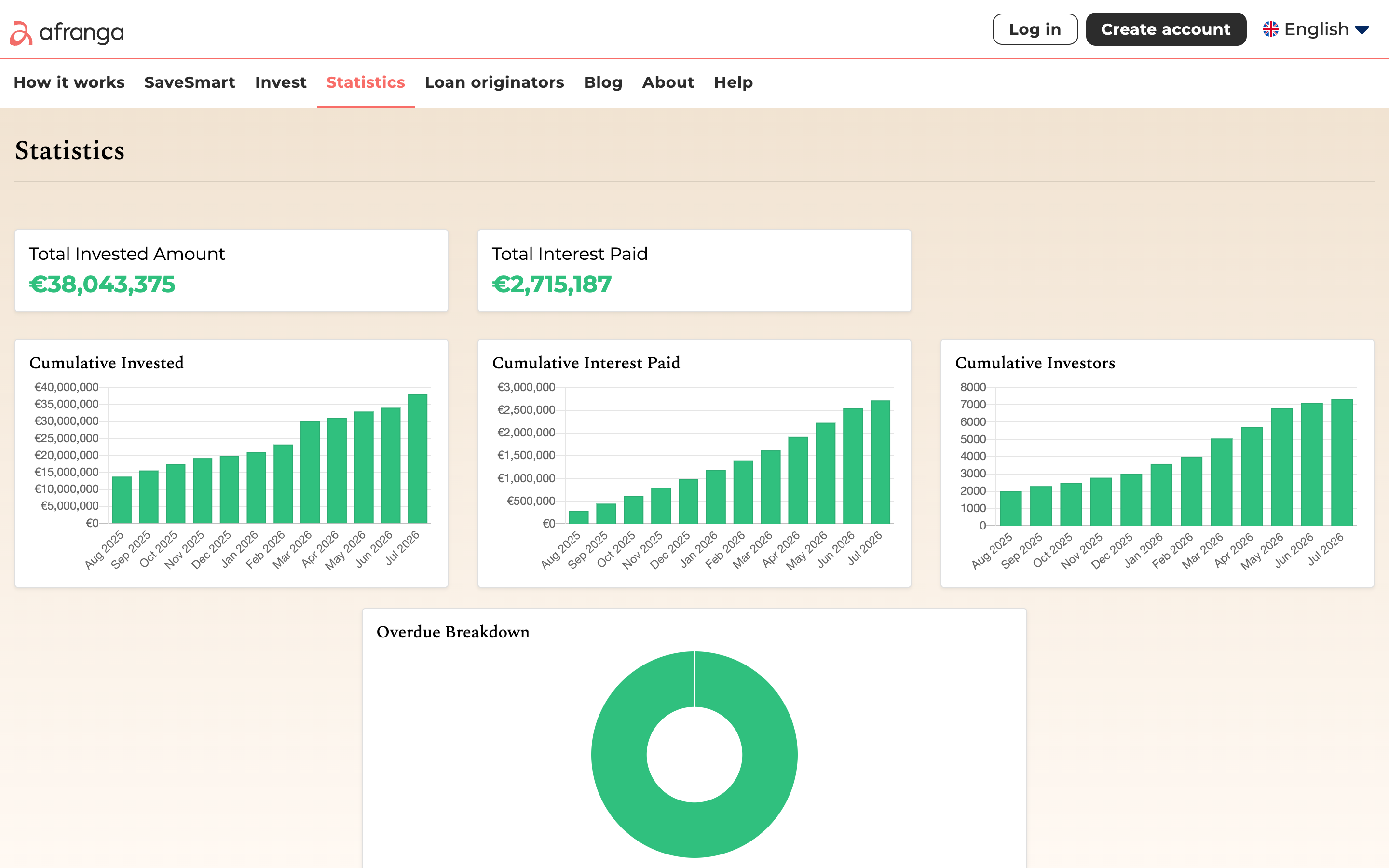
As of July 2026, Afranga’s public statistics page shows about EUR 38 million invested by investors, roughly EUR 2.7 million in interest paid to date, and around 7,300 investors. Third-party reviews put the actual investor return for 2025 near 13.92%, though Afranga’s own statistics page doesn’t publish an average-return figure, so treat any single return number as indicative rather than platform-published.
The Stikcredit Connection
You cannot understand Afranga without understanding Stikcredit. Afranga is owned by Stik Credit JSC, a Bulgarian consumer lender that has been operating since 2013 under supervision from the Bulgarian National Bank (registration No. BGR00370). Stikcredit has issued over EUR 100 million in loans and serves more than 45,000 customers.
Svetlin Sabev, who serves as Afranga’s CEO, was previously COO at Stikcredit. He founded Afranga in 2021 and has been the sole shareholder since 2023. The management team also includes Yonko Chuklev handling compliance and finance (15+ years of experience) and Veniamin Istomin, who joined in September 2024 from Bondster, another P2P platform.
The tight relationship with Stikcredit is both Afranga’s greatest strength and its most obvious risk. On the positive side, Afranga has deep visibility into Stikcredit’s loan book and operations. On the downside, if Stikcredit runs into trouble, Afranga would be directly impacted. This single-originator dependency has been somewhat mitigated by the platform’s expansion to include external loan originators, but Stikcredit still dominates the portfolio.
Stikcredit reported a net profit of EUR 3.48 million in FY2024 with a 54% equity ratio, which are healthy numbers. The impairment rate on its consumer loan portfolio sits at around 36.8%. The re:think P2P team, who visited Afranga in Bulgaria, put that down to conservative accounting and the nature of consumer lending in the region rather than a crisis, and it’s a useful reminder that the credit quality of the underlying consumer book is a separate question from the zero-loss record on the corporate loans investors fund.
Loan Originators and Diversification
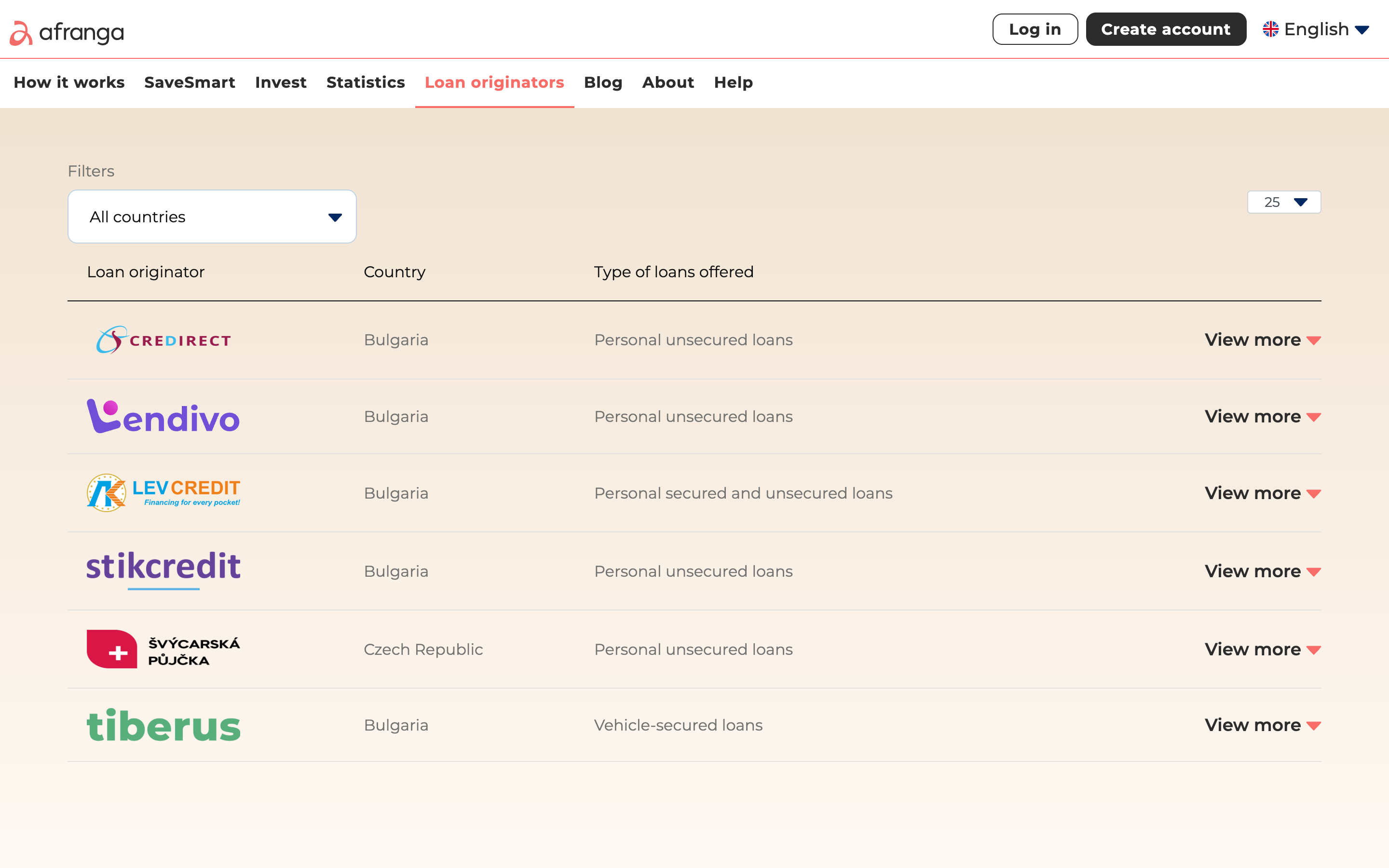
Afranga currently works with six loan originators across two countries. Average returns and portfolio sizes shift over time, so read each originator’s current card and documents before you allocate.
Bulgaria (5 originators):
- Stikcredit: The anchor originator. Personal unsecured loans, the largest book on Afranga by a wide margin, active since 2013.
- Credirect: Personal unsecured loans (payday up to EUR 700, installment up to EUR 5,100). Launched in 2017, serves 30,000+ customers.
- Tiberus: Vehicle-secured loans (car leasing), with fast approval. Built by the team behind Stikcredit and Lendivo.
- Lendivo: Personal unsecured consumer loans, operational since April 2024. Notably, co-founded by Afranga’s CEO Svetlin Sabev.
- Lev Credit: Both secured and unsecured personal loans (up to EUR 2,500 unsecured, EUR 50,000 secured). Claims 0% impairment on its secured portfolio.
Czech Republic (1 originator):
- Swiss Funds: Short-term consumer loans, licensed by the Czech National Bank and part of Orka Ventures Ltd. Listed on the site as Svycarska Pujcka, this is the platform’s main geographic diversification so far.
The addition of external originators beyond Stikcredit is a positive development, though it comes with a trade-off. Afranga naturally has less oversight and control over third-party lenders than it does over its parent company. Concentration is still the point: even with six names, volume and economic linkage lean heavily toward Bulgarian consumer credit and the Stikcredit group. If you want to spread beyond a single platform, I keep a running list of Afranga alternatives, and there’s a direct Afranga vs Mintos comparison for the biggest name in the space.
What You Can Invest In
Afranga offers two main investment products.
Primary Market (Manual Investing)
The primary market lets you browse available loan listings and invest manually. Each loan comes with a Key Investment Information Sheet (KIIS) that provides details about the borrower, the loan terms, and the risk profile. Minimum investment is EUR 10 per loan.
Interest rates typically range from about 10% to 14%, with promotional rates occasionally reaching up to 16%. That 16% sits at the top of the range: originator average coupons on the cards generally run lower, often around 9% to 12%. Loan terms vary from 6 to 60 months depending on the originator. Under the ECSP framework, the investment is structured as a corporate loan rather than a traditional P2P assignment, so investors hold a direct claim against the loan originator, secured by a pledge on company assets. It’s a different model from the assignment-based approaches you see on platforms like Mintos.
SaveSmart (Fixed-Term Product)
SaveSmart is Afranga’s fixed-term investment product, designed for investors who prefer a more hands-off approach. At the time of writing the rates are:
- 3 months: 8% per year
- 6 months: 10% per year
- 12 months: 12% per year
Interest is paid monthly to your Afranga wallet, with the principal returned at the end of the term, and you can enable automatic reinvestment at maturity. The minimum is EUR 10. Rates move, so confirm the current numbers in the product’s own screens. The catch is that SaveSmart investments cannot be withdrawn before maturity, and they’re not covered by any deposit guarantee scheme. This is not a bank savings account. It’s an investment product with inherent risk. In 2026 Afranga also began listing real-estate-backed opportunities, which widens the product story beyond consumer-lender corporate loans.
Fees and Costs
This is one area where Afranga stands out: there are zero fees for investors. No account fees, no deposit fees, no withdrawal fees, no investment fees, and no secondary market fees when available.
The platform makes its money from loan originators, who are charged up to 10% annually as a brokerage fee, plus a one-time EUR 3,000 evaluation fee. The average brokerage fee in the industry is 2 to 3%, so Afranga sits above the norm on the originator side. That fee structure is part of how the platform keeps investor fees at zero.
What’s Still on the Roadmap
Two features that many experienced P2P investors rely on aren’t live yet as of mid-2026, and both are worth factoring in before you commit.
No Auto-Invest
Every loan investment must be made manually. For anyone with a meaningful portfolio, this creates friction and cash drag. Afranga has been promising auto-invest for a while, and it’s reportedly coming. Until it arrives, be prepared to log in regularly if you want to stay fully invested.
Limited Secondary Market
The secondary market was available on the old, pre-ECSP version of the platform but hasn’t been fully reintroduced on the new regulated one. The fee list prices a secondary-market sale at zero, but a working early-exit path hasn’t been reliable on the relaunched stack. That means your liquidity options are limited: if you invest in a 36-month loan, plan as if you may need to hold it to maturity.
No Buyback Guarantee
Unlike many P2P platforms that offer a buyback guarantee, where the loan originator buys back defaulted loans from investors, Afranga doesn’t provide one. Under the ECSP framework, the security model is different: investors hold corporate loans secured by the originator’s assets rather than individual consumer loans with a buyback promise.
This is an important distinction. On the one hand, you don’t have the comfort of an automatic buyback. On the other, the regulated structure with direct claims and asset pledges arguably provides a firmer legal footing than the buyback promises offered by unregulated platforms, which are only as good as the originator’s ability and willingness to honor them. Afranga has reported zero investor losses to date. Whether that reflects strong risk management or simply a young platform that hasn’t been through a full downturn is an open question.
Taxes
Bulgarian loan originators withhold 10% tax on interest income at source. Depending on your country of residence and any applicable double taxation agreement, you may be able to credit some or all of this against your local tax liability, so a gross rate of “up to 16%” is not what lands in your pocket.
Afranga provides annual tax statements to make reporting easier. If you’re investing from an EU country, check the specific double taxation agreement between your country and Bulgaria, as the creditable amount may be limited. For example, German investors can only credit 5% of the Bulgarian withholding tax despite 10% being deducted. This is general information, not tax advice, so confirm your own position with Afranga’s documentation and a qualified advisor.
The Registration Bonus and Referral Program
New investors who sign up through a qualifying partner link can receive a 0.5% cashback on the amount they deposit and invest during the first 90 days after registration. Only funds that are actually invested count. Money left idle in the wallet does not, and the cashback is paid to the investor’s wallet on day 91 after registration. Afranga’s help pages don’t publish a cap or minimum for it, so treat the exact terms as whatever the platform confirms at sign-up.
Keep the framing straight: this is a one-off cashback on invested principal in a short window, not an interest-rate uplift and not part of the loan coupon. Separately, Afranga runs a referral program where existing investors earn 1% of their referral’s invested funds during the first 30 days, capped at EUR 500 per referral. The referred investor must deposit and invest at least EUR 500 within 30 days, and bonus funds must stay invested for at least 3 months before withdrawal.
User Experience
The platform’s interface is clean and functional, if not exactly cutting-edge. Registration involves standard KYC verification, and deposits are processed through Lemonway, so you get an individual IBAN for your investment account. The transition to Lemonway did cause some friction for early adopters, with automatic account creation not going smoothly for everyone. Transfers take about one business day, which is standard for SEPA payments.
Where the platform does well is transparency. Each loan listing includes detailed documentation, financial statements from the originator, and the required KIIS. You can review originator profiles with portfolio sizes, return histories, and background information before investing a single euro. Yonko Chuklev, who heads compliance and finance, was recognized in the Forbes 30 Under 30 Bulgaria list. For a platform of this size, the regulatory and compliance infrastructure seems well established.
How Afranga Compares
In the European P2P landscape, Afranga occupies an interesting position. It’s not the biggest (that would be Mintos), not the highest-yielding, and not the most feature-rich. But it offers something many larger platforms cannot: full ECSP regulation for its current iteration, combined with returns that have consistently topped 13%.
Compared to Mintos, Afranga is far smaller and less diversified. Mintos offers 60+ loan originators across 30+ countries, plus auto-invest and a secondary market, while Afranga has six originators in two countries. But Afranga’s returns have been higher, and its no-loss track record is notable. The closest comparisons are consumer-lending platforms like PeerBerry and Esketit, where Afranga’s regulatory status gives it an edge over unregulated competitors, even as the missing auto-invest and thin secondary market hold it back.
Where Afranga Fits in 2026
Afranga does a few things well. The ECSP regulation, segregated funds through Lemonway, no reported losses, and returns above 13% make a real case, and the move from a single-originator model to a six-lender marketplace shows the platform maturing.
The limitations are just as real. The lack of auto-invest is a genuine inconvenience, the thin secondary market limits your exit options, the heavy reliance on Stikcredit and the Bulgarian market creates concentration risk, and the 10% withholding tax eats into net returns. In my view Afranga fits best as a satellite allocation in a diversified P2P portfolio rather than a primary destination, for investors who already understand crowdfunding risk, size positions carefully, and don’t mind hands-on management. If auto-invest and a working secondary market launch as promised, and the platform holds its loss-free trajectory while adding originators, that assessment could move up. For now it’s a strong performer with some growing to do.
If you decide to look closer, start with the live listings, KIIS documents, and originator reports on Afranga, confirm the current bonus terms at registration, and only commit capital you can afford to lose in full.
Related





Leave a Reply