Jean Galea

Health, Wealth, Relationships, Wisdom

  • Start Here
  • Guides
    • Beginner?s Guide to Investing
    • Cryptocurrencies
    • Stocks
    • P2P Lending
    • Real Estate
    • Forex
    • CFD Trading
    • Start and Monetize a Blog
  • My Story
  • Blog
    • Cryptoassets
    • P2P Lending
    • Real estate
  • Consultancy
    • Consult with Jean
    • Consult a Lawyer on Taxation and Corporate Setups
    • AI Consultancy for Business
  • Podcast
  • Search

Yogurt Bowl Breakfast

Last updated: November 17, 2022Leave a Comment


One of my favorite breakfast meals is the yogurt bowl. It’s super easy to prepare and it’s a great fresh way to start your day.

Ingredients

  • 1 sliced Banana
  • Half a first of walnuts
  • 5 to 10 berries of your choice
  • 1 teaspoon of chia seeds
  • Natural unsweetened Greek yogurt

Directions

Like I said, this is super easy to prepare, so just put all the ingredients in a small bowl, mix and enjoy your healthy breakfast. You can, of course, vary this in many ways so it’s never boring. At times I put strawberries instead of banana. You could also put in matcha, moringa or protein powder for an interesting mix with the yogurt.

You can also vary the nuts, I like to use hazelnuts and almonds to vary from the usual walnuts. The nice thing about walnuts is that they are very easy to break down into smaller pieces using just your hands.

Filed under: General

How Are Bitcoin and Cryptocurrencies Taxed in Europe?

Last updated: March 11, 202617 Comments

If you hold Bitcoin or any other cryptocurrency and you live in Europe, you have tax obligations — and they’ve become a lot more defined since the early days of crypto. Governments have moved from vague guidance to concrete rules, and a new EU-wide reporting directive that took effect in January 2026 means the days of flying under the radar are firmly over.

This article covers how crypto is taxed across the major European countries, what events trigger a tax liability, and what the new EU reporting framework means for you.

Tracking every trade, swap, staking reward, and airdrop manually is a nightmare. Koinly connects to your exchanges and wallets, calculates your gains automatically, and generates country-specific tax reports.

Calculate your crypto taxes with Koinly

The Big Picture: How Europe Classifies Crypto

Across Europe, the consensus is that cryptocurrency is property, not currency. That means buying, selling, swapping, spending, or earning crypto can all be taxable events — much like dealing in stocks or real estate.

The two main income types that come up in almost every country are:

  • Capital gains — profit from selling or swapping crypto you already held
  • Ordinary income — crypto received as payment for services, from mining, staking, or airdrops

Which bucket your activity falls into determines your tax rate, and the difference can be significant.

What Counts as a Taxable Event?

This is where a lot of investors get caught out. Taxable events aren’t just cashing out to euros. Depending on your country, the following typically trigger a tax liability:

  • Selling crypto for fiat currency (EUR, USD, etc.)
  • Trading one cryptocurrency for another (e.g. BTC to ETH)
  • Using crypto to pay for goods or services
  • Receiving staking rewards
  • Receiving mining income
  • Receiving airdrops
  • Receiving crypto as payment for work

France is a notable exception here — crypto-to-crypto swaps are not taxable until you convert to fiat. Most other European countries treat them as taxable disposals.

DAC8: The EU Reporting Directive That Changes Everything

Starting January 1, 2026, the EU’s DAC8 directive requires all crypto-asset service providers — exchanges, brokers, custody platforms — to collect and report transaction data on EU-resident users to national tax authorities. That data is then shared automatically between EU member states.

In practical terms: if you have an account on any regulated European exchange, your transaction history is being reported to your country’s tax authority. The days of crypto existing in a reporting grey area are over.

DAC8 operates alongside MiCA (the Markets in Crypto-Assets regulation), which governs how crypto firms operate and obtain licenses across the EU. MiCA doesn’t change how you’re taxed — DAC8 does, by giving authorities the data they need to enforce the tax rules that already exist.

Crypto firms must have their reporting systems fully compliant by July 1, 2026. The first reports covering fiscal year 2026 are due between January and September 2027.

Country-by-Country Breakdown

Spain

Spain has one of the more detailed crypto tax frameworks in Europe, and it has been significantly updated in recent years.

Capital gains from selling or swapping crypto are taxed as savings income (renta del ahorro) at progressive rates:

  • Up to €6,000: 19%
  • €6,000 – €50,000: 21%
  • €50,000 – €200,000: 23%
  • €200,000 – €300,000: 27%
  • Over €300,000: 30% (increased from 28% under Ley 7/2024, effective January 2025)

Crucially, crypto-to-crypto trades are taxable events in Spain. Trading BTC for ETH, for example, requires you to calculate and declare the gain — even if no fiat ever changed hands. Gains are calculated using the FIFO method.

Staking rewards and airdrops are treated as ordinary income and taxed at general IRPF rates (19% to 47% depending on your total income).

Wealth tax: Crypto must be declared as an asset on your wealth tax return. The exact rate depends on your autonomous community (Madrid applies a 0% effective rate; other regions range from 0.2% to 3.75%). You declare the value of your holdings as of December 31.

Modelo 721: If you hold crypto worth more than €50,000 on a foreign exchange or platform, you must file Modelo 721 each year between January 1 and March 31. This is a disclosure form — not an additional tax — but failure to file carries a €200 penalty.

See also: The Most Crypto-Friendly Countries in Europe

Portugal

Portugal made headlines for years as a crypto tax haven. That era is mostly over, though long-term holders still benefit from favorable treatment.

Since the 2023 State Budget, Portugal taxes crypto capital gains as follows:

  • Held more than 365 days: tax-free
  • Held less than 365 days: taxed at a flat 28%

There is an important catch: exchanging one cryptocurrency for another resets your holding period. A BTC-to-ETH swap starts the 365-day clock again on the ETH you receive.

Staking income is classified as Category E (investment income) and taxed at a flat 28%. It does not qualify for the 365-day exemption — you owe tax on staking rewards regardless of how long you’ve held the underlying assets.

Mining and professional trading (Category B income) is taxed as business or professional income, which can reach higher rates depending on your total earnings.

Since 2024, reporting is mandatory for all crypto holders in Portugal, even those who owe zero tax.

Read more: Why Portugal is Europe’s best place for crypto investors and traders

Germany

Germany remains one of the most favorable crypto tax environments in Europe for long-term holders.

The core rule is simple: crypto held for more than 12 months is completely tax-free upon sale, regardless of the profit amount. Sell 50 BTC after 13 months and owe nothing. This was formally reconfirmed by the German Federal Ministry of Finance in March 2025.

For crypto held less than 12 months:

  • Gains are taxed as ordinary income at your personal tax rate (14% to 45%, plus a 5.5% solidarity surcharge)
  • Gains under €1,000 per year are exempt (increased from €600 starting from the 2024 tax year)

Staking and mining rewards are taxed as ordinary income when received. However, the staking reward tokens themselves benefit from the standard 12-month holding period rule — hold them for a year after receipt and any subsequent gains are tax-free.

DeFi activities: liquidity pool rewards, yield farming income, and lending interest are treated as ordinary income at receipt. The 12-month exemption applies to the resulting tokens if you later sell them.

France

France applies a flat tax (PFU — Prélèvement Forfaitaire Unique) of 31.4% on crypto capital gains. This breaks down as 12.8% income tax plus 18.6% social charges (the social contribution component increased from 17.2% to 18.6%).

France has a distinctive rule that makes it relatively relaxed for active traders: crypto-to-crypto swaps are not taxable events. You only trigger a taxable gain when you convert crypto into fiat currency (euros or any other government-issued currency). Trading BTC for ETH, or swapping tokens for stablecoins, does not create a taxable event under French law.

The DGFiP (French tax authority) only taxes gains when you cash out, and only if your total annual gains exceed €305. Below that threshold, you owe nothing.

Since 2023, the professional vs. occasional trader distinction no longer applies. If you manage your own private crypto portfolio — which describes the vast majority of investors — the 31.4% PFU applies automatically. You can optionally elect for progressive taxation instead, which may benefit lower-income investors.

Mining, staking, and airdrops are treated as ordinary income and taxed at progressive income tax rates.

Italy

Italy’s crypto tax regime has changed significantly and continues to evolve.

For 2025, capital gains on crypto are taxed at 26%. From January 1, 2026, the rate rises to 33% under the 2025 Budget Law. The Italian government originally proposed 42%, but lowered it to 33% following industry pushback.

The previous €2,000 annual exemption threshold has been abolished from 2025 onward — every euro of gain is now taxable.

Italy offered a step-up option for the 2025 tax year: investors could elect to reset their cost basis as of January 1, 2025 by paying an 18% substitutive tax. This was useful for those with large unrealized gains who wanted to lock in a lower effective rate before the 33% kicks in.

Mining income and professional trading are taxed as business income at rates up to 43%.

Netherlands

The Netherlands taxes crypto differently from most European countries. Rather than taxing capital gains when you sell, crypto is taxed under Box 3 (wealth tax) — you pay tax on the presumed return from your total assets, based on their value on January 1 of each tax year.

The Box 3 rate is currently 36%, applied to a deemed return on your net assets rather than your actual gains. Crypto is classified as “other investments” under Box 3 and is subject to the higher deemed return category.

A tax-free allowance applies: singles with net assets below €57,684 (€115,368 for fiscal partners) pay no Box 3 tax in 2025.

The Dutch system is in flux. A 2024 Supreme Court ruling found that Box 3 taxation was disproportionate in cases where the notional return exceeded actual returns. Transitional rules are in place until 2028, when the Netherlands plans to replace the system with a tax on actual returns (including unrealized gains) at a flat 36% rate.

Malta

Malta distinguishes between holding crypto as a store of value and actively trading it.

Crypto held as a long-term investment and not part of a trading business is not subject to capital gains tax. This favorable treatment is grounded in Malta’s Virtual Financial Assets Act, which classifies certain crypto assets explicitly.

If you trade crypto frequently or as part of a business, profits are taxed as business income at the standard corporate rate of 35%. However, through Malta’s full imputation system and available structuring options, the effective rate can be reduced to between 0% and 5% for qualifying structures.

Malta is also implementing DAC8 reporting requirements for crypto service providers from 2026.

Belgium

Belgium has historically been lenient on crypto taxation, but that is changing. New regulations are being implemented in 2025, taking effect from January 1, 2026, which will bring Belgium in line with broader EU reporting standards under DAC8.

Under existing rules, crypto gains by private investors who act as “good family fathers” (a Belgian legal standard for prudent management of personal assets) have generally not been subject to capital gains tax. Speculative trading or professional activity is taxed as ordinary income at rates up to 50%.

The 2026 changes are expected to increase reporting obligations and reduce the ambiguity that has made Belgium relatively favorable for passive crypto holders.

Staking, DeFi, and Airdrops: The Modern Complexity

The original crypto tax frameworks were written with simple buy-and-sell activity in mind. The reality of crypto in 2026 is far more complex — staking, liquidity pools, yield farming, lending protocols, and token airdrops all create income events that don’t fit neatly into traditional categories.

Here’s how most European countries approach these:

  • Staking rewards: Generally treated as income when received, taxed at ordinary income rates. Portugal is explicit about this (28% flat). Germany taxes them as income but the resulting tokens benefit from the 12-month holding rule.
  • DeFi yield and liquidity pool rewards: Treated as ordinary income in most jurisdictions. Germany specifically addresses these under its 2025 crypto guidance.
  • Airdrops: Usually taxed as income at the fair market value when received. In Spain, for example, the conservative position is to declare them as income under the general tax scale. The practical challenge — that most airdrops are of negligible value and extremely difficult to track — is acknowledged, but doesn’t remove the legal obligation.
  • NFTs: Treated similarly to other crypto assets in most countries. Selling an NFT for a profit triggers capital gains tax.

Good Practice for Every Crypto Investor

Regardless of which country you’re in, the fundamentals of crypto tax compliance are the same:

  • Keep records of every transaction — purchase date, amount, price at time of acquisition, and price at time of disposal
  • Download your transaction history from every exchange you use, regularly
  • Export wallet transaction logs, especially if you use DeFi protocols
  • Record the fair market value of any staking rewards, airdrops, or income received in crypto on the date you received them
  • Use a crypto tax tool to automate calculations, especially if you have high transaction volume

For anyone with a meaningful crypto portfolio, using dedicated software is not optional — it’s the only realistic way to stay compliant. Koinly is the tool I’d recommend for European investors.

Countries That Still Offer Favorable Treatment

If you’re seriously considering tax optimization through residency, the most favorable European jurisdictions as of 2026 are:

  • Germany — 0% on gains after 12 months
  • Portugal — 0% on gains after 365 days (short-term gains at 28%)
  • Malta — 0% on long-term investment holdings (not trading businesses)
  • Switzerland — private investors generally not subject to capital gains tax; wealth tax applies but at low rates

See the full breakdown: The Most Crypto-Friendly Countries in Europe

This article is for informational purposes only and does not constitute tax or legal advice. Crypto tax rules change frequently and vary by individual circumstance. Always consult a qualified tax professional in your country of residence before making any decisions based on this information.

Filed under: Money, P2P Lending

Best Sports Nutrition and Supplements Online Shops in Spain

Last updated: April 05, 20242 Comments

If you enjoy practicing any kind of sport, you probably know that nutrition goes hand in hand if you want to achieve good results.

I have a chef who cooks all my food, but supplementation (under the guidance of a sports doctor) is always a must when practicing sport at a serious level.

My main sport is padel, although I also do cycling, swimming and weights to complement that. To make sure my body can sustain all the exercise that I throw at it, I use supplements like protein shakes, vitamins and energy bars to keep going during long sessions.

As always, I try to find an online shop that can meet my supplementation needs as I don’t want to waste time physically going to shops to buy products every few weeks.

Bulevip

My search for the best sports nutrition and supplements shop in Spain led me to Bulevip. This is an excellent online shop that stocks all the top nutrition brands like Optimum Nutrition and Scitec. They also have other sports equipment like GPS watches and sports clothes.

What I like about Bulevip is their excellent customer care. You can chat with them through the site during office hours to clarify any concerns. Shipping is free as are returns, as they should be. Unfortunately, many online shops still make it difficult for customers by charging for deliveries and returns.

Another nice thing is that they like to include small gifts with every purchase. This is great for trying out new products, for example, along with my favourite protein shake I might be able to select a free packet of another flavor, and that way I can experiment with flavours without risking buying a 2.5kg pack that I end up not liking.

Visit Bulevip.com

MyProtein

MyProtein is another site that has caught my attention for its extensive range of products tailored to every kind of sports enthusiast. Renowned for their quality protein powders, MyProtein also offers a wide variety of supplements, including vitamins, minerals, and performance-enhancing substances designed to boost your workout. They pride themselves on their innovative product development, ensuring they’re always at the cutting edge of sports nutrition. MyProtein’s website is straightforward to navigate, making it easy to find what you need to support your training regime. They frequently run promotions and discounts, providing excellent value for money and making high-quality supplements more accessible.

Furthermore, MyProtein’s commitment to sustainability, with initiatives aimed at reducing plastic waste and improving the environmental footprint of their products, adds an extra layer of appeal for the eco-conscious consumer.

Visit MyProtein

Filed under: Expat life

How to Keep Score in Padel

Last updated: January 23, 2019Leave a Comment

So you’ve started to play padel but you’re not yet sure how to keep score? Here’s a handy guide to solve your doubts.

Match > Set > Game

Each padel match is made up of two to three sets. To win a set, you must win at least six games.

The games are scored starting at “love” (or zero) and go up to 40, but that’s actually just four points. From love, the first point is 15, then 30, then 40, then game point, which wins the game. If each pair has equally won three points (40-40), that’s called a “deuce”, which is, essentially, a tie. In that case, the following point won will be called “advantage” and if the same pair wins the next point they have won the game. If the point is lost the score will return to “deuce”. And so on until one side has won the two consecutive points which are needed to convert into a game.

The first pair to win 6 games, always with a minimum advantage of 2 clear games, will convert into a set. In the case of a tie (draw) at 5 games, the players will have to play two more games, to win by two games, for example, 7-5. However, if there is a tie at 6 games a “tie-break” independent point system will be implemented.

During a tie-break, the point system is numeric. The first side to reach 7 points, with a 2-point clearance needed at 5-5 and so on to win the “tie-break” and convert the set. A set ending in a tie-break decision will be won by 7-6.

The first player to serve in the tiebreak is according to the order of serve followed in the set. For the first point of the tiebreak, this player will only serve one point from the right side of the court. The players of the opposing team (respecting the previous order of service) will then serve the following two points with their first point being from the left side of the court. After this, the players will serve two consecutive points always serving from the left side of the court, until the end of “the tie-break” always respecting the aforementioned order of service.

A “tie-break” set will be won by 7-6.

The player of the pair that did not begin serving in the “tie-break” will start serving in the next set.

Note: in some amateur tournaments, to make sure matches don’t take too long, the advantage system is eliminated, so upon tying at a deuce, the next pair to make a point will win the game.

Determining Who Serves First

To determine who serves first, the umpire flips a coin. Whoever wins the toss gets to decide one of four things: that they want to serve first, that they want to receive first, which side of the court they want to start on (in which case, the opponent chooses who serves first), or that they want to leave the choice up to their opponent.

Whoever starts serving continues to serve until that game is over. Then the opposing couple will serve. Both couples have the right to choose which player from their couple serves first. Once that decision is taken, the serve order has to be maintained throughout that set.

The first serve is always from the right-hand side. It must be hit diagonally across the net and bounce within the lines that limit the receiver’s box. The return of serve is played and the ball is in play until one side wins the point. The following service is taken from the left and served diagonally to the right and so on alternatively.

Keeping Score

In competitive matches, the umpire is responsible for keeping score. Typically the score is also shown on an electronic scoreboard.

During non-competitive padel matches, the player serving is responsible for keeping score and shouting out the current score before every serve. When announcing your score, start with your score first, then your opponent’s. So if you have zero and your opponent has 30, say “love-30.” In the case of a deuce, if the server gains the advantage he can announce “advantage server” and if the receiver gains the advantage he can instead announce “advantage returner”.

Before the first serve in each new game, whoever is serving announces the score in sets. Say your score first, then your opponent’s. So if you won the first set, you would say “1-0.”

Of course, the rest of the players should also try to keep abreast with the score, as mistakes can be made. We’re all human after all.

I’ve played in matches where the server forgot to shout out the score before serving, resulting in wildly different opinions on what the score actually was. This can lead to arguments and time wastage, so it’s better to just shout out the score before serving to make sure everyone is in agreement and aware of the score.

Alternative Configurations for Amateur Tournaments

During amateur competitions, the organizers might also decide to assign a specific time frame for each match, typically 20 or 30 minutes. At the end of the time frame, the match is ended at the current score. The time-frame method is useful when the organizers want to make sure that everyone enjoys the same amount of play time, and thus avoid potential complaints from people whose matches were too short and hence feel that they didn’t get their money’s worth.

Another option you might encounter is to play up to a specific number of games. For example, the winning couple can be the first to win 4 games. This is ideal when the organizer wants to keep matches relatively short. The same benefit can be achieved with the time limit mentioned earlier, and I consider that to be the better option. The only advantage of this option is that mismatched couples can finish a match quickly and move on to a more balanced match. However, ideally, the organizer would have taken care of the mismatching problem beforehand.

Using Apps

One handy tool for keeping score in padel matches is to use an app on your smartwatch. I use the Tennis app on the Fitbit Versa, and there is also a Tennis scorekeeping app for the Apple Watch. In this way if you remember to mark each point you will have no doubts about the score at any point, and it also helps you keep the score in mind when preparing the next serve or return, which is a very important part of the mental game in padel.

Questions?

I hope this basic guide to scoring in padel was helpful. If you have any doubts or questions please leave a comment below and I’ll do my best to give you a definite answer.

Filed under: Padel

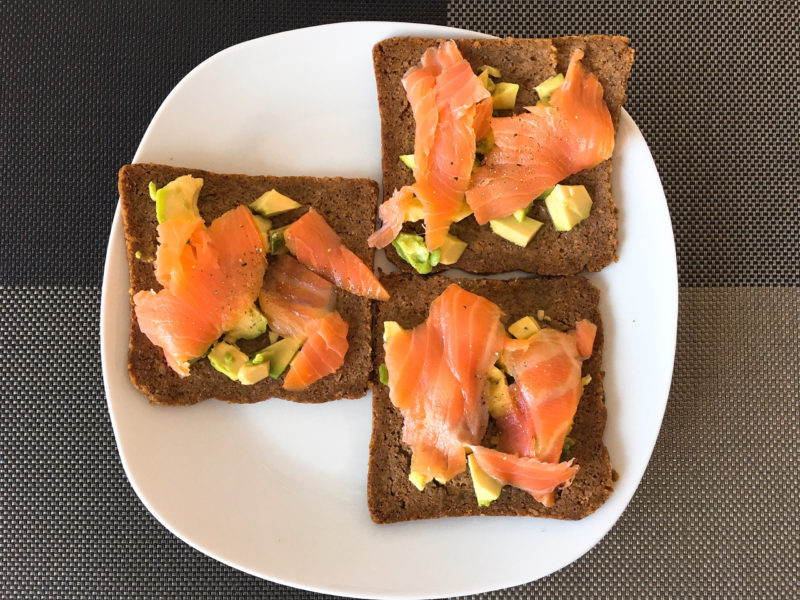
Smoked Salmon & Avocado Breakfast Sandwich

Last updated: November 17, 2022Leave a Comment

Here’s another quick and easy breakfast recipe that fits right into my ideas of a healthy diet. I love simple and nutritious dishes, and this plate packs a lot of protein and healthy fats together with a great dose of fiber to keep you feeling full throughout the morning.

What we’ll be making is an open sandwich (just one slice of bread rather than two) but you could easily make it a full sandwich if you wanted. In general, I try to keep bread consumption to a minimum due to my genetic makeup. Bread and other grains that are heavy on carbs are the quickest way for me to put on weight and that’s definitely not something I’m seeking at this point.

Ingredients

All quantities are for one serving.

  • 1/2 pack of smoked salmon
  • 1/2 an avocado
  • Olive oil
  • German bread (or any wholemeal substitute of your choice)
  • Pepper

Directions

Drizzle olive oil over each sandwich and use a knife to spread it evenly. Chop the avocado into small pieces and spread them over the bread. Finally, add the salmon slices and top that off with some pepper for added flavor.

A very nice variation to this dish is to add scrambled eggs and freshly cut herbs (chives work well). You can also try skipping the olive oil and using fresh lemon juice squeezed over the sandwich as the last step.

Toasting the bread is also a great variation especially in the colder months.


Filed under: General

  • « Previous Page
  • 1
  • …
  • 82
  • 83
  • 84
  • 85
  • 86
  • …
  • 92
  • Next Page »

Latest Padel Match

Jean Galea

Investor | Dad | Global Citizen | Athlete

Follow @jeangalea

  • My Padel Experience
  • Affiliate Disclaimer
  • Cookies
  • Contact

Copyright © 2006 - 2026 · Hosted at Kinsta · Built on the Genesis Framework