Sort your Portuguese crypto taxes with CoinTracking
Portugal spent years as the go-to crypto tax haven, then introduced a tax regime in 2023. The reputation lingers, but the reality is more nuanced. The headline rule is genuinely generous, the 365-day exemption, but it comes with conditions, and short-term gains are taxed. Tracking which of your coins cross the one-year line is exactly what software is for.
Here’s how crypto is taxed in Portugal and how to prepare your return.
- CoinTracking (my pick): deepest reporting, tracks holding periods precisely, free up to 200 transactions. Read the review.
- Koinly: the easiest option, with a Portuguese report and a large free tier. Read the review.
How Crypto Is Taxed in Portugal
Since the 2023 State Budget, crypto for individual investors is taxed under the personal income tax code (IRS). The defining rule is the holding period:
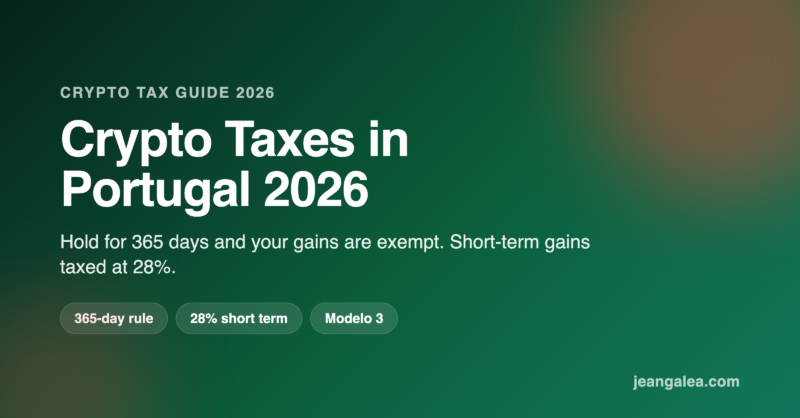
- Held 365 days or more: the gain is exempt from tax (for crypto that is not classified as a security).
- Held under 365 days: the gain is taxed at a flat (autonomous) rate of 28%, with an option to aggregate at progressive rates.
There’s an important carve-out: the 365-day exemption does not apply to crypto that qualifies as a security. Holdings acquired before 2023 do count toward the 365 days, and the exemption is also conditioned on the counterparty being in the EU/EEA or a country with an information-exchange agreement with Portugal.
Crypto-to-Crypto and Other Events
Crypto-to-crypto swaps generally don’t trigger tax: taxation is deferred until you convert to fiat or other non-crypto consideration. A 2025 ruling confirmed that a technical swap to a stablecoin (where there’s no direct fiat pair) doesn’t break the holding period.
Staking, Mining, and Professional Activity
Passive staking and lending income is treated as capital income (Category E) and taxed at 28%. Mining, transaction validation, and issuing crypto are treated as business income (Category B) at progressive rates, with most mining revenue taxable.
A Note on NHR
The old Non-Habitual Resident regime closed to new applicants and never specifically exempted crypto gains anyway. The replacement (IFICI) doesn’t shelter passive crypto investors. The real tax-free lever in Portugal is the 365-day holding rule, which is available to everyone regardless of residency status.
Companies and Professional Traders
These rules are for individuals investing their own money. Crypto held through a Portuguese company is taxed as corporate income whatever the holding period. And if your trading is frequent and organized enough to look like a business, with daily trades, borrowed money and trading as your main income, the gains can be treated as Category B business income at progressive rates instead.
How Portugal Compares
Germany is the closest match: crypto held for more than a year is tax-free there too, and short-term gains are taxed at your marginal income tax rate. Spain has no holding-period exemption at all and taxes every gain at its savings rates of 19% to 30%. Portugal also has no wealth tax, so long-term holdings cost nothing to keep while you wait out the 365 days.
The Forms You Need to File
Crypto goes on the Modelo 3 IRS return with the relevant annexes: Anexo G for short-term gains (Quadro 18A), Anexo G1 for the exempt long-term holdings (Quadro 7), Anexo E for capital income, and Anexo J for foreign-sourced income. The filing window for the 2025 return runs 1 April to 30 June 2026, with any tax due payable by 31 August.
How to Prepare Your Crypto Taxes in Portugal
- Connect every account. Add each exchange and wallet so the tool can track acquisition dates, essential for the 365-day rule.
- Import your full history. You need every transaction to identify which gains qualify as long-term.
- Reconcile. Patch any data gaps with a CSV.
- Generate the figures. Separate long-term (exempt) from short-term (taxable) gains and complete your Modelo 3 annexes.
Prepare your Portuguese report with CoinTracking
The Best Crypto Tax Tool for Portugal
CoinTracking is my pick for its depth, precise holding-period tracking, and lifetime-licence value. If you want the simplest experience, Koinly produces a Portuguese report and is very beginner-friendly. Both have free tiers, so import your history and check the numbers first. For the wider field, see my guide to the best crypto tax software.
Frequently Asked Questions
Is crypto still tax-free in Portugal?
Not entirely. Since 2023, crypto held under 365 days is taxed at a flat 28%. But crypto held for 365 days or more is exempt from capital gains tax (for assets that aren’t securities), so long-term holders can still pay zero. The exemption has conditions, including the counterparty’s jurisdiction.
How long do I need to hold crypto to avoid tax in Portugal?
365 days or more. Gains on non-security crypto held for at least a year are exempt from capital gains tax. Holdings acquired before 2023 count toward the 365 days. Gains on crypto held for less than a year are taxed at 28%.
Is swapping crypto taxable in Portugal?
Generally no. Crypto-to-crypto swaps defer taxation until you convert to fiat or other non-crypto consideration. A 2025 tax authority ruling confirmed that a technical swap to a stablecoin to reach fiat doesn’t break the holding period.
Do I still get crypto tax benefits under NHR in Portugal?
NHR never specifically exempted crypto gains, and it has closed to new applicants. The real tax-free lever is the 365-day holding rule, which applies to everyone regardless of NHR status.
Related







Leave a Reply