Bitcoin hit an all-time high above $106,000 in late 2024 and pushed past $123,000 by mid-2025. Even after a significant pullback in early 2026, it remains one of the highest-performing assets of the last decade. If you’re looking for ways to get exposure — or to put existing holdings to work — there are more options available now than ever before.
This guide covers everything from the simplest approach (just buying and holding) to more sophisticated tools like futures, options, spot ETFs, and automated trading strategies. I’ve also updated the sections on lending and Bitcoin mining to reflect what’s actually happened since the 2022 crisis and the April 2024 halving.
If you’re interested in gaining exposure to the world’s largest cryptocurrency, you can do it through direct ownership, CFDs, futures, options, or now — regulated spot ETFs available through your regular brokerage account. Read on.
How the Price of Bitcoin Works
It doesn’t matter which financial instrument you choose — whether that’s buying Bitcoin outright and storing it in a private wallet or trading CFDs. Your ability to profit comes down to one thing: the market price of Bitcoin.
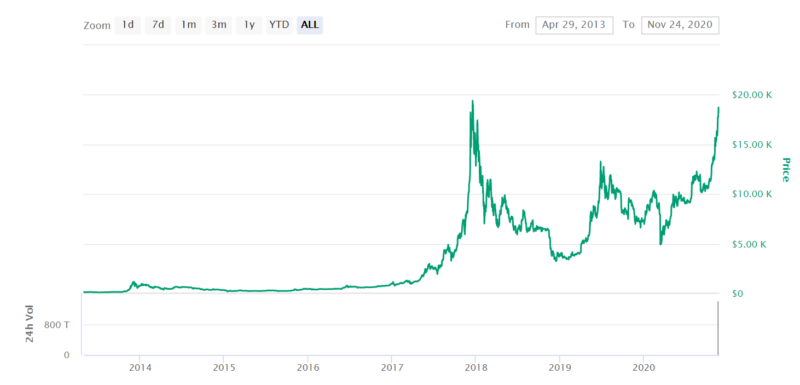
Bitcoin’s price is determined by supply and demand, just like any other asset. When buyers outnumber sellers, the price rises. When sellers dominate, it falls. Bitcoin is also capped at 21 million coins — a hard supply limit built into its code — which underpins its long-term scarcity argument.
- If market sentiment is positive, more buyers than sellers push the price up.
- If sentiment weakens and sellers take over, the price drops.
Bitcoin trades 24/7, on every day of the year. Its price moves constantly and can be highly volatile in the short term — which creates both opportunity and risk depending on your approach.
Buying Bitcoin: The Simple Buy-and-Hold Strategy
Before we get into more complex instruments, the most popular approach remains the simplest: buy Bitcoin and hold it. If the price rises above what you paid, you sell at a profit.
Here’s a simple example using realistic 2026 figures:
- You invest $2,000 into Bitcoin
- Bitcoin is priced at $65,000 at the time of purchase
- You hold for two years
- Bitcoin has risen to $120,000 when you sell
- That’s an increase of roughly 85%
- Your $2,000 investment is now worth approximately $3,700
This is the classic buy-and-hold strategy — known in crypto circles as HODLing. The goal is to ride out short-term volatility and benefit from long-term appreciation. Historical data consistently shows that investors who held Bitcoin for four or more years have always come out in profit.
Dollar-Cost Averaging (DCA)
Rather than putting everything in at once, many investors use dollar-cost averaging — buying a fixed amount at regular intervals regardless of the price. This reduces the impact of timing the market.
The data backs this up. A $10 weekly DCA from 2019 through 2024 grew $2,620 into roughly $7,913 — a 202% return, outperforming both gold and the Dow Jones over the same period. Even investors who started buying at the 2017 peak ($19,500) are up around 400% today.
Most exchanges — including Coinbase — offer recurring buy features that automate this for you.
Where to Buy Bitcoin
The easiest and most cost-effective way to buy Bitcoin is through a reputable exchange. Coinbase remains one of the go-to options. You can fund your account via bank transfer (SEPA, SWIFT) at minimal cost, with trading commissions around 0.26%. Coinbase has been operating for over 12 years and is publicly listed on the Nasdaq — one of the stronger trust signals in a space where many platforms have come and gone.
Binance is another solid choice. It’s the largest exchange by volume, supports hundreds of trading pairs, and charges 0.1% on trades. You can read my full Binance review here.
Once you’ve bought, think carefully about storage. Bitcoin held on an exchange is technically in the platform’s custody — not yours. For meaningful amounts, consider a hardware wallet like Trezor or Ledger Nano. The collapses of FTX, Celsius, and others in 2022 were harsh reminders of counterparty risk. Self-custody is not paranoia — it’s prudent.
Bitcoin Spot ETFs: The Institutional Onramp
One of the biggest developments in Bitcoin’s history came in January 2024, when the SEC approved the first US Bitcoin spot ETFs. This was a watershed moment: for the first time, everyday investors could get direct exposure to Bitcoin through a regular brokerage account — no crypto exchange, no wallet, no custody to manage.
BlackRock’s iShares Bitcoin Trust (IBIT) quickly became the standout product. It hit $100 billion AUM in just 435 days — shattering the previous record of 2,011 days held by Vanguard’s VOO. IBIT attracted over $25 billion in net inflows in 2025 alone and has surpassed 800,000 BTC in assets under management.
By early 2026, total spot Bitcoin ETF assets represent roughly 6.3% of Bitcoin’s entire market capitalization — a sign of just how much institutional money has entered the space.
Who Should Use a Bitcoin ETF?
Spot ETFs make the most sense for investors who:
- Want Bitcoin exposure through tax-advantaged accounts (401k, IRA, ISA)
- Prefer dealing with a regulated product through their existing broker
- Don’t want the responsibility of managing private keys or wallets
- Are investing on behalf of institutions or pension funds
The trade-off is that you don’t hold the actual Bitcoin — you hold shares in a fund that holds it. You also pay an annual management fee (typically 0.12%–0.25% depending on the provider). For long-term holders who want pure price exposure without self-custody, this is a very clean solution.
The major ETF providers include BlackRock (IBIT), Fidelity (FBTC), Ark/21Shares (ARKB), and several others. You can buy and sell them like any stock on a US brokerage.
Trading Bitcoin CFDs
If you want to trade Bitcoin actively rather than hold it, Bitcoin CFDs let you speculate on price movements without taking ownership of the underlying asset.
CFDs (contracts-for-difference) track the current market price of Bitcoin. The two main advantages over outright buying are leverage and the ability to short-sell.
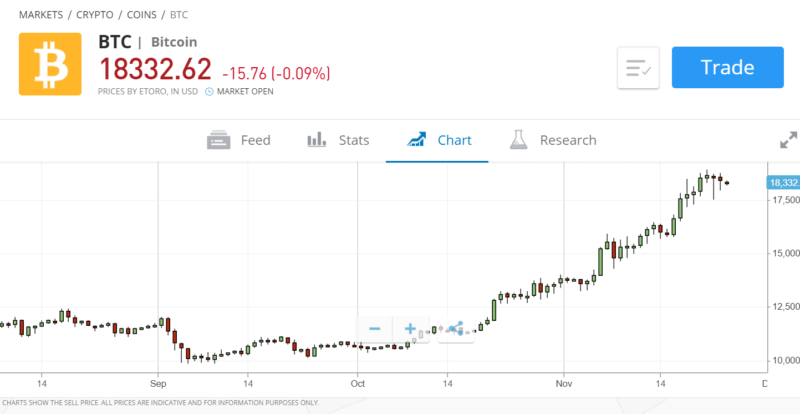
Leverage
CFDs give you access to leverage — the ability to control a position larger than your account balance. For example, with 1:2 leverage, a $500 stake controls a $1,000 position.
- You stake $1,000 on a Bitcoin CFD buy order
- You apply leverage of 1:2
- Bitcoin rises 3% — your profit is $60 instead of $30
Regulated brokers serving European and UK retail clients cap Bitcoin CFD leverage at 1:2. That limit exists for good reason — leverage amplifies losses just as effectively as gains. If your leveraged trade moves against you by 50%, you lose your entire stake.
Note: US citizens cannot trade CFDs. Americans looking for leveraged Bitcoin trading typically use regulated futures products instead.
Short-Selling
Bitcoin CFDs also allow you to go short — betting that the price will fall. If you believe Bitcoin is overvalued at $65,000 and it drops to $55,000, a short position lets you profit from that move.
- Bitcoin is priced at $65,000
- You place a $1,000 sell order via a CFD broker
- Bitcoin falls to $55,000 — a drop of roughly 15%
- Your $1,000 stake nets you $150 in profit
What to Know Before Trading Bitcoin CFDs
CFDs are short-term instruments. You pay overnight financing fees for each day a position stays open, which makes them uneconomical to hold for weeks or months. They’re best suited to active traders who open and close positions within days.
CFDs are also complex and heavily regulated. The industry has protections in place — segregated client funds, negative balance protection — but they don’t eliminate the risk of loss.
Read my full guide on CFD trading here.
Buying Bitcoin on Margin
Leverage and margin refer to the same underlying concept — trading with more than you have — but through different mechanisms.
- Leverage is expressed as a multiple (e.g., 1:2 means you trade twice your stake).
- Margin is the minimum deposit required to open a position (e.g., 10% margin means a $1,000 deposit controls a $10,000 trade).
Some exchanges offer margin trading outside the CFD framework. Coinbase has expanded its futures offering significantly — its regulated futures product (CFTC-overseen) now provides access to over 20 futures contracts with leverage options available to qualified US traders.
Be aware: the mechanics of margin trading mirror CFDs closely. You’ll pay ongoing fees for holding positions, and liquidation is a real risk if the market moves against you.
Bitcoin Derivatives
Derivatives are financial contracts whose value is based on the price of an underlying asset — in this case, Bitcoin. They allow you to take sophisticated positions on price direction and timing.
Bitcoin Futures
Bitcoin futures have been available on the CME since late 2017 and have grown substantially since. They allow you to agree today on a price at which you’ll buy or sell Bitcoin at a future date.
Each futures market has an expiry date (usually quarterly) and a strike price — the price the market expects Bitcoin to reach. You don’t need to hold the contract to expiry; you can offload it on the secondary market as the value moves.
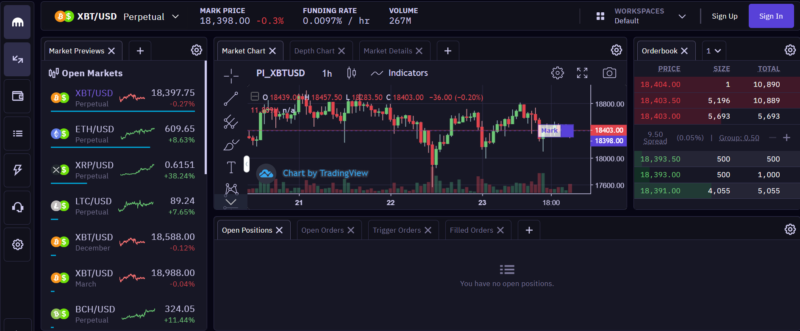
Here’s a simplified example with current price levels:
- Bitcoin is currently priced at $65,000
- A 3-month futures contract has a strike price of $72,000
- You buy 10 contracts at 0.1 BTC each — total exposure of $65,000
- Two months later, Bitcoin is at $80,000 — $8,000 above the strike price
- You offload the contracts, locking in your gains
CME Bitcoin futures are primarily for institutional traders due to contract size minimums. For retail access, Coinbase offers various futures types — perpetual, monthly, quarterly, and semiannual — with a minimum contract size of $1. Leverage up to 1:50 is available on some products, though using high leverage requires careful risk management.
Bitcoin Options
Options give you the right — but not the obligation — to buy or sell Bitcoin at a set price by a specific date. Unlike futures, if the trade goes against you, you can simply let the contract expire and your maximum loss is the premium you paid.
Example of a Bitcoin Options Trade
- Bitcoin is priced at $65,000
- You buy 3-month call options with a $75,000 strike price
- The premium is $3,000 per contract
- You buy 5 contracts — total outlay is $15,000
- Two months in, Bitcoin is at $90,000 — $15,000 above the strike
- Each contract made $15,000 gross; subtract the $3,000 premium — $12,000 net per contract
- Total profit: $60,000 across 5 contracts
If Bitcoin had fallen below $75,000 and stayed there, you’d simply let the contracts expire. Your loss is capped at the $15,000 in premiums — nothing more.
Where to Trade Bitcoin Options
For US readers: The CME now offers regulated Bitcoin options alongside its futures products. This is the safest regulated route for American traders.
For everyone else: Deribit remains the dominant platform for Bitcoin options globally, with deep liquidity and a wide range of strike prices and durations. Fees are 0.0003 BTC per contract.
Read more about Deribit in my review of this platform.
Automated Bitcoin Trading
Automated trading bots place buy and sell orders on your behalf based on pre-set rules or strategies. They’ve been a fixture of the forex world for years and have found a natural home in crypto, which trades around the clock.
The appeal is obvious: consistent strategy execution without emotional decision-making, running 24/7. The reality is more nuanced. A bot is only as good as the strategy behind it, and the market can behave in ways no backtested model accounts for.
You have two main routes:
MT4-Based Bots
MetaTrader 4 (MT4) is the most widely used third-party trading platform in the CFD and forex world. You can install automated trading scripts (Expert Advisors) that connect to a Bitcoin CFD broker and execute trades on your behalf.
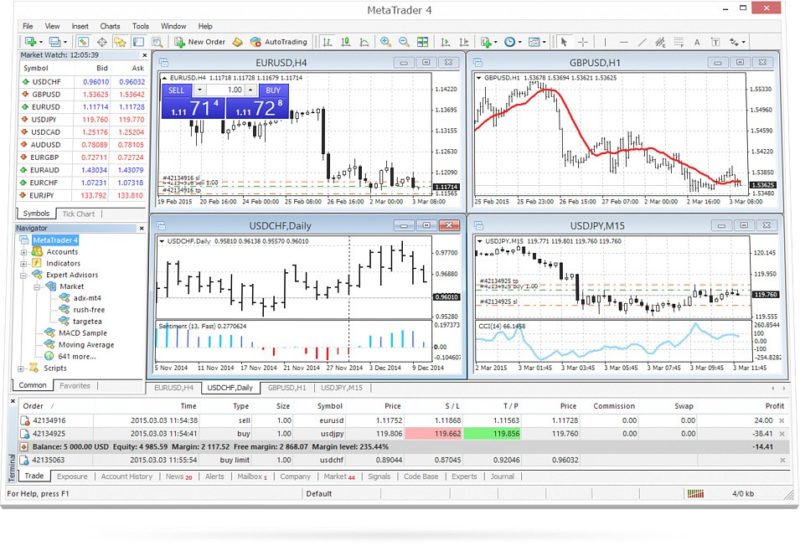
There are hundreds of MT4 bots available — most making claims they can’t substantiate. Treat any provider promising guaranteed returns with skepticism.
Specialist Automated Bitcoin Platforms
Read more: The best crypto trading bots
These are dedicated platforms where you either build your own bot or purchase a pre-built strategy from a marketplace. You then connect the bot to your preferred exchange.
Cryptohopper
Cryptohopper lets you build trading bots using a drag-and-drop interface — no coding required. You define the conditions under which the bot buys and sells, or you can purchase pre-built strategies from their marketplace.
Backtesting is built in, which lets you stress-test your strategy against historical price data before going live. Cryptohopper integrates with Binance, Coinbase, Bitfinex, KuCoin, Poloniex, and others. Plans range from a basic free tier to a top-tier plan supporting up to 500 positions across 75 cryptocurrencies.
HaasOnline

HaasOnline is a desktop-based platform aimed at more experienced users. If you can code, you can fully customize the bot logic. If not, you can still use the pre-built bot templates and adjust parameters to suit your risk tolerance. Like Cryptohopper, it connects to most major exchanges.
Bitcoin Lending: What Changed After 2022
Crypto lending was one of the fastest-growing sectors in the industry — until 2022, when it became one of the most cautionary tales in finance. Celsius froze $4.7 billion in customer funds before declaring bankruptcy. BlockFi froze $1.2 billion before doing the same. These weren’t fringe operators — they were among the most-promoted platforms in the space.
The collapse of those platforms fundamentally changed how the surviving players operate and how investors should evaluate them.
What Remains Available
Lending platforms that survived the 2022 crisis did so by operating more conservatively: over-collateralized loans, third-party custody, independent audits, and cleaner balance sheets.
The two platforms I’m most comfortable recommending in 2026 are:
Earning Interest on Your Bitcoin
The core mechanism of crypto lending remains the same. You deposit Bitcoin into a platform, which lends it out to borrowers who must put up their own crypto as collateral. You earn interest in return.
Here’s a basic example:
- You have 0.5 BTC sitting in a wallet earning nothing
- You deposit it into a lending platform
- The platform lends it out to over-collateralized borrowers
- You earn annual interest, paid in BTC
- When you’re ready to exit, you withdraw your principal plus interest
The key point: your interest accrues in Bitcoin, not dollars. If the price of Bitcoin rises significantly while your coins are deposited, you benefit from both the appreciation and the interest income.
Borrowing Against Your Bitcoin
You can also flip the model — use your Bitcoin as collateral to borrow fiat currency or stablecoins, without selling your BTC. This is useful if you need liquidity but don’t want to trigger a taxable sale.
The risk: if Bitcoin’s price drops sharply, your loan-to-value ratio increases and the platform may issue a margin call or liquidate part of your collateral. Understand the terms before committing.
One important note: the interest rates on crypto-backed loans are typically higher than traditional secured loans. Run the numbers carefully. If you’re paying 10% annually to borrow while Bitcoin appreciates at, say, 20%, the strategy works in your favor. If Bitcoin stagnates or drops, you’re paying interest while your collateral shrinks.
A Note on Risk
The events of 2022 should be treated as a permanent reference point for anyone considering crypto lending. Even platforms with strong reputations can face liquidity crises when markets turn sharply. Keep a portion of any lending position at a platform with strong reserve verification, and never deposit funds you can’t afford to be locked up for an extended period.
Bitcoin Mining in 2026
Mining remains one of the more capital-intensive ways to gain exposure to Bitcoin — and the economics shifted significantly after the April 2024 halving, which cut block rewards from 6.25 BTC to 3.125 BTC per block.
The network hashrate has continued to hit new all-time highs, briefly crossing 1 ZH/s (1,000 EH/s) in early 2026. More competition means each miner earns less per unit of computing power deployed.
Who Can Profitably Mine Bitcoin in 2026?
The honest answer is: large-scale professional operations with access to cheap electricity and modern hardware. Home mining on a general-purpose GPU is no longer economically viable for Bitcoin. Profitable mining in 2026 requires:
- Latest-generation ASIC hardware (Antminer S21 Pro or equivalent)
- Electricity costs below $0.05 per kWh — ideally lower
- Efficient cooling and reliable infrastructure
- Scale — the fixed overhead is only worth it above a certain threshold
At current difficulty levels and with Bitcoin trading in the $65,000–$85,000 range, the ROI on new mining hardware is around 1,000 days. That means most new rigs won’t recoup their cost before the next halving in 2028 — unless the Bitcoin price rises meaningfully in the interim.
For individual investors, the most practical way to get mining exposure without running hardware yourself is through cloud mining services or by investing in publicly listed mining companies like Marathon Digital or Riot Platforms.
The Regulatory Picture: MiCA for European Investors
If you’re based in Europe, the regulatory landscape changed substantially when the EU’s Markets in Crypto-Assets (MiCA) regulation came fully into force in December 2024, with full CASPs licensing enforcement ramping through 2025 and a hard deadline of July 1, 2026 for all providers.
What this means in practice:
- Any crypto exchange or platform operating in the EU must now hold a MiCA license or a national equivalent
- Platforms without authorization must stop offering services in the EU by mid-2026
- Major jurisdictions like Germany, France, and the Netherlands report over 90% compliance among crypto firms as of Q1 2025
- Platforms that are MiCA-compliant are subject to capital requirements, custody rules, and KYC/AML obligations — adding a meaningful layer of consumer protection
For investors, MiCA is broadly positive. It filters out lower-quality operators, mandates transparent disclosures, and creates a framework for consumer recourse. Bitcoin itself represents 48% of total trading volume on regulated EU exchanges.
Summary: Which Approach Suits You?
There’s no single right way to make money with Bitcoin. The best method depends on your time horizon, risk tolerance, and how involved you want to be.
- Long-term hold (HODLing or DCA): The simplest approach with the best historical track record for retail investors. Low effort, but you need the discipline to ride out significant drawdowns.
- Bitcoin spot ETF: Ideal if you want Bitcoin exposure through a regulated product in a traditional brokerage or retirement account. No self-custody required.
- CFDs or margin trading: For active traders comfortable with leverage and short-term positions. Higher potential returns, but real risk of significant losses.
- Futures and options: Sophisticated instruments with defined risk profiles. Options in particular are worth understanding if you want to limit downside while maintaining upside exposure.
- Automated bots: Worth exploring if you want to take emotion out of trading and have time to set up and monitor a strategy properly.
- Crypto lending: A way to earn yield on idle Bitcoin holdings. Now viable again through surviving, audited platforms — but always with awareness of counterparty risk.
- Mining: Only realistic for well-capitalized operations with access to cheap power. For most individuals, not the right entry point.
Whatever route you take, Bitcoin remains a volatile asset. Position sizing matters. Don’t allocate more than you’re comfortable seeing temporarily cut in half — because historically, that’s always been on the table.
Related



Hello Jean,
I am new to crypto. I am a restaurant owner, a father, documentary filmmaker. I started investing last month. Sometimes I think I am too late, but at other times perhaps not. I have been reading and learning as much as I can. I come from an artistic and culinary background, not a financial background–and math is anathema to me.
I came across your blog and have been drawn to your articles. I don’t have a community because if I mention my interest to crypto to colleagues or friends they look at me as if I am a religious zealot.
I have been investing moderately, not more than $13K so far, in LINK, Litecoin, Cardano, ETH.
I have a question about Bitcoin. It’s difficult for me to wrap my mind around in terms of this: often I feel I’m too late, so why bother with it? I don’t really understand the investing implications long term, and that is what I want to do–invest for 5 or more years.
Today it’s around $53K. So if I invest $1000, it’s just hard to see how holding such a small position would be worth anything. And I guess this boils down to a math problem. For example, I’m trying to figure out, I invest $1000 today, and if BTC goes to $70K, what would be the profit? Is there an app or a simple formula to figure this out? And have you considered doing an article for people who only are willing to invest $2-4K in BTC and giving the reasons why this may or may not be a good idea and what it could possibly mean in real terms.
Thanks for your time and I think you are doing great writing.
Regards,
Aaron
Hello Aaron and thanks for your comments.
Calculating returns is actually pretty easy. You would divide 70/53 which gives approximately 1.32. Then multiply that by your investment, so if we take $4k it would be 1.32 * $4k which would result in a total value of $5.28k.
Hence your total profit, in this case, would be $1.28k.
Bitcoin remains the original and most well-secured cryptocurrency, and in my view everyone, especially beginners, should start from there and always retain a majority holding in Bitcoin.
As you advance in your crypto journey, you might want to take a risk on some other promising projects like Cosmos, Chainlink, Polkadot etc.
If we’re talking about a pure investment play to try and grow your capital rapidly, Ethereum is probably the best bet at the moment, as it is a very solid project, second only to Bitcoin, and with enormous potential for growth and hence price appreciation. I would suggest reading about DeFi, as the majority of the DeFi ecosystem is built on Ethereum, which itself is due for a major upgrade in the next year or two, which could very well change crypto landscape if performed successfully.