Jean Galea

Health, Wealth, Relationships, Wisdom

  • Start Here
  • Guides
    • Beginner?s Guide to Investing
    • Cryptocurrencies
    • Stocks
    • P2P Lending
    • Real Estate
    • Forex
    • CFD Trading
    • Start and Monetize a Blog
  • My Story
  • Blog
    • Cryptoassets
    • P2P Lending
    • Real estate
  • Consultancy
    • Consult with Jean
    • Consult a Lawyer on Taxation and Corporate Setups
    • AI Consultancy for Business
  • Podcast
  • Search

How to Find Out Your Padel Skill Level

Last updated: September 11, 20224 Comments

Myself with padel legend Miguel Lamperti. Definitely a few skill levels ahead of me!

When playing in matches and tournaments you will be asked what padel skill level you have. You have to be honest with yourself and make your best judgment. Putting yourself in a lower level means playing with slower players and you will not enjoy yourself. On the other hand, placing yourself in a group of higher skilled players means that you will be a nuisance to other players and potentially ruin a match for another three players.

Here’s a handy padel skill level qualification PDF that explains the padel skill levels. Apart from being useful for joining tournaments and matches, it is also useful to keep these levels in mind when setting targets for yourself. You can, for example, set a target to try and advance one level every 6 months, and you will know exactly when you get there based on the information provided in this PDF.

Note that the PDF is in Spanish, so use Google Translate to change it to your language if necessary. If there is enough demand for it, I can translate it to English, just leave a comment below if you need that.

If you prefer something interactive, there’s a form you can fill in here and it will give you the level as a result.

The British Padel Ratings System (BPRS) has been designed to provide a standardised reference for all aspects of amateur and professional play. A variety of systems in the marketplace today, adopted by padel clubs, all encourage their users/members to arrange games – In order to avoid an array of standards it is encouraged that all systems throughout the UK utilise the same numeric-scale, categorising all players accordingly as shown below. This same system is also currently the most commonly used numeric-scale in Spain (1.00 to 7.00).
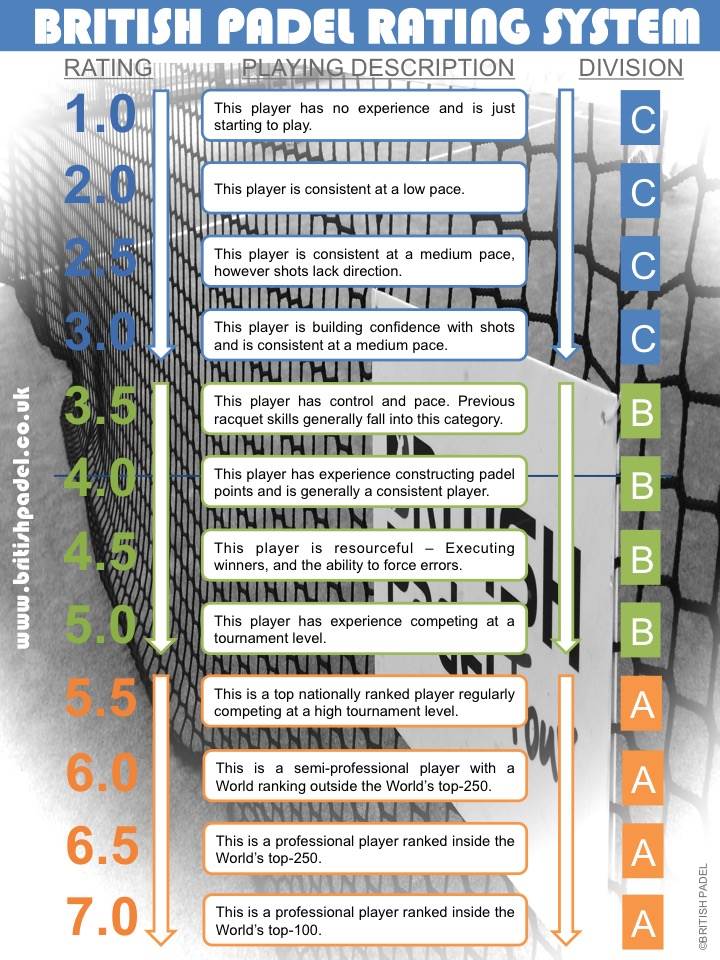
Another useful level guide is this one provided by the Guia Padel book, which is probably the best book about padel there is at the moment. Again, it’s in Spanish. I found it even easier than the other guide, and qualified myself as 3.5-4. There’s definitely a lot of progress to be made, but that’s part of the attraction of this sport!

Filed under: Padel

The Tony Robbins Morning Priming Exercise

Last updated: September 18, 20192 Comments

YouTube video

Here’s a textual description of the Tony Robbins morning priming technique. Tony uses this technique every morning and I’ve been trying it out myself for the last few weeks. It’s truly powerful.

There are three parts of three minutes each in this priming exercise.

Phase 1 – Breathing

Tony uses an adaptation of Kapalabhati Pranayama for his breathing exercise.

  1. Get in a comfortable, seated, position. Close your eyes.
  2. With your arms raised above your head, breathe deeply through your nose.
  3. Lower your arms and blow out through your nose as your arms are coming down.
  4. Repeat for 30 breaths.
  5. Rest for 10 seconds. Feel your body and any sensations.
  6. Repeat the set for 3 times.

Phase 2 – Gratitude

  1. Put your hands on your heart and feel it beating.
  2. Breathe in and feel the blood rushing through your body.
  3. Think of 3 moments or people that you can feel deeply grateful for. Feel what you felt and see what you saw, make it real.

Phase 3 – Goal setting

Focus on three important goals that you have for the next day, month or year. He calls it Three to thrive.

Will you try it out? Let me know how it goes!

If this doesn’t work for you, another breathing exercise I like is the one recommended by Dr. Andrew Weil. You can find more information about his 4-7-8 technique here and here.

Filed under: Thoughts & Experiences

Best Padel Clubs & Courts in Barcelona

Last updated: April 05, 20246 Comments

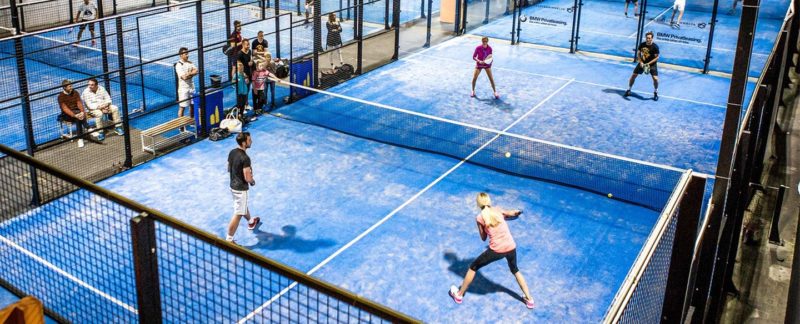
Do you want to play padel but have no idea where the best courts and clubs are? This is exactly why I have prepared this article. It will give you several options all over Barcelona, be it in the city center or the surrounding towns.

You might also want to check out my post about tennis courts in Barcelona.

Barcelona Center

Here you’ll find the name of the padel sports center and the area (click here for a PDF showing all the barrios in Barcelona) they are in.

Putxet Sport – San Gervasi

Putxet Sport is a comprehensive fitness club that offers 2 recently built padel courts plus personal and group tuition. This is where I currently train and play most of the time.

Indoor Padel – Sant Marti

The only indoor padel courts in the center of Barcelona. Group and individual training are available at economical prices. I train here regularly.

Artós Sports Club – Sarrià

They offer private coaching as well as group lessons. Padel courts can be reserved online.

MB Padel – Zona Franca

A very nice outdoor padel club, they have daily matches via Whatsapp, and the courts are well maintained. I pretty much play here every Sunday with the Barcelona Padel Meetup group.

Valldaura Sport – Nou Barris

Three padel courts await you at Valldaura Sport.

Centro Municipal de Tenis Vall d’Hebrón – Vall d’Hebrón

This club hosted the tennis finals at the Barcelona olympics in 1992. There are 6 padel courts.

Club Natación de Barcelona – Barceloneta

Play padel on the beach (or almost) at Club Natacion de Barcelona.

Club Natacio Catalunya – La Salut

Three padel courts.

Club Tennis de la Salut – La Salut

Ten padel courts.

CEM Espanya Industrial – Sants

This club is located near Sants station and has two padel courts (brick walls) that are quite cheap.

Fairplay Pádel Club – Les Corts

A very good club that also organises regular tournaments. There are 8 padel courts and a nice chillout area.

Club Esportiu Laietà – Les Corts

Eleven padel courts.

Pádel Blau – Sarrià

Four padel courts with a blue surface, which is where the name comes from. Economical prices. You can use their app or online booking system to find matches to join.

Ciutat Esportiva Vall d’Hebrón – Vall d’Hebrón

Two good padel courts and a Whatsapp group to register to matches during the whole week.

Pádel Barcelona El Prat – El Prat

There are 14 padel courts at this big club. What I love is that if you pay 39 euro per month you can play as much as you want in the mornings with no fee per session.

David Lloyd Barcelona – Les Corts

This is a really nice club with top facilities all over. You can check out their tournaments on the Facebook page.

Bonasport – San Gervasi

Bonasport has 8 padel courts, although they’re quite old and have stone walls rather than glass

Sant Just Desvern

Sant Just Padel Club

A very modern club with 15 courts.

Llobregat

Star’s Padel

This is where world champion Fernando Belasteguin trains, so I don’t need to tell you that the facilities are top notch. There are 14 padel courts.

Village Padel Club

Village Padel club has 8 high quality padel courts. They organize regular tournaments and have their own leagues. Check out their Facebook page for the latest news.

Padel Indoor L’Hospitalet

Six indoor padel courts.

Castelldefels

Club de Tennis Andrew Gimeno

They organize internal leagues and have 11 padel courts. They also have loads of tennis courts and a pool and gym.

Viladecans

Red Indoor

Seven professional high quality indoor tennis courts.

Gavá

Padelarium Gavà

An indoor padel club.

Padel Indoor Gavà

Eight indoor padel courts.

Sant Joan Despi

CT El Moli

Two padel courts.

Tennis Sant Joan Despi

Nine courts.

Teià

Club Tennis Barcelona Teià

This club has 6 padel courts.

Badalona

Padel Indoor Badalona

Six indoor padel courts.

Terrassa

Terrassa Club Padel

Ten indoor padel courts, including 1 beach tennis court.

Montgat

Padel Montgat

A very nice club that is situated close to the sea, there are 4 padel courts.

Premià de Dalt

Club de Tenis de Premià de Dalt

This club is located around 20km away from Barcelona. There are 4 padel courts and private classes with Guillermo Casal, a WPT player.

Vilassar de Dalt

Vila Sport Club

A new club that is still under construction.

Vilanova del Valles

Vilanova Indoor Padel

6 indoor padel courts.

Vilanova i la Geltrú

Club Padel Vilanova

8 padel courts.

Have I missed out on any other padel courts/clubs? Let me know and I’ll add them.

Filed under: Padel

The Best Spanish Real Estate Crowdfunding Platforms in 2026

Last updated: March 11, 202618 Comments

Spain has one of the most compelling property markets in Europe right now. Prices have risen roughly 27% over the past five years, rents are climbing faster than inflation, and demand continues to outstrip supply in every major city. For investors who want exposure to Spanish real estate without buying a full apartment in Madrid or Barcelona, crowdfunding platforms have matured into a serious option.

I’ve been investing through Spanish real estate crowdfunding platforms since 2017. The market has changed dramatically since then — some platforms from the early days are gone, the regulation has been completely overhauled, and a new generation of professionally run platforms has emerged. This article is my current, honest take on where things stand in 2026.

How the Regulation Changed Everything

The old regulatory framework (Spain’s 2015 Crowdfunding Law, Ley 5/2015) was a starting point, but it was patchy and didn’t give investors much protection. In 2022, Spain implemented the EU Crowdfunding Service Providers (ECSP) Regulation through the “Crea y Crece” law, bringing Spanish platforms in line with the rest of Europe.

Today, every legitimate Spanish real estate crowdfunding platform must be authorized by the CNMV (Comisión Nacional del Mercado de Valores — Spain’s securities regulator) as a Participatory Financing Service Provider (PSFP). The CNMV maintains a public register of authorized platforms. If a platform isn’t on that list, walk away.

The ECSP framework also sets firm limits for non-professional investors: a maximum of €3,000 per project and €10,000 per year per platform. You can exceed these limits if you self-certify as a sophisticated investor, but the framework is designed to protect retail investors from overcommitting to illiquid, higher-risk assets.

The Spanish Property Market in 2026

The fundamentals haven’t changed — they’ve strengthened. Average house prices in Spain grew by over 10% in 2025, reaching levels not seen since 2008. Barcelona is generating gross rental yields of around 7.17% and Madrid around 5%, both driven by persistent demand and a chronic undersupply of new housing.

Construction permits for 2025 totalled around 140,000 — well below the estimated 180,000 new households forming each year. That gap isn’t closing anytime soon. New housing stock is expensive to build, planning permission takes time, and political will to fix the supply problem is weak.

Rents have risen more than 34% since 2020. The 2023 Housing Law introduced rent caps and “stressed market” designations in cities like Barcelona and Madrid, which has complicated things for landlords of direct property. Crowdfunding platforms, by investing through a corporate structure rather than as a direct landlord, largely sidestep the stress of rent controls — though investors should be aware the regulatory environment for Spanish residential property is increasingly activist.

The luxury segment and commercial real estate remain largely unaffected by rent controls and continue to attract strong interest from international buyers.

What Returns Can You Expect?

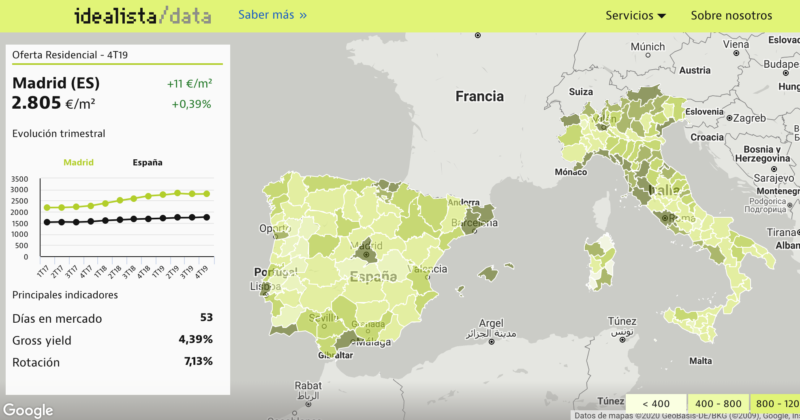
The baseline expectation for direct Spanish residential rental yields has historically been around 4-5%, as Idealista’s long-running data shows — rising from a low of 2.8% at the 2008 crisis trough to a current average around 4-5% in most cities.

idealista data spain

Crowdfunding platforms tend to target higher returns than passive buy-to-let because they take on development, renovation, or promotion risk. Depending on the platform and project type, target returns typically range from 10% to 18% annualized. Debt projects (lending to developers) tend to offer 8–12% with more predictable timelines of 6–24 months. Equity projects (co-owning the development) target 12–18%+ but tie up your capital for 2–4 years and carry more uncertainty.

I’d treat the advertised returns as targets, not guarantees. Delays are common in Spanish property development due to planning and bureaucracy. Projects that were supposed to complete in 18 months often run 24–30 months. Factor that into your effective annual return calculations.

Taxes on Your Returns

Returns from crowdfunding platforms are taxed under the Spanish savings income scale (base del ahorro) as part of your IRPF declaration. The 2025 rates, which remain in effect for 2026, are:

  • 19% on the first €6,000 of savings income
  • 21% on €6,001 to €50,000
  • 23% on €50,001 to €200,000
  • 27% on €200,001 to €300,000
  • 30% on savings income above €300,000

Note that the top two bands — 27% and 30% — were added in 2025. The old article on this page listed three bands; there are now five. As a retail crowdfunding investor, you’ll almost certainly sit in the 19% or 21% bracket.

Platforms operating in Spain are required to withhold tax at source (the retención) and send you an annual certificate detailing your income and withholdings. You still need to declare this in your IRPF, but the platforms make it relatively painless. All platforms covered in this article provide this documentation.

There’s also Actos Jurídicos Documentados (AJD — stamp duty) on underlying property transactions, typically around 1% of the deed price. This is handled at the corporate level within the project structure, so it’s baked into the economics of each deal rather than something you pay directly.

My Top Spanish Real Estate Crowdfunding Platforms for 2026

Urbanitae

Urbanitae is the standout Spanish platform right now and by some distance the largest. It’s registered with the CNMV as PSFP number 4, fully compliant with the ECSP regulation, and has financed over €280 million in projects as of the end of 2025.

The platform offers several investment structures. Debt projects lend money to developers at fixed interest — typically 8–12% annualized with terms of 6–24 months. Equity projects make you a co-owner of the development, with returns tied to the eventual sale — these target 12–18%+ but run 2–4 years. They also offer a “preferred IRR” structure that blends both approaches, giving investors priority on returns before the developer takes their share.

The average annualized return across completed projects is cited at around 14%, though this is a weighted average across a mix of project types and vintages. More recent debt projects have been completing in the 10–13% range.

Minimum investment is €500. The platform is available in English and Spanish, which matters if you’re not a native Spanish speaker. Projects fill fast — usually within hours of launch — so you need to move quickly when something interesting goes live.

Invest with Urbanitae

Wecity

Wecity (operated by Cityprive PFP, SL) is registered with the CNMV as PSFP number 9, founded in 2019 and based in Madrid. It focuses on residential, commercial, and office properties across Spain.

The platform runs two main models: short-term buy-renovate-sell projects (12–36 months) targeting capital gains of 10–15%, and mid-term buy-rent-sell projects (3–5 years) with rental yields of 3–7% plus capital appreciation. Recent projects have offered fixed-rate loans in the 10–11% per annum range.

Minimum investment is €500 in practice, though some projects allow entry from €100. Like Urbanitae, Wecity operates under the ECSP retail limits of €3,000 per project unless you self-certify as a sophisticated investor.

Invest with Wecity

Civislend

Civislend is registered with the CNMV as PSFP number 8. It focuses on debt financing — lending to real estate developers — and reports a weighted average return of around 10% across its completed projects, with typical project terms of 12–18 months.

The platform had a strong 2025: it exceeded €60 million in financing in the first half of the year alone and raised €32.5 million in a single tranche for hotel and office assets in November. That scale is meaningful. It suggests the platform is attracting institutional-quality deal flow alongside retail investors.

Civislend’s model is deliberately straightforward — debt-only, fixed returns, defined timelines. If you want predictability over upside, it’s a solid option. Average returns have been in the 10–13% range annualized.

Invest with Civislend

StockCrowdIN

StockCrowdIN was the first platform I invested in back in 2017, so I have a long history with it. It’s still operating in 2026, registered with the CNMV as PSFP number 24, and has financed over €126 million across more than 900 projects.

I have to be honest though: the picture has gotten murkier. Some investors report significant portions of their portfolio in default or “in recovery” status. The platform continues to publish new projects, but the default metrics are worth scrutinizing before you commit capital. A €50 minimum makes it easy to start small and test the waters.

I’d rank it below Urbanitae and Civislend right now based on what I’ve seen from investors’ experiences, but it remains a licensed, operational platform with a real track record. My full StockCrowdIN review covers my personal experience and the platform’s history in detail.

Platforms to Avoid or Be Cautious About

Housers

I’ve written extensively about my experience with Housers and won’t repeat the full story here. The short version: Housers started as the most prominent Spanish platform, grew fast, and then stopped doing proper due diligence while continuing to market aggressively to new investors.

The platform is technically still active and holds a CNMV license. But look at the numbers: roughly 7% of the portfolio is classified as “in recovery,” another 7% as overdue, and over 19% has been restructured. Investors who put money in around 2019–2020 report recovering only 60–70% of their capital after five years, at annualized returns of 2–3%.

Housers became exactly what I described years ago — a marketing machine that forgot to protect its investors. I have no current investment with them and wouldn’t recommend starting one.

Brickstarter

Brickstarter is a Spanish vacation rental investment platform that has been around since 2017, but I no longer recommend it. Despite over eight years of operation, the platform has only funded around EUR 2M total, which is an extremely low volume that raises serious questions about viability. It is not regulated under the ECSP framework (no CNMV license), offers zero transparency on default rates or financial performance, and is rated 0.8/10 by P2PEmpire. I’ve moved Brickstarter to my worst platforms list.

Privalore

Privalore ended all crowdfunding investment activities in December 2019. The Barcelona-based developer continues to operate as a real estate company buying and selling apartments, but it no longer offers crowdfunding to retail investors. If you encounter references to Privalore as a crowdfunding option, they’re out of date.

Diversifying Beyond Spain

I also invest in European real estate crowdfunding platforms outside Spain. The Baltic platforms and some Central European platforms offer impressive headline returns, though with different risk profiles. I’ve written a separate article covering the best European real estate crowdfunding platforms which covers Raizers, Fintown, LANDE, and others.

The Spanish platforms covered here complement rather than replace a broader European allocation. The markets are different, the regulatory environments differ, and spreading across both geographies gives you better diversification.

A Few Practical Notes for Non-Spanish Investors

Spanish crowdfunding platforms are generally open to EU residents, not just people living in Spain. If you want to invest but aren’t a Spanish resident, you’ll need a NIE (Número de Identificación de Extranjeros) — essentially a tax identification number for foreigners in Spain. You can obtain one from the Spanish consulate in your country. It’s a bureaucratic step, but a one-time requirement.

All platforms covered in this article operate in Spanish at minimum; Urbanitae also has solid English-language support.

Finally, remember that all investments in these platforms are illiquid. There’s no secondary market on most platforms — once you’re in a project, your money is tied up until the project completes. Factor that into how much you allocate.

Summary

The Spanish real estate crowdfunding market has professionalized significantly since 2022. The ECSP regulatory framework has raised the bar, weeded out some weaker operators, and given investors more clarity about what they’re buying.

My current ranking for 2026:

  • Best overall: Urbanitae — largest, most established, best project variety
  • Best for predictable debt returns: Civislend — straightforward fixed-rate model, strong 2025 activity
  • Good second option: Wecity — solid platform, good project variety
  • Established but watch carefully: StockCrowdIN — pioneer platform, but default concerns in recent years
  • Avoid: Housers — technically still operating but deeply troubled
  • Avoid: Brickstarter — unregulated, negligible volume, zero transparency

As with any investment, don’t put money into crowdfunding platforms that you can’t afford to leave locked up, and don’t treat advertised returns as guaranteed. The Spanish property fundamentals are genuinely strong right now, but individual projects can and do run into problems.

If you have questions about any of these platforms or your own experience investing through them, leave a comment below.

Filed under: Money, Real estate

How I Meditate and How it Helps Me

Last updated: February 06, 20237 Comments

I’ve been meditating in various forms since my teenage years, albeit with many on and off periods. Lately, I seem to have found a style that suits me very well, and I’ll be sharing some background on that today.

Essentially, I’ll be describing zazen meditation.

Zazen is primarily a seated type of meditation. There are several types of meditation, including ones that involve walking or even lying down. Zazen is considered the heart of Japanese Soto Zen Buddhist practice.

The aim of zazen is that of suspending all judgmental thinking and letting words, ideas, images and thoughts pass by without getting involved in them. Of course, all this is done while being immersed in sitting meditation.

In Zen temples and monasteries, practitioners traditionally sit zazen as a group in a meditation hall, usually referred to as the zendo. The practitioner sits on a cushion called a zafu, which itself is usually placed on top of a low, flat mat called a zabuton.

Before taking one’s seat, and after rising at the end of the period of zazen, a Zen practitioner performs a gassho bow to their seat, and a second bow to fellow practitioners.

The beginning of a period of zazen is traditionally announced by ringing a bell three times (shijosho), and the end of a round by ringing the bell either once (houzensho).

Long periods of zazen may alternate with periods of kinhin (walking meditation). In such cases the bell sequence will be a bit more elaborate than what I just described:

  1. Three rings to start zazen
  2. Two rings to end zazen and start kinhin
  3. One ring to end kinhin
  4. Three rings to start zazen again
  5. One ring to end zazen

If you go to a zazen meditation center you will most likely take part in a longer session that will be punctuated by breaks of walking meditation, so you will hear the bell sequence I just described.

There is no need to use music while practising zazen meditation. It’s not common to have any background music at the zendo. At home, you are free to use whatever works for you.

This practice might seem difficult, but daily practice is very effective in increasing your sense of self-awareness and intuition. While the practice of zazen typically awakens a certain energy and sense of wakefulness in us, there is no need to set any objectives or aims to achieve anything. It simply consists of concentrating on the posture and the breathing as well as the mind and the thoughts it gives rise to.

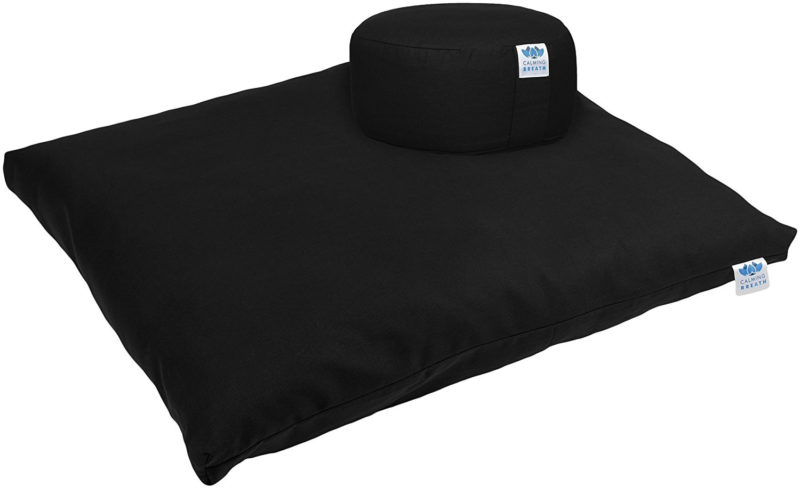
You will need a zafu and zabuton, as we already mentioned. These can easily be found on Amazon. Here’s a picture of the Calming Breath set I got; I’m very happy with them. The zafu also doubles as a foot rest while working, which is great.

Let’s take a deeper look at each of these three pillars of zazen meditation:

Posture

Sit on the zafu (cushion) cross legged, with the zabuton beneath you for comfort.

There are several poses you can use:

  • Full Lotus
  • Half Lotus
  • Burmese

Full Lotus pose

If you can sit in Full Lotus without serious pain, then it is by far the most stable of all the cross-legged postures.

Place one foot on top of the opposite thigh then lift your other foot up onto its opposite thigh. The soles of your feet should be facing slightly upward and outward. If you experience pain, try going back to one of the easier postures while you continue to work on your mobility for this pose.

Half Lotus pose

Many people who cannot manage Full Lotus can sit quite comfortably in Half Lotus.

Place one foot on top of the opposite thigh. Your other foot should be resting on the floor just under the opposite thigh/knee. Try it both ways. You may find that one side is considerably easier than the other. If that’s the case, then consider some yoga stretches to work on the imbalance so that eventually you can alternate sides and work on Full Lotus.

Burmese pose

The Burmese Pose is ideal for those who aren’t flexible enough to comfortably stay in the Lotus poses. For this reason, it’s currently my preferred pose for meditation.

Put the sole of one foot against the inside of the opposite thigh. Put the sole of the other foot against the shin of the opposite leg. All of both your legs and feet should be in contact with the floor. It’s not an easy position but does offer a really stable platform for those that can manage it.

The weight of the body is placed on three points: the knees pushing against the ground and the perennial muscle which presses against the zafu. The spine is straight and vertical. The back is flexed, and the shoulders are relaxed. The chin is tucked in, the back of the neck is stretched. Push the top of your head up towards the sky. The mouth is closed and the tongue touches the upper palate and the inside of the two front teeth. This calms  “interior chatting”. The eyes are half-closed and look down towards the ground, about one meter in front, without focusing on anything in particular.

Breathing

The rhythm of the breath is very important in zazen meditation.

Breathe calmly through the nose, remaining totally conscious of it, meaning being attentive to each breath, like a tiger on the watch. Breathe naturally and breathe out calm, long, deep breaths all the way under the navel. Don’t judge your breathing – if it’s slow or rapid – it is just the way it is.

Little by little, with practice, breathing out becomes soft, slow, peaceful, long and deep; pushing the abdominal mass downwards and creating a concentration of energy in the zone which is called the kikai tanden (ocean of energy) located under the navel. At the end of the breath, breathing in is done naturally.

State of Mind

Once you have the right posture and the breathing rhythm in place, you can start noticing your state of mind. In the first practices of zazen you will most likely get distracted easily, and you will have many thoughts going on. Once you settle into the practice, however, you will notice that you start to take control over your mind and you start to adopt a stronger, more centered state of mind.

At the end of the day, Zen is very simple, but at the same time very hard to comprehend. It’s a question of struggling and practicing repeatedly, much like life itself. In this seated position of zazen, without doing anything special and expecting nothing in return, if our posture, our breathing, and our mental attitude are in harmony, we will begin to understand the authentic Zen.

If you don’t feel comfortable with zazen, I would recommend that you adopt the pose itself and use a more mainstream kind of meditation. You can use apps like Calm or Headspace for example, which are excellent introductions to the practice of meditation.

Whenever I want to do a quick meditation I still revert to Calm. For example, at times when I don’t have time to do a full zazen meditation session, I’ll just pop in my noise canceling earphones and use Calm to do a 15-minute meditation. You don’t even need a mat for that, you can do it sitting down anywhere.

Further reading and viewing:

A five-minute instruction introducing the correct positioning and breathing for the Zazen style of meditation:

YouTube video

A ten-minute zazen session:

YouTube video

A longer explanation of Zazen and posture:

YouTube video

An introduction to meditation in general, including why it’s beneficial and how to make it a daily habit:

YouTube video
  • Dojo Zen Barcelona Kannon
  • Association Buddhiste Zen d’Europe

Dealing with Irritation

By nature, I’m quite easily irritated and frustrated, and I am constantly working on improving this part of myself. I know exactly how it feels and how it manifests in my body. I clench my teeth, I can feel my heart beating rapidly, my legs get restless, and everything else in the world seems to fade away as my whole being zooms in on the discomfort and injustice of the situation. It’s a dark place to be in and not conducive to any good result especially when interacting with people.

This sense of irritation and frustration is easily triggered, but a very typical trigger is when I have to call customer service for any big company. Here’s a recent one from when I had to call my bank. As usual, I had to navigate my way through a series of automated questions and subsequent questions, which is enough to trigger some frustration and “don’t waste my time” feeling. Add to that the fact that I was calling due to a mistake the bank had made with my account, so I was already charged going into the call. As I was put on hold and left alone with the elevator music, I noticed stress in my stomach and tension in my body. I stopped, realizing this irritation felt familiar. I know I have this tendency to get frustrated and I didn’t want to strengthen it.

It was an opportunity to tap into my practice. So I took a few deep breaths and helped my mind and body relax. I made a commitment to myself that when the customer rep would come on the phone I would express no irritation and treat them warmly. When she asked if I was having a nice day, instead of projecting my irritation, I said “I am, thanks. How are you?”. The conversation then proceeded calmly, it was indeed their mistake and I had to explain what happened, wait until I was put on hold for a few more minutes, and then have them acknowledge the mistake and rectify it. In this situation there was nothing I could do to influence things, they made a mistake and it needed to be fixed, following all their standard procedures. The only factor I had under my control was my response before and throughout the conversation.

Since this is a challenging scenario for me, when I hung up the phone I had a sense of triumph. If we remain grounded and mindful in situations where we can easily become irritated, even if we don’t get what we want we release the stress and irritation that we are carrying. To me, that in itself is a victory. The way Thich Nhat Hanh describes it is that every feeling is a field of energy; a pleasant feeling is a feeling that can nourish, irritation is a feeling that can destroy. Under the light of awareness, the energy of irritation can be transformed into an energy which nourishes. So basically, our choices directly strengthen the qualities within us. If we practice patience, we strengthen patience. If we get swept away by irritation, we strengthen irritation.

It’s up to us which quality we wish to strengthen.

Building Resilience

resilience

During a recent session of meditation I came across this insightful quote by the 8th-century Indian Buddhist monk Shantideva:

Where could I possibly find enough leather to cover the surface of the thorny earth?

Yet leather on the soles of my shoes is as good as covering the entire earth.

Likewise it is not possible for me to restrain the external course of things.

But if could I restrain this mind of mine why would I need to restrain all else?

Too many times we get angry and distressed at what’s happening around us. To be sure, we are never going to be short of things to pick on in this crazy world that we live in.

Shantideva tells us that it is hopeless to try and control the many aggravations of our daily lives. Yet is it possible to change our way of experiencing life instead?

Of course it is! Life is a subjective experience. As I think about this quote, I remember my 93 year old grandmother, who maintains an incredibly positive and cheerful state whatever comes her way.

She’s lived through the Second World War and the early death of her husband amongst many other hardships, but I can’t recall a single time when I found her in an angry, stressed or depressed state.

Unfortunately I haven’t inherited her natural gift of defaulting to having a positive outlook on the world around us, but I know through experience that I can continuously retrain the mind to achieve the same state.

Daily meditation is an essential tool for this purpose. It builds awareness and helps increase our resilience to the challenges and obstacles that we encounter.

Meditation helps remind me of the impermanence of things; the natural ebb and flow of life. It’s a great way to culture feelings of forgiveness, love, and kindness toward the world and fellow humans.

If you have never meditated or have not made it a daily practice, I highly encourage you to do so. For help in getting started, you can check out my favorite meditation app: Calm.

Filed under: Thoughts & Experiences

  • « Previous Page
  • 1
  • …
  • 83
  • 84
  • 85
  • 86
  • 87
  • …
  • 92
  • Next Page »

Latest Padel Match

Jean Galea

Investor | Dad | Global Citizen | Athlete

Follow @jeangalea

  • My Padel Experience
  • Affiliate Disclaimer
  • Cookies
  • Contact

Copyright © 2006 - 2026 · Hosted at Kinsta · Built on the Genesis Framework