TL;DR: I think 2027 is a good year to build a Bitcoin position. The price sits about 36% below its October 2025 peak, euro inflation is back, and Europeans can now buy through regulated, cheap channels. It’s also the pre-halving year, which I treat as a mild tailwind at best. Cycle returns are shrinking, so I’d size it as a long-term allocation you can hold through a fall of 80% or more.
Where Bitcoin Stands Now
As of 26 October 2026, Bitcoin trades around $80,000, roughly EUR 71,700 at the ECB rate of 1.1188. That’s down about 4% over the past month, about 30% over the past year and about 7% since January. The all-time high was roughly $126,000 on 6 October 2025, so the price is about 36% below it.
The low this year came around 1 July at roughly $57,700, 54% under the peak. Binance Research called that drawdown unusually shallow compared with past bear markets, which took roughly 84-86% off the top in 2018 and 77-78% in 2022.
Either this bear market is milder than its predecessors, or it isn’t finished. I don’t know which, and I can’t call the bottom.
2025 closed near $87,000. So far this year, Bitcoin and gold are the two worst-performing major assets, the first time that’s happened in 15 years. That’s a sour backdrop. I’d rather build a long-term position while Bitcoin is out of favor than after it has run.
Volatility has come down too. Bitcoin’s one-year realized volatility is about 43%, against a ten-year average of about 64%, according to Grayscale, which sells Bitcoin products and has an interest in the answer. The same research puts Bitcoin at about 1.9 times as volatile as gold in 2025, the lowest ratio in 15 years. A calmer asset is easier to hold, though I’d still plan for a position halving at some point.
The Halving Clock and 2027
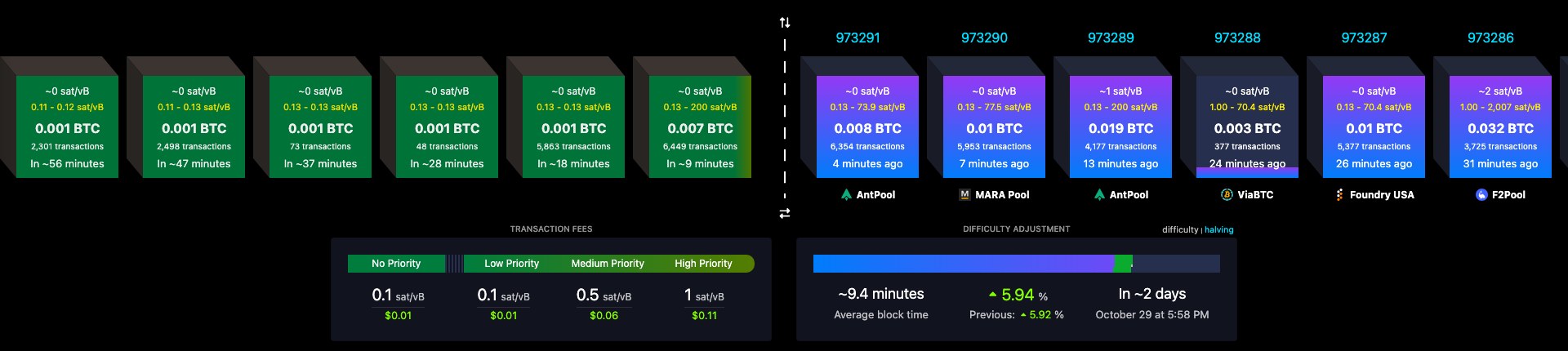
The block subsidy is 3.125 BTC today. The next halving arrives at block 1,050,000, expected around April 2028, and cuts it to 1.5625 BTC. That makes 2027 the pre-halving year. About 20.1 million coins are in circulation, roughly 95.7% of the 21 million cap, so the supply schedule is nearly complete and fully predictable, while the euro’s isn’t.
Past cycle tops came in November 2013, December 2017, November 2021 and October 2025, each roughly 12 to 18 months after a halving. If that rhythm holds, 2027 is the quiet stretch after the post-peak slump and before the next run.
Four data points make a pattern and nothing more. I count the calendar as a small point in favor of buying in 2027, and my case rests on the drawdown and on buying steadily at a size I can hold.
Gains from halving to cycle peak have also shrunk every cycle: about 9,500%, then 2,940%, then 702%, and only about 97% in the latest one. Bitcoin is a much bigger asset now, and it can’t multiply the way it did when it was tiny. My expectation is a positive return over a full cycle, with a lot of pain along the way.
The Euro-Inflation Case
Eurozone inflation hit 3.8% in September 2026, according to Eurostat, up from 3.2% in August. Energy drove it, up 18.8%.
The ECB raised its deposit rate to 2.50% on 10 September, its second hike of the year after June, and meets again on 29 October. The Fed raised rates to 3.75-4.00% on 17 September.
Money supply is still expanding. US M2 was about $23.3 trillion in August, up about 5.7% year on year, and euro area M3 grew 3.5%. A saver earning near the ECB’s 2.50% while prices rise 3.8% loses purchasing power, and that gap is the case for holding a scarce asset. Bitcoin’s issuance schedule is fixed and public, and no central bank decides it.
The macro picture cuts both ways. Real rates matter, and in 2026 rate hikes have coincided with Bitcoin and gold falling. Inflation argues for owning a scarce asset, but this year’s hikes have coincided with Bitcoin falling, and that could continue into 2027 if the ECB and the Fed keep hiking. My inflation argument works over several years of euro purchasing power, and I don’t use it to predict next quarter’s price.
How Europeans Can Buy It Now
MiCA’s transitional period for crypto-asset service providers ended on 1 July 2026. Unauthorized firms must stop onboarding EU clients, and more than 200 providers are authorized. Picking an exchange used to mean checking its reputation and hoping. Now you can check its license before you deposit anything.
If you want to buy the coins directly, Coinbase and Kraken are where I’d start. Coinbase holds a MiCA license from Luxembourg and Kraken one from Ireland, so both can serve customers across the EU. My Coinbase review and Kraken review cover fees and features, and my comparison of the best crypto trading apps covers the alternatives.
The other route skips crypto exchanges entirely: a physical Bitcoin ETP on a European exchange, held in the brokerage account you already use. The current lineup:
- BlackRock iShares Bitcoin ETP (IB1T), listed on Xetra, Euronext Paris and Euronext Amsterdam, with about $1.1 billion in assets in May 2026.
- 21Shares Bitcoin Core (CBTC), with a 0.10% fee, on Euronext Paris and Xetra. It opened to French retail investors in July 2026.
- Bitwise Physical Bitcoin (BTCE) on Xetra.
- WisdomTree Physical Bitcoin (WBTC) on Borsa Italiana, with a 0.25% fee from July 2026.
ING Germany has also opened retail access to crypto ETNs. For an index-fund-style investor, an ETP next to your other holdings is the lowest-friction way in, with no wallet to manage, and CBTC charges 0.10% a year.
The trade-off is custody: you get price exposure and no keys, so you can’t move or use the coins. If you want the coins themselves, read my guide to Bitcoin wallets. Self-custody is more work, and the backups and security are your responsibility.
Institutions Are In, and They Swing
US spot Bitcoin ETFs hold about $104-105 billion in assets, with about $57 billion in cumulative net inflows. BlackRock’s IBIT is the largest at about $66 billion. Flows move hard in both directions. IBIT took in $665 million on 20 October 2026. Two days later the funds as a whole lost about $635 million, leaving a net outflow of about $443 million for the week.
Strategy, formerly MicroStrategy, held 848,517 BTC as of 18 October 2026 at an average cost of about $75,446 per coin, according to its SEC filing. At $80,000 Strategy is only about 6% in profit, and I’d watch how it behaves if the price drops further.
A March 2025 executive order created the US Strategic Bitcoin Reserve. It holds seized coins, and the government hasn’t bought any Bitcoin for it. If that ever changes, it would be new demand. I don’t build my case on a state buyer that doesn’t exist yet.
What Could Go Wrong
A further drawdown is the main risk, since the July low may not be the floor. And if the latest cycle’s roughly 97% gain is the new normal, a buyer expecting 3x or more could be disappointed even if everything goes right.
Quantum computing is a risk with a long fuse. Today’s quantum computers can’t break Bitcoin’s cryptography, but roughly 6.5-7 million BTC sit in addresses whose public keys are exposed. BIP-360, a quantum-resistant output type, was merged into the BIP repository in February 2026 with no activation date.
A proposal to freeze vulnerable coins, BIP-361, is contested. Developers and holders still have to agree on how to handle this, and that fight could hit sentiment well before any capable machine exists.
Custody is concentrated. Coinbase custodies over 80% of US spot ETF assets, so a single operational failure there would touch most of that market.
How Much to Own and How to Buy
Size the position by the drawdown. Pick an amount you could watch fall 80% and still pay your bills without selling. If a fall like that would force your hand, the position is too big.
Past bear markets show 77-86% is possible, which is why the test uses a number that large. For most index-fund investors that points to a small slice of the portfolio. I won’t put a percentage on it, because it depends on your income and temperament.
Build it with dollar-cost averaging: a fixed euro amount on a fixed schedule through 2027 and beyond. You don’t need to call the bottom or guess whether $57,700 was the final low. A falling price means your next purchases buy more coins, and a rising one lifts what you already hold. Automate it so you aren’t deciding every month. My guide on how to buy Bitcoin walks through the mechanics.
Plan the tax side before the first purchase, since rules differ by country and clean records from day one save real work later. Start with how crypto is taxed in Europe, and set up crypto tax software early if you’ll buy across several platforms.
Verdict
My view is that 2027 is a sensible year to start or add to a Bitcoin position. The price has given back a large share of its gain, and euro inflation is running at 3.8%. MiCA and the European ETPs give investors a regulated, low-fee way in, and the halving calendar adds a small push.
I hold that view with real uncertainty. The next cycle will probably return less than the last. In 2026, rate hikes coincided with Bitcoin falling, and the other arguments didn’t stop that. I’m confident in the allocation logic and unsure about the timing. Buy a size you can ignore and spread the purchases over months.
Frequently Asked Questions
- Is it too late to buy Bitcoin after the 2025 peak?
- The price is about 36% below the October 2025 peak, so you aren’t buying the top. Gains per cycle have shrunk every time, so expect less upside than earlier buyers got and size the position for that.
- When is the next Bitcoin halving?
- At block 1,050,000, expected around April 2028. The block subsidy drops from 3.125 BTC to 1.5625 BTC, which makes 2027 the pre-halving year. Past cycle tops arrived roughly 12 to 18 months after a halving.
- Can I buy Bitcoin without a crypto exchange?
- Yes. Physical Bitcoin ETPs such as IB1T, CBTC, BTCE and WBTC trade on European exchanges, and you can hold them in a regular brokerage account. CBTC charges 0.10% and WBTC 0.25%. You get price exposure but not the coins themselves.
- Does Bitcoin protect against inflation?
- Its supply is capped at 21 million coins, and about 95.7% already exist. In 2026, though, Bitcoin fell while euro inflation rose and central banks hiked. It hasn’t worked as a short-term hedge, so the argument only holds over years.
This isn’t financial advice. Do your own research.
Related






Leave a Reply