Jean Galea

Health, Wealth, Relationships, Wisdom

  • Start Here
  • Guides
    • Beginner’s Guide to Investing
    • Cryptocurrencies
    • Stocks
    • P2P Lending
    • Real Estate
  • Blog
  • My Story
  • Community
  • AI Consultancy
  • Search

Swaper Review 2026 – A Top P2P Lending Platform

Last updated: March 11, 20264 Comments

Swaper P2P lending platform

In this review, I’ll be taking a look at Swaper, one of my favorite P2P lending platforms in both function and design.

Swaper is one of the latest entries into the P2P lending space in Europe, having started operations in May 2019. They have found success pretty quickly though, amassing more than 4000 active investors, 160m euro in investments and 2.1m euro in interest paid back to investors.

What is Swaper?

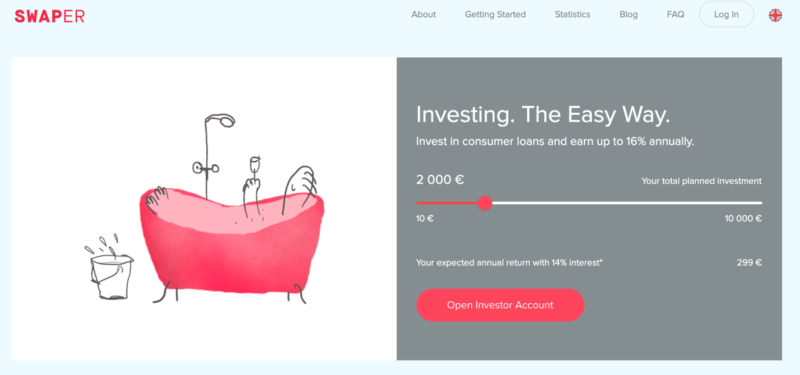
Swaper is a P2P lending platform, where you can earn up to 16% annually. The minimum investment is €10. There are no fees for investors, including the secondary market.

Swaper differs from other platforms by operating with only one loan originator, Wandoo, as well as offering all loans at a fixed 14% interest return. If you’re a VIP investor (details below) you will earn 2% more, therefore 16% annually.

You can invest in either EUR and GBP to avoid money transfer fees.

A buyback guarantee is also in place, whereby when borrowers are late for more than 30 days, Swaper will buy back the loan from the investor.

As an investor, you can also make use of the auto-invest system to invest money automatically, for example a set amount every week, or also to reinvest the interest received.

Swaper operates and provides its services under the legislative acts of the Republic of Estonia. Swaper is not a regulated financial institution and the claim rights offered for purchase on Swaper’s website are not considered as securities or any other regulated financial instruments.

Therefore the business activities of Swaper do not fall under the supervision of any Financial Supervisory Authority. Your investments are not guaranteed in any way. This is pretty normal for P2P lending platforms, although if this is your first P2P lending investment I would advise that you take this into consideration and make sure you’re comfortable with the risk before taking the plunge.
[Read more…]

Filed under: Money, P2P Lending

The Best Bitcoin and Crypto Interest Accounts in 2026

Last updated: March 11, 202659 Comments

Crypto loansEarn interest on crypto

Did you know that you could earn interest on Bitcoin, Ethereum and other crypto-assets that you own?

Bitcoin has been criticized by certain people in the past for being an asset that does not yield any dividends, but this argument no longer holds any water.

Important context: The crypto lending sector went through a severe crisis in 2022. Several major platforms — including Celsius, BlockFi, and Voyager — collapsed and filed for bankruptcy, wiping out billions in customer funds. The platforms featured in this article survived that crisis and continue to operate, but the events of 2022 are an important reminder that counterparty risk in crypto lending is real. Never deposit more than you can afford to lose, and understand that interest rates come with risk.

Many crypto investors store their digital assets on exchanges like Coinbase and Binance for long-term safekeeping. Doing so means they are assuming counterparty risk, however, so in my opinion, if you’re going to opt for keeping your crypto with a third-party custodian, you might as well put it to work.

These are my favorite crypto lending platforms where you can earn interest on your crypto and also obtain loans by providing crypto as collateral.

  • YouHodler – biggest number of cryptos supported, lowest fees
  • Nexo – best all-rounder in terms of provided services

Alternatively, you can store your crypto in cold storage, but you won’t be able to grow your wealth in that way unless your crypto asset prices appreciate over time.

In this post, I’ll show you how you can earn 5% and upwards on your Bitcoin by using the interest accounts on the platforms featured here.

Most of the platforms I will describe help you earn interest on your crypto by implementing some form of lending. I have written extensively about my P2P lending experience and my favorite P2P lending platforms, but today we’ll add the crypto factor into the mix – hence we will be talking about crypto-backed loans. In my opinion, as an investor, the addition of crypto as collateral marks a huge improvement over the traditional P2P lending platforms, which can lack transparency and that mostly work with no collateral.

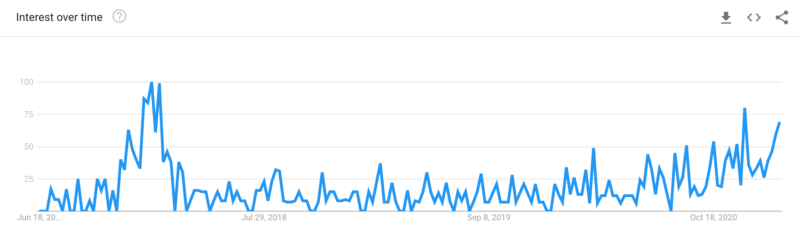
Crypto lending is becoming a huge industry, and we can take a look at Google trends to verify this. Have a look at the chart showing a strong worldwide uptick in interest in crypto lending options over the past three years.

crypto lending interest

Let’s take a look at the best platforms available. One of the important things to note before we start is that these platforms exclude fewer people than traditional P2P lending platforms. While the traditional platforms operate within very strict geographical limitations, with crypto lending platforms basically anyone who holds crypto can participate.

YouHodler

Youhodler

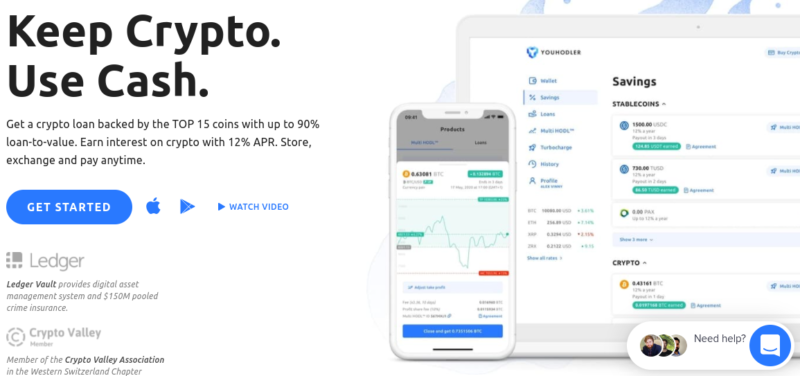
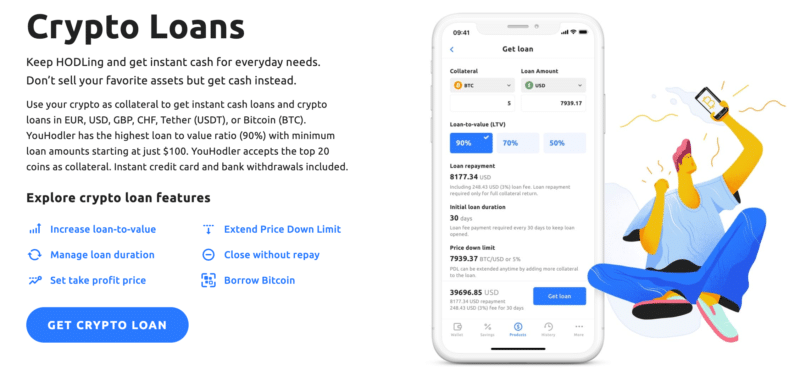
YouHodler offers an extensive set of crypto-fiat financial services. In its essence, the platform intends to help investors take advantage of cryptocurrencies, without having to actively trade them.

YouHodler has managed to make crypto-HODLing an active strategy. For investors, access to a crypto-exclusive savings account and interest-bearing loans are preferable ways to expand your portfolio.

This solves an instant issue with digital currencies – opportunity costs. That is to say, rather than leaving your digital coins sitting idle in a private wallet, YouHodler allows you to earn a yield on your holdings. At the same time, you get to keep hold of your investment and thus – you can cash out your coins whenever you see fit.

YouHodler implements some innovative strategies to boost your returns, so it is an ideal platform for those who like to tweak things and see what works best. The company is registered in Cyprus and is regulated in Europe, while client funds are stored securely within the Ledger Vault platform.

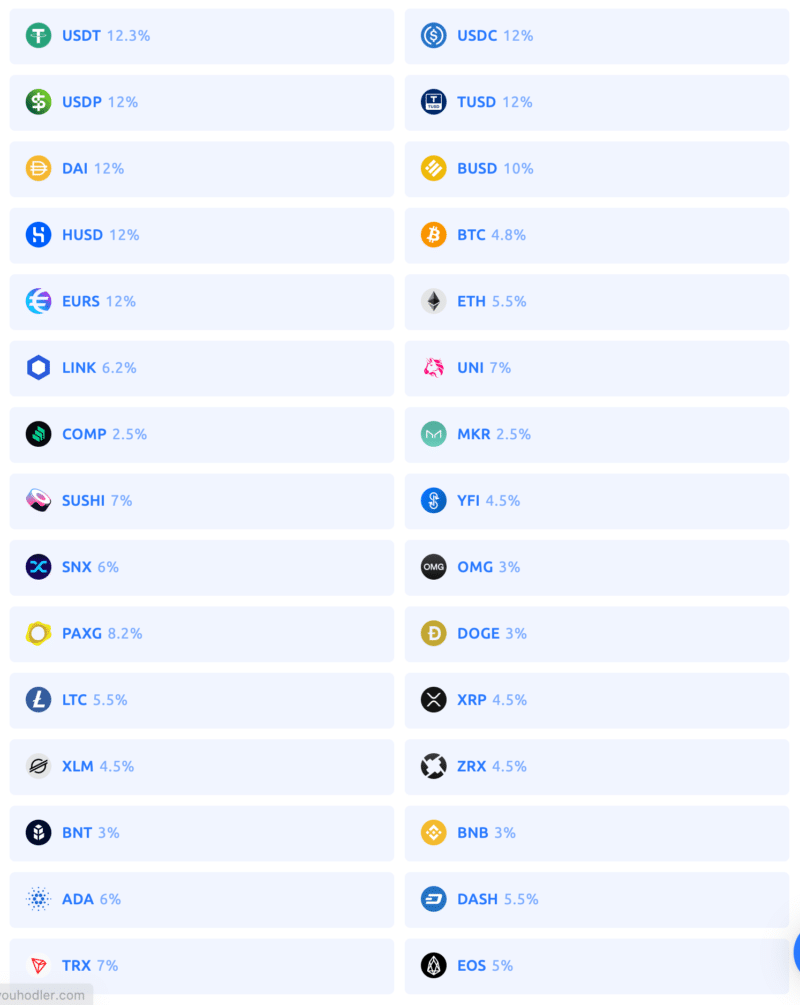
You can also use YouHodler as an exchange to trade cryptocurrencies. If you’ve already made some amazing profits on your Bitcoin, perhaps it’s time to give yourself a break. For example, YouHodler savings accounts pay up to 15% annual interest on stablecoins (depending on your loyalty tier — entry-level rates start around 11%). Hence, you could do a Bitcoin to fiat exchange with just a 2% fee right on our platform, and then convert fiat to your favorite stablecoin in orer to start earning interest.

You can read my full review of YouHodler if you want to learn more about this platform, or just click the link below to go to the Youhodler website directly and get started.

Earn interest with YouHodler

Binance Savings and Staking

Binance savings

With Binance, you have several ways of earning money on your cryptos.

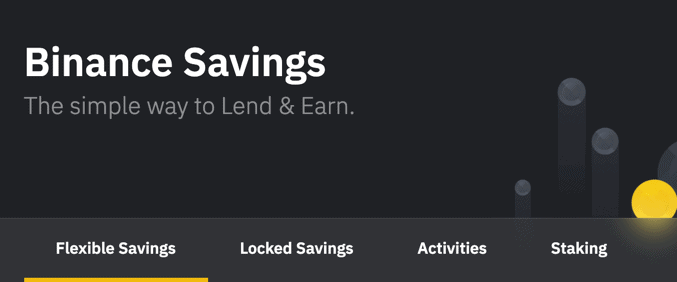
Flexible Savings

The easiest way is probably using their Flexible Savings product. Flexible Savings is your Crypto savings account. Subscribe your crypto to earn interest, with the flexibility to redeem your funds at any time.

Rates vary depending on the coin and market conditions — check the Binance Earn page for current rates. Note that BUSD (Binance USD) was discontinued in 2023 after Paxos was ordered to stop minting it. USDT and USDC are now the primary stablecoins available on the platform.

Locked Savings

For higher returns, you will want to opt for the Locked Savings product. By subscribing your crypto to locked savings periods you will in return get higher interest earnings. You can choose from several durations depending on the coin you are using, but it’s typically one or more options from the following:

  • 7 Days
  • 30 Days
  • 60 Days
  • 90 Days
  • 120 Days

See also: How to earn interest on crypto with Binance

Earn money on crypto with Binance

Nexo – The All-Round Financial Service

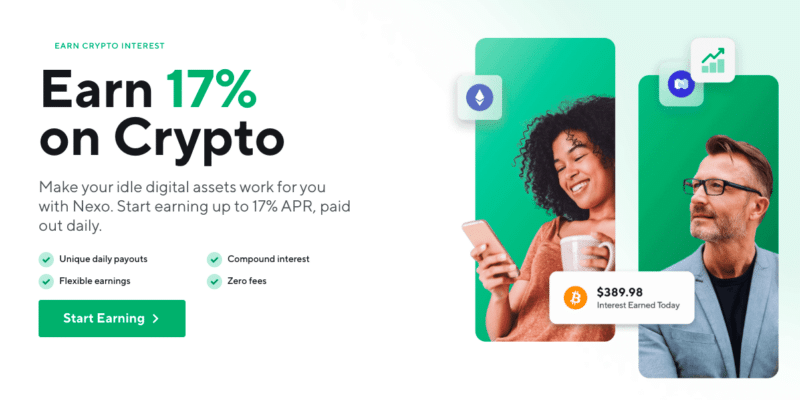
Nexo is an excellent platform for those investors seeking an active strategy for their crypto holdings by providing access to a crypto-exclusive savings account, interest-bearing loans, crypto exchange and a Nexo card which will give you access to fiat without needing to sell your crypto.

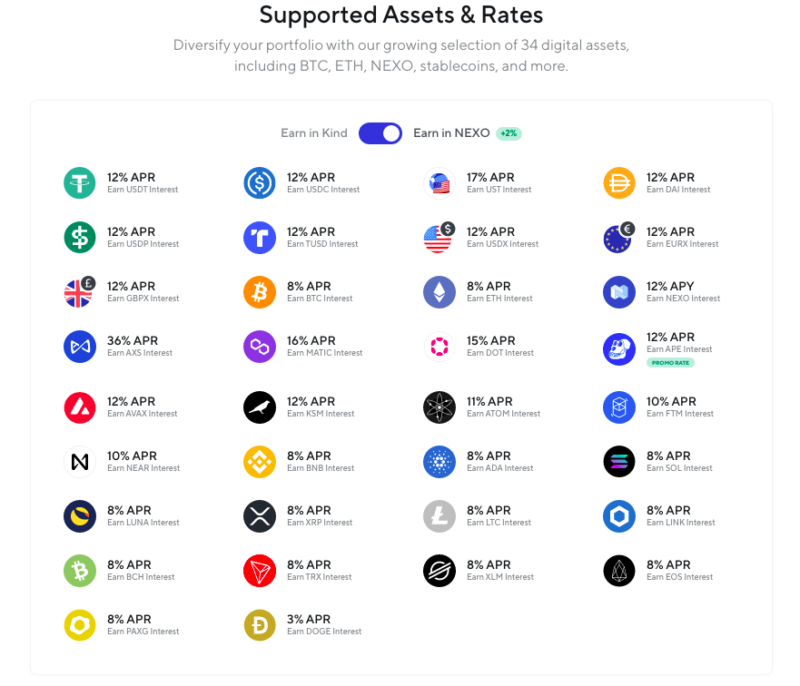
Once you top up and buy crypto you can start earning interest immediately without further action being required from your side. Rates depend on your Loyalty Tier (determined by the ratio of Nexo Tokens against the balance of other assets in your portfolio) and whether you opt for flexible or fixed-term savings. You can earn up to 16% APR on stablecoins with a fixed-term lock-up at the highest tier, and up to 7% on Bitcoin. Flexible savings rates start lower — around 8% on stablecoins and 4% on BTC at the base tier.

Read my in-depth review of Nexo’s plethora of services here.

Nexo also offers crypto-backed loans where your digital assets act as collateral without any further need for a credit assessment. Put simply, Nexo gives you fiat or stablecoins, and you provide crypto as security for repayment. Apart from the tax benefit associated with not selling your crypto, Nexo provides you with the opportunity to access fiat funds at the touch of a button, something that with legacy banks is unimaginable.

Invest with Nexo

Concluding Thoughts

I’ve tried out all these platforms and found YouHodler and Nexo to be the ones I liked most. The platforms mentioned in this post all work fine, but you’ll need to find the one that has the best branding and user interface for your tastes. Some of them also reward you in their native tokens, but in general, I prefer going for Bitcoin rewards.

Read more: The Best Books about Bitcoin and Crypto

What do you think of P2P lending platforms that provide crypto-backed collateral? I think it’s a nice upgrade on the traditional P2P lending platforms and as an investor, it gives me more security.

Filed under: Cryptoassets, Money

Differences Between the US and Europe for Credit Scores, Credit Card Rewards etc

Last updated: November 17, 20222 Comments

For many years I struggled to understand the lingo used in movies and books that came from the US with regard to money and finance. Here are a few terms that you are most likely to encounter that have no real parallel here in Europe.

If you need me to explain anything else just leave a comment and I’ll do my best.

Credit Score

In the US, having a good credit score or credit rating is of utmost importance. The credit score was invented by a private company called FICO (Fair, Isaac and Company). It was founded by an engineer and a mathematician working at Stanford in the 1950s in order to counter the credit crisis of those times. The aim was to quantify how reliable a person asking for a loan really was. It is now used in the US, Canada and Mexico.

There is no such parallel system in most countries in Europe. When you ask for a loan from the bank in Europe, they will ask for the typical papers such as whether you own any property, your monthly payslips, etc. and then make a decision based on that documentation.

Credit score is used also in the UK (UK is considered to be a follower of the US), in fact in the UK it is better if you pay with a credit card and pay the debt on time rather than having savings and paying cash; if you do the latter, you’ll never get a mortgage. There are many websites where you can get a credit score test, for example Experian.

Many other European countries that are not in the EU have credit scoring systems including Norway and Denmark. It is not the same as the US one (neither the UK one is) but the concept is very similar.

[Read more…]

Filed under: Banking, Money

Coinbase Review 2026 – The Best Crypto Exchange for Beginners

Last updated: March 10, 2026Leave a Comment

Coinbase review

Open a Coinbase Account

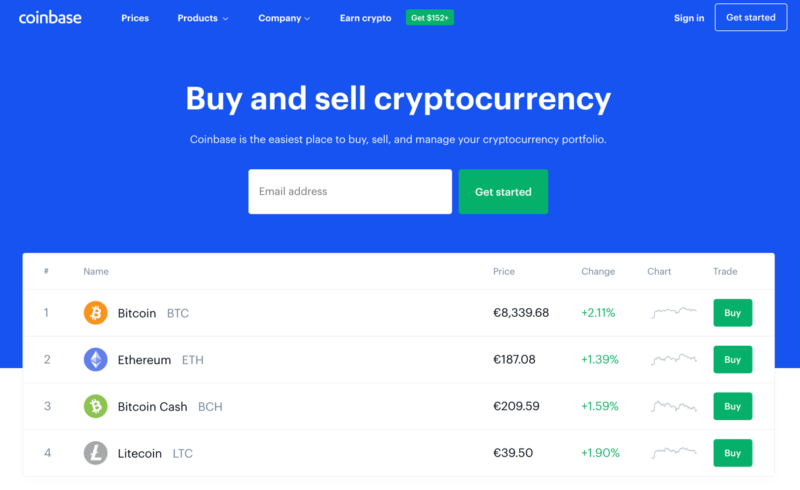
Coinbase is the most regulated crypto exchange in the world and the go-to platform for investors who put compliance and safety above all else. Founded in 2012, it became the first major crypto company to list on NASDAQ (ticker: COIN) — a level of public accountability no other major exchange comes close to.

It now serves over 100 million users globally, holds $500+ billion in customer assets, and is fully licensed across the US, UK, and the European Union under MiCA. For European investors specifically, it has become significantly more capable in recent years.

That said, Coinbase is not the cheapest option on the market. If you use it wrong — specifically if you ignore the Advanced trading view — you will pay far more than you need to. This review covers exactly how to use it properly.

What Is Coinbase?

Coinbase is a cryptocurrency exchange headquartered in San Francisco. It was founded in 2012 by Brian Armstrong and Fred Ehrsam, making it one of the oldest and most established platforms in crypto.

In 2021 it went public on NASDAQ, which means it files audited financial statements with the SEC every quarter. That transparency is genuinely meaningful — it’s a level of accountability that unregulated offshore exchanges simply cannot offer.

As of 2026, Coinbase holds over $500 billion in customer assets and supports over 270 cryptocurrencies. It holds more than 12% of all Bitcoin in existence on behalf of its customers.

Is Coinbase Available in Europe?

Yes. Coinbase is fully operational across the European Union and the UK. In 2024 it secured a MiCA (Markets in Crypto-Assets) licence from Luxembourg’s financial regulator (CSSF), giving it regulatory clearance to operate across all 27 EU member states under a single licence.

For European users this means:

  • SEPA bank transfers for EUR deposits and withdrawals (typically free)
  • EUR trading pairs for major cryptocurrencies
  • Staking available in countries including Spain, France, Belgium, the Netherlands, and the UK (subject to local rules)
  • Full KYC/AML compliance with EU standards
  • In March 2026, Coinbase also launched MiFID-regulated crypto futures across 26 European countries via Coinbase Advanced

From Barcelona or anywhere else in the EU, you get a fully-regulated, euro-denominated experience. That was not the case five years ago.

Coinbase vs Coinbase Advanced: Understanding the Difference

This is the most important thing to understand before you use Coinbase, and it trips up a lot of new users.

When you open a Coinbase account, you access two different trading interfaces within the same app:

  • Simple mode — the default buy/sell screen. Clean, instant, no charts. Designed for beginners. Also the most expensive way to buy crypto on the platform.
  • Advanced Trade — the full trading interface with charts, order types, and a maker/taker fee structure. Significantly cheaper.

These are not separate accounts or platforms. They share the same wallet, the same funds, and the same login. Coinbase merged what used to be called “Coinbase Pro” into the main app in 2023. You simply switch views inside the app or on the website.

The practical takeaway: always use Advanced Trade when buying or selling. The fee difference is substantial.

Coinbase Fees Explained

Simple Buy / Sell (Avoid for Larger Amounts)

When you use the default simple interface, Coinbase charges a spread of around 0.5% to 2% on the quoted price, plus a flat transaction fee on top. The combined cost on a typical purchase works out to roughly 1.5% to 3.99% depending on your payment method and order size.

For a one-off €50 purchase of Bitcoin, the convenience may be worth it. For anything larger, the fees are hard to justify when the cheaper route is just a click away.

Coinbase Advanced Trade (Use This)

Advanced Trade uses a maker/taker fee model based on your 30-day trading volume. For most retail investors, the relevant tier is under $10,000/month:

  • Maker fee (limit orders that sit on the order book): 0.40%
  • Taker fee (market orders filled immediately): 0.60%

As your volume grows, fees drop significantly:

  • $10K–$50K/month: 0.25% maker / 0.40% taker
  • $50K–$100K/month: 0.15% maker / 0.25% taker
  • Volume above $500M/month: 0.00% maker / 0.05% taker

Stablecoin pairs (e.g., USDC/USD) carry 0% maker fees at all tiers.

Deposit and Withdrawal Fees in Europe

  • SEPA bank transfer (EUR): Free to deposit, free to withdraw
  • Debit card: Up to 3.99% — use SEPA instead wherever possible
  • Crypto withdrawal: Network fee applies (varies by asset and congestion)

Coinbase One

Coinbase also offers a subscription tier called Coinbase One at $29.99/month, which eliminates trading fees on up to $10,000 in monthly volume. If you’re buying regularly in that range, the math quickly works in your favor.

Features Worth Knowing About

Recurring Buys (DCA)

Coinbase has one of the cleanest implementations of recurring buys in the industry. You can set up automatic purchases of any supported cryptocurrency on a daily, weekly, or monthly basis. If you’re buying Bitcoin or buying Ethereum as a long-term strategy, this is the feature you’ll use most. It executes automatically and removes any temptation to time the market.

Staking

Coinbase lets you earn staking rewards on eligible assets directly within the app. Available assets include Ethereum (ETH), Solana (SOL), Cardano (ADA), and others depending on your country. For European users, staking is available in Spain, France, Belgium, the Netherlands, and the UK, among others. Rates vary by asset and are displayed clearly in the app.

Note: some staking assets for EEA users have been phased out as Coinbase aligns its product offering with MiCA compliance requirements.

Coinbase Wallet (Self-Custody)

Coinbase Wallet is a separate, self-custody app that lets you hold your own private keys — completely independent of Coinbase the exchange. It supports Ethereum and EVM-compatible chains, Solana, and Bitcoin, and gives you access to DeFi protocols and NFTs.

If you’ve heard the phrase “not your keys, not your coins” — Coinbase Wallet is the answer to that. You don’t need a Coinbase account to use it, and funds held in the Wallet are not stored on Coinbase’s servers.

Coinbase Card

Coinbase issues a Visa debit card that lets you spend your crypto balance directly. Transactions convert at the current market rate. Cashback rewards are paid in crypto. Available in a number of European countries including Spain, though availability varies by country.

Advanced Trade: Charts and Order Types

The Advanced Trade interface offers real-time price charts with adjustable candlestick intervals, a live order book, market orders, limit orders, and stop orders. It’s not as feature-rich as dedicated platforms like Binance or Kraken for active traders, but it covers everything a DCA investor or occasional trader needs.

Security and Safety

Coinbase has one of the strongest security track records in the industry. Here’s what’s in place:

  • 98% cold storage: The vast majority of customer crypto is held in offline, air-gapped storage. Online hot wallets are minimized and insured.
  • $500+ billion in customer assets: As a NASDAQ-listed company, Coinbase publishes audited financials. You can verify exactly how much it holds.
  • SOC 1 Type II and SOC 2 Type II certifications: Independent security audits of its systems and controls.
  • Two-factor authentication: Required for all accounts. Hardware key (YubiKey) support is also available.
  • The Vault: An optional feature that adds a 48-hour withdrawal delay with multiple email confirmations. Useful if you hold large amounts and want a last line of defense against unauthorized withdrawals.
  • Biometric login on mobile.

Regulation

This is where Coinbase genuinely stands apart from most of its competitors.

  • United States: Registered with FinCEN, licensed as a money transmitter in all applicable US states, publicly traded on NASDAQ under SEC oversight.
  • European Union: MiCA licence from Luxembourg’s CSSF — valid across all 27 EU member states.
  • United Kingdom: Registered with the Financial Conduct Authority (FCA).

Being publicly listed means Coinbase has to disclose its financials, risk factors, and material events to the SEC on a quarterly basis. No offshore exchange is held to that standard.

Supported Cryptocurrencies

Coinbase supports over 270 cryptocurrencies. This includes all the major assets you’d expect — Bitcoin, Ethereum, Solana, XRP, Cardano, Avalanche, Chainlink, Polkadot, USDC, and many more. It is more selective in its listings than Binance or Kraken, but that selectivity is broadly seen as a quality filter.

New listings are announced publicly and often carry weight — being listed on Coinbase is still seen as a credibility signal in the crypto industry.

If you’re looking to trade highly speculative low-cap tokens, Coinbase probably won’t have everything you want. For the assets that matter, it’s well covered.

Who Is Coinbase Best Suited For?

Coinbase is a strong choice if you:

  • Are buying crypto for the first time and want the safest, most regulated platform available
  • Want a clean, simple interface with a reliable mobile app
  • Plan to DCA into Bitcoin or Ethereum over the long term
  • Are based in Europe and want full MiCA-compliant access with EUR deposits
  • Value regulatory transparency over lowest possible fees

Consider alternatives if you:

  • Need access to a very wide range of low-cap altcoins (Binance has a much larger selection)
  • Are an active trader who needs sophisticated charting tools, futures, or margin trading beyond what Advanced Trade offers
  • Are extremely fee-sensitive and comfortable using less regulated platforms

For a broader comparison, see my roundup of the best cryptocurrency trading apps.

How to Open a Coinbase Account

Step 1: Create Your Account

Visit Coinbase and sign up with your email address. You’ll need to provide your name, date of birth, address, phone number, and country of residence.

Step 2: Verify Your Identity

Coinbase is a regulated exchange, so KYC (Know Your Customer) verification is required. Upload a government-issued ID — passport, national ID card, or driver’s license. Verification is typically completed within minutes using the mobile app camera.

Step 3: Add a Payment Method

For European users, linking a bank account for SEPA transfers is the best option — deposits are free and usually settle within one business day. You can also add a debit card for instant purchases, though the fees are higher.

Step 4: Switch to Advanced Trade

Before you buy anything, switch to the Advanced Trade view. On desktop, it’s accessible from the main navigation. On mobile, it’s available inside the app. This single step will save you a meaningful amount on every transaction.

Step 5: Buy Crypto

Search for the asset you want, choose a limit or market order, enter your amount, and confirm. Your crypto will appear in your Coinbase wallet immediately upon execution.

From there you can hold it on Coinbase, set up a recurring buy schedule, or transfer it to a self-custody wallet like Coinbase Wallet or a hardware wallet.

Verdict

Coinbase has improved significantly since its early days as a basic beginner platform. MiCA licensing, the integration of Advanced Trade, a far larger asset selection, and $500+ billion in audited customer assets make it a genuinely serious platform in 2026.

It is not the cheapest exchange. If you use the simple buy interface without thinking, you’ll pay more than you should. But if you use Advanced Trade for your purchases, the fees become competitive — and you get that in combination with the tightest regulatory framework in the industry.

For a European investor who wants to buy Bitcoin or Ethereum, set up a recurring investment, and not worry about whether the exchange will be around in five years — Coinbase is a very hard platform to argue against.

Open a Coinbase Account

Filed under: Cryptoassets, Money

Channels to Learn from on YouTube

Last updated: September 12, 20231 Comment

I have always learned best when I am learning on my own rather than at school or in a class environment, bar a few exceptions.

These days we can count ourselves incredibly lucky to have YouTube and other video sites where we can access an incredible wealth of knowledge for free or at low cost.

Since YouTube gets annoying pretty quickly with ads, you can use an ad blocker or just pay for premium. Youtube Premium is cheaper in India, Argentina and Turkey especially.

I’ll keep adding to these as I discover them, and if you have any suggestions just leave a comment at the end.

General knowledge

  • PolyMatter

History

I think it’s very important for anyone who wants to have serious discussions and conversations about important topics to have a good grasp on world history.

So many people form erroneous ideas of how things work just because they don’t have the right background on how we arrived at this stage in our human development.

  • Crash Course History

Finance

  • Whiteboard with your mate Paddy Hirsch

Filed under: Parenting & Education

  • « Previous Page
  • 1
  • …
  • 44
  • 45
  • 46
  • 47
  • 48
  • …
  • 89
  • Next Page »

Latest Padel Match

Jean Galea

Investor | Dad | Global Citizen | Athlete

Follow @jeangalea

  • My Padel Experience
  • Affiliate Disclaimer
  • Cookies
  • Contact

Copyright © 2006 - 2026 · Hosted at Kinsta · Built on the Genesis Framework