Jean Galea

Health, Wealth, Relationships, Wisdom

  • Start Here
  • Guides
    • Beginner?s Guide to Investing
    • Cryptocurrencies
    • Stocks
    • P2P Lending
    • Real Estate
    • Forex
    • CFD Trading
    • Start and Monetize a Blog
  • My Story
  • Blog
    • Cryptoassets
    • P2P Lending
    • Real estate
  • Consultancy
    • Consult with Jean
    • Consult a Lawyer on Taxation and Corporate Setups
  • Podcast
  • Search

My International Padel Experience in Rotterdam

Last updated: September 08, 2018Leave a Comment

Myself and Ole Muller, winners of Men’s B Category

During the past weekend I’ve had the chance to take part and play in the International Padel Experience tournament in Rotterdam.

Together with my partner Ole, I was really looking forward to my first experience playing and competing outside of Spain. Padel is the second most popular sport in Spain but it’s still in its early stages throughout the rest of Europe. I was therefore curious to see how the sport is picking up in the Netherlands.

We played at Padel club Victoria. They have 3 very nice padel courts and many players who converted to padel after playing other racket sports such as tennis and squash. It was very nice to chat with players from several countries and talk about their padel experience. I think in the coming years we will be seeing the definite explosion of this sport throughout Europe and many more new players.

Let’s get back to the IPE Rotterdam tournament, it was well organised. All the matches we had scheduled started on time and there was a very nice atmosphere at the club. Free beer was provided by sponsors Estrella Damm, although to be honest I would have preferred to have free water or at least a water fountain. We were lucky with the weather as it was hot and sunny during the whole three days, so it was very important to stay well hydrated while playing.

The tournament had four categories, Men A and B, Women, and Mixed. We took part in Men B, guided by the padel level guide available on the International Padel website. In reality we encountered players between levels 2 and 3.5 in this category, so there was quite a wide range. This led to some very easy matches against players who only started playing very recently. The final however was really hard and we thoroughly enjoyed it. We only managed to win at the very last moment after a super tense tie break that decided the match. After chatting with Luis from International Padel, I learned that every tournament is a bit different with regards to the players’ levels. For example, since padel is more established in countries like Spain and Portugal, the level is considerably higher. Luis therefore recommended that we stick to category B for our next tournament in Lisbon, Portugal.
[Read more…]

Filed under: Padel

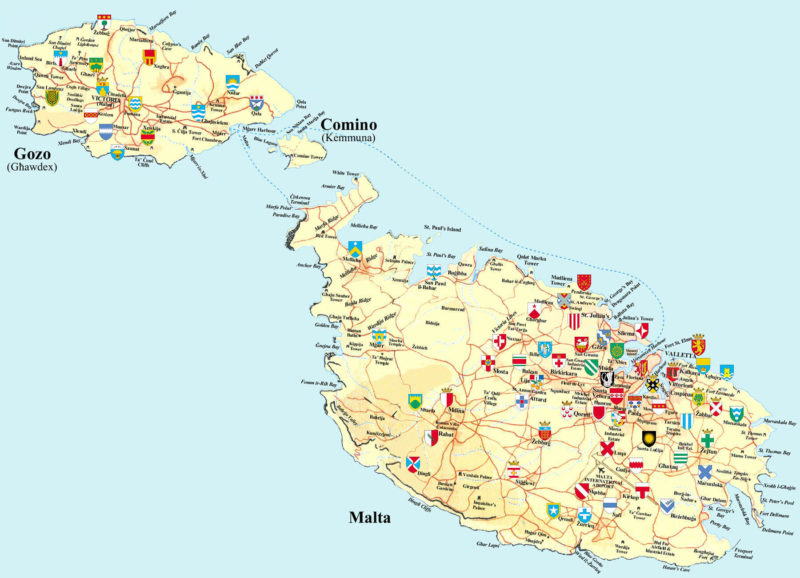
🇲🇹 Why I Left Malta

Last updated: January 13, 2026789 Comments

Originally published: August 2017

Note: I wrote another article about Malta in 2022, sharing my latest views and feelings about the situation there.

A few years ago I decided to leave my home country and try my luck abroad. This wasn’t a spontaneous decision at all, rather it was the result of many years during which my disillusion and frustration with Malta had been growing and growing until I felt I had to take action or I would fall into a very negative perpetual state of mind.

Of course, I have many friends and dear family back in Malta, but honestly, I don’t miss living there. I make it a point to visit at least once a year and I usually have a good time catching up with friends and spending time with my family, but I don’t feel like I would like to go back and live there.

As you can imagine, several friends and family members ask me why this is so. I’ve finally found some time to really list the reasons for my moving away from Malta and why I don’t feel as comfortable living there as I do in other places.

While this post will be very honest, I’m afraid that some readers will find it too negative or downright offensive. Please keep in mind that this is an honest outpouring of my thoughts and feelings and is in no way meant to attack anyone or show any lack of appreciation. I did grow up in Malta and received many good things, I was blessed with a great family and a good education and also had lots of great experiences. However, as I grew older I started to feel that this was not the place where I wanted to spend the rest of my life in, and this is an attempt to describe why.

Malta is described in propaganda as being an idyllic “paradise on earth” island in the middle of the Mediterranean Sea. Surely life is incredibly good over there! Not to mention it’s a tax haven!

First of all, Malta is no tax haven if you’re Maltese. There are a few schemes designed to attract business and executives from abroad. These schemes have been widely used and abused, and that’s where the reputation for being a tax haven is coming from. The island is also famous for housing a great number of online gambling companies. These companies came to Malta due to the fiscal and regulatory incentives and they are by and large doing extremely well.

Online gambling is not something that interests me and in general, I don’t like the vibe that they have about them. I’m sure many Maltese will disagree with me on this, but this is my view on the topic. The gambling companies pay very well and usually provide attractive offices and perks to their employees. Due to them, property prices in the Sliema and St Julian’s area have risen to incredible levels (many would agree that it’s bubble stage already). A whole financial services industry has grown to support these companies.

The downside? Apart from the moral doubts of working at these companies or even incentivizing them to move to Malta, I see a lot of dependence on them. If another country were to offer better regulations and tax incentives, it is likely that many of these companies would leave, as they don’t have any significant ties with Malta. They are merely using the country. In the eventuality of them leaving, we will see serious repercussions on property prices and the financial services industry. Whether this situation ever plays out is anyone’s guess, but it’s definitely something that has always bothered me.

Now I don’t mean to turn this into an attack on gambling companies. They do well to seek out the best environment for them to operate so I don’t blame them for anything. I certainly didn’t leave Malta because of this, so let’s explore some other more important reasons for me leaving.

If I were to describe Malta in one word, it would be frustrating. There is no doubt that islands are (were?) blessed with natural beauty, great weather and beautiful sea. I think the small size of the islands is, however, a big problem for people like me. It is clear that you can find idiots in every country, but in bigger countries, you can mostly keep away from them. You can frequent different places, live in different areas, and generally live amongst people that you like. Not so in Malta, every time you step outside of your door you are bound to experience some kind of ignorance, be it illegal construction, irresponsible driving, and unprofessional behavior. There is no deeply ingrained culture of doing things the right way. Rather it’s more of a “whatever, if it barely works then it’s good enough”.

I acknowledge that I have trouble really describing what it is that frustrates me and pains me so much about living in Malta. I also know that most Maltese genuinely love living in Malta, and whenever I have tried to speak out against the way things are done, the usual reaction is to try and shut me up and tell me that things aren’t so bad.

I inevitably realized that there was no way I’m going to change the culture of a country. One of the best pieces of advice was given to me by a Bulgarian builder in Malta. In one of my moments of frustration, the builder, who was fixing some stuff in our office, overheard me complain about things in Malta. He calmly came up to me and told me “my friend, if you don’t like the menu, change the restaurant”. It was a seemingly joking and simple comment, but it rang so true for me that that was the moment that I decided to leave for good, and sure enough, two months later I left.

Living in Malta, at least as a local, involves sustaining yourself (whether you want it or not) on a constant stream of local news. You can’t escape the latest political mess, and the smallest incidence can make front-page news. It is really an environment that discourages you to think big and expand your mental horizons. For many years I found it very stifling and I harbored a lot of internal anxiety, frustration, and anger due to this situation over which I had little control.

Since moving abroad, all these effects instantly disappeared and I finally felt free to be what I really want to be and rapidly increase my knowledge in the areas that interest me, such as investing.

They say that a person is the sum of the other people that are closest to him. In Malta, I always struggled to surround myself with people who would constantly inspire me and drive me to become a better person. Due to the small island mentality, there seems to be a lot of jealousy and people try to keep you in line. You’re best just being an average Joe behaving like everyone else if you want to live a good life there. Do something significantly different than the rest and you’re going to have a very difficult time indeed.

But come on Jean, you might say, what about the lovely “best in the world” weather that Malta is blessed with? Well yes, Malta does indeed have very hot summers and mild wet winters. The problem is that the vast majority of houses have zero insulation and in the winter months you can feel really uncomfortable due to the insane levels of humidity and cold inside. Although I always felt bad during the winters, reality really struck during my first experience of winter in the UK, when I realized that I was much happier in winter there than I had ever been in Malta. Like many other countries, buildings there are well insulated and have good heating, so you can stay in your flip-flops and shorts inside in winter. In Malta, I would be wearing jackets, long johns and a beanie and I’d still be uncomfortably cold.

One other big pain point: the roads. Malta’s road surfaces are among the worst in Europe and are more befitting of a third-world country than a country that presents itself as being a hub of innovation and being on par with its European counterparts. I once tried taking my Brompton bike to Malta to cycle around during our holiday but ended up walking back home after 200 meters. There are way too many potholes, bumps, and uneven road surfaces to be able to ride a bike like that comfortably without damaging it. Not to mention the challenge of staying alive when riding a bike in Malta.

Some of my friends have been severely injured due to irresponsible driving or bad road surfaces, and one of them even died by the roadside after being run over by a youngster driving without a license. I won’t even get started on the Maltese judiciary, but I’ll just mention that after eight years this man has not been sentenced yet. See here and here for more great examples of Maltese incompetency where justice is concerned.

A related aspect is the lack of good pavements. Unfortunately, Malta is not a walkable place at all. We grow up getting accustomed to getting out of our houses and into the car to get whisked to wherever we need to be. This leads to people exercising less and the resulting obesity issues. Malta has the highest child obesity rate in Europe, and Maltese adults are the second most obese in Europe. This fact is evident to me whenever I land in Malta and have a look around. I believe the walkability issue is a significant contributor to the problem. Owning a car is almost a necessity and gives you the independence to go wherever you want, while public transport is of average quality and mostly consists of buses and taxes (an underground metro system would be a game changer). Of course, we can all see with our own eyes that traffic has increased exponentially during the past twenty years, to the point that you are now guaranteed to get stuck in a traffic jam every time you go for a drive, at any time except during the night. Given that in general people tend to keep their cars far longer than the European average, we have a lot of pollution from vehicles and that affects everyone’s health.

Moreover, Maltese people in general tend to overeat, with typically huge portions being served in families, while fast food has gained in popularity. The famous mediterranean diet is not really present in Malta, instead people tend to consume large quantities of bread, junk food and pasta. Kids are given sweets abundantly. This is coupled with a sedentary lifestyle and other bad habits like smoking and alcohol consumption, and you get the resulting obesity situation. A visit to the country’s main hospital will also give a clear indication to where all this is leading to, with crowded waiting rooms filled with people who could clearly used a better diet instead of being given more pills.

Back to the lack of paving. In other countries, I got used to walking a lot, but in Malta it’s impossible to run any errands on foot except if you’re going around the corner from your house. Pavements seem to be an afterthought and come in all shapes and sizes. Some are tiled, some have rough surfaces, some are super narrow etc. What this also means is that we have a big problem with accessibility. One of the main highlights of my trips to Malta is spending time with my 93-year-old grandma, and I would love to be able to take her out for a walk while we chat about our lives. Alas, it’s pretty much impossible given the state of the pavements and the very close proximity of cars and trucks belching out fumes.

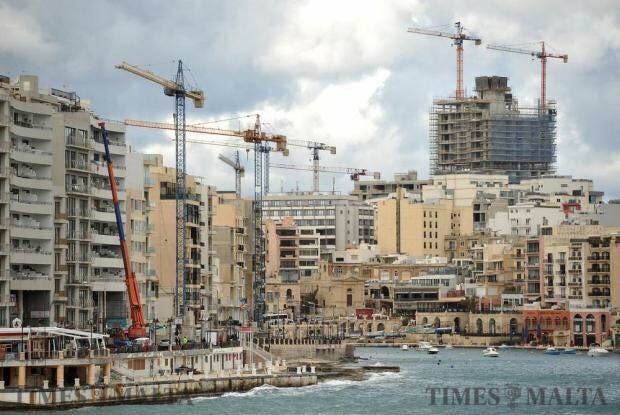
Lastly, let’s come back to the idyllic island thing one more time. During the past thirty years, there has been way too much indiscriminate development. Many ugly buildings were built and a good part of them were built in areas that were meant to remain in their natural state. The result is an overexploited island where very few green areas remain. As a kid, I used to go out and play soccer with my friends in the fields nearby. This was commonplace wherever you lived in Malta. Nowadays there is no chance that kids would be able to do that.

A Times of Malta showing illustrating over development in Sliema and St. Julian’s.

Everything’s been built up, and as I said, it’s been one huge land rush with developers making big money while they exploited every inch of the island. Of course, this constant development has also brought with it a lot of air and noise pollution, apart from visual eyesores. We are now seeing an increasingly high rate of respiratory diseases, and frequent complaints about noise due to construction. Gozo, the other island, is currently at a very nice balance between nature and man-made buildings, but I’m afraid that the developers will turn their greedy eyes there next.

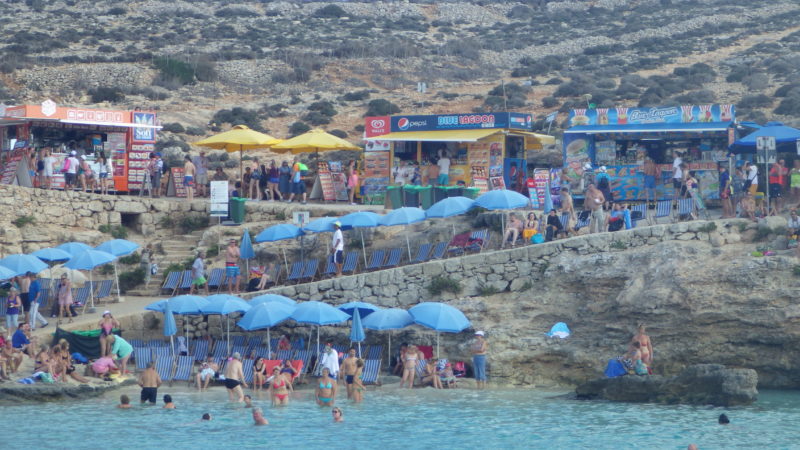
Over exploitation (umbrella rentals) of one Malta’s iconic spots – Blue Lagoon

How about the famous Smart City? Rather than attracting all the big IT companies and making Malta another silicon valley, as was originally promised, it’s been sitting there mostly empty. Moreover, it seems likely that it will soon be turned into another luxury apartment complex. This land had been given to the Smart City developers on the condition that it will be used for ICT purposes, but it seems that the new fashion is to completely disregard such contracts. Real estate agents are already selling apartments on plan even though it is still technically an IT office center and there are absolutely no building plans in place to turn it into an apartment complex. Something similar happened just last year with the former ITS complex in Pembroke. Such free-for-all practices are very common when it comes to building and development.

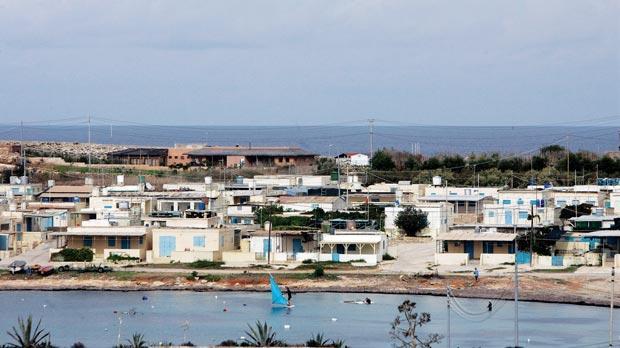
It’s not only big developers who are the problem though. Many individuals have also constructed illegally while the authorities have turned a blind eye. There is a whole village of illegal properties in Armier bay, and no political party has done anything to remove them over many years.

Armier bay illegal construction.

To make matters worse, much of the remaining countryside is taken up by hunters who occupy whole swaths of land. Yes, in Malta bird hunting is a very popular pastime, and incredibly just a few years ago a referendum to ban this barbaric practice in spring failed to get a majority backing. Any walk in the countryside is sure to be accompanied by the sounds of guns as the hunters try their best to blast every bird out of the sky.

A protected bird illegally shot down in Malta.

No wonder you will hardly see any birds in Malta. Illegal hunting is a widespread and serious problem, with poachers specifically targeting raptors (birds of prey) and Herons as well as rare migratory birds such as the Greater Flamingo, Black Stork and Eurasian Spoonbill, among others. Moreover, as I mentioned, hunters occupy a lot of public lands and block off access to hikers, mountain bikers and the regular folk who are out to enjoy a bit of countryside.

In line with the selfish nature so prevalent in Malta (a so-called Catholic country), we find the issue of smoking. Smoking was banned in enclosed public places and workplaces in Malta on July 1, 2004, with the implementation of the “Protection of Non-Smokers Health Regulations.” This ban was extended to include bars and restaurants in 2005, and in 2018, Malta introduced a comprehensive smoking ban that prohibited smoking in all public places, including outdoor areas like beaches and parks. The ban also prohibited smoking in private vehicles when children under the age of 18 are present. The implementation of the smoking ban in Malta has been enforced in restaurants and offices, which arguably already had arrangements for smokers before the ban, but it is a miserable failure when it comes to clubs and many bars. If you don’t believe me, go have a look for yourself, pick any club and you will most likely see the bouncers, DJ and other people in management smoking, so it is little wonder that patrons also feel at liberty to smoke. The ban in outdoor areas is another complete joke, again just visit any park and beach and see for yourself. As a health-conscious non-smoker, I find this to be another prime example of the selfishness and short-term thinking of the Maltese.

Sometimes people will challenge me by posing the question: “If Malta is so bad, why do so many foreigners fall in love with Malta and want to live here?”. I think that’s a very interesting question that merits delving into.

First of all, Malta is a very very unique place, for many reasons. It has a rich and varied history having been under the rule of several nations and cultures. Its size and geography is also unique, as is the fact that Maltese people have their own language. I can definitely see how these exotic qualities can be such a strong attraction for foreigners.

They would have never have experienced such an environment before, especially if they come from a big city/country where things are much more impersonal. Landing in Malta you tend to feel very welcome as people are very friendly and ready to help out, it feels like everybody treats you like family. This leads to foreigners saying hey, this is an awesome place to live in. Back home I’m just a number and nobody cares about anyone, but here everybody is so involved in each other’s lives, this is something special! I totally see why a foreigner would feel like this. I myself sometimes wish I were a foreigner so I could feel that way. If you don’t speak Maltese there is a better chance of insulating yourself from the daily gossip and mannerisms that end up getting on one’s nerves.

Here’s the thing though. While I acknowledge that some foreigners do move to Malta, love it and enjoy living there for many years, many others try the experience and leave after 3-4 years because they just can’t take the way things are done there. It’s one thing living a life of work-beach-party (Malta is the best place for that) and quite another when you decide to settle down, start dealing with the authorities, buy a house and try to get contractors to deliver quality work, etc etc.

People who are used to not having to struggle to get simple things done will start to get pissed off at how much time they’re spending dealing with seemingly innocuous tasks, and eventually end up leaving the island. Of course, the passage of time also amplifies the feeling of living in a very small place that acts like an echo chamber and innovation is stifled by the local way of life and culture, and that can also lead to one deciding to leave and live in a more open environment.

I guess I’ve written more than I meant to, the reality is that I really struggle to put my feelings into words, and that is why I don’t frequently share my thoughts on the subject. I prefer to focus on the positive things I have in my life rather than acting all pessimistic. My feelings about Malta at the end of the day are genuine sadness for what was once really an idyllic place that has been destroyed over the years. I would love to say that I hope to one day return, but I really can’t see how the culture can change and the harm due to construction undone.

P.S. While in this post I focused on the negative things about Malta that led me to leave, there is, of course, the flip side. There are many great things about Malta, and I do still think that it is a very good place for digital nomads to spend some time in.

Click here to leave a comment

2019 Update

It’s been more than two years since I wrote this post, and I’ve interacted with many people about the subject both in the comments section as well as over email exchanges. Unfortunately, not only has the situation in Malta not become any better since I wrote this, but things took a nasty turn for the worse.

The obvious big news item was the assassination of journalist Daphne Caruana Galizia in 2018, followed by several scandals in the political scene. During the last few months of 2019 we’ve seen Malta in the worldwide news for all the wrong reasons, with several top members of the governing party being forced to resign due to their misdeeds and connections to the murder.

As we close off the year, prime minister Joseph Muscat has been named ‘Person of the Year’ for organised crime and corruption by a consortium of investigative journalists.

It was a busy 12 months in the world of organized crime and corruption. But without further ado, here is our 2019 Person of the Year: https://t.co/oDVXs9EZYI#occrpaward #CorruptActor2019

— Organized Crime and Corruption Reporting Project (@OCCRP) December 27, 2019

Dr Muscat joins a list of previous winners of the OCCPR’s yearly prize that includes strongmen such as Russia’s Vladimir Putin, Azerbaijan’s Ilhan Aliyev, Venezuela’s Nicolas Maduro and the Philippines’ Rodrigo Duterte.

“Under Muscat’s leadership, criminality and corruption have flourished — and in many cases gone unpunished,” the OCCPR said.

The organisation highlighted the way Dr Muscat had acted throughout the investigation into the murder of journalist Daphne Caruana Galizia.

I had intentionally avoided politicising things with my original post, as I don’t consider myself a supporter of a particular party in Malta, but things have really gone to new extremes with the Labour party in government led by Dr Muscat in recent years.

Not only have things become worse in Malta, but the country’s reputation overseas is at an all-time low due to this government’s shenanigans.

What is quite impressive to me is that the Maltese population by and large has been quite passive during this whole debacle. Not to mention that probably around half of the population still doesn’t think that anything irregular has taken place in the past few years, as you can witness if you open any article on local newspapers reporting cases of corruption. The kind of brainwashing on display is at least on par with what you would expect from people in communist countries with no access to outside information. To see people defending the prime minister and his cronies while hurling abuse at any detractors, Maltese or foreign, is just sad.

One would hope that the Maltese will choose better people in leadership, independently of which party they’re from, and avoid further damage to the country. It’s worth keeping in mind that right now, the Maltese economy seems to be doing very well, however I am of the opinion that this boom has not been very organic nor is it built on solid ground.

If we take an honest look at the last 15 years of growth in the Maltese economy, we would find that the big driver has been an artificially favorable tax system designed to attract foreign companies to relocate their business in Malta and thus gain huge tax benefits. That drove an influx of foreigners needed to staff the relocated companies (most of them online gaming companies), which in turn drove up property prices and helped build an impressive financial industry to service these aforementioned companies. If one of these pillars were to be affected by the scandals rocking the political scene, all the pieces will fall like dominoes causing a serious crisis in Malta.

Taking the Decision

Over the years since I’ve written this post, I’ve received many emails from (mostly young) people who identify with my feelings and are struggling with taking the decision.

I want to make it clear that while we live in an era where travel is very easy and affordable, uprooting yourself and moving to another country is still a significant psychological and logistical challenge for most people.

Here’s a copy of an email reply I sent to a person who reached out to ask for advice on how to approach the decision. I hope it can be of help to others in the same stage of their lives.

Every person who decides to leave their home country will have the fears and worries that you mention, that is perfectly normal.
I had the same concerns myself when I was in the same situation. What I did was to sit down in a quiet place for an hour or so, take a pen and two sheets of paper. On one list the pros and the other the cons about moving. Take your time and let your heart and mind both outpour onto those two pages. When you’re done, you should have a clearer picture of what you should do. If it’s still not clear, assign a rating of 1-5 or 1-10 next to each point that you list, with 1 being of least importance and 10 being essential for you. Then add the scores up and hopefully one should be significantly higher than the other.
Know that you can’t control what you’ll find on the other side, but you owe it to yourself to at least seek a betterment of your situation if that’s what you need to do.
I have yet to come across anyone who regretted leaving a negative environment that bothered them (job, country, etc) but I have met plenty of older people who have significant regrets about not taking a chance on a better future when they were younger.

Further Reading

  • Bloomberg – Why the EU is furious with Malta – covers problems that I mentioned in the post and other big issues that surfaced in the past year since I’ve written this post.
  • Only in Malta – Facebook group showcasing daily unbelievable occurrences in Malta
  • Malta New Reality – More shenanigans in Malta
  • The Shift – Daily updates on scandals and corruption in Malta
  • 70% of Malta’s young people wish to leave.

Filed under: Thoughts & Experiences

📈 I’m New to Investing, Where do I Start From?

Last updated: February 02, 202620 Comments

Finance and investing are some of my main passions these days, and I’ve written extensively about my experiences on this blog.

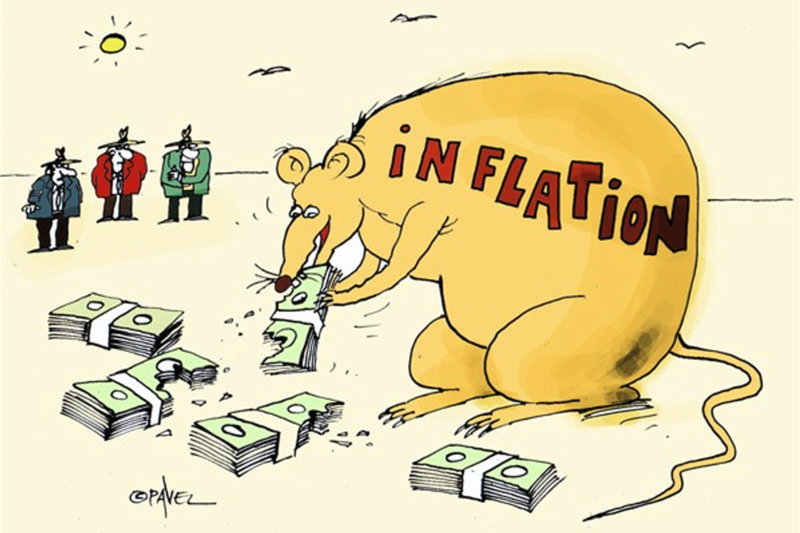
Many people think that their money is safe at the bank and they don’t need to do anything with their savings. Well, here’s the inconvenient truth: by leaving money in the bank and not investing it, you’re actually losing money every year, to the tune of around 3% in most developed nations. This is due to the effects of inflation.

Here is the way inflation works. One euro today will buy more products than one euro next year, and the effect is compounded over the years.

If you’re 30 years old or over, you will probably remember clearly the times when everything was much cheaper. I remember, for example, the price of a pizza around 25 years ago being just a quarter of what it is now. That means that if I had kept all my money in the bank without investing it, over this period of time it would be worth much less, hence I would have actually lost a lot of value.

The obvious remedy to the problem of inflation is therefore that of investing our savings. Before you rush out and invest everything, make sure you know where you’re putting your money and have a proper strategy in place. I suggest you learn as much as possible about investing, without relying too much on financial advisers, as typically they will be looking after their own interests, not yours.

Apart from traditional investments where you get a yearly return in the shape of dividends, profits or returns on loans, many people are now deciding to convert their fiat currencies into cryptocurrencies such as Bitcoin. The major attraction in Bitcoin is that it is deflationary rather than inflationary. Since it has a limited supply, as time goes by the value of each bitcoin will increase rather than increase. This is the total opposite of fiat currencies, where, as we mentioned earlier, one dollar/euro today will be worth a bit less tomorrow.

How are you fighting the effects of inflation?

I get this question frequently enough from friends and people who land on this blog. To provide a quick reference, if you want to start investing your money through online platforms, there are a few different ways you can do it:

  • Cryptocurrencies
  • Property crowdfunding
  • Peer-to-Peer Lending
  • Stock market
  • Online properties (websites, apps, etc)

The level of risk and expertise needed to operate in the above markets differs wildly, so I’ll try to give some further pointers as to what to start off from. I will also include the expected level of return per year one should be aiming for.

Cryptocurrencies

This is probably the only current way to make really big profits (or losses) in a relatively short time. You can refer to my post about cryptocurrency resources to learn more about this area. It’s definitely a super interesting way to invest your money, and possibly cryptos will revolutionize our lives in the very near future. At the very least, you should keep yourself informed about what’s happening in this space, even if you don’t invest.

To get started with cryptos, read my guide to investing in Bitcoin and other cryptocurrencies and my opinion on whether you should buy Bitcoin or Ethereum.

Projected returns are hard to predict in such a nascent space. David Fauchier, the founder and chief investment officer at Cambrial Capital, said 20% net returns is the benchmark for him in terms of crypto trading. It’s about being able to achieve those returns even when the overall market is flat, not just in times of volatility.

I think that 20% figure makes sense for a fund, but as an individual investor/trader, the returns can be much higher.

Expected yearly return: 40%+

Property Crowdfunding

Property Crowdfunding or property-based P2P lending is one of the most popular ways to get exposure to real estate from the comfort of your home. I think this is a pretty safe and low-risk investment given that you are purchasing real estate, which historically has held its value very well. As always, you need to be vigilant in what properties you invest in and diversify as much as possible.

I recommend diversifying geographically, having properties in various locations around Europe, including the UK. Germany and the Baltics, in particular, have yielded excellent results for me. You can also diversify on property types, such as buy-to-let, flipping, and even property-backed loans.

These are my favorite platforms:

  • Bulkestate
  • CrowdProperty

You can check out my full list of favorite real estate crowdfunding platforms in Europe, where I go into more depth about these platforms and online real estate investment in general.

Expected yearly return: 4-12%

Read my guide on real estate investment

Business and Personal Finance (P2P Lending)

This might initially sound like a fishy area, but really it’s not. After the last financial crisis, banks tightened up their lending procedures, and while that was, in general, a good thing, it also left a lot of people out in the cold and unable to get a loan.

In Europe, this is a big problem in many Eastern European countries as well as other Western European countries like Spain too. With interest rates being as low as they are at the moment, the situation created was that of people in Western Europe having money to invest and on the other hand people in Eastern Europe needing cash for business or personal needs. The resulting opportunity created the rise of loan platforms that are doing so well today.

With these loan platforms, you can choose to diversify your investments over hundreds or thousands of loans across many countries. You can also choose to diversify as to what types of loans you want to invest in. For example business loans, car loans, home refurbishing loans, bridging loans, etc.

My recommended platforms in this space:

  • Swaper
  • Peerberry

You can read more about what I consider to be the best P2P lending platforms in Europe.

Expected yearly return: 8-12%

Read my guide to P2P lending

Stock Market

The stock market is one of the most well-known ways of investing, so I won’t spend much time on it. I will only say that you should really think twice about using financial advisors and investment brokers, as they are mostly just salesmen who make money on the amount of products they manage to sell to you. In other words, they aren’t really on your side.

Research has shown that most index funds perform better than actively managed funds, so you don’t need to be paying hefty commissions every year for someone to manage your funds. You can use index investing to your benefit, especially now that roboadvisors are taking the place of fund managers.

Another great strategy would be to go for dividend growth investing. There are tons of websites of investors who detail their month-to-month earnings using this strategy. I like the idea of dividend growth investing when compared to index investing for the following reasons:

  • No yearly commissions to pay (indexing can cost 0.5 to 1% of your total sum invested)
  • You choose which companies to put in your portfolio. You can thus avoid companies that you don’t want to support. For example, being a health-conscious person, I don’t want to invest in and support Coca-Cola. So that company would be out of my dividend growth portfolio, even though it has a great track record. The same goes for Mcdonald’s.
  • It’s more exciting, depending on your personality, to actually choose which companies you want to be a part-owner of, and track them year over year. On the downside, it also takes more time.

With both strategies, you would then use an online stock broker to purchase your shares or ETFs.

I personally love to pick stocks myself, even though I know that the theoretical odds are stacked against me. Check out my ideas on stock picking and my favorite stocks.

Expected yearly return: 10%+

Read my guide on stock investing

Gold and Silver Bullion

First of all, what the heck is bullion? Bullion is gold and silver that is officially recognized as being at least 99.5% pure and is in the form of bars or ingots rather than coins.

The word bullion comes from the French Minister of Finance under Louis XIII, Claude de Bullion. To create bullion, gold first must be discovered by mining companies and removed from the earth in the form of gold ore, a combination of gold and mineralized rock. The gold is then extracted from the ore with the use of chemicals or extreme heat.

See also: Should you invest in gold right now?

With that out of the way, we can now talk about where to buy, store and sell bullion online. The storage part is key here. Most probably, you won’t want to worry about storing your own gold or silver in a safe place. That’s why platforms like BullionVault take care of storage for you. Of course, you can also buy and sell on the platform.

One important factor to consider with bullion: Gold and silver have no intrinsic value.  They aren’t productive assets. Compare them to stocks. When you own a share of stock, you own a piece of a business that produces goods and/or services to consumers.  A good business generates a profit.  Every year that passes, gold remains sitting in the vault, but the owner of a company such as Apple or Nike might have a giant pile of cash from the profit generated over that same year.

When evaluating the performance of gold as an investment over the long term, it really depends on how long a term one is considering. Over a 45-year period, gold has outperformed stocks and bonds; over a 30-year period, stocks and bonds have outperformed gold; and over a 15-year period, gold has outperformed stocks and bonds.

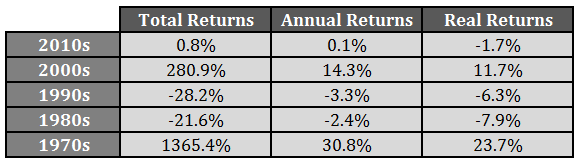
Gold returns in recent decades

Many investors don’t really consider bullion to be an investment at all. Rather, the precious metal acts as a hedge, or a way to try to protect wealth against the risk of loss in such asset classes as real estate, equities, and bonds. There’s the doomsday scenario reasoning too, which argues that in the case of a global financial collapse or armageddon, gold and silver will be some of the only things with value attached. People will first value food and shelter that cover their basic needs, and soon after demand will start again for gold and silver as people seek to build a store of wealth or impress others.

Needless to say, gold and silver are very contentious assets, with strong arguments both for and against. In my opinion, if you have money to spare, it wouldn’t hurt to keep some of your net worth in gold as a hedging mechanism. I would give priority to nailing good investments in some of the other categories above, however.

You can use Bullionvault to invest in gold.

Expected yearly return: Nobody knows really, it could be negative returns to double-digit positive returns. It’s more of a hedging mechanism than something you invest with hopes of a specific rate of return.

Read my guide on investing in gold

Online Properties

By online properties, I mean websites or mobile apps. Chances are you know of a friend or friend of a friend who has achieved some degree of success by owning a website or a mobile app. This is your chance to do the same, but rather than starting from scratch, you buy an existing up-and-coming website, or indeed one that’s well established and turning a healthy profit.

You need to be careful in evaluating such online properties, but they can give returns of 40% plus per year, which is super attractive compared to other opportunities. If you know what you’re doing, the risk-reward ratio is very much in your favor.

Bew careful about pure Amazon affiliate sites. If you’re relying 100% on Amazon commissions and you think that you’re your own boss – think again. Amazon owns your ass. For example, they recently decided to cut the commissions for a set of categories by up to 80%.

It’s a good business move by them, IMO, and nothing new (link). Diversification is key. Sites that have multiple traffic and revenue sources are the ones that achieve the highest multiples. If you rely on one or two sources, you’re not playing the long-term game. You’re just looking for quick-wins.

To learn more about buying and selling online properties, check out my guide to flipping websites and the Empire Flippers podcast.

Domain Magnate and OnFolio are two platforms that you can use to invest in website group buys where you don’t necessarily have to manage things yourself.

I think that some niches are better than others. I’ve been looking at several niches and so far the best I’ve seen are online marketing, personal finance, investing, and technology. Fitness websites also interest me a lot but it’s really hard to make a decent dime on those without ending up promoting rubbish products.

Expected yearly return: 40%+

Read my guide on website investing

I hope this short summary will help you get a good idea of all the options available. If you have any questions or would like me to write more in-depth about any of these topics, please let me know.

Read my guide on CFD trading

Is Investing Risky?

Everything in life is risky, it’s a game of probability.

Although we have rules in our modern societies, at the end of the day we remain biologically programmed for self-preservation and protection of our offspring. I try to keep that in mind during my daily life, so as not to expect anyone to look out for my interests and do the job I’m supposed to be doing.

If anyone does happen to act in that way, then it will make my day. But it’s never my default expectation. I learned to think in this way from Stoic philosophy and it has served me very well in the past years when I’ve had to deal with adverse and uncertain situations.

Ultimately, I’ve made peace with risk and even grown to love it. I wake up every day excited to know what opportunities (and risks) I will come across during the day, knowing fully well that I will win some and also lose some.

My aim in business and investing is to be able to look back every five years and ask myself:

Am I significantly wealthier than I was five years ago?

If the answer is yes, then I’m happy with what I’ve been doing during those years. If not, then it’s time to see what I’m doing wrong. Over the long run, it is our actions that determine our destiny, but that is not necessarily the case in the short run. And that is why you need to adopt a long-term approach to not only investing but life in general.

Almost anything can be a good investment, for the right people at the right time. Say you got suckered into a pyramid scheme like Neways, which was popular in Malta when I was in my early twenties. The majority of the people lost their money, but those who got in early made some tidy profits. It all depends on the circumstances of your investment.

It is inevitable that you will make some bad investment decisions along the way. Just like in sport you will have bad performances that will cost you matches and championships. Of course, you should have known better, but that’s how you acted in those circumstances due to all the various factors involved. The only thing you can do is to try to learn a lesson and move on.

Life is such a continuous game of mistakes and lessons learned. A good base of education will ensure that we avoid getting wrecked, but there is no way to avoid making mistakes except not playing at all.

In investment, my approach is to learn as much as I can within a reasonable timeframe, then dive in. If it’s a new asset class that I’m interested in, I will spend 6 months reading everything I can find about the class, then go straight in with small amounts, leave another 6 months and hopefully learn some lessons along the way. After 1 or 2 years I’m ready to take bigger steps.

Make sure you do your own homework before you invest and don’t rely on other people’s advice. Be prepared to lose money and subsequently spend your time analyzing what went wrong and what you can learn rather than complaining or feeling bad and blaming yourself or other people for it.

Market Timing

Most new investors will find themselves investing in some stock or crypto when its price has already peaked, leaving them with little upside and potentially huge losses if the asset is especially volatile.

Professional investors or amateur ones who work hard at the game can spot opportunities due to their immersion and education. Once they spot them, they also have the capital to deploy into an “obvious” opportunity.

Others are blind and oblivious to what’s happening as they are busy with other stuff. Even if a professional investor friend of theirs told them about the massive opportunity and no-brainer trade they would not be comfortable investing any money, and frankly, they shouldn’t unless they happen to have decided to fully follow and piggyback on the investor friend’s knowledge, as you would if you were to join a fund.

What happens later is that they see everyone talking about the opportunity weeks, months, or years later, and then it starts to seem obvious to them too, and they buy into it as well, but too late.

I myself am almost always late by my measures in most investments, typically going in a quarter or midway into an investment’s run, but I’ve also been guilty of going in way too late too. However, that’s usually good enough for me and gives me the right mix of time invested VS returns gained.

Be aware of the pitfalls of trying to time the market. The only way to lessen timing mistakes and avoid going in at the wrong moment is to work hard on understanding the industry and its trends as well as networking and surrounding yourself with other trendspotters and experts.

It’s OK to Miss Out on 1000x Returns

The markets in recent years have been crazy enough that it’s common to see a lot of people feel sorry for themselves for missing out on 1000x+ on Bitcoin, Ethereum, ICOs, Gamestop, some DeFi yield farming trend, NFTs, etc etc.

However, I’m here to say that it’s totally OK to miss out on investing very early in any of these things. The truth of the matter is that the risks of buying into the initial stages of all these projects or trends were extremely high. For every story of riches, there are a thousand others of total ruin.

Don’t get me wrong, I’m not the type of person to dismiss a trend just because I don’t understand it or because it’s the newest thing. But I do like to understand things, and I know by now that I’m pretty good at going over lots of different sources of information and coming up with sensible conclusions about pretty much any topic. So when I feel that I don’t really know why I would invest in something other than the thing in question going up like a hockey stick or people on Twitter boasting about their massive returns, I tend to sit out. Instead of throwing money into the game, I double down on my efforts to understand the subject in order to come to a sensible conclusion.

Leaving money on the table during the early stages takes away a lot of anxiety and helps me focus on what I’m good at – understanding stuff. And when I do, I take calculated but significant bets on things that might change the world within the next 5-10 years.

And that’s pretty damn fine.

Don’t dismiss the next exciting market without doing your homework, but don’t go all-in on things that are trending but you have no idea about, either.

As in many other areas in life, doing proper research and thinking long-term provides the best holistic results.

Filed under: Money

👎 Housers Review 2026 – Avoid this platform!

Last updated: January 15, 202613 Comments

Contents

  • Exploring one of my projects
  • How Things Work
  • Projects Available
  • Secondary Market
  • Platform Interface
  • Team
  • Customer Support
  • Public Reputation and Social Media
  • Returns
  • Fishy Happenings
  • Conclusions


Update March 2021:

So far I’ve had a few loans get delayed, SAN ANDRÉS, La Boladilla Village, La Boladilla Beach. I’m not too happy with how things were done on these projects. All investors were called to vote, however, the results of the vote were not announced nor have investors been notified via email about the results. In the case of San Andres, the developer promised to have the project completed before the end of 2019, but then failed to communicate again before the end of the year.

At this point, I have decided to exercise more caution when investing in Spanish properties. I’m going to concentrate on other countries for the majority of my investments, as the Spanish investments have been lacking professionalism in some ways. Development loans, in particular, are quite risky in my opinion.

As of March 2021, 36% of the projects on Housers have been delayed. Rather than address this problem, Housers seems to continue focusing on marketing with great aplomb as if everything is fine. Therefore my respect for this platform has greatly diminished and I will not continue investing in it.

I had written some parts of the review below before the COVID crisis and I’ll keep it here until we know for sure how things turn out with Housers. However, I suggest you avoid this platform for the time being.

If you’re looking for exposure to real estate in Spain, you can use StockCrowdIN.


Housers is the largest online real-estate crowdfunding platform in Southern Europe and allows you to invest in property from any part of the world.

When investing with Housers, your investment is backed by a tangible asset (“brick and mortar”), and hence it is considered a much safer investment than, say, cryptocurrencies. That’s not to say that you shouldn’t invest in cryptocurrencies, but real estate investment is definitely a lower risk investment.

When investing at Housers, you will earn monthly rent and also benefit from capital gains. Properties in southern Europe are currently rapidly rising in value.

You can easily diversify your portfolio. Compare investing in tens or hundreds of properties all over Europe to buying one apartment in your home country. You’re spreading your risk much better if you use Housers.

A great advantage is that all this is hassle-free. Everything relating to the property is taken care of. You won’t receive any calls from tenants asking to fix their broken pipes or have to fight to collect your rent.

The Spanish and Italian markets are recovering very rapidly and are projected to continue rising in the next few years at least. The rental yields in both markets are among the highest in Europe.

When investing in property, you also need to pay more attention to cities rather than countries as a whole. That’s why Housers focuses on high-growth and successful cities such as Madrid, Barcelona and Milan.

Housers itself as a platform has achieved tremendous success. There are more than 115,000 registered users and more than 95 million euros have flowed into the platform to fund properties. The average reported annual yield is 4%.

Exploring one of my projects

To illustrate how Housers works, let me take you through one of the projects I invested in. Note that this is one of the earlier and successful projects, most other projects I had have yet to supply a return and unfortunately this positive project is the exception not the norm.

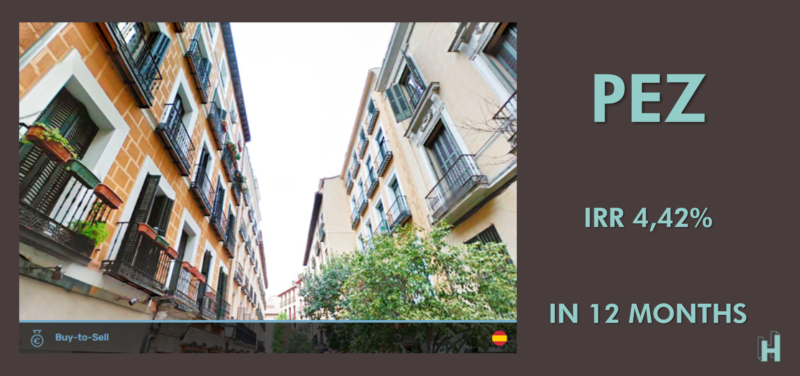
We’ll be considering the project named Pez; a buy-to-sell opportunity in Madrid. In this case, the legal form of the investment was a loan to the developer.

Here’s how the project timeline went:

  • I invested on 22/06/17, the day the funding period started.
  • The project was fully financed on 11/07/17.
  • The property was acquired on 02/10/17.
  • Refurbishment works started on 20/10/17 and completed 20/02/18.
  • The project was finally sold on 05/07/18.
  • Project fully finalized on 25/07/18 and money sent to investors.

The visual information provided for the project was actually quite scant. As investors, we only got a few standard photos of the area where the apartment is located, the floor plans and two renders of how the refurbished apartment would look like.

We did, however, get some PDFs about the project which gave us more insight into the strategy:

  • Business plan
  • Loan information
  • Budget
  • Dossier
  • Real-estate evaluation

Based on that information I decided to invest in the project, although I would have liked some more photos and plans for the project.

A bit more than a year later, the project was sold.

Once the project was sold, there was some more information available about the internals of the project.

  • Average investment per investor: 213.65€
  • Number of investors: 412

Pez was a buy-to-sell opportunity with an expected return of 6,59% in 12 months, that ended with an annualized IRR of 4,42%. The yield is the same 4,42% since the project took 12 months from start to finish. 

Net Yield from the Sale: Represents the dividends that the investor will receive derived from the sale. (12 months)

IRR: Internal rate of annualized return of the investor. It’s the interest rate or yield offered by this investment. It serves to evaluate the profitability of the project and compare it with other types of investment in the market.

A few days after the project was sold, I received capital and interest in my Housers account, closing off a successful investment.

From the interest paid by the developer, a 10% Housers commission was deducted along with 19% for IRPF (Spanish tax). The net interest was then sent to my account.

How Things Work

Housers is currently operating in three markets:

  • Italy
  • Spain
  • Portugal

Housers operate an opaque fees structure that is hard to understand. In fact, I have not found a single good explanation of the fees they charge. They started off in the early days saying that they would only earn commissions when the project was successful, taking a chunk out of investors’ profit, but things changed along the way.

I have to be honest and say that after spending 20 minutes trying to figure out the latest fee structures I gave up, but it’s definitely not the best fee structure for investors.

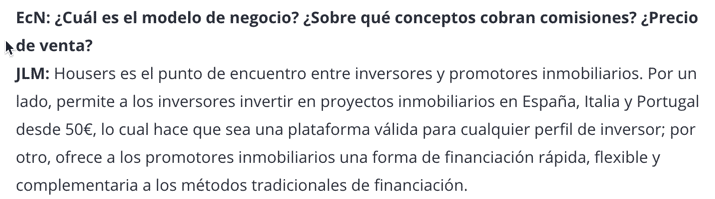
I was also bemused to see how their CMO totally avoided answering a direct question about commissions in a recent interview in Spanish::

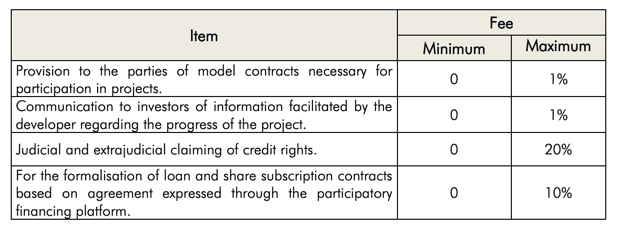
Here is more information about Housers fees taken directly from their website:

– Application of fees to investors:

For making the necessary model contracts for participation in the projects available to the parties: a percentage to be determined on the value of the financing project in accordance with the documentary needs of the project in question shall be applied at the time of making the above documentation available. The commission will be charged only once for each project and not for each document or contract made available to the developer.

• For communication to investors of information provided by the developer regarding the progress of the project: a percentage to be determined on the value of the financing project shall be applied in accordance with the documentary needs of the project in question.

• For services of judicial and extrajudicial claiming of the credit rights (forced or unforced): at the time the judicial or extrajudicial claim is presented, the investor must pay a percentage to be determined on the value of the unpaid claims in order to cover related expenses.

• For the service of formalising loan and share subscription contracts, based on agreement expressed through the platform, acting on behalf of investors: In this case a percentage to be determined will be applied on the value invested or lent by each investor when the financing objective has been reached and the loan contract or share subscription is formalised. The accrual and collection of the same is deferred to when investors begin to receive a return derived from and proportional to their investment (both ordinary interests generated by the loan and interest for delay due to breach of contract).

Many projects are designed to attract investors with special promotions like extra interest or cashback. Once the project is funded, typically the interest repayments start going out regularly and later stop abruptly. Once this happens, you will be asked to vote on whether you want to engage a debt recovery company or give the borrower more time to repay. All the projects I was involved in ended the voting with investors giving more time to the borrower and hoping for the best.

Curiously, Housers customer service gets back to life in these events, and are very proactive in calling you to urge you to cast your vote. I’m not sure why they are so motivated to get people to vote, perhaps there is some legal reason behind it, but it definitely feels fishy given they fail to respond to investors’ emails.

Keep in mind that if you live outside these three countries you will incur withholding taxes that are applied by the countries in question. I have not found a way to offset those taxes so it’s a further reduction in returns.

Projects Available

Housers grew very rapidly, and after starting with Spain soon expanded into Portugal and Italy.

They even briefly delved into art projects, although that was a one-off and probably not something they will do again as it requires a totally different set of skills to evaluate, not that Housers do much evaluation on their projects anyway.

You can invest in the following project types:

  • Buy-to-let (5 years+ investments with monthly payouts)
  • Buy-to-sell (12-24 months window to refurbish and sell)
  • Development loans

Investors seem to still be very keen on putting in their money, as all projects are quickly fully funded, but I’m starting to suspect it’s a case of dumb money at this point, as the projects themselves have become more and more speculative over time.

I’ve seen many projects in the south of Spain, mostly around the Malaga and Marbella regions, which by the looks of it seem to have been in some kind of bubble, as more and more development loans kept showing up for grandiose projects, which we now know were never completed due to various reasons/mismanagement cases/excuses.

Housers seem to be branching off into two new lines, Green and Corporate. Green is for sustainable and environmentally friendly projects while Corporate stands for development loans to open new businesses.

Secondary Market

The Housers secondary market seems to be dead at the moment. In fact, it was never really alive so to speak, as it is horribly complicated and very few deals were over struck on it.

Platform Interface

I’m not a fan of the current interface. The User Area uses a side menu with icons that really don’t mean much to me, so I end up having to click through all the items in order to finally find what I want.

It should be easier to see what amount investors have invested in each project, but it’s not easy to find out that information unless you click through the individual project’s page, which can be very tedious if you have many investments.

Team

In 2018, the current CEO Juan Antonio Balcázar replaced Tono Brusola, who was one of the co-founders. I’m not sure what led to Mr Brusola stepping down, but things have definitely gone downhill after he left. Perhaps he saw bigger opportunities in the Fintech space as he is now leading Fundsfy, a savings platform. He is a well-known serial entrepreneur in Spain and things were going great at Housers while he was in charge.

I know very little about Mr Balcázar, although a scroll down his Twitter feed doesn’t really provide me with much reassurance. This is just one of many factors I consider, and in this case I was not impressed.

At this point, I believe there are very few people actually running the platform; I don’t believe one bit the idea that Housers has 40+ employees, as they claim.

Customer Support

In the first two years, Housers had very good customer support both over email and via phone. During 2020, support has gone down the drain. Nobody answers emails anymore and phone support, while friendly, basically promises that things will be done and then never get back to you.

One thing that has absolutely diminished my trust in the platform is the use of a tactic in support whereby any finance-related questions are deflected with words along the following lines:

“We’ll pass on your query to the finance department and wait for them to get back to us”.

I’ve seen this tactic one other time, coincidentally (or maybe not) on another Spanish platform, and all it means is that they are never going to get back to you.

This is no way to treat customers. If you have a customer service line open then they should be able to answer any questions within normal limits. Questions related to the status of certain projects or the finances in our accounts should definitely fall under their remit.

Public Reputation and Social Media

If you take a look at the Housers rating page on Trustpilot you will find many other investors expressing their concerns and disappointment at the way Housers have been handling things.

The same happens on Twitter and Facebook. In most cases, Housers promptly reply asking the investor to contact them privately so that they can look into their case. This is quite ridiculous given that the investor would have typically contacted them several times before and received no reply. It is pretty obvious that they are just trying to politely silence all negative opinions.

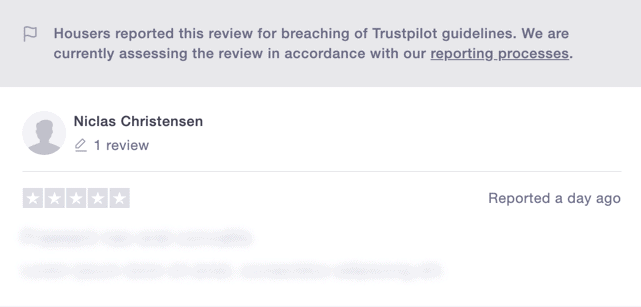
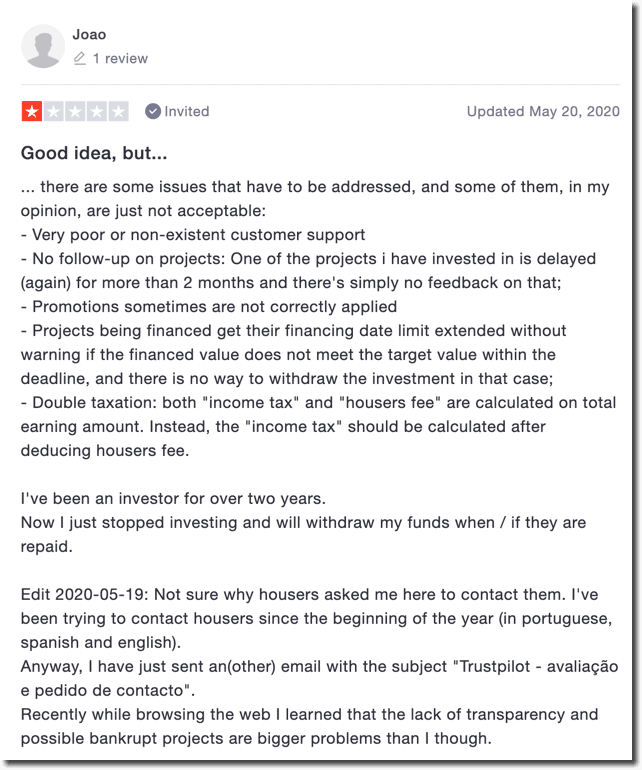
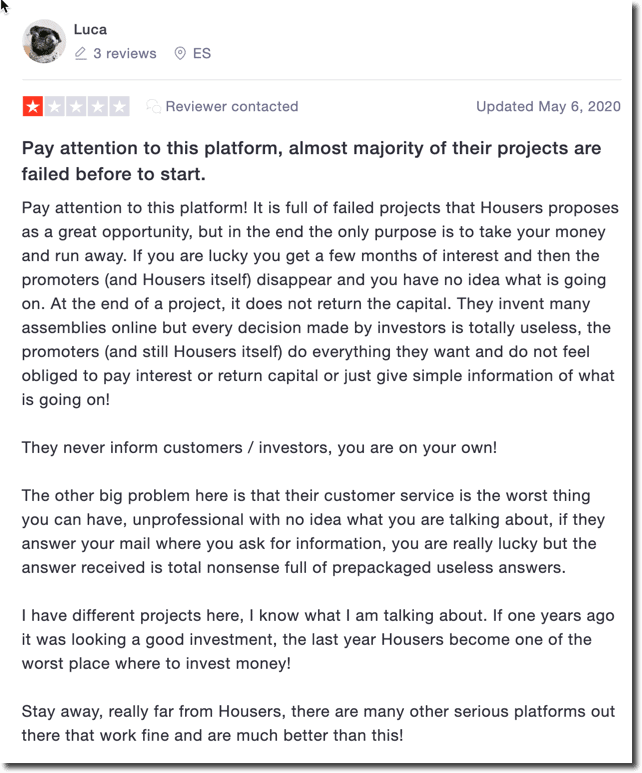
Their latest strategy is to delete all negative comments or ask Trustpilot to take them down for supposedly breaking some guidelines. Housers are just trying to silence all negative opinion, but it’s only a matter of time before it becomes obvious to all that Housers is not to be trusted.

On the other hand, there are also several reviews that have not yet been taken down and clearly share many of the same concerns that I and others do. Here’s are a few:

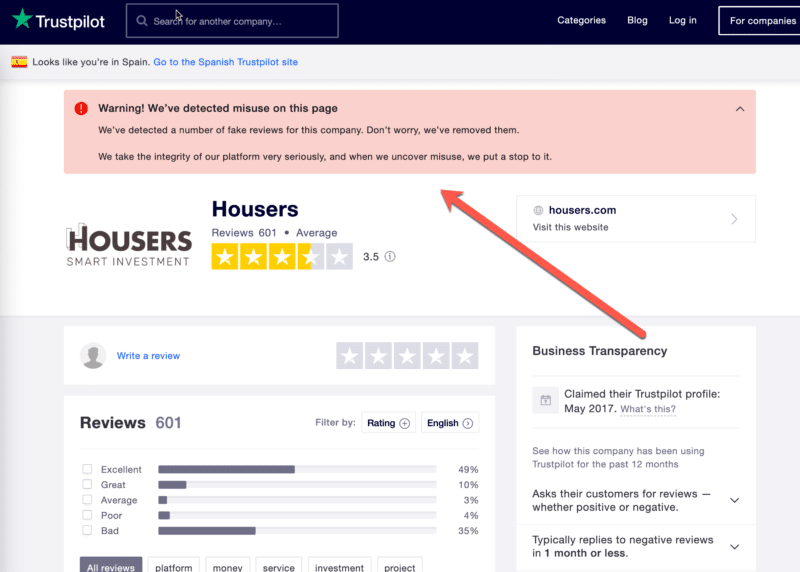
In January 2021, Trustpilot itself started showing a warning saying that Housers have been caught manipulating the reviews. Basically what they did was to buy a bunch of fake reviews in an effort to counter the many negative reviews that many real users were leaving. Another scammy move from this company; at least Trustpilot called them out on it.

On the Spanish investing forums you will find a lot of feedback about this platform. Some investors even went to their offices to demand explanations for certain things and never got anywhere.

Here’s one of the Google reviews in Spanish for those of you who speak the language, I think it sums up the platform perfectly:

NO INVERTIR AQUÍ

La idea era buena desde que empezaron los proyectos, pero la plataforma nada tiene que ver con la inversión inmobiliaria.

La forma de actuar de Housers es la siguiente:
Lanzan un proyecto con un tipo de interés prometido. Los inversores entran y dejan su dinero. Cuando Housers consigue el dinero objetivo de la financiación, se queda una parte como comisión entre el 8-10% sin haber hecho nada, solo por ser intermediarios.

Ese dinero que se va perdiendo por el camino hace que su negocio sea financiar proyectos más que la parte inmobiliaria. Que luego funcionen o no los proyectos eso ya es secundario. Su objetivo es captar inversores.

La prueba está en que la mayor parte de los proyectos siempre tienen problemas y no se cumplen plazos, alegando toda culpa al promotor.

Cuando Housers te vende la idea te dice que ellos solo cobran si el proyecto funciona quedándose el 5% de los intereses generados, pero si fuera así no tendrían ni para pagar las oficinas de Madrid.

Por supuesto, las opiniones con 5 estrellas son tan falsas como decir que Housers es una plataforma seria.

Nada profesionales. No tienen ni idea del negocio, bueno sí, del negocio de la estafa y la publicidad engañosa son los reyes.

I’ve also read reports from architects saying that the project plans and actual photos of the project did not match at all, but I have been unable to confirm that myself.

As of June 2020 there are several Telegram groups you can join, where the discussion centers around whether Housers is a scam or not, and legal proceedings against them.

Here’s a list of all the Housers Telegram groups I know about:

  • https://t.me/housers_foro
  • https://t.me/HousersCom

Returns

Most of the money I invested in this platform is still tied up as several development loans have failed to be repaid in time due to various reasons. The developers have not shown any remorse for the delays caused to investors, and as things stand it is quite uncertain whether we will ever get our money back.

I have had some projects exit successfully, but most of my money is still stuck in there, so at the moment, things are looking very grim. The biggest issues seem to be the development loans, with a significant percentage of them being restructured with uncertain outcomes.

Fishy Happenings

Things have been looking very suspicious lately with Housers, with many investors outright calling the platform a scam. It certainly is looking like Housers is becoming so.

Consider the project Puerto de la Torre IV.

The project was meant to close the financing phase on 28/05/20. Last time I checked it was well below 90% of funds needed to close the phase.

At 0:10 on 29/05/20, the project was showing in the list of Non-Financed projects, as expected.

At 09:00 on the same day, the project appeared in the Financed projects list. It appears that someone from Housers manually moved the project.

Housers thus appear to be breaking the law article 68.2 de la Ley 5/2015 de Fomento de la financiación empresarial. The law requires at least 90% financing of such projects, which was clearly not achieved in this case.

I have contacted Housers for an explanation and they replies saying that the 90% applies to the financing of the projects but since there were several phases, they can include the other previous phases in the computation. They are probably right, but it is still misleading to the investor.

There are also developers that have obviously abused the fact that they could easily raise money via Housers, and they have several projects that are delayed for many months with no intention to pay back the investors. ByNok is one of the most shameful developers in this regard. They are supposed to be a luxury developer but their lack of professionalism is incredible.

Here’s another incredible thing that happened in June 2020. It concerns the project Bellevue Green.

In this case, the project developer, Puebloliving, is claiming that the loan was for 24 months and not for 12 months, as it appeared on the website and in the contract signed by all investors. The owner of this company, Morten Ostberg, is claiming that in initial emails with Housers they had discussed 24 months as the timeline. It seems like another obvious scam to me, and another shameless developer trying to defraud investors.

Conclusions

Do they really?

I was really excited about Housers in the early years of the platform, but I cannot honestly recommend it anymore, even though for my own money-preservation reasons I would like it to succeed long-term.

Housers seem to only care about the fact that they get their commission of 8-10 % on the capital raised, and whether the loans ever get repaid is the investors’ problem, they have no skin in the game and hence don’t care. They have the incentive to just keep adding projects to the platform without doing any fact-checking, and this doesn’t augur well for the future.

Housers have also been sanctioned in September 2019 by the CNMV in Spain. A group of investors who have lost their money with Housers has also been formed, and you can join it here. Possibly there will be the chance to get legal recourse at some point.

The platform is already under police investigations in Spain according to the CEO of ByNok, one of the project promoters on Housers, although this is not yet a well-known fact.

There was some news that an individual investor won a case against them, although I don’t have the details on that unfortunately.

The platform has a lot of Spanish investors, so it is not as well known outside Spain, but the Spanish investors and FIRE enthusiasts are livid about the platform.

In order to get back on track, if at all possible, Housers need to get their customer service team back in place, do better due diligence on new projects, and offer better communication about existing projects, especially those with an uncertain future due to severe delays.

At this point, after having spoken with many other investors in the same situation, and given their terrible customer service, continuous promotion of flaky projects, and ridiculous replies to people who reach out to them publicly on social media or on Trustpilot, I have to conclude that this platform is pretty close to being labeled a scam.

There are several other bloggers who have raised the issue of Housers being one of the worst platforms in terms of transparency, and they are also very disappointed with Housers. If you’ve also lost money with Housers, I urge you to have your word online, through your social media accounts or through a platform like Trustpilot. I’m well aware of the fact that it would be beneficial for me as an investor to say good things about Housers, but that’s not the purpose of why I write here. Housers are running a despicable business model and they don’t care one bit about investors on the platform. So I want people who are considering investing in this platform to know the truth.

The lessons I draw for myself from this debacle is that I should be more skeptical about online platforms and give them a few years to have a track record in place before investing heavily. In the case of Housers, I invested too much and too soon into projects that I didn’t have the means to properly evaluate.

As I’ve mentioned before, over the past five years I’ve taken some extra risks in my investments as I was investing in many different asset classes at the same time without being an expert in any of those classes. However, I am a firm believer in the idea that you learn things much better and in a deeper way when you have real skin in the game. Yes, these lessons might be expensive, but as a young investor with hopefully several decades ahead these losses can be recouped and the valuable lessons learned now will serve to guide my way towards a better investment strategy in the coming years.

If you’re still feeling positive about Housers, invest at your own risk, and I would strongly suggest staying away from development loans as those have been the source of the biggest problems so far.

Spanish property (and other countries too) is most certainly heading for tough times after the COVID-19 crisis, so I would bide my time before making real estate investments in this country unless there is a better sense of direction from the market. The government and overall political situation in Spain is a circus of incompetence of all sorts at the moment as well, and that’s yet another reason not to continue investing our hard-earned money.

You can find some projects in Spain on the Reinvest24 and Brickstarter platforms.

Have you invested with Housers?

Do you have any questions about Housers or property crowdfunding? Let me know in the comments section and I’ll do my best to answer from my experience.

Click here to check out the Housers website

Filed under: Money, Real estate

How to Bypass Time-limited Free WiFi Restrictions

Published: August 01, 2017Leave a Comment

Picture this: you arrive at an awesome cafeteria and decide to sit down and do some work on your laptop. You buy a nice croissant and coffee and immediately connect your laptop to the WiFi connection.

After 25 minutes you finish your snack and start working, but alas, your session only lasts 5 minutes before the WiFi disconnects and you are notified that there is a 30 minute limit to the connection. There goes your work session!

How can we bypass this restriction?

All you need to do if you’re using an Apple laptop is to download a free application called LinkLiar. This application enables you to generate random MAC addresses and that will prevent the WiFi network for identifying you between sessions. Every time you generate a new MAC address using LinkLiar, you are effectively seen as a new user and given another 30 minutes (or whatever the time restriction is) to enjoy free WiFi.

This is a great tool to use in airports, where it is very common to have time restricted free WiFi, but it can also be used in cafes and restaurants or other areas with time restricted WiFi.

Of course, use your common sense and make sure that you are not disrupting other people by using this technique. It’s pretty harmless in airports, but hogging a table in a busy restaurant during lunchtime is not respectful. 

Filed under: Tech

  • « Previous Page
  • 1
  • …
  • 83
  • 84
  • 85
  • 86
  • 87
  • …
  • 95
  • Next Page »

Latest Padel Match

Jean Galea

Investor | Dad | Global Citizen | Athlete

Follow @jeangalea

  • My Padel Experience
  • Affiliate Disclaimer
  • Cookies
  • Contact

Copyright © 2006 - 2026 · Hosted at Kinsta · Built on the Genesis Framework