Contents

I’ve been investing in P2P lending since 2016. Over that time I’ve put real money into more than a dozen platforms, watched several fail, and seen others grow into properly regulated businesses that now manage hundreds of millions in investor assets.
The market looks very different in 2026 than it did when I started. Four platforms now hold MiFID II investment firm licenses, the strongest financial regulation available for this asset class in Europe. Several more operate under the EU’s ECSP crowdfunding framework. The platforms that survived the pandemic, the war in Ukraine, and the interest rate shock of 2022-2023 have proven something about their operational resilience.
Below are the platforms I currently consider the best options for European investors. I’ve invested in most of them personally. This is not a list of every platform that exists — I also maintain a list of platforms I’d avoid.
Best P2P Lending Platforms in Europe — March 2026
- Mintos — read my review
- Nectaro — highest rated by the re:think P2P community
- PeerBerry — read my review
- ViaInvest — read my review
- Debitum — read my review
- InRento — read my review
- Afranga — ECSP licensed, zero defaults
- Swaper — read my review
- RoboCash — read my review
- LANDE — read my review
- Hive5 — read my review
- Bondora — read my review
Quick Comparison
| Platform | Score | Regulation | Returns | Lifetime Volume | Founded |
|---|---|---|---|---|---|
| Mintos | 4.5/5 | MiFID II | 11-12% | EUR 12.3B | 2015 |
| Nectaro | 4.7/5 | MiFID II | 13-15% | EUR 47M | 2022 |
| PeerBerry | 4.3/5 | Unregulated | 10-11% | EUR 3.24B | 2017 |
| ViaInvest | 4.0/5 | MiFID II | 12-13% | EUR 618M | 2016 |
| Debitum | 4.2/5 | MiFID II + ECSP | 9-12% | EUR 135M | 2018 |
| InRento | 4.5/5 | ECSP | 8-10% | EUR 80M | 2020 |
| Afranga | 4.2/5 | ECSP | 12-14% | EUR 89M | 2021 |
| Swaper | 4.3/5 | Unregulated | 10-14% | EUR 1.01B | 2016 |
| RoboCash | 4.0/5 | Unregulated | 8-13% | EUR 1.27B | 2017 |
| LANDE | 4.0/5 | ECSP | 10-14% | EUR 32M | 2019 |
| Hive5 | 4.0/5 | Unregulated | 12-15% | EUR 156M | 2022 |
| Bondora | 3.5/5 | EMI licensed | 6% (Go & Grow) | EUR 1.9B | 2009 |
Best Platform For…
| Category | Platform | Why |
|---|---|---|
| Best Overall | Mintos | Largest marketplace, MiFID II regulated, 600K+ investors, secondary market |
| Best Returns | Nectaro | 14.91% actual returns in 2025, MiFID II licensed, zero defaults |
| Best for Beginners | Bondora | Go & Grow offers 6% with daily liquidity — simple, no loan picking |
| Best Regulated | Debitum | Holds both MiFID II and ECSP licenses — double regulatory coverage |
| Best for Real Estate | InRento | Rental income from actual properties, ECSP licensed, 0% default rate |
| Best for Business Loans | Debitum | Exclusive focus on collateralized SME lending across Europe |
| Best for Agricultural Loans | LANDE | Unique niche: farmland-secured loans, ECSP, 37% average LTV |
| Best Track Record | PeerBerry | Fully repaid EUR 51.4M from war-affected regions — zero losses |
| Best Hands-Off | RoboCash | Fully automated investing — set parameters and forget |
Let’s look at each platform in detail.
1. Mintos

| Regulation | MiFID II (Latvijas Banka) |
| Average Returns | 11-12% |
| Buyback | Yes (60 days) |
| Secondary Market | Yes |
| Auto-Invest | Yes |
| Min. Investment | EUR 50 |
| Loan Types | Consumer, business, mortgage |
| Founded | 2015 |
Mintos is the largest P2P lending marketplace in Europe and the platform where I’ve put the most capital over the years. Founded in 2015 in Riga, Latvia, it now counts over 600,000 registered investors and has facilitated more than 12 billion euros in loans across 30+ countries. Monthly origination runs around EUR 97 million, which is several times larger than any competitor.
What sets Mintos apart is its regulatory standing. The platform holds an investment firm license from Latvijas Banka (the Latvian financial regulator) and operates under the MiFID II framework. That gives investors real legal protections, not just a buyback guarantee backed by the word of a small loan originator. In February 2026, Mintos announced it is pursuing a full banking license in Latvia. Returns currently average around 11-12% annually, with loan originators across more than 30 countries and a secondary market where you can exit positions if needed.
Since May 2025, Mintos charges a 0.29% annual fee on Custom Loan Portfolios, and the new High-Yield Bonds Portfolio (launched November 2025) carries a 0.39% annual management fee. The platform also carries EUR 130 million in unresolved defaults from past loan originators, which is why the re:think P2P community gives it a C grade despite its scale. Those defaults are a legacy issue rather than a current trend, but they’re worth noting.
See also: My full Mintos review
2. Nectaro
| Regulation | MiFID II (Latvijas Banka) |
| Average Returns | 13-15% |
| Buyback | Yes (60 days) |
| Secondary Market | Yes |
| Auto-Invest | Yes |
| Min. Investment | EUR 10 |
| Loan Types | Consumer loans |
| Founded | 2022 |
Nectaro was the clear standout platform of 2025 and one of the most impressive newcomers in European P2P lending. It holds an investment firm license from Latvijas Banka — the same regulator that supervises Mintos, ViaInvest, and Debitum — making it one of only four MiFID II-licensed P2P platforms in Europe.
The numbers speak for themselves: 14.91% actual returns delivered to investors in 2025, an A- grade from the re:think P2P community (the highest rating of any platform), and zero defaults since launch. Lifetime volume has reached nearly EUR 47 million with investor numbers growing 323% year-on-year. The platform works with loan originators in multiple markets and offers a secondary market for early exits.
What puts Nectaro in the #2 slot is the combination of top-tier regulation with the highest returns of any properly licensed platform. Most MiFID II platforms offer 9-12% — Nectaro delivers nearly 15% under the same regulatory framework. The platform is still relatively young (founded 2022), which is the main caveat. But the trajectory and regulatory standing are exceptionally strong.
3. PeerBerry

| Regulation | Unregulated (sister platform Crowdpear holds ECSP) |
| Average Returns | 10-11% |
| Buyback | Yes (60 days) |
| Secondary Market | Yes (launched Jan 2026) |
| Auto-Invest | Yes |
| Min. Investment | EUR 10 |
| Loan Types | Consumer, business |
| Founded | 2017 |
PeerBerry launched in 2017 and has become the second-largest European P2P platform by lifetime volume, with over EUR 3.24 billion in loans funded and more than 110,000 registered investors. Monthly origination runs around EUR 31 million, though volume dropped roughly 47% year-on-year in 2025. That decline is worth monitoring, though it may reflect tighter lending standards rather than underlying problems.
PeerBerry’s most impressive achievement: it was the only P2P platform to fully repay investors affected by loans tied to war-impacted regions, returning all EUR 51.4 million without a single euro under recovery. That kind of follow-through matters when you’re evaluating who to trust with your money. The platform launched a secondary market in January 2026, works with 28 loan originators across 13 countries, and average returns sit around 11%.
PeerBerry is not regulated under MiFID II or ECSP at the platform level, though its sister platform Crowdpear holds an ECSP license. For investors who prioritize scale and track record over regulatory framework, PeerBerry is a strong pick.
See also: My full PeerBerry review
4. ViaInvest

| Regulation | MiFID II (Latvijas Banka) |
| Average Returns | 12-13% |
| Buyback | Yes (30 days) |
| Secondary Market | No |
| Auto-Invest | Yes |
| Min. Investment | EUR 10 |
| Loan Types | Short-term consumer |
| Founded | 2016 |
ViaInvest won the re:think P2P community vote for 2025 with 53.8% of votes, beating out every other European P2P platform. That kind of grassroots endorsement from active investors carries more weight than any marketing claim.
Founded in 2016 in Latvia, ViaInvest holds a MiFID II investment firm license from Latvijas Banka. Over 46,000 investors have used the platform, and lifetime volume sits at EUR 618 million with monthly origination of around EUR 6 million. Returns average around 13%, which is among the highest of any MiFID II regulated platform. The parent company VIA SMS Group has been profitable for multiple years.
ViaInvest focuses primarily on short-term consumer loans (typically 30 days) with a buyback obligation. The combination of proper regulation, strong returns, and a profitable parent company makes it one of the most compelling platforms in the market right now. The re:think P2P community rates it a B grade (11/15).
See also: My full ViaInvest review
5. Debitum
| Regulation | MiFID II + ECSP (Latvijas Banka) |
| Average Returns | 9-12% |
| Buyback | Yes (90 days) |
| Secondary Market | Yes |
| Auto-Invest | Yes |
| Min. Investment | EUR 10 |
| Loan Types | Business (collateralized) |
| Founded | 2018 |
Debitum (rebranded to Debitum Investments in February 2024) focuses exclusively on business loans: secured, collateralized, and backed by tangible assets. It’s been operating since 2018 and saw strong growth in 2025, with the portfolio nearly doubling to over EUR 53 million and the platform achieving its first year of profitability. Lifetime volume sits at EUR 135 million across 24,000 investors.
Debitum holds both a MiFID II investment firm license and an ECSP license from Latvijas Banka, making it one of the most thoroughly regulated platforms on this list. Returns average 9-12% annually with a 90-day buyback guarantee. There’s a 15% penalty applied to loan originators who delay repayments, which creates a real incentive for originators to stay current.
If you want exposure to SME lending with a proper regulatory backstop, Debitum is worth a close look. The re:think P2P community rates it B+ (12/15), second only to Nectaro.
See also: My full Debitum review
6. InRento

| Regulation | ECSP (Bank of Lithuania) |
| Average Returns | 8-10% |
| Buyback | No (real estate backed) |
| Secondary Market | Yes |
| Auto-Invest | Yes |
| Min. Investment | EUR 500 |
| Loan Types | Real estate (rental income) |
| Founded | 2020 |
InRento is a real estate rental investment platform that lets you invest in properties generating actual rental income rather than development loans. Founded in 2020 in Lithuania, it holds an ECSP license from the Bank of Lithuania and has funded over EUR 80 million across properties in Lithuania, Latvia, Poland, Ireland, and Spain.
What makes InRento stand out is its 0% default rate. Every project on the platform has paid as expected, which is a genuinely remarkable track record in a sector where real estate platforms have been dropping like flies (EstateGuru, Reinvest24, Bulkestate all collapsed). Returns range from 8-10% annually from rental yields, with some capital appreciation on top. The minimum investment is EUR 500, and investors receive monthly rental income distributions.
The model is fundamentally different from most P2P platforms: instead of short-term consumer loans with buyback guarantees, you’re investing in actual properties with real tenants paying real rent. That’s a different risk profile, and I’d argue a more tangible one. InRento is expanding into new European markets, which should provide more diversification options going forward.
See also: My full InRento review
7. Afranga
| Regulation | ECSP (Bulgarian FSC) |
| Average Returns | 12-14% |
| Buyback | Yes (60 days) |
| Secondary Market | No |
| Auto-Invest | Yes |
| Min. Investment | EUR 10 |
| Loan Types | Consumer loans |
| Founded | 2021 |
Afranga received its ECSP license from the Bulgarian Financial Supervision Commission in September 2023 and has quickly established itself as one of the better-performing platforms in European P2P lending. The re:think P2P community rates it B+ (12/15), placing it alongside Debitum as one of the highest-rated platforms.
The platform delivered 13.92% actual returns to investors in 2025 with zero reported defaults, and has facilitated over EUR 89 million in funded loans since launching in 2021. Afranga works with Stikcredit as its primary loan originator, which provides consumer loans in Bulgaria. The 60-day buyback obligation covers principal and accrued interest.
One notable advantage: Bulgaria’s withholding tax on P2P income for non-residents is just 10%, and under most double tax treaties this can be reduced or credited against your home country tax. That’s competitive compared to the 20% WHT in Latvia (though Latvia’s treaties allow reduction to 10% for most EU investors too). The platform is still on the smaller side, but the combination of ECSP regulation, strong returns, and zero defaults earns it a spot on this list.
8. Swaper
| Regulation | Unregulated (Estonian FIU registration) |
| Average Returns | 10-14% |
| Buyback | Yes (60 days) |
| Secondary Market | No |
| Auto-Invest | Yes |
| Min. Investment | EUR 10 |
| Loan Types | Consumer, business |
| Founded | 2016 |
Swaper has been running since 2016 and has now passed EUR 1 billion in total funded loan volume, with around 10,000 investors on the platform and monthly origination of roughly EUR 25 million. It offers short-term consumer loans from originators operating in Spain, Estonia, North Macedonia, and Peru, plus business loans through the newly launched SW Finance OU (established December 2024 with an Estonian FIU license). Interest rates range from 10-14% depending on loan type and geography, with a VIP tier offering higher rates for portfolios above EUR 25,000. The buyback guarantee activates after 60 days.
Effective yields land closer to 10-12% in practice once you account for cash drag. The team navigated the pandemic and the 2022 geopolitical disruption without losses to investors, which deserves credit. The platform is simple by design: there’s no secondary market, so you commit capital until loans mature. Swaper is not regulated under MiFID II or ECSP, though it operates under Estonian law.
See also: My full Swaper review
9. RoboCash
| Regulation | Unregulated (Croatia) |
| Average Returns | 8-13% |
| Buyback | Yes (30 days) |
| Secondary Market | No |
| Auto-Invest | Yes (fully automated) |
| Min. Investment | EUR 10 |
| Loan Types | Consumer (Southeast Asia, Europe) |
| Founded | 2017 |
RoboCash has been running since 2017 and is fully automated by design. You set your parameters and the platform handles everything from loan selection to reinvestment. The platform is backed by UnaFinancial (formerly Robocash Group), a consumer finance company with operations across Southeast Asia and Europe. Over 41,000 investors have used the platform, total funded volume has passed EUR 1.27 billion, and monthly origination runs around EUR 21 million.
Returns range from 8-13% annually, with all loans covered by a 30-day buyback guarantee, the shortest buyback window on this list. However, recent analysis has flagged concerns about UnaFinancial’s balance sheet: the debt-to-equity ratio surged to approximately 25x in 2024, with the company losing over half its equity in one year. Some recovery has been seen in 2025, with the group actively reducing debt, but this is worth monitoring. A strong parent is what gives buyback guarantees their actual value, and that equation has become less clear-cut.
See also: My full RoboCash review
10. LANDE
| Regulation | ECSP (Latvijas Banka) |
| Average Returns | 10-14% |
| Buyback | No (mortgage-secured) |
| Secondary Market | Yes |
| Auto-Invest | Yes |
| Min. Investment | EUR 50 |
| Loan Types | Agricultural (farmland-secured) |
| Founded | 2019 |
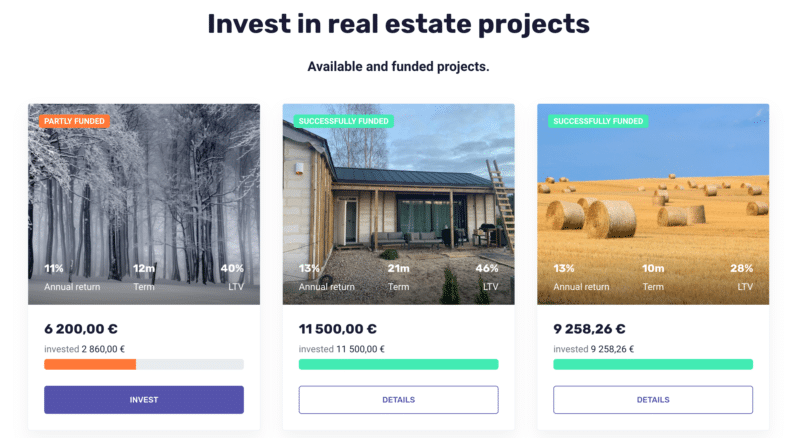
LANDE occupies a niche that no other platform on this list touches: agricultural loans for farmers in Eastern Europe, secured by first-rank mortgages on farmland and agricultural assets. Founded in 2019 in Latvia (originally as LendSecured), the platform holds an ECSP license, has over 8,500 investors, and has funded more than EUR 32 million in loans.
Returns range from 10-14% annually. The collateral structure is extremely conservative, with an average loan-to-value ratio around 37%. All loans carry first-rank mortgage security, meaning LANDE investors sit ahead of everyone else in the repayment queue in the event of default. To date there have been zero capital losses for investors. LANDE also invests its own capital alongside investors in every project, which aligns incentives properly.
The monthly volume is modest (around EUR 1 million), reflecting the niche agricultural focus. That’s not a weakness. It’s a platform that does one thing well rather than trying to be everything to everyone.
See also: My full LANDE review
11. Hive5
| Regulation | Unregulated (Croatia) |
| Average Returns | 12-15% |
| Buyback | Yes (60 days) |
| Secondary Market | No |
| Auto-Invest | Yes |
| Min. Investment | EUR 10 |
| Loan Types | Consumer, business |
| Founded | 2022 |
Hive5 launched in 2022 and has grown fast. It’s incorporated in Croatia and operates primarily out of Vilnius, Lithuania. The platform now has over 28,000 investors with more than EUR 156 million in loans funded and monthly origination of EUR 6-8 million.
Returns sit at the higher end of what’s available: 12-15% annually, with all loans covered by a buyback obligation if a payment is delayed beyond 60 days. The minimum investment is EUR 10 and the interface is clean and straightforward.
One caveat: Hive5 is not regulated by a financial authority, and it operates from Croatia where platforms can argue legal exemption from the ECSP framework. There’s also structural overlap between the platform and some of its loan originators, which is a concentration risk you should weigh up. The higher returns reflect higher risk.
See also: My full Hive5 review
12. Bondora

| Regulation | EMI licensed (Estonia) |
| Average Returns | 6% (Go & Grow) |
| Buyback | N/A (pooled product) |
| Secondary Market | N/A (daily liquidity on Go & Grow) |
| Auto-Invest | Yes |
| Min. Investment | EUR 1 |
| Loan Types | Consumer (Estonia, Finland) |
| Founded | 2009 |
Bondora is one of the oldest platforms in European P2P lending, founded in 2009 in Estonia. I’ve been investing there since 2016. The platform’s flagship product, Go & Grow, offers a fixed 6% return with daily liquidity, which makes it the most conservative option on this list. It set all-time deposit records in December 2025 (EUR 46.7 million in a single month) and is approaching 500,000 investors with nearly EUR 1.9 billion in total investments.
Bondora has been profitable for eight consecutive years, a statement very few platforms in this space can make. Go & Grow appeals to investors who want simplicity and liquidity at the cost of a lower yield. If you want higher returns, the standard portfolio products are still available but require more active management. Either way, Bondora’s longevity and profitability make it one of the most credible operators in the market.
See also: My full Bondora review
Also Worth Considering
These platforms didn’t make the top 12 but are legitimate options worth evaluating depending on your priorities.
Esketit is backed by the Creamfinance group and offers consumer loans across multiple markets with returns of 10-14%. The platform holds an ECSP license and has grown steadily since launching. Buyback guarantee activates after 60 days. A solid mid-tier option with regulatory backing. Read my review.
Income Marketplace offers around 13% returns with an innovative “junior share” mechanism where loan originators absorb the first losses before investors take any hit. Lifetime volume sits at EUR 201 million. The platform is unregulated and still doesn’t have a secondary market, but the structural protections are among the best in the industry. Read my review.
Fintown is a Czech real estate platform focused on AirBnB apartments in Prague. The niche is interesting and the platform has funded around EUR 24 million. It’s unregulated and small, so treat it as a satellite allocation rather than a core holding. Read my review.
Monefit SmartSaver offers a savings-like product with 7-10% returns backed by Creditstar Group’s consumer lending portfolio. With over 30,000 investors and EUR 302 million in assets, it’s a simple option for investors who want P2P-level returns without managing individual loans. The parent company Creditstar is a well-established lender, though the product itself is not separately regulated. Read my review.
Lonvest launched in 2023 and targets up to 13% returns with a 60-day buyback guarantee. It’s connected to the UnaFinancial ecosystem (same parent as RoboCash) and is expanding into Mexico. At only EUR 1.6 million in lifetime volume and roughly 600 investors, it’s still very early stage. The signals are positive but treat it as a small speculative allocation. Read my review.
Maclear is a Swiss-based platform offering business loans with returns of 14-16%. The platform is regulated by the Swiss financial authorities and offers collateralized loans with a buyback guarantee. It’s relatively new but the Swiss regulatory framework provides a different kind of credibility compared to the Baltic platforms that dominate this space.
How I Evaluate P2P Lending Platforms
After nearly a decade of investing in P2P lending, I’ve developed a framework for evaluating platforms that goes beyond headline returns. Here’s what I weigh most heavily:
Regulation first. A MiFID II investment firm license is the gold standard. ECSP is good. No regulation means you’re trusting the platform’s word alone. I allocate the majority of my P2P capital to regulated platforms and only smaller amounts to unregulated ones with proven track records.
Parent company financials. Buyback guarantees are only as strong as the entity making them. I look at parent company profitability, debt-to-equity ratios, and revenue trends. A platform offering 14% returns with a parent company bleeding cash is riskier than one offering 10% with a profitable parent.
Track record through stress. Platforms that operated through COVID, the Ukraine war, and the 2022 interest rate shock without investor losses have earned credibility that newer entrants simply don’t have. That lived experience matters.
Diversification of loan originators. Single-originator platforms concentrate your risk. If that originator fails, your entire investment is at risk simultaneously. Multi-originator marketplaces like Mintos spread that risk across dozens of lenders in different countries.
Liquidity options. A secondary market matters if you might need access to your capital before loans mature. Platforms without one lock your money until each loan term ends.
Understanding Regulation
Regulation has become the single most important differentiator between P2P platforms. Here’s what the three tiers mean in practice.
MiFID II (strongest): Platforms holding an investment firm license under MiFID II are supervised by the same financial regulators that oversee banks and brokerages. Investors benefit from the EUR 20,000 compensation scheme, mandatory capital adequacy requirements, and proper complaint resolution mechanisms. Four platforms on or near this list hold these licenses: Mintos, Nectaro, ViaInvest, and Debitum.
ECSP (good): The European Crowdfunding Service Provider regulation provides a pan-EU framework for crowdfunding platforms. It’s less comprehensive than MiFID II but still requires regulatory authorization, key investment information sheets, and investor protection measures. Platforms with ECSP licenses include Debitum, Afranga, Esketit, LANDE, and InRento.
Unregulated (higher risk): Several popular platforms operate without specific financial regulation, often from jurisdictions like Croatia or Estonia where they can argue legal exemption. These platforms may still be trustworthy, but you’re relying entirely on the platform’s goodwill and track record rather than regulatory backstops. PeerBerry, Swaper, RoboCash, and Hive5 fall into this category. Bondora holds an Electronic Money Institution (EMI) license in Estonia, which provides some regulatory oversight but is not equivalent to MiFID II or ECSP for investment protection purposes.
Who Can Invest?
All platforms listed here accept investors from across the European Union. Most also accept investors from non-EU European countries. If you’re based outside Europe, some platforms will still accept you. Check each platform’s registration flow for current eligibility rules.
Most platforms require you to be at least 18 years old and to complete identity verification (KYC). The process typically takes a few minutes to a few days. Some platforms have minimum deposit requirements ranging from EUR 1 (Bondora) to EUR 500 (InRento).
What Returns Can Investors Realistically Expect?
In 2026, realistic net returns on well-managed P2P portfolios across European platforms fall in the 8-12% range. That’s after accounting for cash drag, occasional defaulted loans, and any platform-level risks that materialize.
That range is worth contextualizing. European savings rates have risen from near zero to somewhere in the 2-4% range for short-term deposits, depending on the bank and country. High-yield bond ETFs yield 5-7%. P2P lending still offers a meaningful premium over both, but the spread has compressed compared to the 2015-2021 period when bank savings paid essentially nothing.
The platforms advertising 14-16% headline rates tend to have higher underlying risk, shorter track records, or significant cash drag that eats into effective yields. I don’t chase the top of that range. The platforms I weight most heavily in my own portfolio target 10-12%, with strong regulatory standing and multiple years of clean track record behind them.
Risks of P2P Lending
P2P lending is an alternative investment with real risks. Platform failure, loan originator default, liquidity risk, and regulatory change can all affect your returns or your ability to access your capital at all. Buyback guarantees protect against individual borrower defaults but not against the insolvency of the loan originator making that guarantee.
The European market has lost multiple platforms in recent years: Grupeer turned out to be a scam, Crowdestor defaulted on 67-80% of its portfolio, Reinvest24 collapsed with 100% of funds in recovery, and EstateGuru has 62% of its portfolio under recovery with EUR 133 million in defaults. These are not edge cases. They represent a meaningful portion of the platforms that existed five years ago.
The most effective risk mitigation strategy is diversification across multiple regulated platforms combined with realistic return expectations. Never invest money you can’t afford to lose entirely, and never concentrate more than 10-15% of your investment portfolio in P2P lending.
I’ve written a detailed guide on whether P2P lending is safe that covers these risks properly. Read it before you invest.
Alternatives to P2P Lending
If you want to diversify your alternative investment allocation beyond P2P loans, European real estate crowdfunding platforms are the most natural complement. They typically offer similar yield ranges backed by property assets rather than consumer or business loans. The liquidity profile is different (terms tend to be longer) but the collateral quality can be higher.
For a more conservative allocation, Bondora’s Go & Grow or Monefit SmartSaver bridge the gap between savings accounts and higher-risk P2P, offering 6-10% with simpler, more liquid products.
Frequently Asked Questions
What is P2P lending?
Peer-to-peer lending connects investors directly with borrowers through online platforms, cutting out traditional banks. You lend money to individuals or businesses and earn interest on the repayments. In Europe, most P2P platforms work with loan originators who underwrite and service the loans, rather than individual borrowers posting loan requests.
Is P2P lending safe?
P2P lending carries real risk. Platform failures, loan originator defaults, and fraud have cost investors money. However, properly regulated platforms (MiFID II or ECSP licensed) offer meaningful investor protections. The key is diversifying across multiple platforms and prioritizing regulation over headline returns. Read my detailed guide on P2P lending safety.
What returns can I expect from P2P lending in Europe?
Realistic net returns in 2026 range from 8-12% annually on a well-diversified portfolio. Conservative options like Bondora’s Go & Grow offer 6% with daily liquidity. Higher-risk platforms may advertise 14-16% but actual returns are often lower after accounting for cash drag and defaults.
Do I need to pay tax on P2P lending income?
Yes. P2P lending income is taxable in most European countries, typically as interest income or capital gains. Some platforms withhold tax at source (e.g., 20% in Latvia, 10% in Bulgaria), which can usually be credited against your home country tax liability under double tax treaties. I’ve written about how P2P lending is taxed in Spain as an example.
What is the difference between MiFID II and ECSP regulation?
MiFID II (Markets in Financial Instruments Directive) is the same framework that regulates stockbrokers and investment firms. It provides the EUR 20,000 investor compensation scheme and strict operational requirements. ECSP (European Crowdfunding Service Provider) is a newer, EU-wide regulation specifically for crowdfunding. It requires authorization and investor protection measures but is less comprehensive than MiFID II. Both are significantly better than no regulation.
What is a buyback obligation?
A buyback obligation (sometimes called a buyback guarantee) means the loan originator promises to repurchase a loan if the borrower falls behind on repayments, typically after 30-60 days. The originator buys back the principal and accrued interest. However, this is a contractual promise, not an insurance policy. If the loan originator itself goes bankrupt, the buyback obligation becomes worthless.
Can I invest in European P2P platforms if I live outside the EU?
It depends on the platform. Many European P2P platforms accept investors from non-EU countries, though some restrict access based on jurisdiction. Check each platform’s eligibility requirements during registration. You’ll need to complete identity verification regardless of where you’re based.
Conclusion
If you’re new to P2P lending and want to start somewhere sensible, I’d suggest opening accounts with Mintos and ViaInvest first. Both hold MiFID II licenses, have real scale, and have survived multiple market disruptions. Nectaro is a strong third choice if you want to maximize returns while staying within MiFID II regulation. From there, diversifying across two or three additional platforms reduces your single-platform concentration risk.
If you want to understand how P2P lending works before committing money, my ultimate guide to P2P lending covers the mechanics in depth. And if you’re still on the fence about whether the asset class makes sense for you, I’ve written a straightforward breakdown of why you should (or shouldn’t) invest in P2P lending.
Before you invest, make sure you understand how P2P income is taxed in your country. I’ve written about how P2P lending is taxed in Spain, which may be useful if you’re a Spanish resident.
Have you invested in any of these platforms? What has your experience been? Leave a comment below.
Related









What is your opinion about Iuvo Group?
I’m not too impressed by Iuvo Group; the website is old-fashioned and given the number of good alternatives there are I don’t see the point of investing there. I’d rather put my money in Mintos or Peerberry.
Hi Jean,
Thank you for the knowledge and the great Mintos article.
I am considering investing with Mintos as my first P2P experience and I was wondering how the designation of investments is decided by Mintos for example using auto-invest custom strategy there are 6000 loans matching my criteria is then just a random allocation of matching loans added to my portfolio. ?
Thank you and regards
Martin
I reached out to Mintos directly about this to make sure I get the right answer, here’s their reply:
Hi Jean,
great post! Thanks for your review. I was wondering if you come across TFG crowd, and if so, what is your opinion about this platform. Thanks!
Hi,
Was thinking of investing in Mintos but considering recent circumstances and impending recession , wouldn’t you agree that the default risk would increase as probably these borrowers would first choose these unsecured loans to not pay?
Have you liquidated some of your loans just because of the recent crash , or have you actually increased your interest rate ??
Thinking whether I should wait or just invest now (but make use of money back guarantee).
Hi Bernard,
Please read my thoughts on the COVID-19 circumstances and the effects on P2P lending.
I advise against knee jerk reactions to market sentiment when investing, hence I have not changed my positions much. I have certainly explored other more interesting areas such as stocks and cryptos, because in such conditions there might be bigger gains to be had in those asset classes.
If it’s your first dip into P2P lending, consider using the best platform (Mintos) and putting in an amount of money that won’t hurt if you lose it. The upside would be that you get to learn how P2P lending works (skin in the game always beats any reading on blogs or books) and benefit from higher interest returns. Once the market conditions stabilise and the future is clearer, you would have already built up a good degree of knowledge that will enable you to either double down on this investment class or seek other alternatives.
In short, it’s always a good time to start learning, but perhaps it’s not the best time to go all-in on P2P lending.
Hope that helps.
Hi, thanks for the article!
I’m new to p2p landing and I’m willing to give it a try, I will check this platforms that you mentioned.
Do you know which of this p2p sites accept investors from UK? I know that Mintos doesn’t.
Thanks again
You’re welcome, try Flender.
Which P2P lending platforms in Europe accept investors from Malaysia ?
Thanks.
Mintos is the top one I would recommend.
Mintos is the top one I would recommend.
Thanks for sharing this article.This will definitely help me to choose the right Peer-to-Peer Lending Platform for me. This gives me a lot of ideas.
You’re welcome Lauren
Gracias Jean!
About Viventor :
– you they still offer interest rates around 15% ?
– do the loans come with buyback guarantees ?
– are there short-term loans ?
– do you still consider it as a good platform diversification option to Mintos ?
Gracias !
Hi, I’ll be doing a deep dive on Viventor soon and publish a full review of the platform.
Great ! Have a nice day 🙂
Thank you for your post
One question arising: how come Twino is your second favourite platform and you were discouraging to invest there just two months ago?
https://jeangalea.com/p2p-loan-platform-diversification/
Hi Gonzalo, thanks for pointing the discrepancy out. Twino was one of the initial platforms I invested in and I had a great run on it until it kind of fizzled out in several ways. I still consider it a decent platform with a good team behind it, but I am concerned that they have not been able to update the website and have been left behind by their competition. They also went through a rough patch financially, but they are now profitable again and have a new CEO, so I’m hopeful that they can get back on track.
I would temporarily not invest there until they show clear signs of recovery. The platforms listed on this post are not necessarily in order of preference. With all the things I have going on, I might sometimes fail to update one post or another, leading to such apparent discrepancies as you pointed out.
Once we’re at it, it’s good to reiterate that you should not rely on my choices or that of any other online publication, for several important reasons, as I listed on this other post. This is my personal blog where I note down what works for me and what doesn’t, mostly for my own benefit and record keeping. My financial situation is different than that of each reader, and we all have different monetary and life goals.
It’s also good to keep in mind that it is tough work to keep on top of a blog with so much content, so I might miss certain updates. Luckily I have keen readers like you who point these out and help me out, so thank you again for alerting me.
Hi Jean,
Thank you for your interesting article about the best P2P lending platforms in europe! It helped me significantly, but still had some questions where I would like to receive your insights:
– How much (%) of your monthly recurring income (an employee salary) would you invest in P2P lending platform?
– What would be your maximum total amount that you would invest in Mintos and IBAN?
– When and how often would you withdraw your profits/money from these platforms?
– Imagine you have 100K EUR available. How would you diversify it accross different investments? (Does not need to be only P2P platforms, can be shares, real estate, savings accounts, etc…)
– How much would you always keep in your savings account?
– Would you consider IBAN as a savings account?
Thank you in advance for sharing your insights!
You’re welcome Alexander.
Since I’m not your financial advisor (nor am I a financial advisor, period) I cannot suggest what percentage of your salary you should invest nor what total amounts you should invest on any platform.
I would not consider IBAN as a pure savings account, as it comes with risks that you wouldn’t have with a traditional bank’s savings account. On the other hand, the savings account at your bank will give you zero returns these days. So it’s a balance between risk and reward that you have to take.
I like to keep at least 6 months of savings in a highly liquid form, being in actual cash, current accounts or other. If possible, I feel more comfortable to have 1 year of savings, perhaps having 6 months’ worth as cash in a bank account, and the other 6 months invested in a highly liquid product such as Mintos’ Invest & Access account. The idea of having 6 to 12 months’ worth of money always available is that it gives you a nice cushion if you were to lose your job or have some other calamities happen in which you need quick and substantial cash to get out of a tough situation.
I am always seeking to invest more and more of my net worth, so the better question is not when to withdraw but when to rebalance. You will obviously need to withdraw if you have some big expense coming up such as a home purchase, but apart from those expenses I just monitor the market and see if it makes sense to move some of my money from one asset class to another. I do this roughly once a year. An example would be to move some money out of the stock market and into P2P lending.
As to your question about how I would diversify, as I just mentioned I like to be as diversified as possible, but I don’t currently have a fixed strategy I’m following. There are several strategies online that you can read about, but none of them are sure winners, so in the end, my belief is that each investor should come up with the strategy that best suits his current situation and future goals, then updated it every year at least to take account for changes in their lives. Here is a post I wrote about ways you can invest online, to give you some ideas of asset classes I am invested in or have been invested in the past.
Hope that helps.
Hi Jean,
Thank you for these insights and answers on my questions!
I agree with you that it is about the liquidity of your money that you need to consider when determining how much cushion you want to keep aside. I like your idea of 6mth/6mth split.
Great point about the rebalancing, instead of withdrawing, it is indeed about making your money do the work, and keep your net worth grow and grow. Whenever needed for some high expenses you just withdraw then.
Good tip on first determining your investment strategies and the goals you want to achieve with it. And especially to review this strategy yearly! In the beginning I would personally do it even more often, just to be sure if I’m on the right track.
Thanks for sharing your blog – I will read it.
One more question – do you know if it’s possible to chose eco-friendly or sustainable loans on Mintos?
Cheers
Alexander
You’re welcome Alexander!
I hadn’t thought about eco-friendly and sustainable loans and I don’t believe any platform focuses on that at the moment, however it’s quite interesting.
Could you explain to me how you would define such loans? I’d be happy to investigate further once I understand the concept better, and even talk to the platforms to see if they have any plans to that respect.
Hi Jean,
Eco-friendly loans – People receive only loans if they buy products or services that are ecologically responsible. (e.g. purchase of an electrical motorcycle, isolate your house, etc…)
Sustainable loans – Only companies or people receive loans if they do sustainable things for society (e.g. make sure girls can go to school, handicapped people can work on the shop floor, organize a festival for elderly,…)
thanks, Alexander
Got it, I think those kinds of loans will always be the domain of specialised platforms like Kiva.
Thanks for sharing this article. I think that Peer-to-Peer Lending is a great for business funding. This article is very helpful for me. I think that this will surely help me to grow my business.
Agreed, thanks for commenting.
Hey Jean,
thanks for this extensive review! I have been reading your blog for a while (even before I started to invest into p2p….basically as some sort of preparation 😉 ).
How do you generally judge investing into business loans, so p2b? Platforms like Envestio and Crowdestor are pretty big cornerstones of my p2p portfolio by now and give me an average return on investment of around 16%.
Have you been tapping into that investment sector as well? I know that you have been more critical towards e.g. Envestio in the past.
Thanks,
Marian
Hey Marian,
Thanks for your nice comments, appreciate it. I think business loans can be a good component of an investment portfolio, but I am critical of loans to businesses that are just starting out and have no real foundations. It’s like investing in a startup without the potential upside, since your return is limited. When investing in P2B loans I look for well-established companies who are not likely to default or have their new project fail. One area I will be looking into during the coming months is factoring and supply chain finance for well-established businesses. I’ll report on that once I have seen some results from my investments.
Overall I think that everyone is happy about the returns that many platforms are offering, the question is for how long this is sustainable. While I’ve invested a lot of money into P2P platforms, I keep a very close eye on the overall financial markets and the platforms to try to anticipate any negative trends and take my money out before it’s too late. So far so good, we’re still in the growth stage for these platforms, so it’s natural to have a very positive air around the industry, strong incentives for investors and high returns. Let’s see how far it goes.
Yes, good points. I tend to make sure that my p2b investments have a loan duration of max. 1 year and I keep an eye on the respective markets (essentially the Baltic States for p2b platforms like Envestio, Crowdestor, Kuetzal etc).
As you said, it’s a growing business and everyone is in that positive spirit which is great as long as we keep our eyes open.
cheers
Marian
Very helpful article. Thanks for sharing Peer-to-Peer Lending history. This definitely helps me a lot to be more knowledgeable about Peer-to-Peer Lending. I think that I can use this for my business.
Hi Jean, thanks for your post. I have just start reading about p2p lending when I came across to your blog.
You mentioned that “(…)We are living in an age of abnormally low interest rates and low inflation.” which is indeed true.
But one thing that intrigues me is that with such a low interest rates, why companies would pay 10-15%y when they could borrow much cheaper money from a bank/ financial institution? As non-expert in this field, the unique reason I can see for this is that the lenders believe that it is too risky for their portfolio.
Could you please elaborate more on that?
Thanks
Good question Ged. That was one of the first questions I asked myself when I came across P2P lending. The simple fact is that after the big global crisis a few years back banks tightened their lending policies severely, partly to protect themselves and partly because the governments and powers that be put a lot of pressure on them to keep within certain parameters.
We can also see the same happening with opening bank accounts nowadays.
Perhaps you remember that 10 years ago it was much easier to open a bank account anywhere in the world. Nowadays both private clients and corporate clients are put through hell by banks demanding reams of KYC and AML documentation, and sometimes outright refused due to their not fitting into what the banks deem “low-risk” clients and businesses.
These two facts result in a situation where many people and businesses are struggling to obtain funding through the traditional means (banks) and thus are forced to seek alternatives. That’s where loan originators and P2P lending platforms come in.
Essentially, companies and individuals are ready to accept much higher interest rates since they have no other alternative of obtaining finance, since they’ve been excluded by the banks.
While it is true that many of these businesses and individuals can have certain elements of risk, we must keep in mind that risk is a very subjective thing, and just because it is risky for a traditional bank doesn’t mean that that individual or company must not be lent to.
A simple example that you will surely understand is the following. Consider two individuals, Person A with a net worth of €500,000 (ownership of various assets including shares and other financial instruments) and Person B with a net worth of €10,000. Both go to apply for a car loan but only one gets it. Why?
The bank does the standard paperwork and discovers that Person A does not have a monthly income, but rather relies on his considerable savings to live off. He retired young and does not need to work to support his monthly family expenses since he has good investments that have been appreciating over the years. Person B, on the other hand, has an entry-level but stable job that pays him €1,300 a month.
In this situation, most if not all banks would rather issue a loan to Person B since they know he has a monthly income and part of that can be destined to paying back the loan, but Person A offers no such guarantees as he cannot show the bank any monthly payslips or regular income.
If these two people came to me, on the other hand, the decision wouldn’t be as clear cut, in fact I would probably be more likely to lend money to Person A rather than Person B because I have very different criteria than traditional banks. As you can see from this example, Person A is being forced to sing alternative funding for his loan because he does not fit into the “good borrower” definition of traditional banks.
Happy to discuss further if you want to follow up.
Quite clear, Jean. Thanks again.
Looking forward to go through the blog content.
Regards
Interesting read, but does it pay to ‘re finance a commercial real estate loan using P2P platforms and are any active in the Maltese market?
Things have gone well so far for me by none of the platforms are active in the Maltese market nor do I expect any to be doing so in the near future.
I think the Maltese market is in a bubble at the moment and I can’t see how the rises in rent and purchase prices can sustain itself much longer. I wouldn’t invest in the Maltese market myself, at least not on a long term basis, which is usually the horizon in looking at with my investments.
Welltrado is an affiliate site at the moment. They have been in the market for more than 3 years already and i do not understand the purpose of their business yet. We have started in January, launched private beta in May and we already bring value for customers, where they can deposit money with us and invest in 10+ platforms and 10 countries with one account.
Evo Estate earns money from platforms/originators – they share their commissions with us. Our investors basically get same deal as if they have invested in originator platform directly.
Hi Jean
I just discovered your blog and found it very interesting!
Have you ever used the website Fastinvest? If not, what have you heard about it? I have been using it for 9months and seems quite good.
Thanks Steve, I am familiar with FastInvest but it’s not one of my favorite platforms due to a dubious founding story and lack of transparency with their financials and loans.
Hey Jean, Incredible piece of information over here.
you make some good points about Best European P2P Lending Platforms to Invest in 2019 that I never thought about.
Thanks for sharing!
You’re welcome John.
Hi Jean. Awesome catchy post, i agree on most of your points!
You talk about the importance of liquidity, but i generally see direct P2P lending (without loan originators) to be more secure, even though the liquidity might be lower compared to the mass production loan originator service Mintos provides. Can’t it be two-folded? I mean would you definitely only go for the top 20 largest p2p lending providers compared to those listed with a lower total funding volume on a site like say p2pmarketdata.com – or do you differentiate in the three party platforms vs. four party platforms (with loan originator intermediates)?
Thanks Martin. Very interesting question, thank you. I tend to look at many factors and the bigger platforms like Mintos tend to have not only higher liquidity but easier ways to get in touch (support in multiple languages), a better interface, a bigger secondary market, etc.
I’m not saying it’s the best way to do things, but I don’t want to spend a lot of time on P2P loans every month, so working with the big and proven platforms gives me more peace of mind and saves me from spending time to learn new interfaces, getting to know new people at each website etc.
Are you still satisfied with Twino or are you experiencing heavy cash drag?
Twino is still good, but I don’t see it surviving long-term against Mintos. We now have a market saturation with so many platforms, and inevitably some of those will have to fold in the coming years, unless they pivot or diversify in a significant way.
In the case of Twino, as an example, their offering is pretty much identical to Mintos, but they have not managed to keep up with the growth of that platform, hence I see investors shifting to Mintos in the coming months/years. This is also something that I am doing myself and would recommend. That’s not to say that Mintos is guaranteed to stand the test of time, but right now I think it’s safe to say that it is the most successful and stable P2P loan platform in Europe.
I completely agree with twino vs mintos. That is why i have withdrawn all the money from Twino recently
Good to know. Would you recommend other platforms that are as stable as Mintos?
I am cofounder of EvoEstate.com – Real Estate P2P aggregator – our goal is to have the safest investments (only real estate as collateral) and most geographically diversified. Our clients have invested in 8 European countries through the platform.
I see, that’s a novel and interesting concept. Can you explain how it works?
Here is explanation how it works: https://evoestate.com/page/how-it-works/
In short: we are intermediaries. Investors do not pay us any fees. Investor gets value ad: easy diversification and secondary due diligence of projects by us
I see, then you must be making your money off some form of affiliate agreement with the platforms. It’s the first time I see something like this being done apart from Welltrado which I think was setting up something similar. I’m not sure there will be that much demand for an intermediated service like this, and I personally think that it’s one intermediation too far.
However, it’s still early days in this market and it might very well be that investors like this simplified approach to investing. Good luck with the project.
We are not working as Welltrado or affiliate. You can have one wallet with EvoEstate and invest through it to all other platforms. Also when you do your taxes, you get one account statement, which saves you time.
How is it different from welltrado and how do you make your profits?
Hi Jean,
Great site. Last year I started to invest in various P2P companies and used reviews like this to choose my investment platforms. I find them very helpful!
I hadn’t heard much about Lendix before, so I had a look at your review. Something I noticed was that Lendix changed their name from Lendix to October. I read that the change was due to Lendix/October wanting to expand into other financial products, not just lending. They thought October was a better name…
Also, have you had much to do with Grupeer?
Keep up the good work!
All the best,
Matt
Thanks for stopping by Matt, I’m not sure why October would be deemed to be a better name, although Lendix is a bit generic given the number of platforms with the word “Lend” in their name, especially if they wanted to expand to other financial products.
In any case, I really like October, it’s a no-nonsense platform, less flashy and marketing-oriented compared to other platforms, but they deliver the goods. I have had no problems with loans I invested in, and they tend to supply the right amount of information (and in English) about the borrowers.
I only started recently with Grupeer so I’ll have more to say about that one in the next few months.
Hi Jean,
Thank you for the nice informative article, loved it!
I’m excited to start on Mintos soon.
Also, you mentioned that you also invest in stocks. Do you mean ETFs? I wanted to try out robo-advisors such as Betterment, but they only allow US residents. In your expert view, could you please recommend a good robo advisor with a low starting fund I could look into? What company or platform do you use to invest in stocks, loans and real estate?
I look forward to hearing from you. Thanks a lot 🙂
Excellent, Mintos is my favorite platform for P2P.
For roboadvisors I have no recommendations.
I have written about all the real estate platforms I use on this site, just use the search option and they’ll show up. It depends on which country you want to invest in, so make sure you include the country in your search query. I have invested in Spain, Italy, Portugal, Germany, UK real estate so far.
With regard to stocks I like the dividend growth investing approach, and the choice of platform really depends on what kind of trading and investing you plan on doing, the amounts you want to invest and where you’re a resident. Some good brokers to look into are Interactive Brokers, Saxo Bank and DeGiro. I’ve written about the best stock brokers in Spain as well as the best stock brokers in Europe based on my experience and research.
You should not forget all the risks Mintos have. Especially now, when they got denied by FCA.
All loan platforms have inherent risk and I would agree that they should be a minimal part of one’s portfolio. On your blog you make some important accusations with regards to Mintos, but you don’t reply a comment stating Mintos’ own reply. Would be nice to see your reply to their reaction.
1. The accusation part is a copy from Blogspot – I have put a copy so that it does not disappear.
2. The reply is not by Mintos, but by some other 3d party, who got the reply from Mintos.
3. I have not found any article on Mintos Blog related to Shareholder Relations between Mintos, Mogo and others.
Ok but since Mintos addressed the concerns you highlighted, what’s your reply to what they said?
so there are 2 issues:
1. Buy-Back guarantee. Everything is fine here and they probably have changed terms and conditions.
2. Relationship between loan originators (Mogo, Hipocredit and others) – i could NOT find any article in their blog as they claim:
“We also have published information on our platform when there are overlapping between Mintos and loan originators shareholders.”
Thanks for expanding on that.
Shame he wouldn’t expand on how they make money ….
Hi John, if you mean how the platforms make money, that is a good point indeed and would be a good addition to the post. I’ll add in a section about it, thanks for your feedback.
Thanks for sharing a informative post.It is really informative and helpful.valuable information provided.An installment loan is a loan that is repaid over time with a set number of scheduled payments;[1] normally at least two payments are made towards the loan. The term of loan may be as little as a few months and as long as 30 years.
Hi jean, I appreciate the site, recently moved to Eire from UK, I wanted mention I’ve bn using funding circle zopa rayesetter in UK for last 2 years so I’m used of the concept, I moved here year ago and inbvestef in linked finance , but I have bn looking into European p to p sites, thanks to yours asmd others I started invest mintos October 2018 and when exchange Rateimprove all use twino and lendix
I do have a question for you , I wish to invest into equities like a MAP or something like that a fund that would be fairly safe I guess, as i take my risks with p2p
Do you recommend any funds I could look at? They are so many , its tricky to know which way to turn ,
The sum I wish to usebis approx 50\60k euro
This would diversify my money nicely between p2p UK Eire and Europe ,, not intrested in owning property again , way too much hassle , p2p has given me my time bk so…..
Appreciate your thoughts and if u wanted to know anything of my experiences using p2p in UK
Kind regards
Mal
Hi Malcolm, it would be cool to know about your p2p experience in the UK for sure.
With regard to equities I’m not an expert in that area but Vanguard index funds are always highly rated. I would recommend De Giro as a broker.
There was a very good informative post that does an excellent job of introducing the concept of top European peer to peer landing sites in 2018. Thank You.
You’re welcome.
Hi Jean, thanks for the post! Can USA investors invest in Mintos and Twino?
I believe so Tom, here’s what it says on the Mintos FAQ:
Both individuals and entities can invest through Mintos. Individual investors must be at least 18 years old, have a bank account in the European Union or third countries currently considered to have AML/CFT systems equivalent to the EU, and have their identity successfully verified by Mintos.
Family trusts, partnerships, limited liability companies and other organizations must have a bank account and be registered in the EU or third countries currently considered to have AML/CFT systems equivalent to the EU.
what is the incentive for you advertise a good P2P platform that you invest through? I also invest through these platforms but will not tell any of my friends, let alone write a blog about it. You know, success attracts more money and before you know it returns will come down. Also i fear that the really successful platforms may be bought up by big banks or hedge funds and then they will put their own funding in and shut it down for retail investors. So, shhhht don’t write about this anymore. It is our secret ok?
I take that as a tongue-in-cheek comment but it’s worth mentioning why I share this stuff. Blogging about my investments helps me learn and also helps many of my friends learn from my experiences. I love sharing and teaching and blogging about many topics comes natural to me. The argument about attracting jealous eyes or having others flood the market has existed since the beginning of time. Yes there is this risk, but the benefits I obtain from blogging far outweigh the downsides. For every set of jealous eyes, there are 3 or 4 other people who read my articles and leave valuable feedback that makes me a more informed person and better investor.
Great Article…I mainly use Mintos; will see others though as well. May I ask you Jean if you ever had a loan yourself with one of the sites mentioned or others? If yes how was it? Maybe an article about the experience? Mintos don’t give loans as I checked….You can just invest….
Hi Joseph,
I’ve only been active on these platforms as an investor.
ok thanks. I will try to get a loan from them…if you want i will report back to you how it was
Sure, that would be interesting thanks.
Will do…Cheers
Very interesting article! I read about Mintos and Twino from other blog posts and articles, and it looks like they are quite reliable with good returns too. Are there any other platforms that you would recommend that are known to accept investors from Malta? Also, how does the tax system work after starting to get the returns?
Thanks Bjorn, those are the only two I would recommend at the moment. You would need to declare the returns in Malta, they give you the gross sum and then you deduct tax from it and declare it, leaving you with the net amount. Best to check with an accountant exactly how it is noted on the Maltese tax return.