Jean Galea

Health, Wealth, Relationships, Wisdom

  • Start Here
  • Guides
    • Beginner?s Guide to Investing
    • Cryptocurrencies
    • Stocks
    • P2P Lending
    • Real Estate
    • Forex
    • CFD Trading
    • Start and Monetize a Blog
  • My Story
  • Blog
    • Cryptoassets
    • P2P Lending
    • Real estate
  • Consultancy
    • Consult with Jean
    • Consult a Lawyer on Taxation and Corporate Setups
    • AI Consultancy for Business
  • Podcast
  • Search

Living in Barcelona – An Honest Review

Last updated: March 03, 20247 Comments

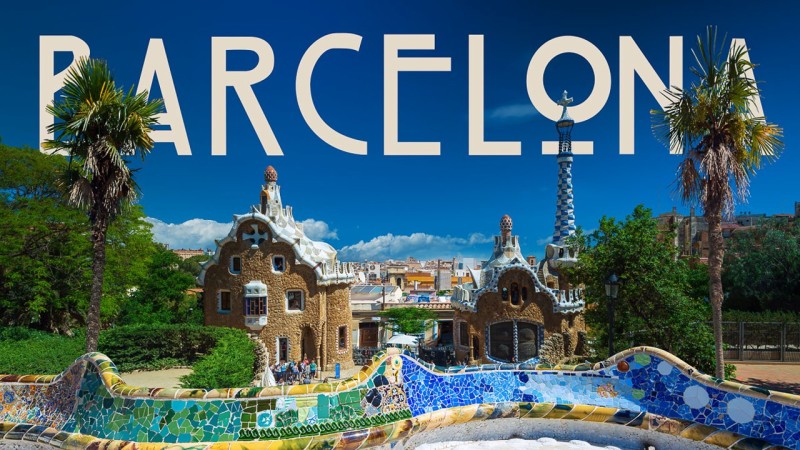
BarcelonaAfter spending several years traveling as a digital nomad in search of an ideal place to settle in, our choice fell on Barcelona.

I think it’s one of the best destinations in Europe for online entrepreneurs, lifestyle designers and freelancers. The closest alternative I’ve found is Lisbon, and I’ve compared the two in my Lisbon vs Barcelona article. In a nutshell, Barcelona is the better place lifestyle-wise, but Lisbon wins on the taxation front due to its NHR programme and lack of tax on crypto. It would also probably be fair to say that if you’ve already made your money and want to be around investors and well-off families, Cascais (seaside town close to Lisbon) is the better option for you.

This is a subjective post as every person/family has their own needs and requirements from a place; Barcelona just happens to fit mine very well. Here’s why. I will list both positives and negatives. People tend to criticize me for looking negatively at countries or cultures, but I only try to be realistic.

I choose to live in a city/country not because everything there is perfect, but because the good things outweigh the bad ones by a very significant margin. This ratio can change over time so I do evaluate my thoughts every few years, keeping into consideration the alternatives available.

Although I do my best to integrate wherever I am, that doesn’t mean that I’ll adopt the negative aspects of that culture, nor do I stop wishing that those aspects would change over time.

With that in mind, I’ll be going through all the best and worst things about Barcelona.

The Good

Sport is in Barcelona’s DNA

Barcelona is a city where sport is held in very high regard. You can easily practice any kind of group sports, and there are great locations for individual sports too. Do you love running? You have the hills and mountains all to yourself, not to mention the seaside promenade. Beach volley, check. Football, check. Cycling, awesome. Padel, of course! Swimming? At many gyms all year round or in the sea. The list never ends. The only problem I have is deciding what sport to practice!

A big chunk of Barcelona owes its origins to the Barcelona Olympic games in 1992, and today one can still feel that ambiance pervade the city. There are many gyms to choose from at all price ranges, with many of them having an indoor pool. The topology of the city also presents natural invitations to practice sport. There are some awesome hills and mountains to climb if you’re into cycling, or you can head to the beaches for a swim or try your hand at SUP.

When I arrived in Barcelona I also fell in love with padel, and this city, along with Madrid, is the top place to be for any padel amateur or pro player.

One can also find several apps designed to help people access many gyms and sports facilities for one monthly price, which is very convenient. On the other hand, the level of gyms and sports club is very average. I would expect a city like Barcelona to have better clubs. If you are looking for the best of what there is, have a look at Arsenal (men only) and Bonasport.

I don’t need to mention that Barcelona is home to one of the most famous football clubs in the world, Barcelona FC.

Culture and Diversity

Barcelona is a city that oozes culture wherever you go. Each barrio in the city has its own character and it’s clearly felt as soon as you arrive there. The city center is, of course, world-famous, with the Gothic quarters and El Born being a true experience for culture vultures. Note that the center has become a pickpocket and junkie ridden place, and most locals don’t spend much time in that area anymore unfortunately.

Gastronomy

Another thing I love about Barcelona is eating out. There are thousands of restaurants and many great cafes too. By using apps like The Fork (El Tenedor) you can also get fantastic discounts when eating out. Spain is also home to the fabulous menu del dia, which translates to menu of the day. The majority of restaurants will offer a three-course meal at a very good price every single working day during lunchtime. Expect a three-course meal for 10-14 euros. That’s why many workers don’t bother cooking themselves, they just go out and have a great meal and socialize during their long lunch breaks. In the evening they then prepare something simple or go out to socialize again over tapas.

While we’re talking about gastronomy, it’s also worth noting that I’ve found a good number of coffee shops, and coffee is very reasonably priced. They’re great for mingling with other people, holding meetings or just absorbing the Barcelona vibe and people watching.

There are plenty of Michelin star restaurants too if you fancy luxurious meals that involve all the senses.

I’ve even managed to find a chef to cook all my meals at an affordable price, which is one of the best luxuries one can have in my opinion.

Transportation

Moving around is really easy. You can use the metro and bus system, both of which are modern and efficient. You also have the possibility to use the city’s bike-sharing system, as well as make use of car and scooter-sharing platforms. Moreover, Barcelona is a very walkable city. I can’t imagine how many kilometers I’ve walked since I got here. Back when I lived in Malta, I barely walked as we had to take the car to go anywhere. Here I don’t even own a car, it’s just too easy to get to where I want to go via public transport or my own foldable Brompton bike.

Barcelona has a very efficient bus and metro system, so you can get to most parts of the city very easily with minimum hassle. I also love the fact that there are many scooters (it’s the city with the most scooters per capita in Europe) as I’m a big fan of this mode of transport. I don’t love the noise that the older ones make, and I hate the noxious fumes the very bad ones leave behind, but hopefully, over time they’ll be made illegal in favor of cleaner electric scooters. I use the electric scooter sharing system which is great.

From where we live to anywhere in town I can pretty much choose between 7 types of transport depending on various parameters, such as comfort, traffic, cost etc.

Co-working Spaces

Barcelona is one of the European cities with the most co-working spaces. In the past few years these types of offices have really taken off, so I definitely think one can easily find a space to fit his tastes. Here’s a map of all the coworking spaces in Barcelona. As for quality, Norssken is the best I’ve seen.

International Feel

Being a major tourist hub as well as home to many ex-pats, Barcelona has a truly international feel. I haven’t encountered anything similar in other Spanish cities and so I think Barcelona is unique in this aspect. As much as I love to immerse myself in new cultures, I don’t feel so good in the long run when I so obviously stick out in any way amongst the local population. Barcelona is a melting pot of cultures so I have no problem at all, if anything it gives me access to different cultures all in one place.

Friendly People

I realize this is a somewhat subjective thing and it also depends a bit on who you have the luck to meet. However, the vast majority of people are very friendly and ready to help. I had spent two months in Barcelona in my twenties (the real start of my digital nomad lifestyle), and even then, when I couldn’t really speak Spanish, I had found people to be very helpful. I don’t understand why some people say that the people in Barcelona are not friendly and will refuse to speak to you in a language other than Catalan. I’m not sure where this myth originated from but my experience has been totally different. Note that this might be true in smaller towns in Catalunya, but definitely not in Barcelona itself.

Cost of Living

The cost of living is very decent. It’s lower than in other big cities in Europe. Keep in mind that local salaries are also on the lower end when compared to their northern European counterparts. If you own an international business or work for a foreign company, chances are your monthly income will be significantly higher than the local average, so you’ll be able to afford a great apartment, eat out at the best restaurants, etc.

International Private Schools

For those of you with kids, you’ll be pleased to know that there are several international schools. The American School is the leading private school in the city. The public schooling system seems to be good enough by international standards, although I think the level of spoken English needs to be improved drastically.

I find it appalling that many young people in their twenties in their thirties still can’t speak any English. I am one of those who believe that having a great command of the English language is one of the best elements of one’s education as it opens so many doors. The fact that the classes are taught in Catalan within the public school system makes that option unfeasible for many ex-pats including myself, but I would always go for an international private school anyway. Keep in mind that there is a strong movement within the local system to promote the Catalan language and suppress Spanish within schools. You can imagine how much attention is given to English and other foreign languages within this environment.

Kid-Friendliness

Barcelona and Spain in general are a great place to raise kids. Private international schools are good, although the public system is not ideal for expats as previously mentioned. Taking kids with you to restaurants and other places is the norm and they will get many smiles and compliments from the locals.

On the other hand, I would advise against adopting the typical bedtimes practiced by most Spanish. Research and common sense indicate that it is much better to put kids to bed earlier.

Opportunities for Short Trips

If you ever get bored of Barcelona, there are many awesome day trips you can take, and of course flights to other Spanish cities and the islands are cheap. The Catalan government is very active in promoting the community’s best sights and outings. On this site, you will find many suggested trips.

Barcelona has a pretty unique position between the mountains and the sea. It’s great to be so close to the beaches, both those in Barcelona itself and also places like Castelldefels and Sitges which are only a short train ride away. They can be easily reached by car as well of course. On the other hand, there are the mountains which offer a nice opportunity for those times when you need to get away from it all and immerse yourself in nature.

Furthermore, connections from Barcelona to other important cities in Spain and throughout Europe are readily available. You can hop on a train or fly to most places directly from Barcelona. Since most of the conferences in my field take place in the US, having good flight connections to North America is also a plus. It’s very important for me to be somewhere that is well-connected to the rest of the world and with few barriers to international travel. Barcelona is one such place, with a very good airport just twenty minutes away from the city center.

Interesting Suburb Options

Families or people who are more used to living in the suburbs rather than the main city centers can opt to live in some good suburbs near Barcelona, chief of which are Castelldefels, Gava, and Sant Cugat. Within the Sant Cugat area, the best places to live are Coll Fava, Parc Central, Volpelleres, Mirasol, Golf and Can Matas.

Personal and Business Networking

Barcelona is becoming a central hive of activity for startups, freelancers, entrepreneurs and digital nomads. It’s one of the top destinations in Europe and even worldwide if you fall within those categories.

Since the city hosts so many entrepreneurial minds it is no wonder that one can find several groups and meetups which can serve as a hotbed for networking as well as making new friends.

If you’re new in Barcelona or new to the networking scene in general, you will find many meetups and groups, for example the group I founded a few years back:

Barcelona Entrepreneurs and Digital Nomads – One of the biggest groups on Facebook for Barcelona-based entrepreneurs and digital nomads. Recommended for asking questions about the city, coworking spaces, good cafes, etc.

The Negatives

Every place has things that could be improved, and Barcelona is no exception. Here are the things that bother me the most:

Property Prices

One of the worst pains is finding rental accommodation. Like many other major European cities, prices for buying or renting property have been steadily going up, and coupled with the fact that most buildings are pretty old and shabby, you end up having to spend a pretty penny to get a decent modern apartment. On the other hand, it is still quite far from the prices in cities like London and Paris. We are also finally seeing the refurbishment of many apartment blocks taking place. This was sorely needed, as the quality on offer wasn’t up to standard with what you find in other countries. Therefore we had a mismatch with economically well-off ex-pats struggling to find a decent apartment even though they had solid budgets. Things are now changing, and if you have the money you can usually find an apartment that fits your requirements.

I’ve written an article about renting vs buying property in Barcelona if you’re more inclined to buy rather than rent. There are currently rent controls in place in Barcelona as well as a social-housing quota for new builds. This has led to new home building practically grounding to a halt after a social-housing quota of 30% was imposed on all new projects above 600m2. This is the result of the nonsensical socialist policies that are all the rage in Spain and in particular in Barcelona at the moment.

Worst Regional Tax System in Spain

Catalonia, which has twice as many regional taxes when compared to the rest of the Spanish regions, ranks last in the Tax Foundation’s 2020 Spanish Regional Tax Competitiveness Index. In 2020, a new tax on amenities with an environmental impact was ratified after the tax on the environmental hazard of radio-toxic elements was declared unconstitutional. Catalonia also reduced the inheritance tax credit and raised the marginal income tax rate by up to two points. Additionally, it has one of the worst-structured individual income and wealth taxes.

Catalonia also ranked last in 2021, and the surrounding regions hardly offer any hope for those who might be thinking of living just outside Catalonia. Aragon and Valencia are ranked just above Catalunya. Madrid, on the other hand, is first in the competitiveness index.

The Independence Movement

I’ve written an entire post on this destructive movement that has dealt a big blow to Barcelona’s reputation, not to mention the millions of euros it cost to repair the damage done during the separatist protests in recent years. I won’t even get started on the incompetence of Barcelona’s mayor which has led to a noticeable decline in many aspects of the city in recent years.

Dog Poop

Yes, unfortunately, this is a city of dogs and a small percentage of dog owners are not very responsible. You have to be careful as you’ll encounter dog poop on most of your walks here, which is pretty disgusting especially if you end up stepping on it.

Lack of Green Areas and Parks

There is just one big park in the city, and if you have kids, you’ll quickly notice how hard it is to find areas for them to play.

Sand in Children’s Play Areas

Unfortunately, the city council insists on using sand for children’s play areas. This means that your kids will end up very dirty if they play there. I have one of these play areas right in front of my apartment, and every morning I see dogs pissing in the sand while on their walk with owners, and a few hours later it’s full of kids happily playing in that same sand. Insane.

Noise Pollution

Another issue is the noise that is generated by cars (the majority of which use the noisier diesel engines) and more importantly scooters, the worst of which are obnoxiously loud and polluting.

Luckily, scooter sharing programs in Barcelona use electric scooters and they are growing steadily in usage. Unfortunately, they are hampered by the pig-headed thinking of the local mayor, who, instead of aiding them, recently changed the rules in order to drastically reduce the number of shared scooters available, crippling this system.

There are also new laws that prohibit older and more polluting cars from entering the city.

Air Pollution

That brings us to the point of air pollution. Unfortunately, Barcelona’s air is quite polluted, even though it sits on the coast and has some nice mountains on the other side. Go out to the suburbs and you’ll immediately notice the difference in air quality.

For this and the above reasons, in most parts of the city, you are forced to keep the windows shut at all times of the day.

You’ll see most of the locals prefer to eat on the terraces, many of which are along busy roads. I honestly don’t understand how they enjoy that, but I guess they’ve grown up in those conditions and have developed some sort of way to ignore the noise and pollution while they enjoy their meals or drinks.

These negatives are all quite serious, especially when you have young kids who are more sensitive and susceptible to illness as they develop. This is the reason why many young families, local and expats, move to the suburbs (Sant Cugat being the top place for expats). However, by doing that, you do give up some of the many incredible things that Barcelona has to offer. The good thing is that you can still commute to Barcelona quite easily if you wish to, so I think it’s a good compromise if you have kids.

And some others that are hopefully self-explanatory:

  • Not washing their hands after going to the bathroom and doing their thing
  • Not taking their shoes off when they enter the apartment
  • Cagatio tradition (too weird any way I look at it)
  • Extremely loud talking
  • Cigarette butts are thrown onto the street, and spitting is common too
  • Poor timekeeping
  • Low level of accountability, there’s always something or someone else to blame
  • Customer is not given much value in shops

Due to some negative traits in their culture, I think it will be very hard for Spain to compete internationally in business. Greed and corruption, as in many other Southern European states, dominate over efficiency and helping each other out and trying to make everyone successful rather than just yourself. I don’t know if such countries can ever make the shift, as I can see these traits already in kids just a few years old, so they’re most probably not going to change later in life. Perhaps an influx of ex-pats might shift the pendulum, but I’m not counting on it.

In the meantime, given my setup, I manage to structure my life in a way that I get to enjoy the positive things about Spain while minimizing the negatives, so all in all for me Spain remains my top choice as a place to live in.
My Wishlist

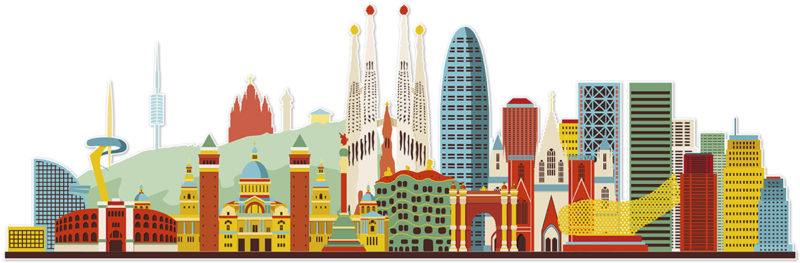
In case you’re wondering what I look for in a city where I plan to live mid to long term, here’s my current wishlist:

  • Nice people and environment
  • Good weather
  • Opportunity to practice sports, especially padel
  • A nice modern city
  • Easy connections to Malta and the rest of the world
  • Good co-working spaces
  • Decent government and taxation

All in all, I think that Barcelona is a place where you can really be what you want to be and build a life around your interests. It might not excel and top the charts at anything in particular, but it does have an incredible vibe that makes you feel at home. It is this vibe that attracts so many tourists here every year. Many of the ex-pats here started off by casually visiting the city, then immediately falling in love and moving here shortly after. Every barrio in the city has its own character, and that helps in providing a lot of diversity and opportunity for finding a place that you really like living in, with the kind of people you like in the streets, the right restaurants and cafes etc.

Barcelona feels very much like home to me, and I do think it’s one of the best places to live in the whole world, but sadly I also have to note that its trajectory doesn’t look too good for the next 10-20 years due to various factors that I already mentioned (most everything boils down to bad politics) and I wouldn’t be surprised if it loses out to other up-and-coming destinations like Lisbon over the medium to long-term. Having said that, the exceptional weather conditions will remain a major attraction for many, especially those moving here from northern Europe or other places where bad weather is the biggest pain point in their lives.

I’d love to know other people’s experiences and takes on Barcelona, so the comment section is awaiting your views!
Filed under: Expat life

Changing Your PayPal Withdrawal Currency

Last updated: March 11, 202689 Comments

paypal_logo

I’ve already written about how to avoid losing money from PayPal’s disadvantageous exchange rates when withdrawing money from your PayPal account to your local bank account, but in this post, I will be showing the exact process that is used at this point in time (June 2014) for anyone who wants to do the same. Unfortunately, you won’t find this information anywhere on PayPal’s website, so I had to figure things out myself by contacting their support staff.

First of all, a quick explanation of why I wanted to change my withdrawal currency. My local bank accounts are in Euro and since my business is based in Malta I am only allowed to withdraw money to the credit card issued by my bank or to a Euro bank account.

Sadly there is no option to have a credit card account in USD. Therefore what was happening was that whenever I withdraw from PayPal (where most of my funds are in USD), the PayPal system would automatically convert from USD to EUR to match my local bank account. The problem is that the rates PayPal uses are much worse than the conversion rates at my local bank. So I wanted the conversion to happen on the bank’s side rather than PayPal’s.

Luckily it turns out to be easy to do. All you need to do is notify PayPal manually that you want that particular credit card to receive USD rather than EUR, and you can do this by opening a support ticket from PayPal’s website. Below I am reproducing the reply I got from PayPal when I asked them to change my withdrawal currency:

Thank you for contacting PayPal regarding questions about the withdrawal options for your Business account in Malta.

For bank withdrawals, you can only add a US bank account to your Business account, and then withdraw your PayPal USD balance to there.

For credit card withdrawals into USD, we can change the currency for your cards added to your account into USD on your request. If you wish to do this, please confirm the last 4 digits of the card that you want to be changed to USD and we will then update this in our system. This will also resolve any currency conversion loss for you when making withdrawals.

Another annoying thing for me is the $2,500 limit for every withdrawal. There is a charge for every transaction, so it is not only inconvenient to be limited in this way, but I am also getting charged for multiple transactions when I could have more easily done one. Sadly there isn’t a solution to this latter issue. This is what the PayPal support rep had to say about my query in this regard:

Regarding your question about the 2500 USD withdrawal limit per transaction, I confirm that all withdrawal limits are overridden on your account from PayPal´s side. The 2500 USD withdrawal limit is a worldwide regulation on VISA´s side, so I regret that we cannot lift this limit. However, you can make as many withdrawals per day as you want, as long as they don´t exceed 2500 USD per transaction.

I hope this post helps clear things further for those of you who have asked me how to perform this little trick and save money on your withdrawals.

Note: If you have any questions after reading this and the several other articles relating to PayPal on this site, please leave a comment or contact PayPal directly. Unfortunately, due to time constraints, I am unable to offer any advice over email so all emails related to PayPal will remain unanswered.

  1. Are You Losing out from PayPal’s Exchange Rates?
  2. Which PayPal Account is Best for You?
  3. Changing Your PayPal Withdrawal Currency
  4. Understanding PayPal Cross Border Fees
  5. How to Withdraw From PayPal into a Maltese Bank Account
  6. Withdrawing Money From PayPal for Non-US Accounts
  7. Which PayPal E-Commerce Checkout Service Should You Use?
  8. Should You Open Separate PayPal Accounts for Each of Your E-Commerce Stores?
  9. PayPal VS Wise Borderless
  10. Linking Virtual Bank Accounts and Cards to PayPal (Revolut, Wise etc)
  11. How to Change Ownership of a PayPal Account

Filed under: Money, Payment Processors

How to Save Money on Currency Conversions and Overseas Transfers in 2026

Last updated: March 10, 202654 Comments

If you’re still using your bank for international money transfers, you’re overpaying — probably by more than you realize. Banks don’t just charge a transfer fee. They also quietly apply an exchange rate markup of 2–5% above the real mid-market rate. On a $10,000 transfer, that’s $200–$500 gone before the money even leaves your account.

The good news is that the fintech alternatives have matured considerably since I first wrote about this. What started as scrappy startups are now multi-billion dollar platforms with real banking infrastructure, debit cards, interest on balances, and genuinely competitive rates. And beyond fintech, stablecoins have moved from being a curiosity to a practical tool for international transfers.

Here’s what’s actually worth using in 2026.

Wise

Wise currency conversion

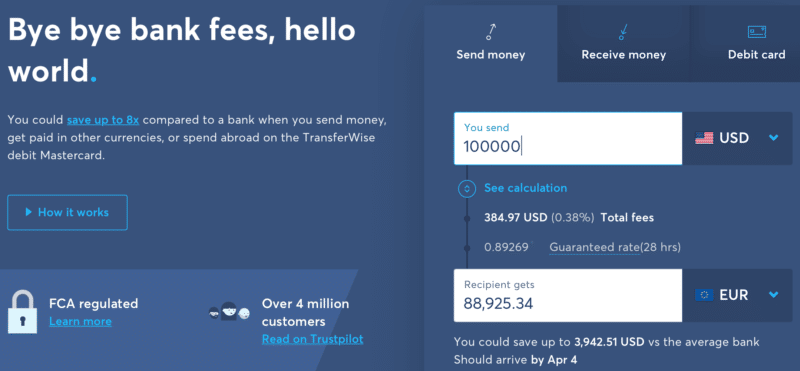
Wise (formerly TransferWise) is still my top recommendation for most people. They use the real mid-market exchange rate with no markup — what you see on Google or XE.com is what you get. Their fee is charged separately and transparently, and for major currency pairs it typically comes in under 0.5% of the transfer value.

But Wise is no longer just a transfer service. It’s evolved into a full multi-currency account:

  • Hold money in 40+ currencies with no monthly fee
  • Get local account details in USD, EUR, GBP, AUD, and more — useful for receiving payments internationally
  • Order a Wise debit card for a one-time fee of around $9 USD. Spend in any currency at the mid-market rate
  • Earn interest on idle balances: as of early 2026, around 3.26% variable on GBP and 3.14% APY on USD, with EUR rates lower but still positive

The interest feature is genuinely useful if you’re holding balances between transfers. The fee is 0.29% annually on USD and 0.26% on EUR, which is modest for what’s effectively a money market fund.

One thing to keep in mind with the debit card: you get two free ATM withdrawals per month up to $100 USD total. Beyond that, you pay 2% on the excess and a $1.50 fee per additional withdrawal. Fine for occasional use, not ideal if you’re withdrawing cash regularly.

Sign up to Wise

Revolut

Revolut is the other major player and worth considering depending on your usage pattern. On weekdays, the free (Standard) plan gives you up to $1,000/month of currency exchange at interbank rates. Above that, you pay a 0.5% fair usage fee. On weekends, there’s a 1% markup for Standard plan users.

Paid plans remove the weekend markup entirely (Premium, Metal, and Ultra) or halve it (Plus at 0.5%). Premium starts at around $9.99/month depending on your region.

Where Revolut has an edge over Wise is the breadth of its banking-adjacent features — budgeting tools, stock trading, crypto, and more — all in one app. If you want a single app for your financial life, Revolut is compelling. If you just want the best rate on transfers and a multi-currency account, Wise is usually cleaner.

How the Numbers Compare: $100,000 USD to Euro

The Malta bank comparison in this article has been updated below, but first, a note on why these comparisons still matter.

I’ve spent time researching exchange rates offered by Maltese banks, since Malta is where I have family and financial ties. When I checked rates across the main banks for a USD to EUR conversion, almost every bank was offering around 0.745 EUR per 1 USD for smaller amounts, with HSBC consistently coming in worse at around 0.741. Those rates don’t include the wire transfer fees on top.

Here are links to the exchange rates offered by the main banks in Malta if you want to check current figures yourself:

  • HSBC Malta
  • Bank of Valletta Exchange Rates
  • Banif Exchange Rates
  • Lombard Exchange Rates
  • APS Bank Exchange Rates

The pattern is consistent: traditional banks apply a 2–5% markup above the mid-market rate on top of their flat transfer fees. For a $100,000 transfer, that’s a $2,000–$5,000 haircut before the money arrives. Fintech platforms like Wise typically bring the total cost (fees plus rate markup) under 0.5–1% for major pairs. The math isn’t close.

CurrencyFair

CurrencyFair was one of the pioneers in peer-to-peer currency exchange, and I used it for years. It’s still operating — it was acquired by Australian fintech company Zai in 2021 and remains active. However, it’s worth knowing that in 2023 CurrencyFair dropped its peer-to-peer matching model (the feature that made it genuinely distinctive), reduced its supported currency list, and effectively became a standard FX platform.

It still works, and may be worth a comparison quote for specific corridors, but it no longer has a structural advantage over Wise. I’d treat it as a fallback rather than a first choice today.

For Specific Corridors: Remitly and WorldRemit

If you’re sending money to emerging markets — Latin America, Africa, Southeast Asia, the Philippines — Remitly and WorldRemit are worth checking. They’ve built out payout networks that include cash pickup, mobile wallets, and airtime top-ups in addition to bank deposits, which matters a lot in markets where banking penetration is low.

Remitly has a Trustpilot rating of 4.6 and is particularly strong for the US-to-Philippines and US-to-Mexico corridors. Exchange rate markups run 1–3.7% above mid-market, so they’re not as competitive as Wise on rate, but for corridor-specific speed and payout options they sometimes win.

WorldRemit covers 150+ receiving countries but has seen more mixed reviews (Trustpilot 3.8). Fees range from $1–$5 flat with 0.5–2% rate markup for bank transfers.

For large transfers ($10,000+) to 50+ currencies, OFX is also worth considering. They charge no flat transfer fee above certain thresholds and apply a rate margin of around 0.5–1.5% — competitive for larger amounts, though their real-time rates aren’t always publicly visible upfront.

Bonus: Negotiate a Better Rate with Your Bank

If you’re processing significant currency conversion volume — I’d say $50,000 and above annually — it’s worth calling your bank and asking for a preferential rate. Most banks will negotiate, and they don’t advertise that this is possible.

To give you a concrete example: I’ve negotiated a special rate with my bank for USD to EUR conversions. On a given day where the official buying rate was 1.1138 and the reference rate was 1.0946, my negotiated preferential rate came in at 1.0998. On a transfer of $66,000, that difference translates to over €700 saved compared to the standard rate.

It’s not always worth the administrative overhead, and for anything under $50,000 Wise will likely beat even a negotiated bank rate once fees are factored in. But if you’re doing regular large conversions, it’s a call worth making.

How to Time PayPal Withdrawals for a Better Rate

This is for those of you who receive payments via PayPal and need to convert to a local currency before withdrawal.

PayPal’s exchange rates are notoriously poor — they apply a significant markup above the mid-market rate, and then charge a withdrawal fee on top. The better approach, if you have flexibility on timing, is to monitor the exchange rate and withdraw when the rate is favorable.

The practical way to do this without checking manually: set up rate alerts at XE.com. Set your target rate — look at historical rates over the past 90 days to calibrate what’s realistic — and XE will email you when the rate hits your threshold. Then you initiate the withdrawal immediately.

Alternatively, link a Wise account to receive PayPal transfers in USD, then convert manually through Wise at a much better rate than PayPal would give you directly. This adds a step, but the rate difference is usually significant enough to be worth it for larger amounts.

The other option is the simple one: withdraw on a fixed day each month. You won’t always get the best rate, but you eliminate the mental overhead of rate-watching and ensure regular cash flow.

Note: If you have questions about PayPal-specific issues, please leave a comment rather than emailing — due to time constraints I can’t respond to PayPal-related emails individually.

Bitcoin and Stablecoins for International Transfers

bitcoin

When I first wrote about using Bitcoin for international transfers, it was an experiment. In 2026, it’s a legitimate strategy — and in some cases the cheapest option available.

The basic mechanics are the same: convert fiat to crypto at the sending end, send across borders (near-instantly, 24/7, with no correspondent banks involved), then convert back to local fiat at the receiving end. For a $1,000 transfer, this can cost under 1% end-to-end compared to 3–7% for a traditional wire or PayPal.

The main practical route:

  • Open an account on Coinbase (or Kraken, which has strong EUR support)
  • Complete identity verification — required for regulatory compliance, takes a day or less
  • Sender deposits the USD equivalent in crypto to your deposit address
  • You sell the crypto for EUR and withdraw via SEPA — Coinbase’s SEPA withdrawal fee is around €0.15, arriving within 1–2 business days

Trading fees on Coinbase Advanced (formerly Coinbase Pro) run 0.60% for makers and 1.20% for takers at standard volumes, dropping with higher 30-day volume. For occasional large transfers this is competitive, though Wise may still win on simplicity and total cost for EUR transfers.

The stronger case: stablecoins

The volatility risk with Bitcoin is real — the few minutes between receiving BTC and converting it to EUR is enough for the exchange rate to move against you. Stablecoins solve this.

USDC (USD Coin) is now a $74 billion market cap asset backed 100% by cash and short-dated US Treasuries, attested monthly by independent auditors. Sending USDC is essentially moving digital dollars. On networks like Solana or Base, transactions settle in seconds with gas fees often below $0.01.

The workflow for remittances increasingly follows a “stablecoin sandwich” model: convert local currency to USDC at the sending end, send USDC across borders, convert USDC to local currency at the destination. All-in costs including the on/off ramp typically run 1.5–2.5%, compared to 6–8% for traditional bank wire transfers on the same corridors.

This is particularly compelling for sending money to regions where Wise and Revolut have limited coverage, or where the recipient doesn’t have a bank account — MoneyGram’s integration with the Stellar network lets recipients convert USDC to cash at participating branches.

For regular USD/EUR conversions where both parties have accounts at regulated exchanges, the crypto route is genuinely practical today. The regulatory environment has also improved significantly: the GENIUS Act passed in mid-2025 established a clear US framework for stablecoins, and Visa launched USDC settlement in December 2025.

One caveat: cryptocurrency transactions can have tax implications depending on your jurisdiction. In most European countries, converting crypto to fiat is a taxable event. Make sure you understand your local rules before using this approach at scale.

Convert currency with Wise

The Bottom Line

For most people doing international transfers in 2026, the hierarchy looks like this:

  • Wise — best default for transfers and multi-currency accounts. Real mid-market rate, transparent fees, debit card, interest on balances.
  • Revolut — strong alternative if you want more app features. Watch the weekend markup on the free plan.
  • Remitly / WorldRemit — better for specific emerging market corridors with cash pickup or mobile wallet payout needs.
  • OFX — worth comparing for large transfers ($10,000+) with no flat transfer fee.
  • Crypto/stablecoins (Coinbase, Kraken) — genuinely competitive for tech-comfortable users, especially for corridors where fintech coverage is limited.
  • Negotiate with your bank — for high-volume users doing $50,000+ annually, still worth the conversation.
  • CurrencyFair — still operating, but no longer distinctive. Compare rates, but don’t expect it to beat Wise.

The worst option in every scenario is letting your bank handle a conversion at their advertised rate without question. The gap between what banks charge and what fintech platforms charge has only widened over the past decade.

How do you manage your currency exchanges? Leave a comment below — I’m particularly curious whether anyone has been using stablecoins regularly for remittances.

Filed under: Banking, Money

Which PayPal Account is Best for You?

Last updated: March 11, 202694 Comments

Note: If you have any questions after reading this and the several other articles relating to PayPal on this site, please leave a comment or contact PayPal directly. Unfortunately, due to time constraints, I am unable to offer any advice over email so all emails I receive that are related to PayPal will remain unanswered.

Choosing a PayPal account structure is not straightforward fare for most people, so in this post, I’ll attempt to demystify the whole process of signing up with PayPal and choosing an account type.

Before we start, a quick note:

If you are looking to send money as cheaply as possible then Wise is usually going to be cheaper than PayPal.

Wise does not make money off the exchange rate and only charges a small percentage of the overall transfer as its fee.

Have a look at my comparison between PayPal and Wise Borderless as well as my full review of Wise Borderless. N26 and Revolut might also be good options depending on your needs.

Send money using Wise

Now back to PayPal accounts.

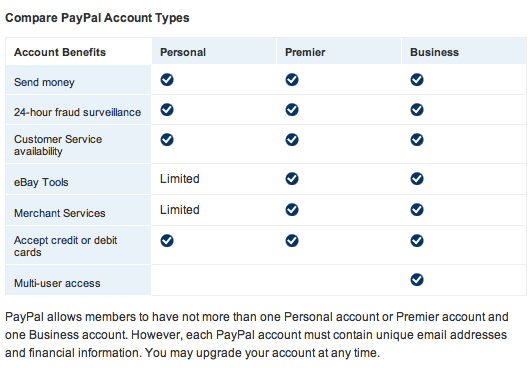
You start out with a Personal account, but you can then upgrade to Premier or Business accounts.

PayPal offers two different account types; PayPal for your personal use (Personal and Premier), and PayPal for your business (Business). It’s free to sign up and each account type offers different features and capabilities. To decide which one is right for you, read on.

An account for personal use is ideal if you shop online. You can:

  • Shop on eBay and merchant websites using your credit card, debit card or bank account
  • Send and receive money from friends and family
  • Accept debit card, credit card and bank account payments for a low fee when you sell on eBay and/or on your own website

Make the right choice for your online business. With a Business account you can:

  • Accept debit card, credit card and bank account payments for a low fee
  • Operate in your company or business name
  • Manage Users, allowing you to give separate access rights to each of your employees
  • Consult the Business Setup guide

Paypal account types

Buying Crypto with PayPal

Did you know you can now buy crypto with PayPal? That’s right, you can use Binance since it accepts PayPal deposits. Just hit the links below to get started.

Binance-Banner

You can also read my full review of Binance to learn more about this crypto exchange.

Buy Bitcoin with Binance

This withdrawal method is extremely popular at the moment, as people worldwide seek to get themselves some Bitcoin or Ethereum due to their extremely bright future price prospects.

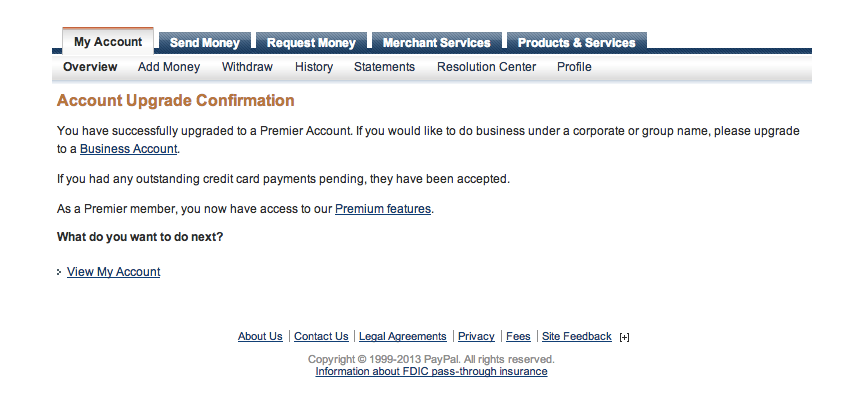
If you decide to go ahead with the upgrade, you’ll get this confirmation screen:

upgrade confirmation
There is no good reason to have a Premier account if you are going to use PayPal for business. The fees are similar to or same as Business but some of the features not available.

  • You don’t need to have a properly registered “business” to have a Business account. It can be a DBA (“doing business as”).
  • You can have several Business accounts (just remember that each one should be linked to a different bank account/credit card).
  • There are no monthly fees for any of the accounts.
  • Additional services cost $35/month for all of them. You need to get approved to get them. You may get approved for one but not the other.
  • Additional services include:
    – Website Payment Pro (allows you to link PayPal to a shopping cart and charge credit cards without taking your customer to PayPal).
    – Recurring Payments
    – Virtual terminal (may be handy if you run live events or work with offline clients).
  • If you have various ventures and want to have a separate PayPal account for each one, now you can set up a “child” account that is linked to your main one. The benefit is that the money will be swiped from it daily and put into your parent one automatically and with no fees involved. Also, you don’t need to link a child account to a bank account. To set up a child account, create a new PayPal account then call PayPal on the phone and ask them to link the new account to your main PayPal account.

The concise comparison:

  • Personal: Recommended for individuals who shop and pay online.
  • Premier: Recommended for casual sellers or non-businesses who wish to get paid online, and who also make online purchases.
  • Business: Recommended for merchants who operate under a company/group name. It offers additional features such as allowing up to 200 employees limited access to your account and customer service email alias for customer issues to be routed for faster follow-ups.

Since my business is based in Malta, I’ll be describing the PayPal fees for this situation. Other European countries should have similar fees, but do check the PayPal website for your country for more accurate details.

Click this link to check the standard rates for receiving and sending money with PayPal.

The standard rate for receiving payments for goods and services is 3.4% + 0.35 EUR.

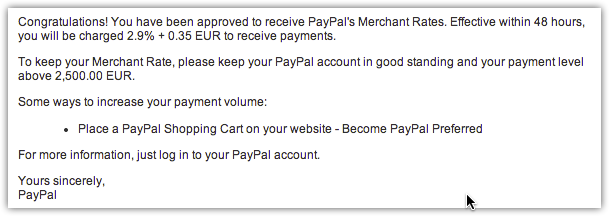
If you receive more than 2,500.00 EUR per month, you’re eligible to apply for PayPal’s Merchant Rate – which lowers your fees as your sales volume increases. Your fees can be as low as 1.9% + 0.35 EUR, based on your previous month’s sales volume. For receiving money for product or service sales at the merchant rate, these are the prices:

Monthly SalesPrice Per Transaction
€0.00 EUR - €2,500.00 EUR3.4% + €0.35 EUR
€2,500.01 EUR - €10,000.00 EUR2.9% + €0.35 EUR
€10,000.01 EUR - €50,000.00 EUR2.7% + €0.35 EUR
€50,000.01 EUR - €100,000.00 EUR2.4% + €0.35 EUR
> €100,000.00 EUR1.9% + €0.35 EUR

Here’s the e-mail you get after you apply (manually) for the Merchant Rate:

paypal merchant rates

Note that the rates in the table above are for domestic transactions. If you have customers offshore then you will incur what is known as a cross-border payment charge.

See also: Understanding PayPal Cross Border Fees

Click here to view the higher cross-border transaction fees. You will still benefit from lower rate bands with cross-border payments once you apply successfully for the Merchant Rate.

The accounts we’ve mentioned till now don’t have any monthly fee, but PayPal also offers the PayPal Pro solution, which costs $30 per month.

See also: Should you withdraw from PayPal to a credit card or to a bank account?

The Pro solution is for heavy PayPal users, and allows you to benefit from lower rates among other services. Click this link for more information about Pro. Go for Pro if you need full payment gateway functionality, as this system will allow you to create a fully customized checkout process that will enable customers to complete the purchase from your site rather than being transferred to PayPal as is the standard procedure.

Here’s Pro in a nutshell:

  • $30.00 USD monthly
  • No set-up fees
  • No cancellation fees

Transaction fees 1.9% to 3.4% + 0.35 EUR

Choosing a Checkout Service

If you are using PayPal to collect payments for products and services that you are selling online, you will also need to choose a checkout service. All e-commerce solutions such as Shopify, WooCommerce, and Easy Digital Downloads will allow you to select one out of several e-commerce checkout business solutions offered by PayPal.

See also: Should you open separate PayPal accounts for each of your e-commerce stores?

The choice is between the following:

  • PayPal Website Payments Standard
  • PayPal Express Checkout
  • PayPal Payments Pro

Read my separate post about the pros and cons of each and then decide accordingly

Managing Multiple Currencies

You can choose what currencies to accept and how you would like to accept them. When a buyer sends a payment in a currency you hold, the money will automatically appear in your account in that currency. When a buyer sends a payment in a currency you don’t hold, you can:

  • Open a new currency balance to accept the payment.
  • Convert the payment to a currency you do accept.
  • Block the payment.

You can choose a primary currency as the one you use most often for sending and requesting payments. It’s also the currency that is used for your withdrawal limits.

If you convert a payment into your primary currency, PayPal offers conversion rates that are pretty bad. You can read my guide on PayPal currency conversions for more information about that. You can always preview conversion rates on currencies you don’t hold before accepting payments.

You might also want to change your PayPal withdrawal currency before you withdraw money to your credit card.

An Example

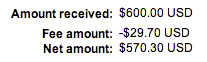
So how do PayPal transactions look? Let’s say I have a client from the US and charged him $600 for some web services I rendered. When he pays me via PayPal here’s what I see in my account:

paypal fees example

Now what’s important here is to know exactly what that $29.70 fee stands for. Since this is a cross-border payment (US to Malta), it can be broken down as follows:

  • Base fee (3.40% + $0.30 USD) = $20.70 USD.
  • Cross-border fee consisting of a fixed (0.50% and 1.00% depending on between which countries the transfer is made) = $3.00 USD and $6.00 USD respectively.

As an average, be prepared to pay around 5% in transaction fees for every offshore payment you receive via PayPal.

If I remember correctly, with a Personal account you can accept or deny payments. Before you accept the payment, you can see the estimated transaction fee on the ‘Transaction Details’ page. If you deny the payment, the fee is not charged. With a Premier or Business account, there is no such option to accept or deny payments.

Refunds

When you issue a refund, you don’t lose any money and the purchaser gets all his money back. Click here to see the full refund policy together with a worked-out example of how refunds work.

PayPal has recently changed its policy, stiffing sellers, unfortunately.

Withdrawing funds from PayPal

Not all countries offer the same facilities for withdrawing funds from Paypal. For example, in my home country Malta, we used to be able to withdraw money only to a credit, debit, or prepaid card as well as a US bank account, but no local accounts.

This was then changed to allow withdrawals to EUR based local accounts, but unlike with other payment providers, we are not able to withdraw to local accounts in other currencies. This is a big disadvantage if you are making most of your sales in another currency such as USD.

So right now I have to accept all USD being converted automatically by my bank to my card’s currency which is always EUR by default since we’re based in Malta.

Read the following posts on this topic as it is critical that you get this right:

  • Withdrawing from PayPal to online bank accounts like Wise or Revolut
  • How to change PayPal’s withdrawal currency for credit cards

Paypal provides a handy checker where you can select your country and see which withdrawal options are available for that country.

What about PayPal Alternatives?

There are many PayPal alternatives, two of which are Payoneer and Stripe.

Payoneer

Payoneer

It’s worth looking at some PayPal alternatives that might be better suited to your needs. I’ve already mentioned Wise earlier in this article, but Payoneer is another widely used PayPal alternative, especially in India.

Launched in 2005 and headquartered in New York, Payoneer is a payment services provider that allows users to send and receive money online. The platform currently services more than 4 million customers located in more 200 countries.

Cross-currency transactions cost in the region of 2% above the mid-market rate, although this can be lowered if you hold a VIP account. If you obtain the Payoneer pre-paid debit card, then you’ll pay $3.15 per ATM withdrawal.

Payoneer is also a notable PayPal alternative due to its highly rated customer support. You have the option of contacting support via telephone, live chat or through a support ticket. However, response times are somewhat slow over the weekend, so you’re best off calling them if your query is of an urgent nature.

Check out Payoneer

Stripe

Stripe is recognized worldwide as the most painless way to accept credit cards online as a merchant, and it was created with developers in mind, making integrations easy. Fees are on the low side, and you can also get the first $20,000 of transactions with zero fees if you follow my method.

Further notes

Please be aware that there are two different types of payments that can be sent using PayPal – Purchase Payments and Personal Payments. With a Personal payment type, the sender of the payment can choose who pays the fee which is incurred. However, it is not free to send the payment. Either the sender or the receiver must pay. It is possible to receive personal payments to a Personal or Premier PayPal account.

If you are planning on receiving payments for a business you are running, you may need to upgrade your account type, as a Personal account is not suitable for receiving large amounts of payments. However, if you are only receiving a small number of payments, you are free to do so.

In case you are into gambling and want to make a deposit using Paypal, you should be aware that the payment platform has a strict policy about casino transactions.

See also: How to change ownership of a PayPal account

It is possible to have two PayPal accounts, however only one can be for personal use, and must be either Personal or Premier type. It’s not possible to have a Personal and Premier account at the same time.

You can downgrade from a Business account to a Premier account, but not back down to a Personal account.

PayPal users can have one Personal account and one Premier or Business account. Each account needs to have a unique email address, bank account and credit card.

Hopefully, that helps to make your choice easier. If you have any questions, fire them off in the comments section.

  1. Are You Losing out from PayPal’s Exchange Rates?
  2. Which PayPal Account is Best for You?
  3. Changing Your PayPal Withdrawal Currency
  4. Understanding PayPal Cross Border Fees
  5. How to Withdraw From PayPal into a Maltese Bank Account
  6. Withdrawing Money From PayPal for Non-US Accounts
  7. Which PayPal E-Commerce Checkout Service Should You Use?
  8. Should You Open Separate PayPal Accounts for Each of Your E-Commerce Stores?
  9. PayPal VS Wise Borderless
  10. Linking Virtual Bank Accounts and Cards to PayPal (Revolut, Wise etc)
  11. How to Change Ownership of a PayPal Account

Filed under: Money, Payment Processors

The Value of Silent Retreats

Last updated: November 13, 2023Leave a Comment

silent retreat

Every year or so, I like to take a few days off and make a retreat. I don’t go on holiday to some fabulous destination (although I do that too at other times).

When I go for a retreat, the one thing I look for is silence.

I like to find a retreat house in the countryside or wilderness and spend 3-5 days there without talking to anyone. I suspect many of us don’t realize exactly how noisy our lives are. The experience of spending a few days in complete silence can at times be overwhelming, but highly beneficial.

Whenever I do such a retreat, I always come back to ‘real life’ way more focused, and with a renewed and positive attitude. Last week, I did this year’s retreat and as usual, it was a great experience. In fact, I’d like to make it a more regular thing. I’d also like to incorporate more elements of reflection and meditation in my daily life.

There are many retreat centers all around the world, what you need to make sure is that the center is one that helps you stay in silence for as long as possible. We’re not looking for a center that fills up your day with activities here, it should, in fact, be as boring as possible.

I prefer going to Christian retreat centers; one of my absolute favorites is the Montserrat benedictine monastery in Spain. The reason is twofold. One is that Christian centers tend to be centered around a really nice church or monastery that embodies the spirit of contemplation and reflection that we are looking for. Secondly, if you need it, you will also find monks ready to help you guide you along your journey.

If you’re attempting this for the first time, I would strongly recommend choosing a guided retreat. It doesn’t have to be religious, most monks and priests are happy to help you from a human aspect without necessarily involving religious teachings or readings from the Bible. If you do want to have a more religious experience, they are of course also delighted to guide you.

I’ve done both types of retreats and found them both beneficial. Ultimately, it’s all about what you believe and think about the world and your personal life journey. If you’re a religious person, it will help you to focus on passages from the Bible and spend time in prayer, while if you’re not particularly religious you will benefit from the solitude that breeds internal reflection. You can take an inspirational book with you to help out. Ultimately, both outcomes will be very similar.

My favorite retreat location – Montserrat

A key element of my retreats is always the practice of journaling or writing. While the first day or two can be tough until I quiet down my mind, once I get settled thoughts inevitably turn inwards and I usually get lots of insights. It is essential to write things down and also write about all your struggles. This will help you remember the lessons you learned and also help you if you have someone guiding you to the retreat, as you will have a handy reference during your talks with the guide.

In addition to exploring silent retreats worldwide, I occasionally organize exclusive, soul-nourishing retreats in Montserrat for members of the Good Life Collective. These gatherings offer a unique blend of tranquility and community, perfect for those seeking deeper connections and personal growth.

There are no hard and fast rules for the duration of retreats and their frequency. If you manage to find a place that you like and is not that far from home, I think that would be a really good win, as you can go there whenever you feel that you need to. So far, I have tended to stick to 4 or 5 days as that gives me enough time to quieten down and be very productive while at the same time not staying away from my family and normal life too long.

Have you ever been on such a retreat? How did it help you?

Filed under: Thoughts & Experiences

  • « Previous Page
  • 1
  • …
  • 89
  • 90
  • 91
  • 92
  • Next Page »

Latest Padel Match

Jean Galea

Investor | Dad | Global Citizen | Athlete

Follow @jeangalea

  • My Padel Experience
  • Affiliate Disclaimer
  • Cookies
  • Contact

Copyright © 2006 - 2026 · Hosted at Kinsta · Built on the Genesis Framework